Sex, Power & Play at Europe’s Largest Arms Fair

A guest post from N.E.. N.E. is a PhD Candidate in International Relations at the University of Sussex (UK), researching militarism and ecological injustice. She is also an Advisor to Scientists for Global Responsibility, Associated Researcher with the World Peace Foundation and author of the new report Resisting Green Militarism: Building Movements for Peace and Eco-Social Justice


**Disclaimer: none of the people displayed in the photos are present in the text and should not be thought of as complicit with the sexual harassment discussed in the text.
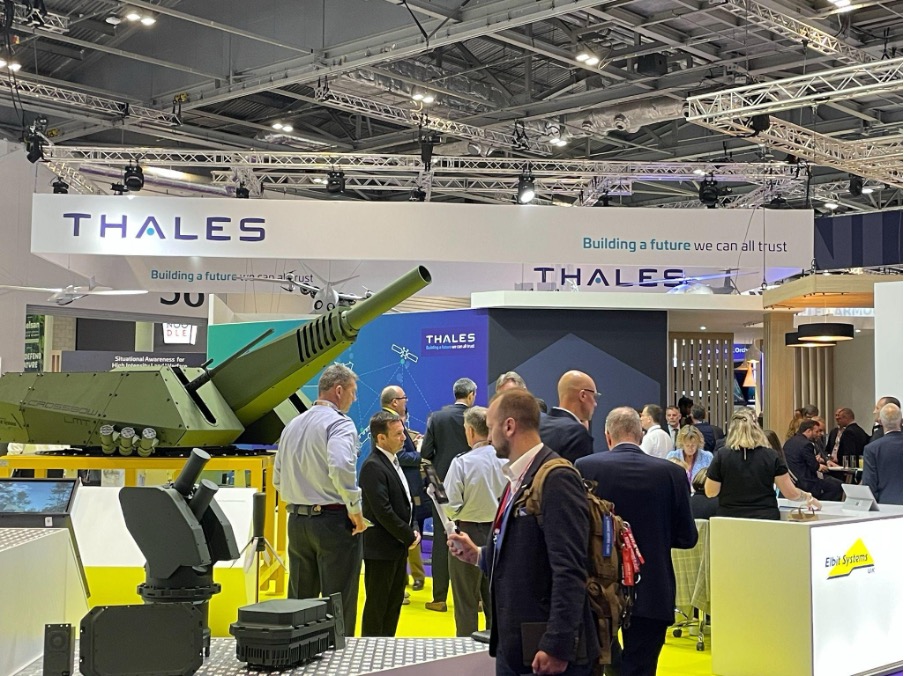
Thales and Elbit Systems, DSEI 2023. Credit: Nico Edwards
Thales and Elbit Systems, DSEI 2023. Credit: N.E.

Global headlines are once again seized by the outbreak of armed conflict, detailing indescribable suffering and destruction. War, it feels, is everywhere and always. To some, this means business. Many of the facilitators and profiteers of armed conflict globally attended the Defence and Security Equipment International (DSEI) in London, September 2023.

What follows is a personal story, but what it tells us about enduring systems of power and harm goes far beyond my person. That weathered feminist truth that the personal is always also political rings true still. What I experienced in the world of “defence men” – the global war elite – attending DSEI as a white woman, was highly demonstrative of the social, political and economic forces that enable and perpetuate armed violence. The personal behaviours of militarised business masculinities hold clues as to why decisionmakers keep hurtling toward global war at the expense of both people and the planet.

Setting the Scene: A Playground for Phallic Force 

Happening in London biannually, DSEI is one of the world’s biggest and most important arms fairs. I went there to research military sectors’ pivot toward environmental sustainability and how to “green” warfare – a key emerging feature especially of European and North American propaganda. The event oozed of hubris. Rob, an American war simulations expert and my main interlocutor, confirmed he’d never seen such a galore of impressive weapons tech exhibitions. Indeed, several arms company reps told me affirmingly: business is booming. Spread across 100,000 sqm. Rob and I were among almost 40,000 participants from all over the world. Including the usual array of repressive, human rights abusing regimes or states involved in active warfare.

You don’t have to be a polemicist to catch how DSEI is but one big bonding ritual for predominantly white men in suits enacting their obsession with force. DSEI puts the global war elite’s drastic detachment from the real-world needs of people and planet into sharp relief. Inside the fair, “defence” and “security” materialise as glaring euphemisms for military-industrial might and titillating experiments in how to model the future of warfare in line with Hollywood fantasies of high-tech battles between good and evil. Rather than signal a dedication – however deceptive – to keeping people safe, the event felt like an inferno of white men in suits blatantly driven by that boyish excitement for tech, kinetics, heroism, beauty, sex and money. And yet, there are enough of these men in power across the globe to make it seem as if they are the realists responding to real threats.

Continue reading
Academics Against the Arms Fair: An Open Letter

Last week, about 1500 weapons manufacturers and representatives of more than 100 states descended on London for Defence and Security Equipment International (DSEI) – the world’s largest arms fair. The companies have exhibited products ranging from crowd control equipment and ammunition to fighter jets and military vehicles, which they displayed to militaries, police forces and border agencies from around the world. DSEI is a major event for the international arms trade, and the deals done there play a major role in reinforcing Western militarism, fuelling conflict, repressing dissent and strengthening authoritarian regimes.

Two weeks ago, the Stop the Arms Fair coalition held a week of action in an attempt to prevent the arms fair from taking place. Anti-militarist groups, working in solidarity with activists from countries which have suffered the brutal consequences of the arms trade, held a series of events to disrupt the setup of DSEI. One event during this week was ‘Conference at the Gates’, an academic conference held in front of the arms fair, where participants debated ideas about militarism while taking action to resist it.
Continue reading

Thinking Internationally About The Arms Trade

A guest post, following our recent podcast on the arms trade and its discontents, from Anna Stavrianakis. Anna is a Senior Lecturer in International Relations at the University of Sussex. Her research focuses on the arms trade, arms transfer control and militarism.


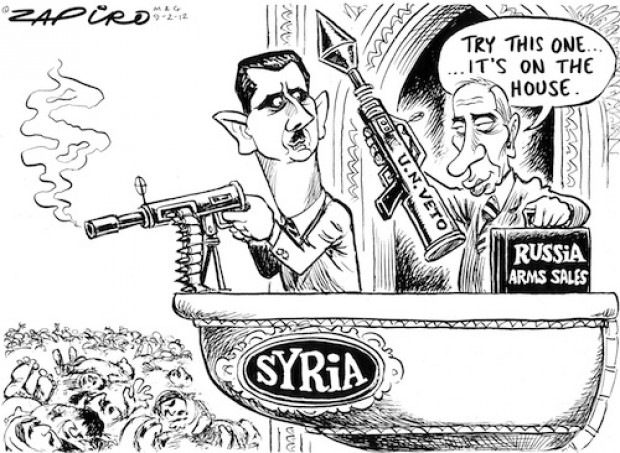
Zapiro - Russia Syria Arms Trade

September 2015, ExCel Centre, London: Stop The Arms Fair activists block the road and prevent military vehicles entering the Defence and Security Equipment International (DSEI) exhibition. They are protesting against one of the largest arms fairs in the world – sending a message to the UK government and arms companies that “inviting representatives of repressive regimes and their armed forces to hob-nob and do dodgy deals at DSEI … with representatives from the UK government and unscrupulous arms companies from around the world IS NOT OK.” Two weeks previously, Cancun, Mexico: Control Arms activists build a life-size sand sculpture of a Stormer 30 tank on Baracuda Beach, Cancun, calling on states to save lives! by ensuring the toughest possible standards at the first Conference of State Parties to the Arms Trade Treaty, the biggest game in town for contemporary international arms transfer control.

These two campaigns share the language of “dodgy deals” but are otherwise quite different visions of the arms trade and its control. The Control Arms campaign focuses on encouraging, informing and embarrassing diplomats into agreeing a multilateral treaty that enshrines higher common international standards and establishes stronger norms against arms transfers that violate human rights and international humanitarian law. The Stop The Arms Fair coalition, meanwhile, takes direct action to halt the operation of arms fairs in the UK by physically blockading the exhibition centre, in protest at the relationship between arms companies and the UK government, and the relationships between the UK government and authoritarian, repressive and war-fighting foreign governments.

I’ve written in the past about the international politics of NGO and campaign group strategy – whether reformist, insider approaches are more effective than transformist, outsider ones – in the context of debates about global civil society. Yet what continues to trouble me, intellectually and politically, is a raft of questions about the operation of the arms trade itself. Namely: where, or with whom, does political responsibility lie for the negative effects of the arms trade in a world of formally national states that are home to internationalising arms companies and operate in a multilateral system based on sovereignty? What social forces drive the arms trade, how does their power operate, what is the character of the problems they generate, and how should scholars and activists best respond? Competing understandings of the operation of the arms trade can be seen in the varied activist responses to it: is the problem one of lack of regulation, the need for improved multilateral action, improved normative standards and international law, as per the Arms Trade Treaty? Or is the problem the relationship between the state and arms capital, and government promotion of the trade, as per the anti-DSEI protests? In the case of DSEI, how are we to understand the operation of internationalising arms capital that has an intimate yet fractious relationship with national states? And in the case of the Arms Trade Treaty, how should we make sense of efforts to create a level playing field of respect for human rights and humanitarian law in the context of a vastly asymmetric and hierarchical world military order?

Thinking theoretically, I have come to see that a large part of the difficulty in answering these questions lies in the grip that methodological nationalism continues to hold on IR as a discipline. Continue reading

The Dissonance Of Things #3: The Arms Trade and Its Discontents

This month, I step into the role of host for our third ever podcast, on the topic of the arms trade, ways of thinking about it, and the various forms of opposition to it. Helping us make sense of all that are Chris Rossdale of the University of Warwick and Anna Stavrianakis of the University of Sussex. Chris is a participant observer of anti-militarist social movements and the author of numerous pieces on the politics of protest, as well as this post for us on political solidarity. Anna is the author of many pieces on the arms trade and militarism, including Taking Aim at the Arms Trade: NGOs, Global Civil Society, and the World Military Order (Zed, 2010).

The immediate context for our discussion is a whole series of protests against the Defence and Security Equipment International (DSEI) Exhibit, due to take place next week in London. One part of that was an academic ‘Conference at the Gates’ earlier today at the ExCeL Centre, and it is on the notion of activist academia that we begin the conversation.

As ever, consume, cogitate, share, discuss and share again. You can also follow past and future casts on soundcloud.


Further resources, including articles discussed in the podcast: