A guest post from Cai Wilkinson on recent LGBTQ developments in Russia. Cai is a Lecturer in International Relations in the School of Humanities and Social Sciences at Deakin University, Australia. Her research interests include critical approaches to security, fieldwork-based securitization studies, norm contestation and resistance, and genders and sexualities in International Relations. Her geographic focus is on the former Soviet Union, and she is currently working on projects about LGBT rights and human rights norms in Kyrgyzstan and Russia. She received her PhD from the University of Birmingham, UK, in 2009 for a thesis entitled Interpreting Security: Grounding the Copenhagen School in Kyrgyzstan, which drew upon seven months of fieldwork conducted in Bishkek and Osh in the aftermath of the 2005 overthrow of the Akaev regime. Her work has been published in Security Dialogue, Central Asian Survey and Europe-Asia Studies, and she has contributed chapters to volumes on securitization theory, statehood in Central Asia, and fieldwork-based research methods. Cai is also Chair of the International Studies Association LGBTQA Caucus.
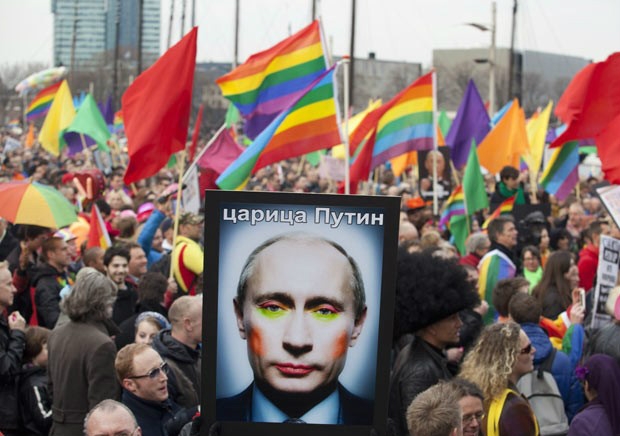
The issue of LGBT rights in Russia first properly came to mainstream international attention in March 2012, when the St Petersburg Duma passed a law prohibiting “public acts aimed at the propaganda of sodomy, lesbianism, bisexualism and transgenderism amongst minors“. The law provoked an international outcry, including calls for tourists to boycott St Petersburg, sister-cities to consider cut off ties with Russia’s “window on Europe”, and condemnation from the EU, with the European Parliament passing a resolution noting that it was “gravely concerned by developments which restrict freedom of expression and assembly on the basis of misconceptions about homosexuality and transgenderism” and calling on Russia and other countries considering the adoption of similar legislation to “demonstrate, and ensure respect for, the principle of non-discrimination”.
In actual fact, this was not the first “anti-gay” law to be passed in Russia; Ryazan Oblast’s Duma adopted an amendment to local legislation to outlaw the “propaganda of homosexualism” in May 2006, and Arkhangelsk and Kostroma Oblasts followed suit in 2011. Yet the passing of the St Petersburg law proved to be a catalyst for other administrations to introduce similar laws, with a further six subsequently adopting similar legislation and others considering it (so far only the Moscow Regional Duma has rejected legislation). Most significantly, these laws paved the way for consideration of a federal bill outlawing the “propaganda of non-traditional sexual relations to minors”, which the Russian Duma passed on June 11 despite continuing international condemnation and the fierce opposition of local LGBTQ activists and their supporters, who frequently endured physical attacks and arrests while protesting against the law.
Despite being a long-time Russia-watcher, the swiftness at which anti-gay laws have spread and at the ferocity of both popular and state homophobia has been striking. This is not, I should add, simply the result of not paying close enough attention. As a queer undergraduate student studying Russian with a compulsory year abroad to plan for, I was extremely conscious of attitudes towards homosexuality and queerness and the stigma and dangers that local LGBTQ people faced (Laurie Essig’s Queer in Russia was an essential primer), and was extremely careful not to out myself to anyone who wasn’t definitely queer-friendly while living with families first in Krasnoyarsk and then Voronezh in 2001-2002.
At the same time, it appeared until the mid-2000s that slowly but surely Russia was becoming more tolerant. Homosexuality was decriminalised in 1993 without any notable opposition, declassified as a mental illness in 1999, and the percentage of survey respondents advocating for the “liquidation” of homosexuals fell from 31% in 1989 to 22% in 1994 and all of 5% in 2013 (although inevitably survey results are heavily contingent on the phrasing of questions and, as Alexander Kondakov demonstrates, attitudes to homosexuality are no exception). Attempts to recriminalise homosexual relationships between men failed in 2002, 2003 and 2004.
Popular culture in the first half of the 2000s appeared to offer further evidence of the trend: Continue reading
 The Disorder Of Things