Beware the Academic Troll-Master!

But I see motivating students, passing on enthusiasm, as the first and most important task of a teacher. (Which isn’t to say that one has to blindly encourage everything a student says or writes; far from it.) That’s why I would say that one of the most despicable figures in the academic bestiary is the Troll-Master: the figure who feeds on the crushed enthusiasm of belittled students. The easiest way to win a cheap kind of respect is by adopting a nothing-can-impress-me hyper-critical stance, doused in cool weltweltschmerz, finding fault everywhere, handing out praise and encouragement only very rarely; it’s a transparent tactic, but one that works surprisingly well, and not only on jejune students, but also on very accomplished people, even those who have written a number of books. Often, the Troll-Master’s own intellectual project will be mediocre and/or suspended – it’s clear that all their libidinal energy is tied up in enslaving students into neurotic servitude. Troll-Masters can permanently insinuate themselves into students’ heads, but usually their power depends upon the hothouse claustrophobia of the university department – they are village despots, whose charismatic tyranny seldom works outside their own turf. If they have a long-term effect, it is only to produce more grey vampires.

K-Punk, ‘Break Through in Grey Lair’
One temptation is the patronizing attempt to over-identify with the imperative “not to learn” supposedly possessed by students. We could call this the “slacker” temptation – of course all students want to do is smoke dope and play Playstation! This model of teaching presupposes two intellectual classes: those who (contingently) want to learn (the lecturer him- or herself) and those who do not (most students, and by extension, most everybody). This approach is a kind of mastery, disavowed in this case and all the more pernicious for it – I know enough to tell you that you do not need to know. It is the supercilious attitude of the newspaper columnist who chucks in references to Marx, postmodernism, etc. before airily informing the less-informed reader that he or she doesn’t need to bother finding out anything about them for him- or herself. Equality of intelligence is here smothered by the laziness, not of the students, but of the teacher, who churns out information without really believing that the audience will be interested in receiving it. As Rancière puts it, “explication is the work of laziness”. The fear masked here, both by assuming student apathy and by preserving the knowledge you yourself possess, is the idea that actually there is nothing “special” about your capacity to learn…

…We must acknowledge a changed landscape: not exclusion, straightforwardly, but a peculiar form of staggered expansion. The supposedly elite institutions are still there at the top, the old-boys and girls networks still churning out elite fodder for the same kinds of jobs – politics, diplomacy, high-end culture industry work, etc. At the same time, the expansion of higher education and the re-branding of ex-Polytechnics as universities in the UK has created a situation in which no one need be excluded. It is no longer a question of keeping them out, but of ensuring they go where they are supposed to. A further change comes at the economic level. As noted, fees have created a kind of split-subject of the university: the “client” who pays for a service and yet is still a subject “supposed to be criticized” or even failed. Endless feedback forms, along the lines of customer satisfaction surveys, entail that students are supposed to know how well that which they don’t yet know is being conveyed.

Nina Power, ‘Axiomatic Equality: Rancière and the Politics of Contemporary Education’

The University, Limited.

The double assault of the Browne Report and Wednesday’s Comprehensive Spending Review have understandably led to despair and anger among academics in the humanities and social sciences. The reasons are manifold: the apparent belief by Cable and Willetts that only science matters, an insidious privatisation of public institutions, further debt for those least able to pay, massive cuts in teaching budgets, and education as a source of funds for bank bail-outs, not to mention rank hypocrisy from men educated for free and now pulling up the ladder while telling the rest of us that their schemes are not only fair, but progressive too.

This knot of anxiety deserves some dissection. The necessity, in the midst of a storm, for calm and sober reflection. Such is my rhetorical mode today. The main strand of existing critique centres on the implications for inequality. Higher fees, under such an account, can only increase the unwillingness of the poorest to attend universities, and so transform them into bastions of privilege.

But this isn’t quite right. Continue reading

The Ethics of Austerity

Today, the Con-Lib Coalition announces their full plan for spending cuts. Although many bits have been leaked, this will be the first chance we have to take the full measure of what is to come. Much has been and will be written about how these cuts are necessary, and even that they don’t go far enough.

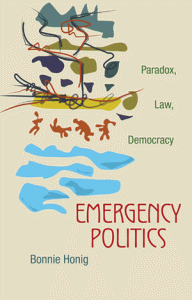
And while much has been said about the economic arguments for and against the cuts proposed by Mr. Osborne, what is not talked about enough, or with sufficient care, is the ethics of austerity. By this I mean the ethical claims that have been made to prepare the ground for the austerity measures announced today. To borrow a phrase from the political theorist Bonnie Honig, we are seeing the culmination of a discourse of emergency politics.

Emergency Politics

While Honig uses the idea of emergency politics to get at how the threat of emergency is deployed to reassert the sovereignty of the state over the democratic sovereignty of the people as the source of law and legitimate political power, I want to suggest that the financial crises has resulted in a similar discourse, which claims we are in a state of emergency economics.

What the claim of emergency economics does, by framing our current experience in terms of emergency, is reaffirm the sovereignty of the capitalist markets over democratic society by presenting us with a catastrophic choice. We must accept the radical restructuring of public life out of necessity; there is no alternative but catastrophe. To discuss solutions is to waste time; to insist on the imperative of democratic values is to court disaster; to oppose the hasty reform of fundamental elements of the social order is to be a dangerous ideologue. Emergency economics are hardly unique to the UK, but today we are witnessing a clear expression of its consequences.

Continue reading

‘The only answer was slaughter, and the only way to do it was fast’; In which others read the autohagiography of Anthony Charles Lynton Blair so I don’t have to

The publication of Blair’s recollections and rationalisations has been a gift to many of us. Not content with the material for satire he provided during office, he has now furnished us with further damning evidence in his own hand. A weighty (non est) mea culpa. Pat psychologising, quasi-religious conviction, the hamfisted use of historical analogy and that overwrought prose (now infamous: “I needed that love Cherie gave me, selfishly. I devoured it to give me strength. I was an animal following my instinct, knowing I would need every ounce of emotional power to cope with what lay ahead“). All of this has enabled some incisive commentary, and some barely contained rage: Tony as Captain Stanhope; Tony as the ‘preacher on a tank’ (Dick Cheney’s apposite barb); Tony as delusional Christ-Pope in waiting.

Three thoughts. First, there is the question of how we can now read Blair, and Iraq as the exemplar of his style of thought. What were the mechanisms that allowed the clear advice of experts of all stripes, and the opposition of most of the population, to be translated into an unbending commitment to the projection of American power? A familiar answer is that the New Labour project was driven by the energies of Blair’s religious (or religious-like) faith, his commitment and earnestness and belief. But the scene set by A Journey and its deconstructions is far more prosaic. On the one hand, there is plenty of garden-variety ‘misperception’. Actors chose the analogies that fit their pre-established understandings, over-emphasised the pressures for action in their calculations, and failed in their responsibility to examine situations from more than one angle. These are the kind of slippages that pop up enough for some systems- and cognitively-minded scholars to trace their role in wars across the ages.

On the other hand, there is Blair’s extraordinary decisionism. Something must be done, and someone must do it. But this is in some ways the reverse of a faith-based politics. It was not belief that guided Blair, and certainly not carefully delineated actions set out by dogma or doctrine. It was the absence of such a schema which mattered, at least on his own account. “The pieces are in flux”. Hence the insistence on leadership, on grasping the truth and necessity of the moment. What continues to intrigue is this movement between an over-abundance of values and the hardened core of Machiavellianism. The necessity was never one dictated by the ends of justice, but only that of power and its demands.

Yes, ideology was at play. But structurally so. Not in the bible readings and personal psycho-dramas of two little rich boys from New Haven and Edinburgh, but in a much less appreciated, and much more insidious sense. A subjectivity with a sociology. There is something typically Žižekian about this apparent paradox. As with others nominally committed to grand projects, the issue is not one of hypocrisy, so much as of the means by which raw power and purity of purpose can be experienced as synonymous:

the figure of the ‘big Other’ as a background against which [to] exert… ruthlessness and drive for power. They had displaced their belief onto this Other, which, as it were, believed on their behalf. Continue reading

Protest against cuts: 20 Wednesday 2010

October 20: Protest Against the Cuts at Downing Street 6pm

From the Coalition of Resitance:

Stop the Con-Dem cuts! Build the Resistance! Can’t Pay, Won’t Pay!

Speakers include Tony Benn, Caroline Lucas MP, Rev Jesse Jackson, Jeremy Dear (NUJ), Dot Gibson (IHOOPS), Lee Jasper (BARAC), Zita Holbourne (BARAC) John McDonnell MP, Mark Serwotka (PCS), Jeremy Corbyn MP, Bob Crow (RMT), Aaron Porter (NUS)

Continue reading

Neoliberalism Strikes Back, or Is This Really a Crisis?

A post from Roberto Roccu.


Of course it is. Yet, Colin Hay hits the right note when he points out that if crises are conceived as moments of radical questioning and change of existing paradigms, then what we see today is not a crisis, but rather a “catastrophic equilibrium”. Indeed, now that the reverberations of the rhetoric of London’s G20 in April 2009 have faded, it appears that the measures adopted both on a national and on the global scale are concerned with shoring up the old growth model based on flexible accumulation, in the attempt to restore its economic profitability, regardless of its social unsustainability.

Rather than downplaying the magnitude of the economic problems we face, Hay’s aim is to show how in a period when all the material conditions for speaking in terms of a crisis are present, with all the potential implications for a radical reconfiguration of our economic policies and political economies, the ideational discourse is still dominated by the very paradigm that created such material conditions. This fits well with Hay’s account of the genesis of neoliberalism, which emerged as the solution to a discursively-boosted epochal crisis of Keynesianism in times where material conditions were far from being as severe as the ones we face today.

It would be easy to dismiss Hay for “being too academic”, particularly in a context where what he calls the pathologies of the neoliberal paradigm have infected all of the developed world with very real consequences for those individuals and groups that have lost their jobs and are experiencing a dramatic increase in their social insecurity. Still, identifying the distinction between existing material conditions and the missing narrative for linking those conditions and framing a coherent and credible political project is extremely fruitful. This is the hiatus where capitalist realism as an ideology and a practice has prospered. In this respect, the regained profitability of the capital accumulation regime has brought about two seemingly parallel yet interrelated trends, that are most visible in the developed country struck hardest by the crisis, the US.

On the one hand, the rise of the Tea Party movement. The mainstream press has set its focus on the populist, anti-intellectual and anti-establishment aspects of the phenomenon. Yet, their fundamentalist neoliberalism – best expressed in the call to “return to the principles of Austrian economics” – has largely gone unnoticed. On the other hand, the ever clearer and stronger political position taken by Murdoch’s media empire against the Obama administration and more generally against any kind of state intervention in the economy is equally relevant. The daily space granted to Glenn Beck on Fox appears to me as the most evident trait d’union between these two trends.

On this side of the Atlantic, dismissing these phenomena as something alien would be misleading and dangerous. And not only because Murdoch’s empire extends well within Europe, and he is even now launching an offensive on the British media. Most importantly from a social standpoint, is the other trend – the rise of populist, worryingly xenophobic yet economically conventional movements – which is manifesting itself with a surprising regularity, even in countries like Sweden, that our diehard clichés still like to characterise as “welfare paradises”.

The analysis of what is happening in the European space is rendered more complex by the presence of a further level of decision-making, located on a larger spatial scale than the state. Now, all of us have become accustomed to hear about the democratic deficit within the EU. One of its major consequences is that the struggle for influence does not follow institutionalised forms, and lobbying is by and large the name of the game. Within this context, the effective mobility and mobilisation of capital and of its allies on the EU scale (and beyond) confronts a mobility of labour that remains mostly on paper, as the bulk of the jobs that are neither highly skilled nor unskilled are still largely allocated on a national basis. As a consequence, it has proven incredibly hard to mobilise working forces beyond the national scale.

Even the rampant xenophobia – exemplified by the rise of parties such as the Northern League in Italy, the Freedom Party in the Netherlands, the Swedish Democrats in Sweden, and the list could go on to include at the least fifteen of the EU’s twenty-seven members – must be seen as a fragment that begs for relations with the whole. And in the Europe of the four freedoms of movement (people, goods, services, capital), where the mobilisation of capital is effectively globalised and the mobilisation of labour is still limited by national boundaries, it comes as no surprise that the genuine anger of the working class(es) is channelled towards an attack of the only one freedom that can credibly be limited by national authorities: the movement of people.

And yet, there would be plenty of material to start from in the direction of some Europe-wide coordination. From the Spanish general strike to the recent demonstrations in the Netherlands to industrial action on the London Underground to the French general strike of this Tuesday. Unfortunately, very little has been happening on the European scale. And as long as capital is more powerful to begin with and better organised on a larger scale whereas labour is weaker and sometimes divided also on the national scale, the prospects for resisting, reversing and subverting the current neoliberal offensive appear to be dire indeed.

Conference: Humanism in Agonistic Perspective

A promising theme and line-up (possibly including one of our “Authors of Disorder”):

Humanism in Agonistic Perspective: Themes from the work of Bonnie Honig

April 18-20th 2011, University of Nottingham

Note: as a general rule we will keep conference postings to a minimum, only highlighting events we are particularly interested in – usually meaning one or more of us are attending, participating in or running the event.

Flunking Economics 101: The not-so-new UK policy for international poverty reduction

There has been a considerable amount of noise about the new directions for international development under the coalition government – not least the keenness it has shown in ringfencing the GDP aid target as part of keeping up its ethical and progressive image, and the enthusiasm it has seemingly shown in pushing for fairer trade practices within the context of the Doha round of negotiations. Last night, in a policy-focused speech to a packed Sheikh Zayed Theatre at the LSE, the new Minister for International Development, Andrew Mitchell, laid out his vision for poverty reduction through mechanisms of growth and wealth creation, which would be driven through the encouragement of the private sector in the context of pursuing the Millennium Development Goals.  This policy would be centred around a re-orientation towards private-sector driven growth and enterprise, through which the poorest in developing countries could ‘lift themselves out of poverty’.

He began, as many speeches do at the LSE, with an aphorism attributed to George Bernard Shaw: “The greatest of evils and worst of crimes is poverty”, a phrase dripping with urgent moral responsibility and irreproachable purpose, before going on to promise that the new government’s international development strategy would be ‘non-ideological’ and committed to ‘what works’ in poverty reduction. It is a very great shame, however, that he did not begin with some basic definitions of poverty, since this would have clearly exposed the intellectual, and ultimately political, black hole at the centre of a poverty reduction strategy based primarily on growth. Continue reading

The Paradoxes of Inequality

In the wake of the financial crisis, and the re-establishment of massive corporate profits during a vertiginous economic period, the issue of inequality has become increasingly prominent amongst critical thinkers. The recognition that the period of neoliberalism has been beneficial in a massively asymmetrical way to the richest is a powerful argument against the neoliberal dogma. Yet with countries like the UK disproportionately cutting government spending on the poor, it seems that the only thing changing is the ease with which the poorest can be attacked.

(h/t: Consider the Evidence)

Continue reading