The European Gaze and the EISA Asylum Seekers Campaign

Gulsah

Gulsah

ayse

Ayse

A reply to Federica’s recent post on the asylum crisis by Zeynep Gülşah Çapan from Bilkent University and Ayşe Zarakol at the University of Cambridge. Gulsah is a Post-Doctoral researcher at Bilkent University. Her research focuses on Eurocentrism in international relations theory and postcolonial and decolonial thought. Ayşe is a Lecturer in International Relations at the University of Cambridge. Her research focuses on social hierarchies in world politics. Her first book After Defeat: How the East Learned to Live with the West explored the responses of defeated non-Western powers to stigmatisation.


The increasing attention to the European refugee crisis in Western media has also galvanized the IR academic community into thinking about possible ways to address the issue. There have been blog posts and Twitter discussions (On Doing ‘Something’ as AcademicsWant to Help the Refugees? Teach Migration as part of IRHow to Speak Out As An Academic Community? Help Needed!) about possible actions, especially with respect to the EISA conference that will be held in Sicily in two weeks. On September 11th, EISA section chairs received an email urging them 1) to sign and circulate an open letter to EU policy makers penned in the name of “the academic community”, 2) to bring up the issue in EISA panels and 3) to wear black ribbons/armbands as a sign of mourning and protest.

We applaud the motivations that led to this effort and agree that EU countries could be doing much more to help refugees. We also concur that European scholars could do much more to raise awareness about the complicity of their own governments in various global political crises. Nevertheless, for the reasons detailed below, we have some reservations about both the desire to frame this effort as an EISA effort involving section chairs and the claim to speak in the name of the entire “academic community”. In the blog post Ivory Towers and Sleeping Beauties that discusses these efforts the author urges the “academic community” to do two things; to check their privilege and make themselves feel uncomfortable. These are suggestions that we completely agree with and this post is an effort to continue the dialogue on how we might think of issues in the international system in a way that checks our privileges and makes us feel uncomfortable.

To begin with, the refugee crisis is not new and it is not primarily a European problem that can be solved by some small gesture from the EU. Most refugees from the Syrian War, for instance, are hosted in non-European countries. According to Amnesty International, more than 95% of the refugees (4 million) are in five countries: Turkey (1.9 million), Lebanon (1.2 million), Jordan (650000), Egypt (249,463), Iraq (132,375). Another region hosting huge numbers of refugees is East Africa – based on UNHCR’s latest numbers, Chad hosts about 450000 refugees, Ethiopia hosts 650000 and Kenya has 550000. In fact, almost every world region except Europe is hosting hundreds of thousands to millions of refugees and has been doing so for far longer than Western newspapers have been covering “the refugee crisis”. By most estimates, there are sixty million refugees in the world at the moment.

We understand why European colleagues may want to pressure their own governments to change policy and we wholeheartedly support their individual and/or collective efforts to do so. But to organise a professional effort only now (and without providing any of the larger context) in the name of the entire “academic community”  may actually reinforce the Western public misperception that this is a recent or a uniquely European problem or that European countries that have agreed to take comparatively small numbers of refugees are doing something unusually selfless. Continue reading

‘Quality Assessment’ and ‘Student Outcomes’: An Open Letter

This is a follow-up to my earlier post on HEFCE’s Quality Assessment consultation. This post elaborates the reasons why using student outcomes data to assess educational quality is unacceptable, in the form of an open letter that all academic colleagues are invited to sign. To do so, just add your name, title and institutional affiliation in the comments.

UPDATE 23.09.15: UUK has just circulated their response to HEFCE, which endorses the use of student outcomes data, making this letter all the more urgent and necessary. They write:

We agree that a core set of quantitative student outcome metrics should be included in institutional reporting. These should be the benchmarked UK performance indicator set, covering retention, widening participation, 6 months destination of leavers from higher education, plus relevant benchmarked results from the national student survey, primarily question 22 ‘overall satisfaction with course’…

*    *    *

To: HEFCE and Universities UK

We are university educators who are deeply disturbed by the proposed use of ‘student outcomes’ metrics as proxy measures of teaching quality in HEFCE’s proposed new ‘quality assessment’ regime and the mooted ‘Teaching Excellence Framework’. We call upon HEFCE to reject, and upon UUK to campaign vociferously against, this use.

The use of ‘student outcomes’ to measure teaching quality is completely inappropriate for the following reasons. Continue reading

‘Quality Assessment’ and Completing the Market in UK Higher Education

Amid all the talk of a ‘Teaching Excellence Framework’ (TEF), a consultation on Quality Assessment (QA) launched by the Higher Education Funding Council for England (HEFCE) on behalf of all UK funding councils has received considerably less attention. But academics, students and others should be paying close attention because HEFCE’s proposals are clearly intended both to soften up the sector for the TEF and – more importantly – spur its hitherto partial marketisation.

I have written a response to the consultation, with very useful input from Meera and from John Holmwood, cofounder of the Campaign for the Public University. You can read the full thing here (it is signed by 50+ other academics). There is still a little time to associate yourself with the document if you wish (email me directly by 18 September). Below I highlight the core points, and in a follow-up post I also provide an open letter that colleagues can sign to oppose the worst aspects of these plans, which are also likely to be reflected in the proposals for a TEF, expected later this autumn.

Continue reading

The Corbyn After-Effect

Corbyn LOL

Win he did. And how. Although the petty vindictiveness of the #LabourPurge was real, it wasn’t enough to materially affect the result, and has arguably strengthened Jeremy Corbyn’s mandate. Even as dodgy expulsions and dodgier retentions sour the taste, nobody can claim that the Labour elite were too lax in their efforts to hobble him. For those who have felt blackmailed and maligned by New Labour and its outriders this past decade or two, the moment of joyful disbelief is to be relished. A social democrat as leader of the Labour Party! What a notion. Negative solidarity is giving way to a new structure of feeling, not just resisting but asserting positively the horizon of a more egalitarian, less parochial politics. It was fitting that Corbyn’s ascent took place on the same day as the major London march in defence of refugees, and that he moved amongst us.

The euphoria won’t last, is indeed already muted, tempting us to get our disappointment in early. Continue reading

The Dissonance Of Things #3: The Arms Trade and Its Discontents

This month, I step into the role of host for our third ever podcast, on the topic of the arms trade, ways of thinking about it, and the various forms of opposition to it. Helping us make sense of all that are Chris Rossdale of the University of Warwick and Anna Stavrianakis of the University of Sussex. Chris is a participant observer of anti-militarist social movements and the author of numerous pieces on the politics of protest, as well as this post for us on political solidarity. Anna is the author of many pieces on the arms trade and militarism, including Taking Aim at the Arms Trade: NGOs, Global Civil Society, and the World Military Order (Zed, 2010).

The immediate context for our discussion is a whole series of protests against the Defence and Security Equipment International (DSEI) Exhibit, due to take place next week in London. One part of that was an academic ‘Conference at the Gates’ earlier today at the ExCeL Centre, and it is on the notion of activist academia that we begin the conversation.

As ever, consume, cogitate, share, discuss and share again. You can also follow past and future casts on soundcloud.


Further resources, including articles discussed in the podcast:

Ivory Towers and Sleeping Beauties: On the Importance of Political Activism in Academia at EISA 2015

FCasoA guest post from Federica Caso on the recently created petition from academics to EU decision makers on the ongoing refugee/migrant crisis (you can see it and sign it), which has also been subject to discussion by Federica and Tiina Vaittinen over at the Feminist Academic Collective. Federica is a doctoral candidate in International Relations at the University of Queensland, where she is working on embodiment and the aesthetics of militarism in the context of the militarisation of society. Her research is informed by feminism and queer theory.


What can we do as academics and political subjects in face of the humanitarian crisis that is unfolding in Europe? Probably not much, but I would like to take the time and energy to tell why I think signing the petition by IR academics and community to address the EU to open safe channels of entry and mobility for asylum seekers is important, and suggest what can be done to mobilise at EISA.

So, does it take a picture of a dead boy on the shore of Turkey to awaken political consciousness? These days, tons of memes about Aylan Kardi circulate on the internet. Even those who oppose what has been called ‘trauma porn’ of sharing pictures of dead bodies cannot do anything but see these images on their social networks feeds. Megan Mackenzie, Annick Wibben, and Tiina Vaittinen have provided some insights into the debate surrounding the ethics of sharing these pictures. Most importantly, they all have raised important issues about what academics and scholars can and must do. As has been rightly pointed out in the context of images of refugees, we need to understand how they shape our emotional and ethical attitude, we need more insights, but we also need more political action. When considering the political impact that an image can have, Tiina Vaittinen says “To share an image of a dead child’s body on your Facebook page! It is truly immoral – while simultaneously it may also be the most moral act to do”, to the extent that it is the act that starts the much needed political mobilisation.

Academia and the discipline of IR have long been accused of being at loss with political action, or better, with the ability to speak to real world problems in a timely and effective way, which I see as academia’s political action. The gap debate in the discipline of IR is quite well known to all of us. Academia provides for a comfortable Ivory Tower from which the academic speaks, and this voice feeds the clouds rather than address an actual audience. Continue reading

The Status of Syrian Nationals Residing in Turkey

migrants-boat-capsize-mediterranean

Preface.

I have written this blog post about three weeks ago and have been sitting on it, reflecting about it since then, I was not sure if I wanted to write yet another piece on the “Syrian refugees”. But yesterday, we all woke up to the images of two young children lying on the beach lifeless around Bodrum, Turkey, and having read some of the posts available, I felt the need to post this. This is not a happy or “cool” post. This is a post about dire conditions and technicalities on the status of Syrian nationals living in Turkey, and it should be seen as a plea for assistance, and action.

The children in the pictures were Aylan Kurdi, 3 years old, and his brother Galip Kurdi 5, who drowned along with their mother Rehan Kurdi, on their way to Kos, Greece. They were from Kobane, trying the irregular route after their application for private sponsorship was refused by the Citizenship and Immigration Canada (CIC), and presumably the Immigration and Refugee Board (IRB) of Canada this summer.

As an expectant father, and a human being, those pictures are too brutally heartbreaking for me. They are too real, yet unfortunately they are not exceptional or extraordinary. I was unable to look at the pictures for more than a second, and I don’t think I can ever get to share them or look at them again. Elsewhere on the Visual Cultures Blog, @MarcoBohr makes the point on how we can only confront the inhumanity of the situation by confronting such pictures directly, but I just can’t get myself to look at them again, so I am not posting them or really talking about them in this post. Instead, I look at some of the reasons (structural, institutional, situational) that pushes people to seek such a risky route out of Turkey. The images, in tandem with all those individuals dying in the Mediterranean, en route to Europe, represents a moral/humanitarian crisis and demonstrates the hollowness of the so-called “normative power Europe.” The European Union, US, Canada, Australia, and every other capable country – including the Middle Eastern countries – must be ashamed of their actions, or the lack thereof, in addressing this crisis. As scholars, individuals, and human beings we must not just read about these deaths, we must whatever we can stop others from dying the same way. 

Continue reading

Fragments from a Critical Geography Conference: ICCG Ramallah, July 2015

A guest post from Lisa Tilley. Lisa is a GEM Doctoral Fellow at Warwick and ULB. Her research has taken place in sites of extraction (urban slums and rural settlements) in Indonesia and draws on political ecology and political economy, as well as postcolonial and decolonial thought. An earlier version of this post is also available at the wonderful new resource that is Global Social Theory.


If this farm had not been ravaged
I could have become an olive tree
or a geography teacher
or an expert of the kingdom of ants
or a guardian of echoes

– From Mahmoud Darwish’s The Dice Player (visual version here)

Writing/Speaking/Thinking the Global Palestine

The settler colonial condition can be fully understood only by those who live it. But the rest of us can at least bear witness in the place (Palestine) where it is most legible.

Since the Nakba (catastrophe) of 1948 when 800,000 Palestinians were expelled and 536 towns and villages were deleted from the map the fast and slow erasure of Palestine has continued as an active political project.[1] Zionist leader Chaim Weizmann encapsulated the unrelenting strategy of everyday dispossession in the phrase: “another goat and another acre”.[2] This has been paralleled too by fast and slow memoricide, the deleting of the artistic, historical and cultural existence of Palestine.[3] Tahrir Hamdi calls these the “two movements” of erasure, the cultural and the material.[4] Two movements working not towards the goal of Palestine no longer is but towards the goal of Palestine never was.

Doing a geography conference (ICCG) in Ramallah was therefore an organised act of defiance against Palestinian erasure (“Welcome to Palestine […] its geography lives”).[5] Continue reading

Darkness and Light: Re-Visiting Cuba

Let me begin this concluding post by saying how great it has been to have my book, From Cuba with Love, read so closely and receive such thoughtful responses (all of which are collected here).  Thanks so much to Rahul, Dunja, Nivi, and Pablo for their thoughts, and especially to Pablo for organising this symposium.  And now for an attempt to come to terms with some of the questions that have been raised in the last week of posts!

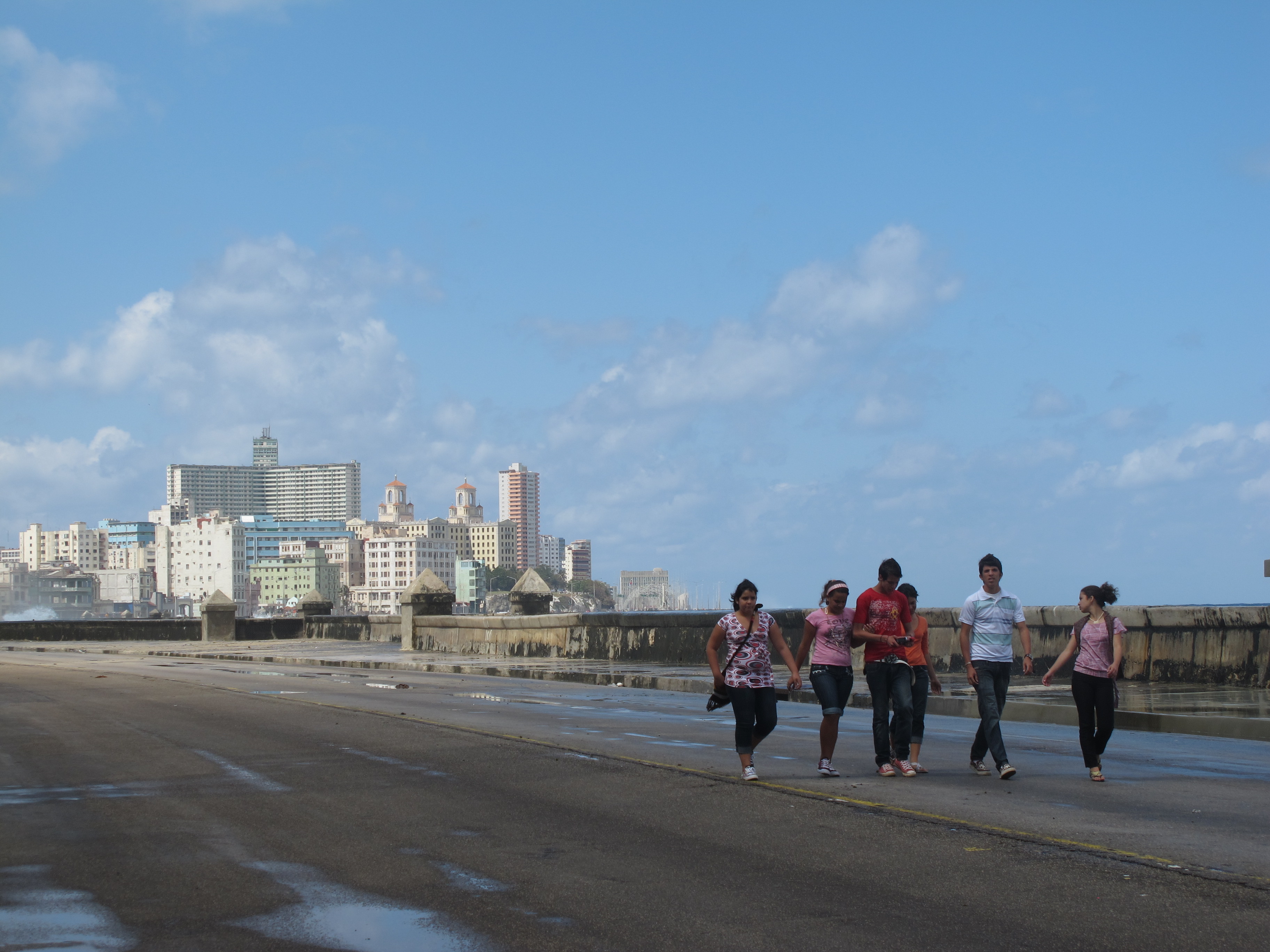
Figure 20_Malecon on a Windy Day

The Malecón in Havana on a windy day, when high waves closed the road to cars, in 2010.

In the book, I expend quite a bit of energy trying to think about sex as a potential site of resistance, so I was fascinated to see a recurring concern (especially from Dunja and Pablo) for the flip side of that coin, or what might be called the darker side of jineterismo-as-sexual-practice.

Continue reading

Knowing Like A Jinetera

The last commentary post in our forum on Megan’s From Cuba With Love, following contributions from Megan herself, Rahul, Dunja Fehimovic and Nivi. Megan’s rejoinder will be up imminently.


Visit Cuba Poster

So near and yet so foreign! declares the advert. Intimate and exotic, Cuba as a repository for fantasy and self-discovery, the neighbour with the mixed-race charms, the imagined nation Cindy Weber once analysed so relentlessly as “the near colony and certain feminine complement” of the United States. Megan’s new, and first, book – From Cuba With Love – exposes the same kind of dynamic, although from a different standpoint.[1] Hers is a near-seamless blend of reportage and feminist IR, moving from autobiography to testimony to political theory, translating from events on the Malecón (the long waterside promenade in Havana dubbed “Cuba’s great sofa”) to the masculine histories of the Cuban state and back again. It is also – for those seduced by such things – a book beautiful to look at, and to hold (which is a way of saying that you should buy a hard copy). It is a book about evasion, repression and muddled motives, but is itself a model of generosity and clarity.

The central figure throughout is the ‘jinetera’, superficially close to the idea of a ‘prostitute’ but evidently much more ambiguous in definition and shifting in practice. As Megan explains, the term ‘jinetera’ and the general practice ‘jineterismo’ are plays on ‘jockeying’, meaning to manoeuvre for advantage and also to have sex, both connotations clearly playful, if also risky (see the previous posts in the forum for more discussion on the meaning and forms of jineterismo).[2] It is with a curiosity about jineterismo that Megan starts. But where we end up is inside an indispensable guide to the ‘sexual-affective economy’, a bold innovation in disciplinary writing, and a testament to the difference gender analysis makes in studying the global political.

From Cuba With Love does what a certain kind of post-structural feminist IR does best, dissecting the identities created by, and in, a concrete historical system. Not the narrow ‘identity politics’ critics abhor, but identity as the fullness of lived experience shot through with power, subjectivities which are at once deeply personal (love, hope, desire, sex) and interwoven with the most brute forms of political violence (the state, the prison camp, the rehabilitation centre, the police system, imperialism and resistance, exclusion and poverty). It is a study that is undeniably ‘global’ in its scope, even about inter-national relations in a rather precise sense, given how often the admixture of sex and money circles the desires of the (usually) western male for a ‘local’ rendezvous, and how implicated notions of race, nation, difference, rivalry, trade, progress, savagery, miscegenation, and geopolitical virility are in that. A kind of diplomacy, even. This is an encounter with ‘the Other’, and a negotiation of the foreign, in its most visceral possible form. Or, as one key informant more bluntly puts it:

It’s different if one goes to bed with a foreigner, or a mountain of foreigners…Do we have to carry such chauvinistic patriotism with us in our pussies too? Is it obligatory to make use of a mambí dick? Or are they trying to avoid alienating penetrations?

Yet From Cuba With Love is not just a great success on those terms. It is also in many ways the stand-out example of ‘narrative IR’, that vague but increasingly popular sub-field (or is it a method?) devoted to exploring world politics from the situated perspective of someone experiencing it (that someone usually being the researcher themselves). Continue reading