The Politics of Annihilation: A Symposium

The Disorder of Things is delighted to be hosting over the coming week a symposium for Benjamin Meiches’s important new book The Politics of Annihilation: A Genealogy of Genocide (University of Minnesota Press, 2019). Following Benjamin’s introductory post below, we will have a rich set of interventions from Jelena Subotic, Alexander Barder, Jessica Auchter, and Myriam Fotou before a final rejoinder from the author. All the entries in this series will be collated here. Previous symposia are also available.
Benjamin Meiches is Assistant Professor of security studies and conflict resolution at University of Washington Tacoma. In addition to his new monograph, he has contributed a variety of articles to International Political Sociology, Security Dialogue, Critical Studies on Security, and Review of International Studies.


“New conceptions require new terms” – Raphaël Lemkin (Axis Rule in Occupied Europe)

“To affirm is not to bear, carry, or harness oneself to that which exists, but on the contrary to unburden, unharness, and set free that which lives.” – Gilles Deleuze (Nietzsche and Philosophy)

Raphaël Lemkin coined the neologism ‘genocide’ in 1944 in a publication called Axis Rule in Occupied Europe, a voluminous study that documented legal and policy changes in Europe under Nazi rule. Little did Lemkin know that less than a century later this term would become one of the most charged terms in contemporary politics. Indeed, within a generation, an explosion took place that transformed the concept of genocide from little more than a scholarly heuristic buried in the midst of a legal tome into the most symbolically vexing and affectively potent form of rhetoric in global politics.
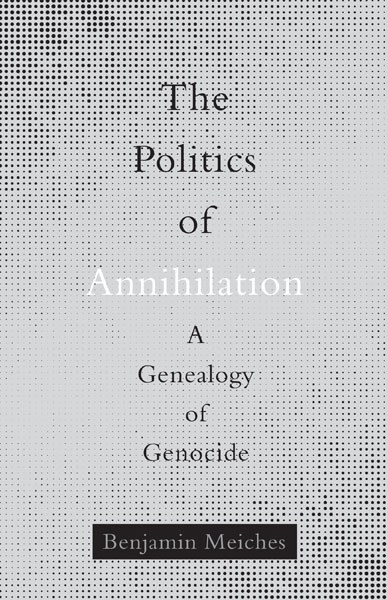
Although barely seven and a half decades separates the genesis of the concept of genocide from today, a great drift took place during this period. Consider, for example, a popular and critical use of genocide discourse today. NK Jemisin, author of the brilliant science fiction series The Broken Earth, uses the character of Nassun to speculate about the meaning of genocide. In the text, Nassun is a member of a hunted group called ‘orogenes’ that suffer murder, enslavement, and torture over millennia. Through Nassun’s voice, Jemisin addresses the problem of genocide. Specifically, Nassun states: “But breathing doesn’t always mean living, and maybe…maybe genocide doesn’t always leave bodies.” In some sense, Nassun (or Jemisin) are correct to view this statement as a new (and important) image of genocide because, today, the dominant images of genocide focus primarily on the act of mass killing based on ethnic, religious, national or racial identity. The irony is that Jemisin’s (or Nassun’s) image of genocide, the genocide that may or may not leave bodies, resonates far more powerfully with the vision of genocide articulated by Lemkin and many of his interlocutors at the inception of this discourse.

Continue reading

Fight to Live, Live to Fight: Veteran Activism after War

A guest post from Ben Schrader, on the topic of his new book, Fight to Live, Live to Fight: Veteran Activism After War, published today with SUNY Press. Ben recently completed a visiting professorship with the Bard Globalization and International Affairs program in conjunction with Central European University. He is a war veteran turned peace activist turned academic. He has published in the Journal of Narrative Politics on ‘Auto-Archeology and Political Affect of War’ (2014) as well as in Critical Military Studies on ‘The Affect of Veteran Activism’ (2017). Ben has a number of other published non-academic works, from think pieces to poetry. He is currently living precariously on the job market. Ben is also a board member for the anti-war organization About Face: Veterans Against War.


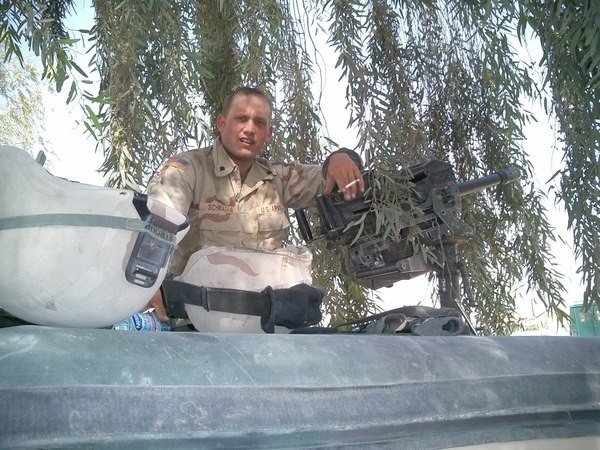
Me in Iraq

Taking in some shade while on patrol in Iraq.

From 2001-2005 I served in the US Army as a 19D Cavalry Scout. I was stationed in Vilseck, Germany and went on two deployments, one to Kosovo from 2002-2003 for a peacekeeping mission, and one to Baqubah, Iraq, where I was a part of my units Quick Reaction Force, so if anything happened in our sector we were the first people that were called. Needless to say I saw a lot of combat. While in Iraq, I began to become disillusioned with the mission, as the reasons we had been given for why we were in Iraq did not seem to align with what we were seeing on the ground. I left the military upset, confused, and as if I had been betrayed by my own country, so to understand my experience I did two things. First and foremost, I joined the group Iraq Veterans Against the War (IVAW), now known as About Face: Veterans Against War. This gave me a tool to channel much of my anger and also connected me with other veterans who were questioning the things they experienced in Iraq. One of the primary tactics I found with IVAW, parrhesia—speaking truth to power—worked to expose the lies that I saw (as well as the truths that have been hidden from civil society), while also working to help me heal by releasing the burden of these truths.

Me at RNC with Rage

IVAW marching with the Prophets of Rage at the 2016 Republic National Convention

The second thing I did was I went back to school. I studied sociology to understand the human and societal impacts of war, and I studied political science to understand the gears and processes of war. Between my activism and academia, I began to see many connections not just on an international level but also on a local level, whereas many of the inequities that Americans face could be tied to different aspects of militarism. This drove me deeper into understanding these connections, as I learned about them in the classroom as a student, and on the streets as an activist. I began to expand my activism and my formal learning beyond just understanding militarism as I got an MA in ethnic studies; examining intersectionality, white supremacy, and colonialism; as well as marching for racial justice, advocating for gender equality, and fighting against homophobia. I then moved on to a PhD where I would work to tie all this together into the project I’m writing about today: a look at military veterans who came home to be social justice activists.

While the project is entangled with my own experiences as a soldier and an activist (as I utilize embodied auto/ethnographic research), my examination of other activists took place over the course of a year. In 2013-2014 I drove around North America interviewing veterans from all walks of life. I started by reaching out to veteran activists that I knew to see if they knew other veterans who would be willing to be interviewed. My only requirement was that they considered themselves “social justice activists,” and that they had served in the US military. In all I ended up interviewing twenty-two veteran activists, twenty of them being in the US, one in Mexico, and one in Canada. I hadn’t begun with the categories of activism I wanted to understand but as one interview led to another categories began to form, as I found veterans who were not only engaged in antiwar activism but also a part of the Occupy movement, doing environmental work, addressing issues of sexual assault in the military, working on immigration issues, and trying to help veteran communities heal from the traumas of war. In some cases, I spent an hour with them conducting an open-ended interview, in other cases I spent a day or two with them observing the work that they were doing. Each interview was different, but all were fruitful. Within the book I primarily highlight two veterans per chapter and their work as an activist, as I do what my former advisor Michael Shapiro calls staging encounters between theory and event. I draw much inspiration from Critical Military Studies as I examine the many ways that war and the military effect the self, groups, and society. Furthermore, these veterans are what Victoria Basham and Paul Higate call geocorporeal actors, not only as soldiers, but also afterwards as veteran activists. I therefore weave these veterans’ stories with my own, from my experiences in war to my engagement with them as interviewees. I try to tell these stories in a manner that is accessible for anyone to grasp both the impacts of war and some of the theoretical concepts around identity formation, militarism, and problems these veterans are addressing around social justice issues.

Continue reading

Returning the Gaze: A Reply to The Eye of War Symposium

The final post in our symposium on The Eye of War as Antoine responds to his interlocutors. All the entries in this series are collated here.


I have read each of the fantastic contributions made to the symposium with real pleasure and intellectual thrill. I feel very fortunate to have my work engaged with so thoroughly and generously by four wonderful scholars who each brought something unique to the conversation. Each entry is too rich in suggestive lines of thought to fully do any of them justice here and so I will only be able to selectively engage their contributions. I know however that they will continue to fire synapses for some time to come and I am very grateful to each participant for that gift. Big thanks also go to Paul for suggesting the symposium in the first place and organising it.

Katharine’s comments focus on the book’s early genealogy of the martial gaze, noting the uncommon historical perspective it brings to contemporary accounts of military targeting. It is certainly the case that much of the abundant scholarship produced on drones has a strong presentist feel, often emphasising the alleged revolutionary character of these weapon systems. Some of the best contributions have produced enriching accounts of their antecedents, either through a history of unmanned weapons (Grégoire Chamayou, Ian Shaw) or of aerial bombing (Derek Gregory), but these remain nevertheless conditioned by the starting point of the drone to which such histories lead by design. Notwithstanding its reference in the book’s subtitle (call it a sop to the marketing imperatives of academic publishing), The Eye of War’s enquiry was never motivated by the drone – indeed, the project was initiated before it became an object of sustained academic study – and it only explicitly features fleetingly in the final analysis. Instead, military perception was to be the investigation’s central object with the primary task being to trace its conceptual fundaments and technical milestones as far back as possible.

As outlined in my introductory post, the crucible for the contemporary manifestation of military perception that I settle on is the Italian Renaissance in which we can see an intertwined rationalisation of vision and mathematisation of space cohere. Katharine usefully supplements this account by connecting it to the Cartesian worldview that systematised what was arguably already implicit in the cultural expression of linear perspective (see also her recent article in the special issue on “Becoming Weapon” I had a hand in). As I note in the book, Martin Jay famously identified the originary “scopic regime” of modernity as one of “Cartesian perspectivalism” with its “understanding of vision as monocular, static, fixed and immediate, distant and objectifying, purely theoretic and disincarnated.” The notion of a rapacious drive for mastery over the world underlying modern epistemology is of course itself a well-rehearsed critique, as is the idea that this project has ironically ended up in a supposedly sovereign subject being increasingly dominated by its creations. If The Eye of War has any claim to originality in this regard, it is in underlining that the martial dimension of this reversal is still insufficiently appreciated.

Continue reading

A Martial Gaze Conscious of Itself

Enter the final contributor to our symposium on Antoine’s The Eye of War (University of Minnesota Press). After the author’s opening post and pieces from Katharine HallDan Öberg, and Matthew Ford, our very own Jairus Grove steps up to the plate. Jairus is Associate Professor at the Department of Political Science in the University of Hawai’i at Manoa and the Director of the Hawai’i Research Center for Futures Studies.  His forthcoming book Savage Ecology: War and Geopolitics at the End of the World will be published by Duke University Press in 2019.


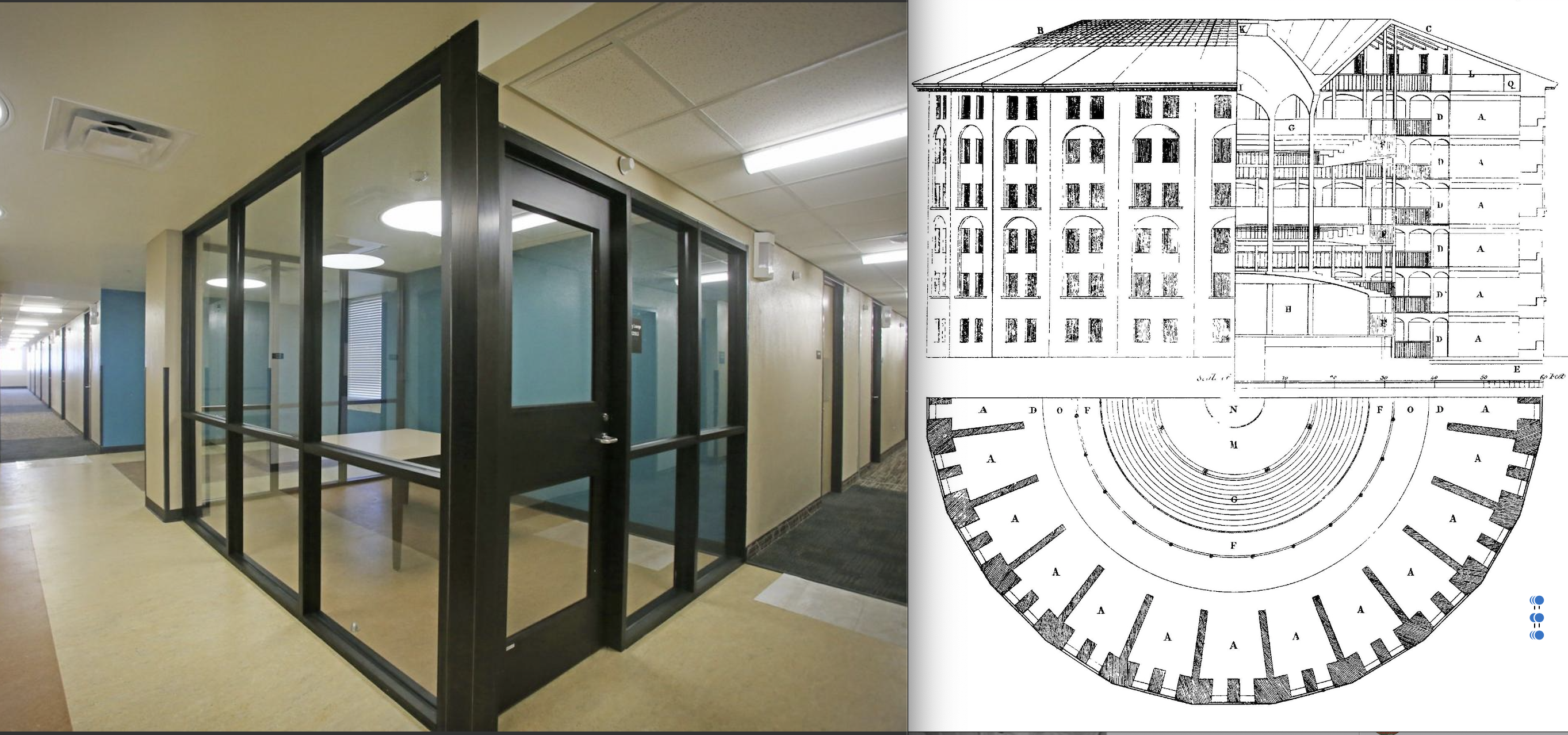
Leafing back through The Eye of War’s evocative images of zebra-striped naval destroyers, pigeon-powered targeting systems, and steampunk-worthy ‘binaural acoustic aircraft detectors,’ I am reminded of how vital prototypes, designs, and never deployed gadgets are to Antoine Bousquet’s story of the martial gaze. I want to spend a bit of time thinking through the status of technical things that are more than ideas and less than practical machines with a little help from one of Bousquet’s interlocutors, Gilles Deleuze. At the end of Deleuze’s book on Foucault, he queries what the exact status of the panopticon is. According to Deleuze, the panopticons of Bentham’s dreams were rarely completed, and yet Foucault saw in its schematic the ordering principle of a new historical episteme. Is the panopticon, then, a metaphor, a kind of architectural condensation of discourses in the form of a blueprint? Those who would see ideas at the heart of the matter would hope so. The panopticon in a thinly constructivist reading would be at best the outcome of a changing set of normative relations regarding enclosure, discipline, and reform. 

The reactionary realist would be just as happy with this reading, as they are already prepared to dismiss Foucault as a naïve ideational thinker inured to the formative significance of things. However, Deleuze accepts neither of these positions. He instead describes Foucault’s thought as diagrammatic, that is, “a display of the relations between forces which constitute power… the panoptic mechanism is not simply a hinge, a point of exchange between a mechanism of power and a function; it is a way of making power relations function in a function, and of making a function function through these power relations.” Drawing inspiration from Gilbert Simondon, Deleuze locates Foucault as a machinic thinker investigating “the very tissue of the assemblage” and the “immanent causal” relationship between abstract machines and concrete machines. The diagram or abstract machine of the panopticon comes to inhabit and form what Deleuze calls the “human technology which exists before a material technology” with the concrete machine its execution in the form of schools, factories, prisons, open plan office spaces, ad infinitum. As Deleuze puts it succinctly, “the machines are social before being technical,” where the social is defined by Deleuze, this time drawing from Gabriel Tarde, as any assemblage or collection of relations that exceed, make up, and go beyond the sociology of humans or individuals.

Continue reading

Requiem for the Battlefield

The third post in our series on Antoine’s The Eye of War (University of Minnesota Press), following an opening summary and Katharine Hall’s intervention on perspective and subjectivity. This next commentary comes from Dr Dan Öberg. Dan is Associate Professor of War Studies at the Swedish Defence University, where his research focuses on the ontology of war, critical military studies and the thought of Jean Baudrillard. Dan is author most recently of ‘Warfare as Design: Transgressive Creativity and Reductive Operational Planning’ in Security Dialogue and ‘Enduring War: Heroes’ Acre, ‘The Empty Throne, and the Politics of Disappearance’ in Critical Military Studies.


If we look closely, we see that the real world begins, in the modern age, with the decision to transform the world, and to do so by means of science, analytical knowledge and the implementation of technology – that is to say that it begins, in Hannah Arendt’s words, with the invention of an Archimedean point outside the world (on the basis of the invention of the telescope by Galileo and the discovery of modern mathematical calculation) by which the natural world is definitively alienated. This is the moment when human beings, while setting about analyzing and transforming the world, take their leave of it, while at the same time lending it force of reality. We may say, then, that the real world begins, paradoxically, to disappear at the very same time as it begins to exist. (Jean Baudrillard, Why Hasn’t Everything Already Disappeared?)

Antoine Bousquet’s excellent and much anticipated book The Eye of War: Military Perception from the Telescope to the Drone traces how the history of the rationalisation of vision and the mathematisation of space during the Renaissance have enabled an ever expanding martial gaze. Herein the reader, among many things, gets an in-depth look at the changing fields of military perception and the subsequent attempts to hide from its view. As the author notes, this development leads towards the dispersal and disappearance of the battlefield in its traditional sense.[1] In this intervention, I would like to put forward a complementary view of the battlefield in relation to the trajectory traced by the author. This view can be summarised as an insistence that from the end of the 18th century and onwards, the traditional battlefield starts to disappear as it is operationalised through military doctrines, planning, and conduct. Moreover, as a direct consequence, the battlefield reappears, refracted through military attempts to model space and time. Below I attempt to sketch out this dual process of disappearance and reappearance by engaging with the history of the military imaginary which both sees and targets, and which arguably corresponds to that martial gaze of which the book speaks so well.

As The Eye of War illustrates, often through fantastic pictures and drawings from historical times, the introduction of new weapon-systems and their social interpretation influence the possibility of targeting and the remits of the battlefield. Historically, we may perhaps argue that varying conceptions of the battlefield have been part of warfare for as long as there has been strategic dispositions in war, evident particularly in attempts to connect tactical means with strategic ends. At times such connections have been drawn on spatially and temporally demarcated battlefields. However, at other times, we find examples of how the conception of the battlefield challenges such remits. For example, in medieval warfare when a strategy of attrition was employed to starve an opponent, the target was crops and the tactics was to put your army in the field, aggressively devastate the countryside, and live off the land. Here the battlefield expands and the target shifts from the enemy soldier to the milieu in which a system of production is established. Or when the strategy was one of plunder, the target was likely to be a poorly protected enemy fortress and the tactics assaulting its walls and exciting pay, while avoiding surrounding armies through manoeuvre. Consequently, the attempt to operationalise the tactical means into strategic ends, that is, the attempt “to target”, potentially constitutes and challenges the remits of the battlefield.

Continue reading

Linear Perspective, the Modern Subject, and the Martial Gaze

The second post in our series on Antoine’s The Eye of War (University of Minnesota Press). Antoine opened the series with a summary of the project earlier this week, and we now welcome Dr Katharine Hall’s contribution. Katharine is Lecturer in Politics and International Relations at Queen Mary, University of London and publishes in the fields of political geography, science and technology studies, and security studies. Her recent works include ‘The Technological Rationality of the Drone Strike’ in Critical Studies on Security and ‘The Emergence of Lethal Surveillance’ in Security Dialogue. Her current projects focus on pilotless aircraft and air power in the interwar period, and on racialised violence and militarised urban policing.


One of the things the distinguishes The Eye of War from many of the books about contemporary drones strikes and military targeting technologies is its historical focus. In analyzing the martial gaze – the linking of perception and destruction, surveillance and targeting – Antoine Bousquet looks not just at the development of this gaze in technologies and practices across the 20th century, but also seeks to situate it within a much longer modern history of perception and representation. The former links Eye of War to a body of critical scholarship attentive to the historical geographies and ‘lines of descent’ of contemporary Western war (ex. Derek Gregory, Caren Kaplan, Ian Shaw, Gregoire Chamayou, Kyle Grayson), while the latter links the investigation into the martial gaze to the birth and development of modern science and the modern (liberal) political subject.

Bousquet calls this historical approach a ‘machinic history.’ This methodology is part assemblage theory, part genealogy, and part intellectual history. The main body of the book is devoted to detailing three functions or logistics of perception: sensing, imaging, and mapping (followed by its opposite: hiding).  Through this investigation he aims to show how perception has become technical, which is the root of his argument. Each of these functions have become increasingly absorbed by and embedded in technical apparatuses, not a new phenomenon but one that has been intensifying. Ultimately this is an argument about the relationship between the human and the technical. Bousquet is concerned with human agency and the removal of this agency from processes of perception, especially where the stakes are so great like in targeted killing. As Bousquet writes, “This book’s ultimate wager is that by plunging into the heart of the machine, we may obtain a truer sense of the potential and limits of our agency within it, political or otherwise.” 

Part of this dive into the machine is to the birth of linear perspective and the Italian renaissance, which Bousquet identifies as the foundational site of the martial gaze. One of the central figures here is Leon Battista Alberti, whose book On Painting details a method for translating what is seen from the eye to the paper, keeping proportions and perspective in scale.  In these foundations (and they aren’t the only ones) is the creation of a system or apparatus to represent the world and to do so through a particular regime of accuracy. In other words what develops from this is a system of seeing and knowing the world – of sensing, imaging, and mapping. The central figure in this system, of course, is the eye.

Continue reading

The Eye of War: A Symposium

Over the coming week, The Disorder of Things will host a symposium on Antoine Bousquet’s new book The Eye of War: Military Perception from the Telescope to the Drone, published last year by University of Minnesota Press. Following today’s introductory post by the author will be contributions from Katharine Hall, Dan Öberg, Matthew Ford, and Jairus Grove before a final rejoinder from Antoine. See also The Eye of War‘s accompanying website for a visual synopsis of the book and special order discounts.

Antoine is a Reader in International Relations at Birkbeck, University of London and a long-standing contributor to The Disorder of Things. His first book was The Scientific Way of Warfare: Order and Chaos on the Battlefields of Modernity (Hurst Publishers & Columbia University Press, 2009). Antoine’s visual-heavy war-centric twitter feed can be found here.

All the entries in this series will be collated here. Previous symposia are also available.


“Visibility equals death.”

This is the stark expression with which strategist Martin Libicki sums up our contemporary martial condition.[1] Indeed, we increasingly live in a world where anything that can be seen can be targeted with lethal force, whatever its position on the globe. The U.S. Air Force certainly has no hesitation in affirming that its “nuclear and conventional precision strike forces can credibly threaten and effectively conduct global strike by holding any target on the planet at risk and, if necessary, disabling or destroying it promptly.”[2]

How have we got to this extraordinary state of affairs? Which concatenation of knowledges, devices, and motives has realised this formidable alignment of perception and destruction? What becomes of war when it hinges on struggles over visibility across planetary battlespaces? Who is the agent of war when it is conducted through technologies that augment, envelop, and supplant human perception? These are the questions that The Eye of War asks and seeks to answer.

Continue reading

Living on the Wrong Side of the Redline

On Valentine’s day 2018, Admiral Harry Harris revealed that an evacuation plan for Non-essential personnel and military dependents was being developed for South Korea. A few weeks earlier the public was given a brief preview of this policy when almost-U.S. Ambassador to South Korea, Victor Cha, announced that he was dismissed by the Trump administration in part because of his resistance to undertaking an evacuation.  In his words, an evacuation would provoke North Korea and hasten the pace of invasion plans by the White House. Admiral Harris’ testimony before congress confirmed Cha’s incredulity regarding such a plan as he described the unrealistic logistics of moving thousands of American military dependents and potentially hundreds of thousands of U.S. citizens residing primarily in Seoul. Adm. Harris’ testimony is not encouraging, particularly in light of Trump’s ominous foreshadowing of a worldthreatening “phase II” if another round of sanctions do not produce complete nuclear disarmament on the part of North Korea.

unnamed

From the island of Oahu the response is: what about us? Seoul is 5 to 10 minutes from North Korean retaliation but Honolulu is only 15 minutes further away by ICBM. Where is our evacuation plan? The already unimpressive track record of U.S. nuclear interceptors has been joined by another very public failure of an interceptor test here in Hawai’i. Add to this the lingering collective dread after our mistaken missile alert on January 13th of this year, and we want to know where our militaryassisted evacuation plans are. Unlike South Korea which has thousands of bomb shelters, Honolulu has no approved public bomb shelters. This is a fact reinforced by recent statements by state civil defense authorities recommending that we all shelter in place despite the fact that most Honolulu homes are of wooden construction and do not have basements. We have nowhere to go, nowhere to hide, and we have received a taste of what it is like to wait for unstoppable death with those we love most.

What makes our collective vulnerability all the more terrifying is the palpable panic on the faces of our active duty service personnel in our communities, classrooms, and families. They are being told to prepare themselves to die for their country in Korea, are being issued a new generation of body armor, trained for tunnel warfare, and tasked to move the last of the necessary tactical equipment to South Korea. States move B-2 bombers to Guam to send a signal to North Korea. They move body armor to Seoul to prepare for invasion. Here in Hawai`i, we take the Trump administration at its word when they say there is no ‘bloody nose strike’ in the works. That is because we can see a full scale attack is being planned. If this seems unthinkable on the mainland, consider how often you have said Donald Trump’s behavior was unthinkable just before he proved you wrong.

Continue reading

The End of The Hague Yugoslavia

The Hague campus of Leiden University today hosted the “Final Reflections” symposium of the International Criminal Tribunal for the former Yugoslavia (ICTY). Everyone from the institution showed up: current and past presidents, current and past judges as well as ad hoc judges, current and past prosecutors, media officers and archivists, plus a bunch of guests—gender advisors, professors, judges from other courts, and so on. Even the president of the International Criminal Court (ICC) spoke at the last panel. This was not a mere stock-taking exercise “between a variety of stakeholders,” says the agenda.  Rather, it was an opportunity for said stakeholders to reflect on the ICTY’s legacy, ideally via a set of “short but emphatic statement[s] on the importance of international criminal courts and tribunals – particularly in today’s political climate.”

Continue reading

Academics Against the Arms Fair: An Open Letter

Last week, about 1500 weapons manufacturers and representatives of more than 100 states descended on London for Defence and Security Equipment International (DSEI) – the world’s largest arms fair. The companies have exhibited products ranging from crowd control equipment and ammunition to fighter jets and military vehicles, which they displayed to militaries, police forces and border agencies from around the world. DSEI is a major event for the international arms trade, and the deals done there play a major role in reinforcing Western militarism, fuelling conflict, repressing dissent and strengthening authoritarian regimes.

Two weeks ago, the Stop the Arms Fair coalition held a week of action in an attempt to prevent the arms fair from taking place. Anti-militarist groups, working in solidarity with activists from countries which have suffered the brutal consequences of the arms trade, held a series of events to disrupt the setup of DSEI. One event during this week was ‘Conference at the Gates’, an academic conference held in front of the arms fair, where participants debated ideas about militarism while taking action to resist it.
Continue reading