What We Talked About at ISA 2012: A Human Right to Housing

Housing is a Human Right Exhibition, Philadelphia (original photo by Annie Seng)

I ain’t got no home. I’m just a roamin’ round, just a wandering worker, I go from town to town. And the police make it hard wherever I may go. And I ain’t got no home in this world anymore.

My brothers and my sisters they’re stranded on this road. A hot and dusty road that a million feet have trod. Rich man took my home and drove me from my door. And I ain’t got no home in this world anymore.

Was a farmin’ on the shares and always I was poor. My crops I lay into the banker’s store. My wife took down and died upon the cabin floor. And I ain’t got no home in this world anymore.

Now as I look around it’s mighty plain to see this world is such a great and funny place to be. Ah, the gamblin’ man is rich and the working man is poor. And I ain’t got no home in this world anymore.

-“I Ain’t Got No Home in this World” by Woodie Guthrie

Beginnings Are Difficult

How to start something new? This question troubles the academic as well as the activist. At the moment it troubles me both as a question of inquiry and as a meta-question of method.

In my previous work I have argued that human rights should be judged first and foremost by the consequences they bring about. Do human rights enable new forms of politics? Do they enable politics that increase the control we have over our lives, or that reduce the suffering and humiliation we are exposed to? Or do they confine us in a liberal subjectivity that makes wider visions of justice impossible, which push us to reconcile our beautiful revolutionary dreams to the limited horizon that contemporary liberal capitalism imposes?

I have offered a qualified defense of human rights as a democratising ethos, which suggests that human rights can enable everyday people to challenge the terms of legitimate political authority, including the institutional shape of their government and the makeup of their communities. This is done by formally opening up the identity of “rights holder” to anyone, regardless of their social position. This opening, however, is only formal and in that formality human rights have an ambiguous significance. For this reason, I have argued that to think of human rights as a democratising ethos also requires that we attend to the politics of human rights. This means that ensuring that human rights support democracy and equality is a political struggle as well as an ethical vision.

Continue reading

What We Talked About At ISA: Researching Sexuality in ‘Difficult’ Contexts

In September 2009, Ugandan Parliamentarian David Bahati introduced a draft ‘Anti Homosexuality Bill’ that proposed enhancing existing punishments for homosexual conduct in the Ugandan Penal Code, introducing new ‘related offences’ including ‘aiding and abetting’ homosexuality, ‘conspiracy to engage’ in homosexuality, the ‘promotion of homosexuality’, or ‘failure to disclose the offence’ of homosexuality to authorities within 24 hours, and mandating the death penalty for a select class of offences categorized as ‘aggravated homosexuality’. The bill remained bottled up in parliamentary committees for the duration of the 8th Parliament, thanks in large part to a sophisticated local campaign that sought to bring international pressure to bear on the government of President Yoweri Museveni, but has since been reintroduced in the current 9th Parliament and therefore remains a live concern. In August 2010, I travelled to Uganda to interview a range of actors associated with ongoing debates over sexuality in the country. Rather than commenting on the urgent and pressing substantive concerns at issue in these debates, at an ISA panel entitled ‘Researching sexuality in difficult contexts’, I chose to reflect on some of the methodological dilemmas I encountered in the field, for which my training in international relations had left me unprepared. Emboldened by recent ISA panels on storytelling and auto-ethnography (and utterly bored by what passes for mainstream IR), these reflections take the form of excerpts from my diary (italicized), interspersed with the more censorious, academic voice that I trotted out at ISA. (I make no apology for not writing about the more ‘serious’ issues at stake—on this occasion—because it occurs to me that where sexuality is concerned, the pursuit of fun can raise deadly serious questions, making distinctions between the trivial and the serious difficult to sustain.)

Uganda, August 2010: I am here to do interviews and I spend most of my day setting them up, preparing for them, travelling to or from them, or conducting them. The rest of the time I hang out, people watch, trying to piece together a picture of how life outside heteronormativity survives in a climate that seems—on the surface at least—as inhospitable as Uganda is supposed to be. On Friday, Al (name changed, and this account provided with permission) invited me to a strip-tease. This was going to be a straight strip-tease, but one that some of the gay men went to so that they could watch the straight men getting off on watching the women strip. It sounded convoluted, but unmissable. Plus, I’d never been to a straight strip-tease, so it seemed important to plug this gaping orifice in my sexual history. We entered a dimly lit hall and took seats at the back in a group near the bar. I think I was the only brown man there. There was also one white man in the whole place, in our group. He had evidently been to the place before, and because he came with the same motivations as Al, he had been traumatized on a previous occasion by the way the women flocked to him (money?). So Al was instructed to tell the emcee (a short guy dressed in a white track suit) to make sure that the women didn’t come to our corner. The real attraction, from the point of view of the gay guys, was that the women sometimes got the straight guys to get on stage and strip. Al told the emcee to do his best to encourage this possibility. Call it Straight Guy for the Queer Eye. I was impressed by the brazenness with which Al communicated all this to the emcee. As for the show, let’s just say it took the ‘tease’ out of strip-tease. The first woman (girl? all the performers looked like they were in their 30s, but they could have been younger and prematurely aged by their work) danced to some vaguely familiar Western pop number. She was followed by another woman with bigger hips. Somebody in the group, setting himself up as my informant, tells me that she is ‘a real African woman’. She danced to Shania Twain’s ‘From this Moment On’ (a song I played to my last (and final, I think) girlfriend on the first day I met her, after a year-long correspondence). Just when Shania reached the second verse, the woman dropped her panties. None of the performers took off their bras. ‘African men aren’t interested in breasts’, my self-appointed informant intones. The next half-hour is a blur of female anatomy. So here I am, in a country that people have been calling ‘conservative’ and that American evangelist Rick Warren has decided is ripe for transformation into the world’s first ‘purpose driven’ nation, looking at more naked women in ten minutes than I have seen in ten years, to the soundtrack of my failed romantic history.

Continue reading

What We Talked About At ISA: The U.S. Military-Industrial Complex, Part 2

Part two of a post on my presentation at this year’s ISA. Part one is here.


So what would be the normative-political case for the Military-Industrial Complex (MIC)? As Ledbetter notes, the defence industry never had a shortage of defenders, proponents, beneficiaries, and apologists. Various critiques of the MIC notwithstanding, numerous American commentators are now firmly united in the belief that their country needs a large defence budget in order to protect and project its identities and interests in the world. According to Maddow, this collective belief had a lot to do with the discursive and institutional success of the infamous “Team B” reports on Soviet power, which so profoundly enthused Ronald Reagan and his administration, leading to the gigantic military buildup in the 1980s. Maddow’s assessment is worth citing at length:

The Think Tanks and Very Important Committees of the permanent national security peanut gallery are now so mature and entrenched that almost no one thinks they’re creepy anymore, and national security liberals have simply decided it’s best to add their own voices to them rather than criticize them. But like we lefties learned in trying (and failing) to add a liberal network to the all-right-wing, decades-old medium of political talk radio, the permanent defense gadfly world can’t really grow a liberal wing. It’s an inherently hawkish enterprise. Where’s the inherent urgency in arguing that the threats aren’t as bad as the hype, that military power is being overused, that the defense budget could be safely and wisely scaled back, that maybe this next war doesn’t need us? The only audience for defense wonkery is defense enthusiasts, and they’re not paying the price of admission to hear that defense is overrated.

But knotted into the right-wing discourse on defence spending is a number of corollary arguments that are associated with a variety of lefty positions in the U.S. context.  America’s mainstream media outlets rarely fail to acknowledge how the twinning of the country’s economic and armed forces not only creates high-skilled jobs, but also – and critically – keeps them in the country. The move is mainly rhetorical. Not only have successive U.S. administrations encouraged American defence industry to globalize, but there is also little evidence to suggest that defence spending creates more jobs relative to spending on, say, health care or education (see, for example, Pollin and Garrett-Peltier, 2011). I would suggest, then, that what lies behind contemporary pro-MIC arguments is, in fact, a creative and complex combination of certain economic theories, (realist?) beliefs in war (or the threat of war) as a manifest destiny of the international system, as well as an overarching (liberal?) commitment to a powerful, sovereign state capable of exercising global leadership (aka., a “force for good”, in still favoured New Labour parlance.)

Let us revisit the pro-MIC rhetoric from the era of “Team B.” In a footnote, Ledbetter directs the reader to The Lonely Warriors (1970) by John Stanley Baumgartner, who is described as “one notable true defender of the MIC.” Written by an expert in public management and business administration, Baumgartner’s book makes three arguments for the MIC: 1) defending the free world is a moral thing to do (“Sputnik is only one example of the reasons for MIC”); 2) by definition, defence is a big enterprise and all big enterprises (directly or indirectly, the MIC employs one in ten Americans) occasionally make big mistakes, especially when they respond to the murky and changing specifications set by the government (“the tiger” or “the monster”) and its contracting officers; and last, 3) “unconscionable profit” is not so unconscionable in comparative terms (profit on sales, profit on investment, price/earning ratios etc. tend to be below the industrial average).

Continue reading

What We Talked About At ISA: The U.S. Military-Industrial Complex, Part I

Earlier this year, the U.S. government set out to reduce its vast defence budget. On 5 January, Barack Obama became the first U.S. president to hold a press conference at the Pentagon. What prompted it was the release of Sustaining U.S. Global Leadership: Priorities for 21st Century Defence, a “strategic guidance” document outlining the national blueprint for “deterring and defeating aggression,” while reducing record budget deficits “through a lower level of defence spending.” (The document also attracted much media attention because it offered a rare glimpse into the strategic thinking of a president who seems to refuse to be associated with a “doctrine.”) In his State of the Union address three weeks later, Obama reinstated his belief that paring defence sending could help “pay down our debt.” The Pentagon’s FY2013 budget projection followed on 13 February, with a request for $614 billion in funding: $525 billion for the base budget and $88 billion for the so-called overseas contingency operations. FY2012 budget request, the Pentagon noted, was bigger.

Pundits in the US have been debating the meaning of the coming defence cuts, starting with the question of whether there will, in fact, be any cuts in the first place. This debate will probably intensify as the election date approaches, although, indicatively, Obama’s strategic guidance contains no “East of Suez” moments, and his Pentagon speech was a candid expression about the need to stay the course: “Over the next 10 years, the growth in the defence budget will slow, but the fact of the matter is this: It will still grow, because we have global responsibilities that demand our leadership… I firmly believe, and I think the American people understand, that we can keep our military strong and our nation secure with a defence budget that continues to be larger than roughly the next 10 countries combined” (emphasis mine; also, “10” appears to be way too low).

Much remains to be said about the type, magnitude, and sequence of the coming changes to America’s defence, and the electoral 2012 will be too short to say it all. The first round of projected budget cuts (“$487 billion”) takes into consideration the provisions of the self-flagellating Budget Control Act from August 2011. The second round of cuts (“$500 billion”) refers the so-called automatic sequestration cuts, also specified in the Act, which will take effect in January 2013 if Congress does find “alternative” ways to control the budget. U.S. Secretary of Defense Leon Panetta described these automatic cuts as the “doomsday scenario,” a label that Congress’s bipartisan supercommittee will no doubt keep in mind as it looks for those alternatives (such as, for example, legislation to reverse the Act). In the end, what will change is the ordering of America’s military priorities, but not the militarization of America’s “global responsibilities” (to use Obama’s own label) as such. Behind it, after all, are multiple and reinforcing structural factors that make real cuts difficult. One of them is “defence industry,” which some pundits and watchdog organizations like to call, somewhat retrospectively, the “military-industrial complex” (MIC).

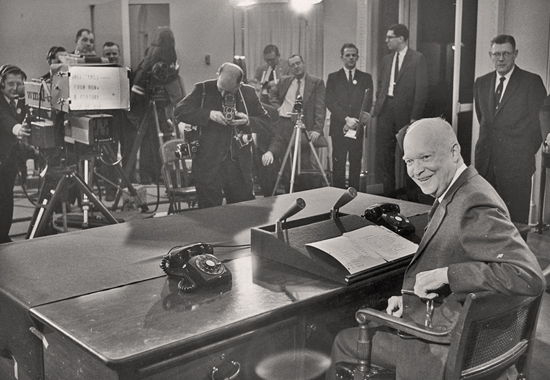
As a conceit, the MIC goes back at least to World War I, but it is popularly dated to Eisenhower’s ‘Farewell Address’ in 1961. As far as US presidential speeches/speechwriting goes, Eisenhower’s was a tour de force in every respect, but the reason why we read it today – or, rather, search for it on YouTube – is for the parts where the president urges the American citizens to pay attention to the “conjunction of an immense military establishment and a large arms industry [that is] new in the American experience,” while advising the American government to “guard against the acquisition of unwarranted influence, whether sought or unsought, by the military-industrial complex.”

Continue reading

#Kony2012 from Advocacy to Militarisation

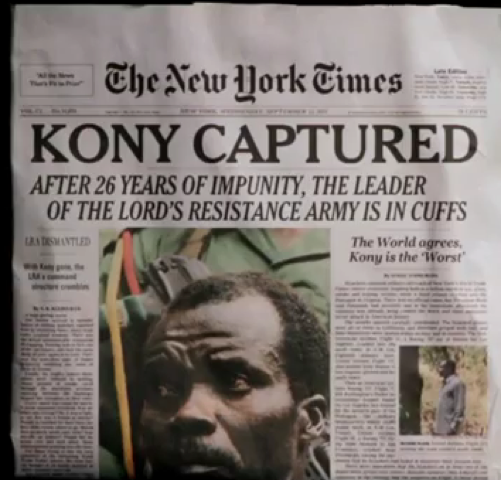
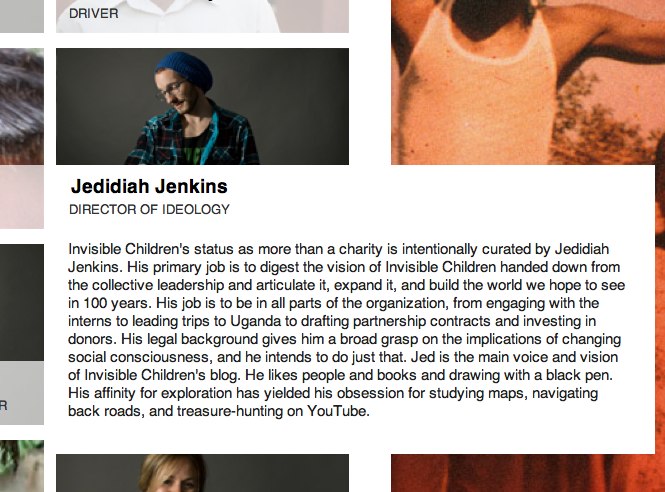
Although the attention spike and mainstream media attention on #Kony2012 has receded, not least thanks to Jason ‘Radical’ Russell’s own brush with infamy, the implications of muscular-liberalism-as-social-media-experiment continue to unfold. My feed at least continues to be peppered with anger towards Invisible Children from informed activists and scholars (although Norbert Mao, for one, takes a much more positive view and Jason Stearns makes a few qualifications of the anti-case worth reading). On Saturday, CEO Ben Keesey and ‘Director of Ideas Development’ Jedidiah Jenkins (formerly ‘Director of Ideology’: yes, really) released a short teaser video promising a sequel to #Kony2012 and declaring that the campaign was “working”. Staying stubbornly loyal to the understanding of foreign policy decision-making expressed in the original narrative, this was said to be because the people at the top were now being forced to respond to an issue they previously hadn’t cared about/known about, all thanks to the public pressure of predominantly young activist-citizens. The major consequence of this pressure being the introduction on March 12 of a Resolution in the US House of Representatives, sponsored by Jim McGovern (a Democrat) and Ed Royce (a Republican), to end Kony’s atrocities and bring justice to Norther Uganda. There’s now a Senate version of the Resolution too, taken by Keesey and Jenkins to dispel those loose accusations of ‘slacktivism’ against Invisible Children and its supporters.

But what does the Resolution actually ask for? Having reaffirmed previous declarations, it:

…calls on the Secretary of State and heads of other government agencies to undertake diplomatic efforts with partner nations focused on—
(A) expanding the number of capable regional military forces deployed to protect civilians and pursue LRA commanders; (B) enhancing cooperation and cross-border coordination among regional governments; and (C) promoting increased contributions from European and other donor nations for regional security efforts.

Now that’s a rather curious formulation of “diplomatic efforts”. Nowhere in the text is there any mention of the human rights records of the Ugandan or DRC armies, nor any suggestion that they are anything but (albeit junior) ‘partners’ in this military endeavour. The preamble makes repeated mention of ‘help’ to regional governments, and one line of text hints at problems (to “address shortcomings in current efforts”), but it is clear that these are deficiencies of coordination and military effectiveness, not of human rights concerns. The claims previously made in defence of the campaign (“we do not defend any of the abuses perpetrated by the Ugandan government or by the Ugandan army”) have rather evaporated in the transition to a formal Resolution, and Keesey and Jenkins make no complaint of that elision. Although recently rather keen to harness #Kony2012’s popularity, Human Rights Watch and others have long catalogued systematic abuses by the UPDF which match the Lord’s Resistance Army closely for brutality. The record of the FARDC (the army of the Democratic Republic of Congo) is worse still. Exact and proportional figures are hard to pinpoint, but there is no question that they are major (and quite possibly the main) perpetrators of rape, terrorism and atrocity in Eastern DRC.

All of this sets a brutal precedent. The vagueness of the call for action and policy detail, lost amongst the emotion ratcheting of being a ‘doer’ rather than a ‘sayer’, opened the door to any number of Liberal Saviour Hawk Military Industrial fantasies (to adapt Teju Cole). This is what groups like the Association of Concerned Africa Scholars warned of, a not-so-creeping militarisation of East and Central Africa. As apparently obvious as stopping Kony’s evil in a hail of righteous bullets cycles seems to Russell and Co., the cycle of insurgency and counter-insurgency tends to be draped at each stage in stark aggressions, with those regional military partners enacting their own ‘invisible’ massacres as they go.

Conspiratorial ideas of Invisible Children as a front for the US government aside, there is clearly a whole set of non-humanitarian interests at play here. I doubt there is any real appetite, and certainly very little capacity, in policy circles for any kind of escalation of direct US military involvement in the area, but then ‘support’ and ‘advice’ for regional allies and proxies has more traditionally been the mark of foreign policy. What those exponential click counts will translate into in policy terms thus remains open, but the signs aren’t great.

Killing is the New ‘Justice’: The Murky Morality of Target Killings

Today’s news of the killing of US citizen Anwar al-Awlaki by US drones sparked a much overdue flurry of criticism and questions on the ethics and legality of Obama’s death-by-drone programme in the war on terror. Awlaki, al-Qaeda’s alleged ‘chief of external operations’ in Yemen (an upgraded title he received posthumously by officials at the White House and the CIA – previously he was by reputation and status merely a radical Muslim cleric) is the first US citizen to have been assassinated in President Obama’s brand of the fight against terrorism. The drones programme is by no means a recent tool in the American war chest, nor has it been particularly reserved in its remit of eliminating specified targets in this interminable ‘war’ effort. What is new, however, is that the US has today eliminated one of it’s own citizens, without due process, stripping said citizen of his 5th Amendment rights and rendering him nothing if not unworthy of living. The fact that a public outcry against the extra-judicial assassination of a human being becomes audible (aside from the controversial killing of enemy #1 Bin Laden of course) only when a US citizen is concerned starkly highlights the normalised extra-judicial status of all foreign drone targets in the perception of the international public. The gloves that came off during the Bush administration are still off and killing as the new justice is beginning to supersede the norm against assassinations.

The norm against political assassinations has been in serious peril since the Bush administration first overtly conceded the strategic use of target killings, framed as a military act to weed out and eliminate high-level Al-Qaeda members, in 2002. This norm continues to deteriorate with Obama at the helm, who has stepped up the drones programme considerably since he took over from Bush junior in 2008. Today, there are roughly double the number of drone attacks per week in regions deemed terrorist hotbeds, specifically Pakistan. Since 2004, these drone strikes are reported to have killed between 1,579 and 2,490 individuals, whereby some analyses estimate the civilian casualty rate among these statistics to be as high as 20%. The vast majority of these deaths have occurred in 2010. While the policy originated as a programme to “capture and kill” a small number of high value terrorist leaders in the G.W. Bush years, the programme has expanded its remit considerably: up to 2,000 killings can hardly be described as a small number, no less if we accept that the total number of military leaders killed was a mere 35 since 2004.

Leaving aside the sovereignty issue that glaringly stares us in the face in a situation where the US decides to engage militarily within a non-war party, such as Pakistan or Yemen, this is a highly concerning development, as it represents not only the gradual erosion of the norm against assassinations but also the very acceptance of the ethics of the targeted killing of persons on a growing scale. Continue reading

The Politics of Austerity: Emergency Economics and Debtocracy

austerity |ôˈsteritē| noun – sternness or severity of manner or attitude
It was possible, therefore, to commit a sin without knowing that you committed it, without wanting to commit it, and without being able to avoid it. Sin was not necessarily something that you did: it might be something that happened to you.

– George Orwell, “Such, Such Were the Joys”

Why what have you thought of yourself?

Is it you then that thought yourself less?

Is it you that thought the President greater than you?

Or the rich better off than you? or the educated wiser than you?

 I do not affirm that what you see beyond is futile, I do not advise that you stop,

I do not say leadings you thought great are not great,

But I say that none lead to greater than these lead to.

– Walt Whitman, “A Song for Occupations,” Leaves of Grass

The Politics of Austerity – Part I

This is the first in a series of posts that look at the political implications of the ongoing global economic crisis. I begin by examining the way that crisis is being used to attack the very idea of democracy through an assertion of the political imperatives of “the market” and the violation, bending and re-writing of the law by capitalist elites. I conclude by laying out how understanding the economic crisis in political terms shapes our ability to respond to it.

In the second post I’ll look at the ethos of austerity, which justifies the pain inflicted on largely innocent people, while suggesting that an affirmative democratic response to the economic crisis must begin with its own ethos, which I suggest should be an ethos of care for the world – which can provide orientation and inspiration for political struggles seeking to address the deeper causes of our current crisis. In the third post, I turn to the structures of the economy and of politics that define the current crisis, looking at the banking crisis, the bailouts, the politics of recovery/austerity and also reflecting of the structural imperatives of capitalism that led us to crisis. This, then, leads to the question of how to respond to the politics of austerity, and of what alternative actions are available to us, which is where the fourth and final post will pick up – with an affirmation of a caring ethos that supports a radically democratic economic vision.

Emergency Economics

In a previous post I briefly highlighted Bonnie Honig’s work, Emergency Politics, to examine the way that the ethical case for austerity is made; most basically, the existence of a supreme emergency, in this case economic, justifies actions that would normally be considered unacceptable. Honig’s work looks at how the appeal to emergency is used to reassert the exceptional political power of the sovereign over and against the law, with a focus on the reassertion of sovereignty witnessed over the past ten years in response to the threat of terrorist attack in the US and Europe.

Rather than accepting the necessarily intractable conflict between the power of the sovereign and the power of the law, Honig attempts to deflate this paradox by turning her attention to the always ongoing contestation that defines democratic politics, a contest over both the content of the law and the institutional embodiment of sovereign power. She suggests, then, that attending to the ambiguities of the “people”, who are both the democratic sovereign and a diffuse multitude, as well as the political element in the law – as new laws come into being through political action – enables us to avoid thinking about emergencies as moments of exception in which the rule of law is lost to the play of political power, while also acknowledging the limits of established law in moments of profound crisis. By undermining the exceptional nature of crises and emergencies Honig alters the challenge we face when circumstances force us to make choices or carry out actions we know are harmful and wrong by asking what we (democratic publics and citizens) can do to survive an emergency with our integrity in tact.

What do we need to do to ensure our continuity as selves and/or our survival as a democracy with integrity? Our survival depends very much on how we handle ourselves in the aftermath of a wrong. We will not recover from some kinds of tragic conflict. But when faced with such situations, we must act and we must inhabit the aftermath of the situation in ways that promote our survival as a democracy.

I continue to find this a useful way to understand our current economic crisis. Appeals to austerity depend upon the exceptional state created by crisis in order to justify the pain inflicted upon masses of people and the priority given to private interests (the markets, investors and bankers) over democratic publics. So, as democratically enacted laws must bow before the sovereign power threatened by exceptional attacks, so economic justice and democratic equality must bow before the commands of market forces, of economic inevitability, in this time of crisis.

The economic version of this argument is stronger still. While the space of political contestation that remains open when we accept the framing of emergency politics is limited, it does exist in the clashing of opposing sovereigns. The prospect of a substantive alternative to neoliberal economic ideology is dim, a light flickering weakly on antiquated appeals for a return to Keynesianism or watered down triangulations of the moderate-middle that sell off dreams of a just economy bit by bit – capitalist realism in action.
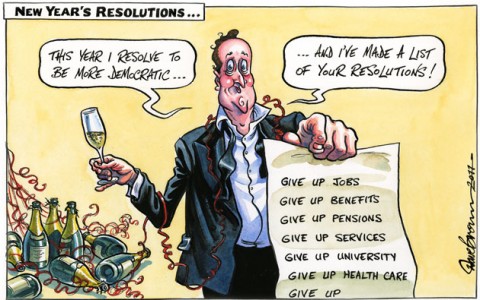
Honig awakens us to an important aspects of our current crisis: that “the market” is not in fact supremely sovereign, and the move to re-establish and further neoliberal policies and push through austerity measures requires an engagement in democratic politics – albeit one that undermines the notion of the public itself and seeks to use the power of the law to subvert democracy. Recognising the current crisis in these terms not only challenges us to consider how to survive our current troubles without giving up democratic virtues, it also reinvigorates and clarifies the political challenge we face. Emergency economics – with its assertion of debtocracy over democracy – is not an inevitable response to the crisis, it is a political one that we can, and should, fight against.

Continue reading

On Torture: Engraving Power

…(cymbal crash)… We have a new Author of Disorder (or is that Disordered Author?). Please welcome, in your virtual way, Elke Schwarz, a PhD student at the LSE working with Kim Hutchings on Hannah Arendt, Michel Foucault, Walter Benjamin, biopolitics and political violence.


‘How does one man assert his power over another, Winston?’. Winston thought. ‘By making him suffer,’ he said. ‘Exactly. By making him suffer. Obedience is not enough’

George Orwell, Nineteen Eighty-Four (1948)

The killing of Bin Laden last month has given new fuel to the claim that torture, as a tool in the securitization tool kit of a neo-conservative US government, actually has its place and validity in a liberal society. How absurd this artificial claim is has been highlighted in many a news source but incidents like this keep the so-called Torture Debate alive and well, as the normalising process unfolds. The practice of torture has become much more widely seen as a ‘necessary evil’ available to a liberal State in the pursuit of the protection of its population, if not humanity at large. A recent study conducted by the Red Cross has shown that as many as 59% of the American teenagers surveyed and 51% of adults accept torture as a means to garner information. When tyrannies torture, however, it continues to be a widely condemned affair and the international community shows no shortage of outrage.

Torture as a practice of and within otherwise liberal societies can only enter the realm of the morally permissible if it is detached from its illiberal roots and the discourses and practices allow societal norms to be such that a violation of the human bodies of some serves as a means to ensure the survival and proliferation of others in the pursuit of information finding. And it is precisely this clinical mask of the instrumental dimension of torture as an means of truth-gathering that the torturer’s power can be understood in terms of their insecurities and vulnerabilities. Facilitated by the display of the fiction of power, the ultimate objective of torture is one of domination in times where political power is challenged and status disputed.

It is perhaps not surprising that torture should emerge as a radical example of routines of illegal acts enacted in the most corporeal sense for the alleged securitisation and greater good for the greatest number of ‘good’ people whose sanctity of life has become precarious. In the wake of 9/11 this increased precariousness of American life has served as a warrant for the now infamous ‘gloves off’ approach instituted by Bush Junior’s neo-conservative posse. The problem is: the gloves have stayed off, even with Obama in command.

Continue reading

It’s Not About You: US Media Bias and Egyptian Protests


Nice piece on Al Jazeera by Mohamed Shokeir that takes the US media to task for its coverage of Egyptian protests.

He asks some important questions about US conceptions of “Arab Anger”, the lack of solidarity with a people fighting an oppressive regime and the myopic US-centric narratives that have dominated the news.

Egypt and the Failure of Realism

Update (19/05/11): A revised and expanded version of this post has been published in The Journal of Critical Globalisation Studies (Volume 4), which you can access for free here.

I’ve hesitated to comment on events unfolding in Egypt (and in the wider region, from Tunisia to Yemen). Not only do I lack any special knowledge of events but many others have said all that I would say with greater skill and clarity. Yet, a sense of solidarity with protesters and my frustration with the commentary on events leads me to offer a few thoughts on the ambiguous role that appeals to “realism” are playing in the response to the actions of the protestors and the government in Egypt.

As the protestors and Mubarak’s goons wait it out in Tahrir Square, the rebellion against the president has entered a key phase. Will the threat of continued violence give Mubarak the space he needs to solidify his power till next year, and in the process avoid the thorough changes the Egyptian people are demanding? As protestors face violence, exhaustion and deprivation the prospect of compromise must seem more desirable than before. The time seems ripe for expressions of support from key states and leaders.  The protestors need our support; it’s much easier for Mubarak to play for time from the presidential palace than for protesters in the streets, but the men and women able to make a difference do not use their voices to share in democracy’s street-choir. And these moral midgets are attended to by their Lilliputian advisors, who counsel patience, restrain and reform that preserves stability.

When Keeping It Real Goes Wrong

Barak Obama has clearly mastered the dark art of evasive support, leaving no doubt that he’s all for Egyptian democracy that doesn’t change too much, too fast, and, most importantly, doesn’t compromise the key strategic interests of the US.

The administration’s restraint is also driven by the fact that, for the United States, dealing with an Egypt without Mr. Mubarak would be difficult at best, and downright scary at worst. For 30 years, his government has been a pillar of American foreign policy in a volatile region, not least because of Egypt’s peace treaty with Israel. American officials fear that a new government — particularly one dominated by the Muslim Brotherhood or other Islamist groups — may not honor the treaty signed in 1979 by Mr. Mubarak’s predecessor, Anwar el-Sadat. (NY Times)

Predictably, Joe Biden made the point with less tact, but perhaps more truth, when he expressed his insensibility to the crimes of Mubarak against his own people.

Asked if he would characterize Mubarak as a dictator Biden responded: “Mubarak has been an ally of ours in a number of things. And he’s been very responsible on, relative to geopolitical interest in the region, the Middle East peace efforts; the actions Egypt has taken relative to normalizing relationship with – with Israel. … I would not refer to him as a dictator.”

Continue reading