Un-Manning; Or, Queering Bradley

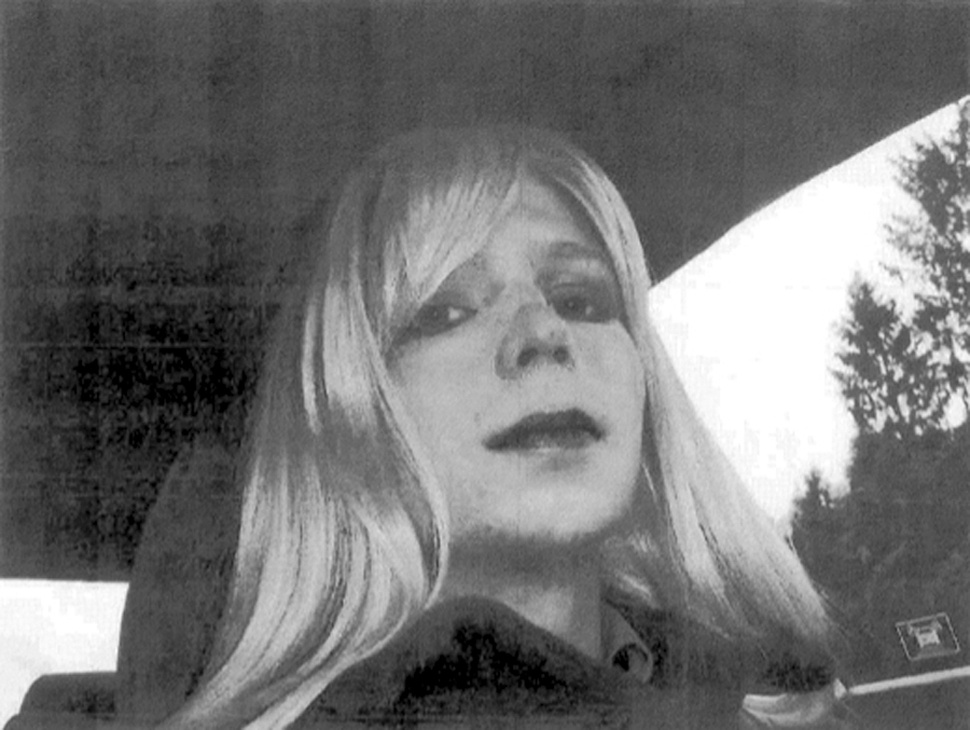
Bradley Manning Trans Wig

Private First Class Chelsea (formerly Bradley) E. Manning has serious gender issues. Or so goes the story of the moment. In the wake of her statement, the question of identity (and language) has somewhat displaced that of the conviction and sentence. Another dimension in the smearing of whistleblowers, perchance. A way to denigrate and emasculate her still further, and so to reinforce the patriarchal entitlement of that shining city on the hill. Except that Manning’s sexual personhood is more contested than that.[1]

Navy Captain and psychiatrist David Moulton, according to CBC, testified that Manning’s ‘gender disorder’, amongst other things, “caused him to conclude he could change the world by leaking classified information”. But Moulton was a defence witness. Captain Steven Lim, Manning’s brigade commander, also pointed towards gender trouble, and revealed the existence of the now much-seen photo of Manning in a wig to the Fort Meade court. Again, a defence witness. Manning’s lawyers were forbidden from seeing much of the (non-)evidence against him, thanks to techniques of classification, and this surely influenced their strategy. Since they could not openly contest claims of the most traitorous harm (claims that were in the end unsubstantiated), why not try and reduce the sentence with whatever biographical resources were available? Where gender identity sometimes served as justification for the leaks, at others it was made irrelevant (to wit: “It was never an excuse because that’s not what drove his actions. What drove his actions was a strong moral compass.”). Interviewed today, David Coombs (Manning’s lawyer) again juggled his client’s personhood somewhat unsuccessfully, maintaining both that “we weren’t offering it as an excuse” but also that Manning’s gender explorations were relevant because they “happened at the same time [as the leaks and therefore] that provides context”.

Paradoxically enough, it is at times Republicans who have had to point out the shamefulness of this strategy:

Now that he prepares to stand trial, he has shown himself to be willing to sacrifice honorable gay and lesbian servicemembers to avoid responsibility. Lawyers for Manning are claiming that his struggle with his sexual orientation contributed to emotional problems that should have precluded him from working in a classified environment. This shameful defense is an offense to the tens of thousands of gay servicemembers who served honorably under “don’t ask, don’t tell.” We all served under the same law, with the same challenges and struggles. We did not commit treason because of it.

Despite the appeal to homonationalism, there is here an actual defence of LGBTQ identity against perpetual fears of a deviance that cannot be trusted with full equality. Fairly obviously, framings of ‘disorder’ put trans* and genderqueer back in the realm of medical pathology from which they have only just begun to escape. And yet this is not a one-sided story of medical bio-politics. Continue reading

Bodies in Pain: Yasiin Bey and the Force-Feeding of Hunger Strikers at Guantanamo Bay

Lauren WilcoxA guest post from Lauren Wilcox, currently Charles and Amy Scharf Postdoctoral Fellow in the Department of Political Science at Johns Hopkins University. Lauren is starting a new job as a University Lecturer in Gender Studies at the University of Cambridge this fall. Her  work is located at the intersections of international relations, political theory, and feminist/queer theory in investigating the consequences of thinking about bodies and embodiment in the study of international practices of violence and security. She is the author of articles in Security Studies, Politics & Gender and, most recently, International Feminist Journal of Politics. Lauren’s current book manuscript is entitled Practices of Violence: Theorizing Embodied Subjects in International Relations.


Mos Def Nose Tube

Earlier this month, the UK human rights organization Reprieve released a video in which Yasiin Bey, formerly known as Mos Def, a well-known and critically acclaimed American hip-hop artist and actor, underwent (or attempted) the force-feeding procedure undergone by hunger strikers imprisoned at Guantánamo Bay. In this five minute video, Bey dresses in an orange jumpsuit like those worn by prisoners at Guantánamo Bay, and states simply that this is the ‘standard operating procedure’ for force-feeding hunger striking prisoners. He is then shackled to a chair resembling those used to force-feed prisoners (such as those pictured below). Bey is approached and held down by two people who attempt to insert a nasogastric tube down his nasal passage way. The video shows Bey struggling against the nasogastric tube, crying out, protesting, yelling for it to stop, and ultimately the force feeding is not carried out. The video is extremely emotional and difficult to watch. After the attempted force-feeding ends, Bey struggles to describe what it feels like, describing it as ‘unbearable’. It ends as it begins, with Bey stating ‘peace’ and ‘good morning’.

For some background context, 166 prisoners remain in Guantánamo Bay: of these, 126 have been cleared for release as not posing any threat to US national security, but are still being imprisoned. To protest their treatment and indefinite confinement prisoners have engaged in hunger strikes since the prison camp opened in July of 2002, the first wide scale hunger strike reached a peak in June 2005, when between 130-200 out of approximately 500 prisoners at Guantánamo Bay began refusing food. Hunger strikes again reached a peak in the spring and summer of 2013, and are ongoing with around 100 prisoners refusing food, and of those, between 44 and 46 are being force-fed (pictured above is an image of an inmate being hauled to the medical facilities to be force-fed), a number so high that the military had to send a back-up team of medical personnel to assist with the force-feeding of prisoners. While the force-feeding of hunger strikers when virtually unnoticed in the media in 2005/6, and again in 2009, the latest months have brought renewed attention to the plight of those who have been held at Guantánamo Bay, some for over a decade, with seemingly no progress made on holding tribunals or securing release of the remaining prisoners. Prisoners have spoken out, including an op-ed published in the NY Times by Samir Naji al Hasan Moqbel entitled “Gitmo is Killing Me”. While President Obama has recently renewed his pledge to close Guantánamo Bay, and a federal judge has even more recently stated that while she had no power to stop the force-feedings, Obama could himself order the force-feedings stopped.

What are the effects of Bey’s action? Continue reading

Constructing National Security: U.S. Relations With India and China

Jarrod HayesA guest post from Jarrod Hayes on his forthcoming book. Jarrod is an Assistant Professor of International Relations at the Georgia Institute of Technology. In 2003 he received his Bachelor of Arts degree from the University of Colorado at Boulder in astrophysics and political science. He completed his Ph.D. in Politics and International Relations at the University of Southern California in 2009. Prior to joining the Georgia Tech faculty, he was the ConocoPhillips Assistant Professor of International Relations at the University of Oklahoma. His areas of scholarly and teaching interest focus on the role of social orders in shaping international security practice. His scholarship appears in the European Journal of International Relations, German Studies Review, International Organization, and International Studies Quarterly.


Srdjan originally approached me about doing this guest post six months ago. So my thanks to Srdjan and the gang for their patience and for giving me an opportunity to discuss my forthcoming book Constructing National Security: U.S. Relations With India and China, set to come out with Cambridge University Press in September (available on Amazon for a discount). What I would like to do is discuss a bit of the background of the book project before addressing the substance of the book and conclude with some of the implications and questions raised by the work.

The book initially started as a project on the democratic peace. When I was in graduate school, I was captivated in my very first semester (Introduction to IR theory with Robert English) by the law-like regularity of the phenomenon—loads of papers and books demonstrate that democracies do not fight each other (see among others my 2012 article in the European Journal of International Relations, also Harald Müller and Jonas Wolff’s ‘Many Data, Little Explanation’ in Democratic Wars: Looking at the Dark Side of Democratic Peace and Ungerer’s 2012 review in International Studies Review). In part owing to how the subject has been investigated (more on that below), academics have lost perspective on the significance of the phenomenon. Security seems to be everywhere, and applied to almost everything. The initial impetus for the highway system in the United States was national security. President Dwight Eisenhower’s avowed purpose for building the massive transit network was to facilitate the movement of U.S. military forces in the event of a land invasion. Two years later security was used to justify education policy in the form of the 1958 National Defense Education Act. The list goes on. Almost any topic one might think of has probably been included under the rubric of security. The democratic peace, however, points to a notable exception. As reams of evidence indicate, democracies have been consistently unwilling to label their peers as security threats. The puzzle is obvious: how is it that democracies have avoided constructing each other as threats while so many other subjects have been labeled as such.

US Army Books

The significance of the democratic peace is self-evident in my opinion. As I read more of the democratic peace (DP) literature, however, I became increasingly dissatisfied with the collective effort to identify the forces that generate the phenomenon. Methodologically, regression-based studies dominate the field. While these studies have been invaluable in establishing the claim that the democratic peace phenomenon exists, by their very nature they are able to demonstrate only correlation, not causation. Not surprisingly, what effort these studies do make towards understanding and explaining the democratic peace focuses on causes — norms and institutions — that could be quantified, sometimes through tenuous proxies. Yet, because the quantitative nature of the studies does not enable access to causal forces, the mechanisms behind the democratic peace remain shrouded in shadow. Perhaps surprisingly given my educational background, I was particularly dissatisfied with the theories and causal assumptions that underlie them in the literature (for the sake of brevity and focus, I will not go into this critique in depth, but interested readers can find it in my 2012 article in the European Journal of International Relations). My dissatisfaction with the literature, specifically with its tendency to brush by the big questions of how the democratic peace is possible, led me to begin pursuing my own theory of the democratic peace.  The book is the result, although it has since grown into an effort to understand how identity shapes security outcomes in democracies.

Continue reading

The Manning Trial, Truth-Telling, and The Precariousness of Democractic Society

The following is a piece written as part of an interview I did at City University on the political and ethical significance of the Bradley Manning trial currently ongoing (links to potentially embarrassing video to follow).

I think that the most important thing that the Bradley Manning trial shows us is the gap that opens up between our legal institutions and our sense of right and wrong, between the law and morality. Many people around the world are shocked by Manning’s imprisonment. People are shocked partly because he has been held under conditions that the UN said violated his human rights, but also because Manning is being tried for exposing the actions of US soldiers and diplomats, including evidence of many potential and confirmed human rights violations. Manning’s supporters are incredulous and view the proceedings now taking place at Fort Meade as illegitimate.Bradley Manning War Crimes

I understand this incredulity and on a level I share it. What I want to suggest, however, is that what we are seeing in the trial of this young man is even more troubling than the corruption of the law by politics – it reveals that the law is always suffused with politics. The law is a technical code. Yes, it is also a normative system that is supposed to determine right and wrong, guilt and innocence. But it is vital that we do not forget that it is a technical code first and foremost, a code that political authorities use to justify their power. Therefore, those with the capacity to influence and manipulate the legal code will always be at an advantage, will always be able to shape that code not towards the pursuit of justice but towards their own interests. This is what Finnish legal scholar Martti Koskenniemi calls this the gap between apology and utopia. The law has its utopian moments and this is especially true of human rights law – for example, Manning supporters see him as a hero who has exposed the grievous crimes of the US government and its military, particularly in Iraq and Afghanistan. They appeal to human rights standards that are quintessential moral claims, but which sadly lack the force of political authority and so are not reliably protected. This is important, but the law also has its moment of apology, where it serves the interests of established authorities, of powerful actors like the US government.

Continue reading

American Vignettes (II): The Spirit’s Agenda

Most of our day we are unaware of what we are thinking, but it is not our thoughtlessness that is disconcerting, it is our lack of awareness of our thoughtlessness.

It is rare to be in a space uncluttered by social messages, but you suddenly find even your modern sensibilities assaulted as you make your way through contemporary America. There are the expected advertisements, but they cover more of the physical surface of the world than you remember. There are the expected automated announcements, but they pierce the air and reverberate more loudly than you remember. You watch as everyone else moves through this cloud of demands, warnings, enticements, and you wonder: “does their head spin as mine does?”

IMG_0135

Advertisement on escalator railing.

The cab you take across Manhattan has a television screen constantly playing commercials – you can silence it but you cannot turn off the scrolling images. The roads you drive down in New York, Chicago and Denver have their negative space filled by an uncountable number of signs, billboards, words – every surface a text. Even tucked away from the public stream of communication, in your home or in your car, the words and pictures crash over you: television is ubiquitous and its light flashes on you wherever you go, the radio blares at you in the coffee shop and the eye doctor’s waiting room, the ads flash on your computer screen as you write emails to friends, and the messages and updates ding and chime on your phone as you sit down to eat a family meal.

The frenetic quality of the day only appears once you are lying in an unfamiliar bed, in a quiet dark room, when you can hear your parents breathing as they sleep down the hall from you, when you can hear the geese who have come south from Canada honking in the distance, when your mind stops receiving, blocking, dodging, collecting words and is able to put its own thoughts together. Being out of place and out of rhythm, you feel the importance of this moment. Slowness. Quiet. Rest. Continue reading

Allow his prophetic voice to be heard…

I was thinking of writing on Dr King’s legacy (again) to mark MLK Day this past Monday, but it turns out that Dr Cornel West has already said what needs to be said.


American Vignettes (I): Totalitarian Undercurrents

The airport is a totalitarian space; sometimes the truth is hyperbolic.

You re-enter the United States, land of your birth, as part of the stream of arriving passengers. It is an everyday experience. You leave the airplane slowly, on stiff limbs, trickling with the mass of travellers into Newark airport.

The imperatives are issued as soon as you enter the terminal building. No smoking. No cell phones. Stand in line. Fill in your declaration form. Foreigner here. Citizen there. Wait behind the red line till you are called. The armed immigration officer checks your papers, holding the power to pronounce your worthiness to enter this sanctified space.

Border Control

With the imperatives come the questions. Where are you coming from? Where are you going? As if the answers are clear. As if these are simple questions. The man with the gun, holding your passport, asks, “Where are you flying next?” But he already knows and he answers for you, “Chicago, on Friday.” This is a test.

“What were you doing in London?” You answer but the officer is not interested, he looks at you with an unarticulated accusation, why would you leave your homeland? Your suspect status is confirmed when he asks, “How long are you staying?” Until you please the armed man with your answers everyone is a foreigner no matter where they were born. Continue reading

Obama’s Ohio Report

My Ohioans did it again.  In every election since 1964 (and almost every time since 1904), the winner of this state ended up taking the presidency – hence the clichés “America’s bellwether” and “as Ohio goes, so goes America”.  Having spent six years of my life studying politics at The Ohio State University not so long ago, I can’t help but identify and sympathize with Buckeye voters, a group of people that every four years gets to decide the fate of the U.S. and, some might add, the world. This is a heavy burden for many reasons, including being exposed to the fanfare of presidential candidate fly-ins (82 of them this time), thousands of attack-counterattack TV ads (that typically target only “undecideds” and/or “independents”), as well as dozens of phone calls and door knocks reminding you to get out and vote for the right person (in the final week of the 2008 campaign, Team Obama said it knocked on a million Ohio doors per day).

The phrase “key battleground state” that every news outlet likes to attach to Ohio refers to its electoral-college vote clout (the 2010 Census reapportionment gives it 18 votes until 2020) as well as its recent record in presidential elections, which is marked by small margin-of-victory numbers (4.6 percentage points in 2008, 2 in 2004, etc.). The state has a remarkable red-blue balance overall; since 1998, the state voted for three Democratic and three Republican candidates each). Also remarkable were the results of pre-election state polling in October, which showed a tied (or at least tightening) race between President Barack Obama and his GOP challenger Mitt Romney (see, for example, the discussion of the RCP poll of polls from 30 October).

To be sure, electoral pathologists – those friends of yours obsessing about assorted ‘paths to presidency’ – had probably explained to you that each candidate could have won an electoral majority without Ohio (e.g. Obama would have had to grab one or two bigger states considered tossups plus all reliably blue states, and Romney would have had to hold onto all normally red states while pulling off multiple upsets elsewhere). This type of electoral math is both fun and fantastic, but reason tends to swiftly restore the status quo ante: it’s all about “Ohio, Ohio, Ohio!

Tuesday’s drama ended right after 11 pm Eastern Time, when the news organizations called Ohio for Obama; less than two hours later, Romney conceded the race.  To examine this outcome, let us begin with two issues identified by the media as key to this election: the auto and coal industries, and the thousands of jobs each of them provides to the state. (Compare, The Globe and Mail’s Ohio postcard of 25 October or The Economist of 27 October to the endorsement editorials in The Columbus Dispatch [Romney], The Cincinnati Enquirer [Romney], The Plain Dealer [Obama], or my favourite OH newspaper, The Blade [Obama]). In a nutshell, while some Ohioans liked what the president did with the former (that 2009 bailout of GM and Chrysler helped the manufacturing sector in the northern part of the state), others hated what he did with the latter. (Being viewed as too green on energy was expected to hobble Obama’s re-election chances in the coal-mining counties of the Appalachian part of the state).
Whatever the explanatory merits of simple storylines like these, unofficial returns bear this one out. The website of Ohio Secretary of State’s office has Obama winning by about 2 percentage points, which is lower than in 2008. The president indeed carried the populous Cuyahoga County (centered on Cleveland) plus a string of smaller counties in the northeast by sufficiently large margins, while Romney won large parts of the coal country.  What went on elsewhere in the state was more important, however. Though Romney ran strong in most traditionally Republican rural areas, he severely underperformed in the remaining half dozen big urban counties, which account for almost 40% of the statewide vote. Even Hamilton County (Cincinnati), historically a GOP bastion, went to Obama by about 20,000 votes again. (For the county-by-county comparisons over time, see Rich Exner’s page at The Plain Dealer; U.S. politics junkies might also consult a map of the 2008 precinct-by-precinct results provided by Stanford’s Spatial Social Science Lab).

Demographically, Obama probably carried the state in the same manner as he did four years ago.  How many Ohioans voted will not be known until late-arriving absentee ballots and provisional ballots are counted, but the turnout (about 68%) can safely be described as well above average. This surely helped the president: by getting its base to register and ballot (including via early in-person voting), the Obama campaign succeeded in maximizing Ohio’s Democratic potential once again (against a stream of ‘voter fraud’ legislation targeting qualified minority voters). What exit polls seem to be suggesting is that the president bested his challenger among female, young, college-educated as well as minority voters.  And what of Ohio’s white working class males (those without a university degree), who sit at the center of any “annoying, all-purpose pet theory” of U.S. presidential elections? Here, it appears that the president succeeded in avoiding a large margin of defeat, and it will be interesting to see why. The success in capitalizing on Romney’s casino capitalism sounds like a plausible hypothesis (and a nice extension of the auto bail-out storyline); but let’s recall that in 2008 Obama won 56% of votes from union households, which was lower than the national average.

What about the role played by ‘non-fundamentals’, specifically Obama’s race? Estimating this particular effect is challenging at any level of analysis, but both survey-based and non-survey-based studies have suggested that in 2008 Obama lost about 5 percentage points of the national popular vote due to racial intolerance on the part of some voters. A meaningful decline in this number would be my candidate for a feel-good story of the 2012 election.


Note: Cross-posted at the CIPS Blog, and meant to be read in conjunction with “Pre-Election Facebook Rants, #652

A Magical Anti-Rape Secretion

Todd Akin (R-MO) says that doctors told him that women can’t get pregnant from rape. The doctor in question was presumably Onesipherous W. Bartley, whose 1815 A Treaties on Forensic Medicine or Medical Jurisprudence explained that conception:

must depend on the exciting passion that predominates; to this effect the oestrum/veneris must be excited to such a degree as to produce that mutual orgasm which is essentially necessary to impregnation; if any desponding or depressing passion presides, this will not be accomplished. (via)

At least we know how up to date a certain kind of Republican is on the medical literature. Aaron ‘zunguzungu’ Bady offers a less generous, but surely more astute, diagnosis:

The thing about a chucklehead like Rep. Akins is that he doesn’t actually care whether or not women have a magical anti-rape secretion in their body that makes conception less likely. That’s the whole point: his right not to have to worry about it. If you look at his entire statement, for example, you’ll notice that his foray into weird science was tangential to his main point, which was, simply, punish the criminal not the child. And this is more or less orthodox GOP doctrine, which has the hammer of law enforcement and looks for nails: solve the problem of rape by hammering the criminal, and make abortion into a crime, so you can hammer that too. But this simple-minded approach stumbles when it runs into the problem of the rape-victim: how to have empathy for the victim (because “victim’s rights” is a central pillar of the law and order approach) while also criminalizing her if she gets an abortion? How to insulate her choice to get an abortion from the contingency she did not control, and could not have chosen?

As many have pointed out, then, the first imperative is to make it her choice, and therefore her fault. But there’s still he cognitive dissonance of a rape victim forced to have the child of a rapist, something that doesn’t sit at all easily in the mind of a right wing family-and-police; she’s still a problem, and a thorny one. And so, a simple answer, for a simple mind: she does not exist. He argues that the rape victim who is impregnated is a fantasy of people who want to make the whole thing complicated and difficult, with their “ethics” and “problems,” and so he invents a “doctors told me” story to make it make sense, to explain how what seems complicated is actually simple. But the fact that he’s just making shit up, that women’s body’s aren’t Nature’s Own Anti-Rape Kit, is irrelevant; when you believe in the super-sufficiency of simple laws (and in The Law), problem-cases just become nails to be hammered down or ignored, while “facts” are nothing more that the warrant for doing so.


Reviewing the Torture Report

The Nation recently ran a review of The Torture Report: What the Documents Say About America’s Post-9/11 Torture Program, by Larry Siems. The book is drawn from the online report that Siems developed from documents that the American Civil Liberties Union obtained from a series of freedom of information requests – those documents are publicly available on the site as well.

I don’t work on torture nor do I have any specialist knowledge of the US policies after 9/11, but Siems’ work looks fascinating. Not only is he using a massive collection of primary sources, but the way he assembles and analyses the material brings out the systemic use of torture and the dubious ends pursued on the bodies and minds of its victims.

20120811-123525.jpg

Key out takes from the Nation review, written by Peter Baker:

This is oddly apt: failures of understanding are part and parcel of institutionalized torture, which seems to require a systemic aversion to detail, especially the details of other people’s experiences. The most publicly visible manifestation of this aversion was the replacement of “torture”—in both the legal memos and the pages of the nation’s leading newspapers—with terms like “enhanced interrogation.” This same preference for detached vagueness pervades The Torture Report. “Cramped confinement involves the placement of the individual in a confined space,” the administration lawyer John Yoo wrote in a 2002 memo. “The confined space is usually dark.” Depending on the size of the space, “the individual can stand up or sit down.”

Abu Zubaydah’s descriptions of his “cramped confinement,” which Siems quotes, dwell on several aspects that Yoo passes over: how a cloth was draped over his confinement box to restrict his air supply; how the box was so small he could neither sit nor stand but instead had to crouch, which caused a wound in his leg to rupture; how he was given a bucket to use as a toilet, and how it tipped over and spilled while he remained inside for hours; how he lost all sense of time. It is unclear whether Yoo left such details out intentionally, or whether they simply never occurred to him. Similarly, it’s hard to know what to make of a note written by Donald Rumsfeld in ink at the bottom of a 2002 memo on detainee treatment that, among other things, set limits on forced standing. “I stand for 8-10 hours a day,” he wrote. “Why is standing limited to 4 hours?”

America commits torture, funds torture research and encourages torture around the world. It is easy to point the finger at one particularly dark corner or another, be it the CIA or the derelict grunts on the night shift. These documents suggest that a bigger problem might be the sheer number of dark corners: American force abroad is wielded and managed by so many overlapping but distinct organizations that it creates plenty of useful ambiguity as to how, exactly, the overlap is meant to work. There’s a clear sense, especially in memos related to the early days of Guantánamo, of all these various people—Army, Navy, Air Force, CIA, FBI—wandering the cell-block halls, unsure of who is doing what, when and to whom. In the absence of a plan, everyone takes turns dealing with the detainees as he or she sees fit. The guards watch, picking up ideas from the pros for later. One could call the disarray a design flaw, but that would involve assuming that torture wasn’t part of the plan. Given that we know it was, all the confusion seems to have helped; CIA agents reveled in exploiting it, often identifying themselves as FBI agents to avoid having their presence exposed or accurately documented. Defense Department agents pulled a similar move, more than once impersonating State Department officials during torture sessions.

The spectacle of lynching, and the photos documenting that spectacle, served as a boast and a warning: look what we can do—and will. With post-9/11 detainee abuse, the exact same message is being communicated, only so too is its negation: look what we disown, what only the bad apples among us desire, and for which we will duly jail them. Endless memos dissecting torture techniques and parsing existing laws out of existence are a key part of this ritual: they insist that nothing terrible is happening. In a 2002 meeting, a military lawyer was surprisingly honest: “We will need documentation to protect us.” A CIA lawyer chimes in his agreement: “Everything must be approved and documented.”