Suggestion


Why can’t I walk down the street
Free of suggestion?
Why can’t I walk down a street
Free of suggestion?
Is my body my only trait
In the eyes of men?
I’ve got some skin
You want to look in
….
Suffer your words, suffer your eyes, suffer your hands
Suffer your interpretation of what it is
To be a Man
….
We don’t want anyone to mind us
Play the roles that they assign us
She does nothing to conceal it
He touches her because he wants to feel it
We blame her
For being there
But we are all here
We are all
Guilty

Fugazi, Suggestion (1989)

It’s Not About You: US Media Bias and Egyptian Protests


Nice piece on Al Jazeera by Mohamed Shokeir that takes the US media to task for its coverage of Egyptian protests.

He asks some important questions about US conceptions of “Arab Anger”, the lack of solidarity with a people fighting an oppressive regime and the myopic US-centric narratives that have dominated the news.

Memo from an Old Contrarian: Hitchens on Revolution, Islamism and More-Or-Less Benign Dictatorship

No one really knows what will come of ongoing events in Tunisia and Egypt (and Yemen and Palestine, &c.). A plethora of under-qualified voices are currently vying for interpretative hegemony, not to mention secure plottings of the various ‘implications’ for the US, global order and the very meaning of freedom in the 21st century. What will it mean for the Mammonites currently scrambling behind the curve? Will the language of ‘partnership’ and ‘reform’ contain the unrest?

It will surely not be long before someone frames the last days’ clashes in Alexandria as the eventual outcome of bombs over Baghdad. I have no particular interest in indulging such faux-talking-head insta-response. What did catch my attention was an especially contrary and confused statement from Christopher Hitchens, billed at Slate as an encouragement to juvenile Tunisia and then at The National Post as a qualified defence of ‘civilized dictatorship’.

Continue reading

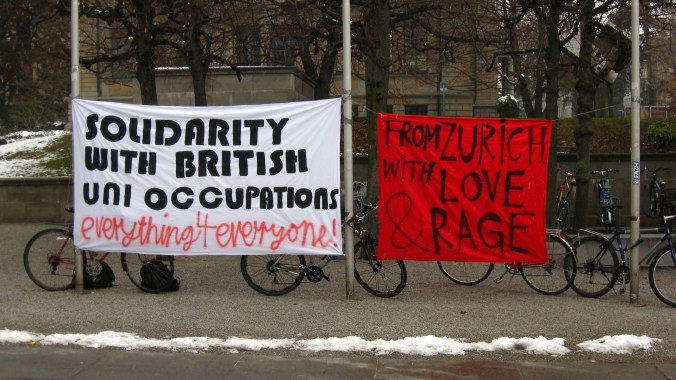
LSE Occupied!

More breaking news. Today LSE students occupied in protest at education cuts, demanding that LSE management produce at least some murmurs of opposition before the Parliamentary vote next Thursday.

Follow here, with updates here. Petition of support here.

Protest: the legality of the Emergency Budget’s gender impact, Monday 6th December

Even a top line assessment of the budget measures show 72 per cent of cuts will be met from women’s income as opposed to 28 per cent from men’s. This is because many of the cuts are to the benefits that more women than men rely on, and the changes to the tax system will benefit far more men than women.

Support Fawcett’s bid for a judicial review of the budget

**JOIN US TO PROTEST OUTSIDE THE HIGH COURT**

12.30 pm – 2pm, Monday 6th December, Royal Courts of Justice, the Strand, London WC2A 2LL

Continue reading

Ethics of Austerity 3: Cynicism, Sincerity and Fear

“You ain’t never been no virgin, kid, you were fucked from the start.”

-Titus Andronicus, “A Pot in Which to Piss

Police Vodafone protesters oxford street

Police protect Vodafone store from the threat of public exposure of truth.

And you have to wonder what it will take for serious people to realize that punishing the populace for the bankers’ sins is worse than a crime; it’s a mistake.

Paul Krugman

Of obedience, faith, adhesiveness;

As I stand aloof and look there is to me something profoundly

affecting in large masses of men following the lead of those who

do not believe in men.

-Walt Whitman, “Thought”

Hypothesis

The winter air has turned cold enough, has pressed in with its full weight, so that there is no more space for lies. The truth of crisis is that the powerful and the wealthy do not take responsibility, they assign it; they do not suffer their follies or their sins, they pay their penance in the currency of our lives.

We’ve spent the last few years living with the anxiety of impending doom, spurred on by hustlers of panic, addled prophets of economic Reformation, and Janus-faced managers of public interest.

Yet, despite the prolonged disaster-foreplay, the consummation of this crisis was always going to be “us against them” and never “we’re all in it together.” Continue reading

Comprador Intellectuals in the Education Crisis

It certainly feels as if things are moving quickly in the fight over the thorough-going recomposition of UK higher education. The scale of occupation and student-led resistance has caught many by surprise. The interpretive battle over ‘violence’ may have performed familiar rituals, but the frequency and militancy of what is going on is new and invigorating. The number of occupations is now considerable, and the leadership of the NUS has been forced into support for tactics and strategy they had previously treated as marginalia. How different it looked in the immediate aftermath of the 10 November actions. The early denunciations of militant protest then seemed to foreshadow the enactment of a reformist middle ground. Aaron Porter gave at least one speech in which he appeared to accept that fees were going to be introduced as planned, and sought to move his energies into getting as much included in the £9,000 fee as possible. He mooted such bold objectives as an end to printing costs and a new universities watchdog to ensure value for money. As if to say, ‘we’ve made our point, now let’s go home’.

Last week’s much smaller protest, and its predictable, petty, kettle, seems to have made all the difference. More walk-outs are planned for today, and doubtless more occupations will follow. This has spooked Clegg to new levels of hysteria, warning that opposition to the cuts will themselves scare off the young, and the poor, and those without sufficient sense to make some back-of-the-envelope calculations as to their eventual debt burden. Obviously, this is true in a rather degraded sense of the word, since without sustained action directed at the proposals, many would not realise the scale of changes until they had already been passed. Verily, ignorance is bliss. Meanwhile, ermine-cloaked colleagues in the blue corner are reduced to crying traitor while the imperatives of civic order require ever more draconian shows of strength.

But where are the academics? Continue reading

Policing as protesting by other means?

In the discussions of the ‘evenements’ of November so far, many have rightly focused on the significance of the student protest for politics, on which there are excellent discussions here and here. But what are the police up to? And what might their participation in this spectacle tell us? Continue reading