Materialism and World Politics conference

Materialism and World Politics

20-22 October, 2012
LSE, London, UK

Registration is now open here for anyone who wants to attend.


Scheduled Speakers:

Keynote: The ontology of global politics
William Connolly (Johns Hopkins University)

Opening Panel: What does materialism mean for world politics today?
John Protevi (Louisiana State University)
More TBC

Closing Panel: Agency and structure in a complex world
Colin Wight (University of Sydney)
Erika Cudworth (University of East London)
Stephen Hobden (University of East London)
Diana Coole (Birkbeck, University of London)

ANT/STS Workshop keynote:
Andrew Barry (University of Oxford)

ANT/STS Workshop roundtable:
Iver Neumann (LSE)
Mats Fridlund (University of Gothenburg)
Alberto Toscano (Goldsmiths, University of London)
More TBC

*******

The annual conference for volume 41 of Millennium: Journal of International Studies will take place on 20-22 October, 2012 at the London School of Economics and Political Science. This includes 2 days of panels and keynotes on the weekend, and a special Monday workshop on actor-network theory (ANT), science and technology studies (STS), and alternative methodologies. Space for the latter is limited though, so let Millennium know of your interest in attending it as soon as possible.

The theme of this year’s conference is on the topic of materialism in world politics. In contrast to the dominant discourses of neorealism, neoliberalism and constructivism, the materialist position asks critical questions about rational actors, agency in a physical world, the role of affect in decision-making, the biopolitical shaping of bodies, the perils and promises of material technology, the resurgence of historical materialism, and the looming environmental catastrophe. A large number of critical writers in International Relations have been discussing these topics for some time, yet the common materialist basis to them has gone unacknowledged. The purpose of this conference will be to solidify this important shift and to push its critical edges further. Against the disembodied understanding of International Relations put forth by mainstream theories, this conference will recognize the significance of material factors for world politics.

Kony 2012 and The Choir of Saviors: You got a song you wanna sing for me?

You got a song you wanna sing for me?
Sing a song, singing man.
Sing another song, singing man.
Sing a song for me.
One for the pressing, two for the cross,
Three for the blessing, four for the loss.
Kid holdin’ a weapon, walk like a corpse
In the face of transgression, military issue Kalash
Nikova or machete or a pitchfork.
He killing ’cause he feel he got nothin’ to live for
In a war taking heads for men like Charles Taylor
And never seen the undisclosed foreign arms dealer.
Thirteen-year-old killer, he look thirty-five,
He changed his name to Little No-Man-Survive.
When he smoke that leaf shorty believe he can fly.
He loot and terrorize and shoot between the eyes.
Who to blame? Its a shame the youth was demonized.
Wishing he could rearrange the truth to see the lies
And he wouldn’t have to raise his barrel to target you,
His heart can’t get through the years of scar tissue.

-“Singing Man“, The Roots

60 million people and counting have now heard about Invisible Children’sKony 2012“. Criticism of the group has been substantial and judicious. The group has defended themselves. Humorous memes are proliferating. Over-exposure has already begun to create awareness fatigue. Yet there is a serious issue largely unaddressed: the most troubling elements of the “Kony 2012” phenomenon are not unique to Invisible Children, but reflect serious moral and political problems with the pursuit of international criminal justice, and in particular the mission and politics of the International Criminal Court and their controversial prosecutor, Luis Moreno-Ocampo.

To put it bluntly: while Jason Russell addresses his audience in the same way he addresses his five-year-old son Gavin, which is clearly inappropriate given the complexity of the issues he’s asking us to consider, Russell’s framing of the evil of Joseph Kony and “our” responsibility to stop him is importantly similar to the narrative of international criminal law, and Ocampo in particular. We should not be too quick to denounce the moral idiocy of Russell as a personal failing – his sentimental and messianic film represents a revealing apotheosis rather than a transgressive break from our sense of international justice. There are unpleasant resonances between Russell and Ocampo – the ICC prosecutor has already praised the group, saying,

“They’re giving a voice to people who before no-one knew about and no-one cared about and I salute them.”

But the commonalities run deeper than a strategic endorsement and should give us pause before we conclude that while Invisible Children may be unscrupulous and ill-informed, some form of outside intervention is needed to save the children of the Great Lakes region of Africa (to say  nothing of the adults being killed) – and yes, an arrest warrant and possible trial by the ICC is as much an intervention as a military invasion. Russell’s call to “stop Kony” is disturbing beyond his narcissism and the organisation’s inept policies and campaigns, his messianic moralising, in which he positions himself (and those like him who just need to be roused to action) as the hero for the powerless victim, is a single melody line in the score that guides the choir singing for international justice. His self-regarding indignation, and our discomfort, should inspire introspection into the desires that lead us to demand that Kony stand trial at the ICC or to insist that “we” must do something to stop the evil that besets that part of Africa.

Continue reading

Human Rights Contested – Part II

This is a continuation of my previous post

Who Are Human Rights For?

All of the authors take account of the ambiguous history of human rights, in which they can be said to have inspired the Haitian, American and French revolutions, while also justifying the counterrevolutionary post-Cold War order dominated by the United States. Yet recognising this ambiguity without also acknowledging the distinctive reconstruction of contemporary human rights that makes them part of a neo-liberal international order and the unequal power that makes such a quasi-imperial order possible would be irresponsible. A primary contribution made collectively by these texts is that they clearly diagnose the way human rights have been used to consolidate a particular form of political and economic order while undercutting the need for, much less justification of, revolutionary violence. Williams says of Amnesty International’s prisoners of conscience, who serve as archetypal victims of human rights abuse,

the prisoner of conscience, through its restrictive conditions, performs a critical diminution of what constitutes “the political.” The concept not only works to banish from recognition those who resort to or advocate violence, but at the same time it works to efface the very historical conditions that might come to serve as justifications – political and moral – for the taking up of arms.

Human rights, then, are for the civilised victims of the world, those abused by excessive state power, by anomalous states that have not been liberalised – they are not for dangerous radicals seeking to upset the social order.

Continue reading

Human Rights Contested – Part I

This post (presented in two parts) is drawn from a review article that will be forthcoming in The Journal of Intervention and Statebuilding, which looks at a recent set of critical writings on human rights in order to consider the profound limitations and evocative possibilities of the contested idea and politics of human rights.

Human Rights in a Posthuman World: Critical Essays by Upendra Baxi. Oxford: Oxford University Press, 2009.

Surrendering to Utopia: An Anthropology of Human Rights by Mark Goodale. Stanford, CA: Stanford University Press, 2009.

The Divided World: Human Rights and Its Violence by Randall Williams. Minneapolis, MN and London: University of Minnesota Press, 2010.

After Evil: A Politics of Human Rights by Robert Meister. New York, NY: Columbia University Press, 2011.

The central tension of human rights is that they propagate a universal and singular human identity in a fragmented political world. No one writing about human rights ignores this tension, but the most important question we face in judging the value of human rights is how to understand this tension and the divisions it creates. The expected divisions between good and evil, between moral universalists and dangerous relativist, between dignified interventionists and cowardly apologists, have long given shape to human rights, as both an ideal and a political project. Seeing the problems of (and for) human rights in these habituated ways has dulled our capacity for critical judgment, as few want to defend evil or violent particularisms or advocate passivity in the face of suffering. Even among serious and determined critics our inherited divisions are problematic (and increasingly over rehearsed), whether we think of human rights as the imposition of Western cultural values, or in terms of capitalist ideology serving the interests of neo-liberal elites, or as an expression of exceptional sovereign power at the domestic and global levels. The ways that these divisions deal with the tension at the heart of human rights misses the ambiguity of those rights in significant ways.

     Rather than trying to contain the tensions between singularity and pluralism, between commonality and difference, in a clear and definitive accounting, the authors of the texts reviewed here allow them to proliferate. Rather than trying to resolve the problem of human rights, they attempt to understand human rights in their indeterminate dissonance while exploring what they might become. To create and invoke the idea of humanity is not a political activity that is unique (either now or in the past) to the ‘West’. The people most dramatically injured by global capitalism sometimes fight their oppression by innovating and using the language and institutions of human rights. Political exceptions – the exclusion of outsiders, humanitarian wars and imperialist conceits – are certainly enabled by the same sovereign power that grants rights to its subjects, which is a metaphorical drama all too easily supported by human rights, but it is only a partial telling of the tale, a telling that leaves out how human rights can reshape political authority and enable struggles in unexpected ways. The work of these authors pushes us to reject the familiar divisions we use to understand the irresolvable tension at the centre of human rights and see the productive possibilities of that tension. If human rights will always be invoked in a politically divided world, and will also always create further divisions with each declaration and act that realises an ideal universalism, then our focus should be on who assumes (and who can assume) the authority to define humanity, the consequences for those subject to such power, and the ends toward which such authority is directed. Continue reading

Body Politics: Corporeal Suffering, Memes and Power/Resistance, with Special Reference to #Occupy, Tahrir Square, ‘Hunger’ (2008) and Rage Against The Machine

*some extremely disturbing images ahead* (and some humorous deployments of Impressionism and Leonardo DiCaprio).


Two weeks ago, Karin Fierke presented a paper at our theory workshop on self-immolation as speech act (part of a forthcoming book entitled The Warden’s Dilemma: Self-Sacrifice, Agency and Emotion in Global Politics with Cambridge University Press). She focused principally on Thich Quang Duc, the South Vietnamese Buddhist monk who set himself alight and burned to death, silent and still, in Saigon in June of 1963, and on Norman Morrison, an American Quaker who copied Duc’s example in November 1965 by combusting his own flesh outside the Pentagon office of Robert McNamara, then the United States Secretary of Defence implementing Operation Rolling Thunder, the rain of fire which infamously unleashed a greater tonnage of bombs on Vietnams North and South than the total dispatched during the entirety of the Second World War.

This mimesis, an affinity not only of form but also of sacrificial politics, was cited as a mechanism for rupturing the symbolic order. Both Duc and Morrison engaged in a corporeal self-violence so forceful that it not only offended senses, but in fact extended a certain community. An act, substituting for speech, argument or manifesto, which forced itself on high politics and forged an international sensibility until that point lacking. One more contemporary dimension of that imitation and repetition is that many must have encountered the image the same way I did, which was via the front cover of Rage Against The Machine’s pugnacious, convulsively political eponymous debut in 1992. And not just the image, but a vague sense of the story imparted by sleeve notes (and lyrics today associated both with opposition to the media grip of Simon Cowell and with visions of the riotous encounter).

Self-immolation persists in a certain tradition of struggle, but the relevance of these themes – the body, sacrifice, the edifice of politics and protest, the circulation of images – has coalesced potently in the wake of recent events (on which more in a moment). Continue reading

Human Rights as Crisis Morality – a reply

If Anthony will forgive my presumptuousness, it seems that the crisis of human rights that worries him is that while critics have much to offer by highlighting the limitations, paradoxes, silences and aporias of human rights, they fail to offer a moral vision that can inspire or a practical politics that might make the world better. This concern goes beyond the practiced rejection of philosophising as an indulgence in the face of human misery. Anthony is concerned with the deeper problem faced by those critics who identify human rights with the global exertion of Western authority and a depoliticised vision of the individual and society under the conditions of contemporary neo-liberal capitalism. And that problem is that the process of critique itself risks overwhelming the possibility of political action for moral ends – to do good on behalf of, and in solidarity with, the “poor, downtrodden and despised”.

There’s a crude version of this critique that suggests human rights naysayers are obscurantist intellectuals, whose evasive politics demonstrate the bankrupt quietism of the contemporary left – or, as they would say back home, that they are “all hat and no cattle”. In his post Anthony is getting at something more substantive and, I think, very important, which is the difficulty of finding a critical ground for moral action in political life. If one admits the limitations and pernicious aspects of human rights as a broad set of political practices, what alternative justification can be offered for political action?

While supportive of human rights, Anthony is quite clear that the

difficulty here for human rights is that the very rhetoric of the movement, with its built in moralism and boosterism, makes it hard to consider that “human rights might be a bad thing”, or that they may not be the best – and certainly not the only – framework for considering serious problems and issues within the international system.

For this reason he respects the important role that critiques of human rights play in recognising the tendency for moral claims to be co-opted by political power, deconstructing the essentialised account of humanity, tracing the violence done to difference through universal claims and acknowledging the politics inherent in any account of justice. The key question, then, is what happens in the wake of our critical interrogation of human rights? Continue reading

Racist Lies, Oslo Edition: Jihadists, Lone-Wolves, and the Far-Right

Last week (Friday 22 July), a man brought a brutal plan to its grim conclusion in Oslo and Utoeya. After years of festering in resentment and roiling with anger, he worked up the conviction to act on his beliefs. He methodically worked out how to make and plant a home-made bomb. He coldly calculated an ambush of young women and men participating in a political summer camp.

He detonated his car bomb and killed 8 people, as well as damaging the prime minister’s office and several buildings in the area. While the city reacted to the terrifying scene, this man calmly made his way to a summer camp on the island of Utoeya dressed as a policeman, armed with an automatic rifle and enough ammunition to carry out an hour-long attack on the residents of the camp. He killed 68 people before surrendering.

Lie No. 1:

As shocking as the attack in Oslo was, it was apparently less shocking than the identity of this angry and violent man. Right-wing media outlets predictably lead with the unconfirmed story that the attack was carried out by Jihadists. But even mainstream commentators and more responsible media outlets ran with the Islamic terror story without evidence and have pushed the angle even after it was revealed that the perpetrator was a white, Christian, “nationalist” from Norway.

Why did the press so quickly and thoroughly misrepresent the story? We can talk about a knee-jerk response or blame faulty reporting, but there’s a simpler and more troubling dynamic at work here. That answer is that “we” expect angry and violent men committing these type of attacks to be Muslim, non-white, non-European.

Even as the true perpetrator of last Friday’s attacks was found and his own racist views made public, the media and the public struggled to accept and understand Anders Breivik because of their own entrenched racism. The hands that commit such violence are supposed to be brown hands, hands that pray to a false and violent God, hands raised in angry protests in far away countries, hands reaching out to choke white victims. Our image of violence reveals the violence of our images.

The blithe accusation of Muslim extremists and the immediate belief that the attacks in Oslo must have been perpetrated by Al-Qaeda, or some other shadowy network, reveal how deeply racist narratives are embedded in “our” understanding of the world.

Continue reading

Pragmatist Notes, part III

In spite of the fact that diversity of political forms rather than uniformity is the rule, belief in the state as an archetypal entity persists in political philosophy and science. Much dialectical ingenuity has been expended in construction of an essence or intrinsic nature in virtue of which any particular association is entitled to have applied to it the concept of statehood. Equal ingenuity has been expended in explaining away all divergences from this morphological type, and (the favored device) in ranking states in a hierarchical order of value as they approach the defining essence. The idea that there is a model pattern which makes a state a good or true state has affected practice as well as theory. It, more than anything else, is responsible for the effort to form constitutions offhand and impose them ready-made on peoples. Unfortunately, when the falsity of this view was perceived, it was replaced by the idea that states “grow” or develop instead of being made. This “growth” did not mean simply that states alter. Growth signified an evolution through regular stages to a predetermined end because of some intrinsic nisus or principle. This theory discouraged recourse to the only method by which alterations of political forms might be directed: namely, the use of intelligence to judge consequences. Equally with the theory which it displaces, it presumed the existence of a single standard form which defines the state as the essential and true article. After a false analogy with physical science, it was asserted that only the assumption of such a uniformity of process renders a “scientific” treatment of society possible. Incidentally, the theory flattered the conceit of those nations which, being politically “advanced,” assumed that they were so near the apex of evolution as to wear the crown of statehood.

– John Dewey, The Public and Its Problems (1927)

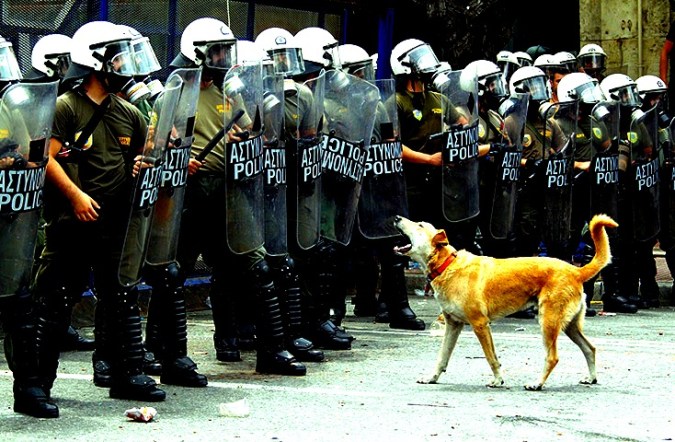
The Politics of Austerity: Emergency Economics and Debtocracy

austerity |ôˈsteritē| noun – sternness or severity of manner or attitude
It was possible, therefore, to commit a sin without knowing that you committed it, without wanting to commit it, and without being able to avoid it. Sin was not necessarily something that you did: it might be something that happened to you.

– George Orwell, “Such, Such Were the Joys”

Why what have you thought of yourself?

Is it you then that thought yourself less?

Is it you that thought the President greater than you?

Or the rich better off than you? or the educated wiser than you?

 I do not affirm that what you see beyond is futile, I do not advise that you stop,

I do not say leadings you thought great are not great,

But I say that none lead to greater than these lead to.

– Walt Whitman, “A Song for Occupations,” Leaves of Grass

The Politics of Austerity – Part I

This is the first in a series of posts that look at the political implications of the ongoing global economic crisis. I begin by examining the way that crisis is being used to attack the very idea of democracy through an assertion of the political imperatives of “the market” and the violation, bending and re-writing of the law by capitalist elites. I conclude by laying out how understanding the economic crisis in political terms shapes our ability to respond to it.

In the second post I’ll look at the ethos of austerity, which justifies the pain inflicted on largely innocent people, while suggesting that an affirmative democratic response to the economic crisis must begin with its own ethos, which I suggest should be an ethos of care for the world – which can provide orientation and inspiration for political struggles seeking to address the deeper causes of our current crisis. In the third post, I turn to the structures of the economy and of politics that define the current crisis, looking at the banking crisis, the bailouts, the politics of recovery/austerity and also reflecting of the structural imperatives of capitalism that led us to crisis. This, then, leads to the question of how to respond to the politics of austerity, and of what alternative actions are available to us, which is where the fourth and final post will pick up – with an affirmation of a caring ethos that supports a radically democratic economic vision.

Emergency Economics

In a previous post I briefly highlighted Bonnie Honig’s work, Emergency Politics, to examine the way that the ethical case for austerity is made; most basically, the existence of a supreme emergency, in this case economic, justifies actions that would normally be considered unacceptable. Honig’s work looks at how the appeal to emergency is used to reassert the exceptional political power of the sovereign over and against the law, with a focus on the reassertion of sovereignty witnessed over the past ten years in response to the threat of terrorist attack in the US and Europe.

Rather than accepting the necessarily intractable conflict between the power of the sovereign and the power of the law, Honig attempts to deflate this paradox by turning her attention to the always ongoing contestation that defines democratic politics, a contest over both the content of the law and the institutional embodiment of sovereign power. She suggests, then, that attending to the ambiguities of the “people”, who are both the democratic sovereign and a diffuse multitude, as well as the political element in the law – as new laws come into being through political action – enables us to avoid thinking about emergencies as moments of exception in which the rule of law is lost to the play of political power, while also acknowledging the limits of established law in moments of profound crisis. By undermining the exceptional nature of crises and emergencies Honig alters the challenge we face when circumstances force us to make choices or carry out actions we know are harmful and wrong by asking what we (democratic publics and citizens) can do to survive an emergency with our integrity in tact.

What do we need to do to ensure our continuity as selves and/or our survival as a democracy with integrity? Our survival depends very much on how we handle ourselves in the aftermath of a wrong. We will not recover from some kinds of tragic conflict. But when faced with such situations, we must act and we must inhabit the aftermath of the situation in ways that promote our survival as a democracy.

I continue to find this a useful way to understand our current economic crisis. Appeals to austerity depend upon the exceptional state created by crisis in order to justify the pain inflicted upon masses of people and the priority given to private interests (the markets, investors and bankers) over democratic publics. So, as democratically enacted laws must bow before the sovereign power threatened by exceptional attacks, so economic justice and democratic equality must bow before the commands of market forces, of economic inevitability, in this time of crisis.

The economic version of this argument is stronger still. While the space of political contestation that remains open when we accept the framing of emergency politics is limited, it does exist in the clashing of opposing sovereigns. The prospect of a substantive alternative to neoliberal economic ideology is dim, a light flickering weakly on antiquated appeals for a return to Keynesianism or watered down triangulations of the moderate-middle that sell off dreams of a just economy bit by bit – capitalist realism in action.
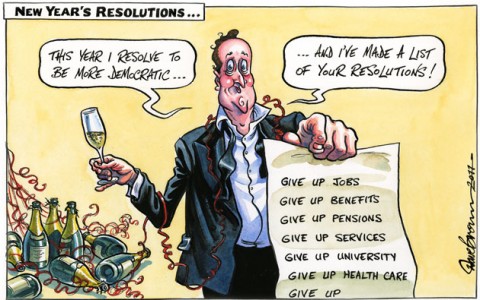
Honig awakens us to an important aspects of our current crisis: that “the market” is not in fact supremely sovereign, and the move to re-establish and further neoliberal policies and push through austerity measures requires an engagement in democratic politics – albeit one that undermines the notion of the public itself and seeks to use the power of the law to subvert democracy. Recognising the current crisis in these terms not only challenges us to consider how to survive our current troubles without giving up democratic virtues, it also reinvigorates and clarifies the political challenge we face. Emergency economics – with its assertion of debtocracy over democracy – is not an inevitable response to the crisis, it is a political one that we can, and should, fight against.

Continue reading

What We (Should Have) Talked About at ISA: The Politics of Humanity and The Ambiguous History of Human Rights – Part III

This is the final post in a series laying out a set of interrelated arguments I presented at this year’s ISA conference. The first post looked at the nature of human rights claims, while the second considered how rethinking human rights in terms of contestation over the ambiguous meaning of humanity as a political identity affects our understanding of the history of human rights. In the final post I suggest a positive ethos, enabled by attending to human rights in terms of agonism and pluralism.

Human Rights as a Democratising Ethos

In part 1, I analysed human rights as an attempt to offer a universal moral justification of political authority. This is a perennial political question, but one which is reconfigured by talk of “human rights”, as the political identity of humanity opens up question over who is included in political community, as well as the boundaries that define such communities. The stakes of the question of human rights – offering a universal account of who is included as a rights bearing member of the political community, and the legitimate order of that community – lead to a profound anxiety over justifications. The moral reasons we have to uphold human rights should be weighty, powerful and certain – or so the logic dictates.

What emerges from this logic is an essentially legislative understanding of human rights, in which moral principles give justification for the necessary and minimal law to grant legitimacy to the universal vision of both individual and community. If this moral law is to be more than an imposition of power, a merely effective positive law, it must involve a universal moral appeal that cannot be denied in order to secure human rights as the necessary law of legitimate authority. In this regard Habermas’ defense of moral universality and human rights are indicative and sophisticated examples. (Habermas 1992, 1998)

Continue reading