Societies Under Siege: Exploring How International Economic Sanctions (Do Not) Work

This is the first in a series of posts on Lee Jones’ Societies Under Siege: Exploring How International Economic Sanctions (Do Not) Work. Responses will follow from guest authors Elin Hellquist, Clara Portela and Katie Attwell over the next few days.


It doesn’t seem to matter what the international crisis is: be it an inter-state war (Russia-Ukraine), civil strife (Syria), gross violations of human rights (Israel), or violent non-state actors on the rampage (ISIS, al-Qaeda), the ‘answer’ from governments and civil society always seems to be the same: impose economic sanctions. In the mid-20th century, only five countries were targeted by sanctions; by 2000, the number had increased tenfold. Once an obscure, rarely used and widely dismissed form of statecraft, sanctions are now clearly central to the exercise of power in international relations – particularly when dominant powers are reluctant to put ‘boots on the ground’.

My new book, Societies Under Siege: Exploring How International Economic Sanctions (Do Not) Work, is the first comparative effort to explore how these sanctions ‘work’ in practice – on the ground, in target states. This post introduces the book and the forum that will follow.

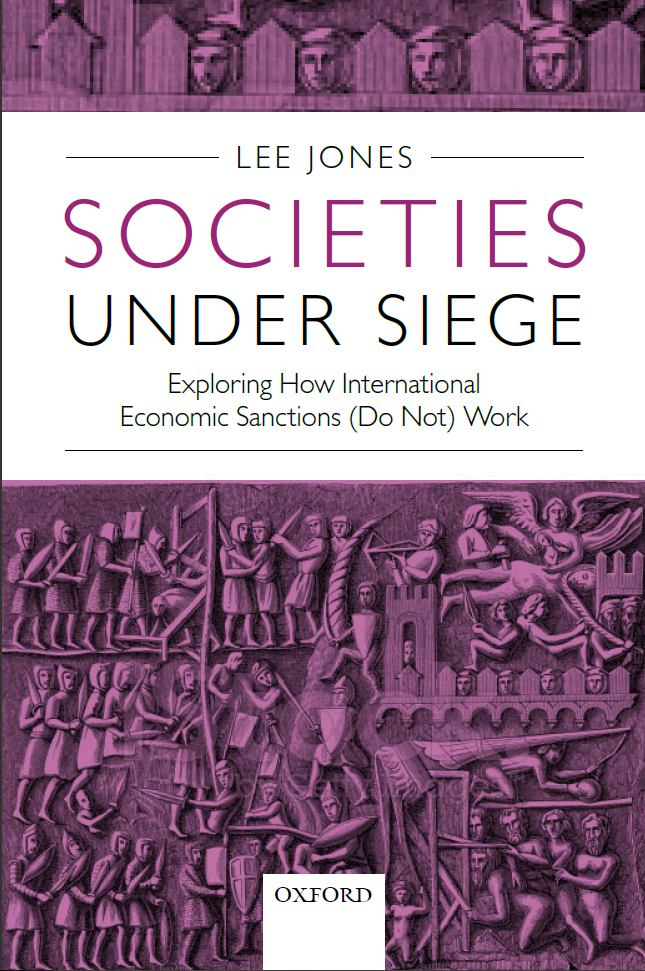
Societies Under Siege cover. The image is an engraving of a (failed) siege during the Albigensian crusade.

Societies Under Siege cover. The image is an engraving of a (failed) siege during the Albigensian crusade.

Continue reading

Reinventing the Future

It is an honour to have had Inventing the Future considered in such depth and detail, and we want to begin by extending our thanks to everyone who contributed to this symposium. This response is a useful moment for us to clarify our argument, to respond to the most significant questions, to acknowledge limitations of the book, and to correct some misunderstandings. We do so in a spirit of humility, given that – as we wrote in the introductory post – we see this book as a contribution to a larger debate and hopefully the spark for reflection on what we think are important issues for the contemporary left.

Post-Work Futures

In Joseph, Sophie and David’s pieces, some fundamental questions are raised about what precisely a post-work world entails, particularly with respect to concerns around the environment, labour, social reproduction, and colonialism. Does a high-tech post-work world entail the exhaustion of resources and the decimation of the earth’s climate? Does a post-work world mean the continued oppression and subjugation of low-income countries? These are essential questions to ask. In responding to these queries, it will be useful to draw up a series of alternative possible futures indicating how a post-work project may play out. Roughly speaking, we can imagine four broad and potentially intersecting futures: a neocolonial and racist post-work world, an ecologically unsustainable post-work world, a misogynist post-work world, and a leftist post-work world.

Continue reading

Postcapitalist Ecology: A Comment on Inventing the Future

The third post, and second guest, in the Disorder’s forum on Nick and Alex Williams’ Inventing the Future. Joseph Kay writes on climate change and libertarian communism with the collaborative blog Out of the Woods.


Having drafted the following comment on Nick Srnicek and Alex Williams’ (henceforth S&W) Inventing the Future: Postcapitalism and a World Without Work, it reads more critically than I expected. In mitigation, I should say that I’m on-board with many of the key themes of the book. I am wholly sympathetic to anti-work politics, generally in favour of automating away toil (with qualifications which will become apparent), and agree that the replacement of global capitalism requires scalability, comfort with complexity, long-term strategy, utopian imagination, and a plurality of organisational forms and infrastructure.

The critical tenor of what follows arises less from disagreement as such, than from my focus on what appear to be the ecological silences in the text. In particular, I focus on the implied conception of nature imported through S&W’s adoption of an avowedly modern rhetoric of progress and control, and on the unmentioned premises of both the project of full automation, and their more general contention that “we are usually not better off taking the precautionary path” (p.177). My argument is not to reject a high-tech, low-work future, but to outline some of the problems to be addressed in rendering such a ‘hyperstitional’ image ecological.

Modernity and the Ideology of Nature

Early on in Inventing the Future, S&W summarise their thesis:

If complexity presently outstrips humanity’s capacities to think and control, there are two options: one is to reduce complexity down to a human scale; the other is to expand humanity’s capacities. We endorse the latter position.

Read in an ecological light, the conjunction of ‘think and control’ affords two readings. The first and obvious reading is that their argument is situated within what Neil Smith called the ideology of nature. Smith argued that the ideology of nature had two poles. The first, a modernising politico-theological argument which saw scientific progress as the means to conquer and subdue nature. Here, the imaginary is mechanical, and separation from – as dominion over – nature is understood as an emancipatory process.

Continue reading

Accelerationism Without Accelerationism

The second post in our forum on Nick and Alex Williams’ Inventing the Future, from Steven Shaviro. Steven is the DeRoy Professor of English at Wayne State University. He blogs at The Pinocchio Theory.


The term accelerationism was coined by Benjamin Noys in 2010, in order to designate a political position that he rejected. In Noys’ account, accelerationism is the idea that things have to get worse before they can get better. The only way out of capitalism is the way through. The more abstract, violent, inhuman, contradictory, and destructive capitalism becomes, the closer it gets to tearing itself apart. Such a vision derives, ultimately, from the famous account of capitalism’s inherent dynamism in the Communist Manifesto. For Marx and Engels, capitalism is characterized by “constant revolutionising of production, uninterrupted disturbance of all social conditions, everlasting uncertainty and agitation… All that is solid melts into air, all that is holy is profaned.” Far from deploring such developments, Marx and Engels see them as necessary preconditions for the overthrow of capitalism itself.

The trouble with accelerationism, according to Noys, is that it celebrates “uncertainty and agitation” as revolutionary in its own right. It doesn’t have any vision of a future beyond disruption. In the 1970s, Deleuze and Guattari suggest that we need, not to withdraw from capitalism, but “to go still further… in the movement of the market, of decoding and deterritorialization,” At the same time, Jean-François Lyotard exults over capitalism’s “insane pulsions” and “mutant intensities.‟ By the 1990s, Nick Land ecstatically anticipates the dissolution of humanity, as the result of “an invasion from the future” by the “cyberpositively escalating technovirus” of finance capital. Today, transhumanists see Bitcoin, derivatives, algorithmic trading, and artificial intelligence as tools for destroying the social order altogether, and for freeing themselves from the limits of the State, of collectivity, and even of mortality and finitude. This is what happens when “creative destruction” – as Joseph Schumpeter calls it, in his right-wing appropriation of Marx – is valued in and of itself.

In 2013, responding to all these currents, Nick Srnicek and Alex Williams published their “#Accelerate: Manifesto for an Accelerationist Politics.” In this text, they seek to reclaim accelerationism as a genuine project for the left – one that can pick up the tools of capitalist modernity, and detourn them to liberatory ends. This is not a matter of celebrating disruption for its own sake; Srnicek and Williams emphatically reject Nick Land’s “myopic yet hypnotising belief that capitalist speed alone could generate a global transition towards unparalleled technological singularity.” Instead, Srnicek and Williams return to Marx’s own suggestion that Continue reading

Inventing the Future

The opening post in our latest forum, on Nick and Alex Williams’ new book, Inventing the Future. Commentaries will follow over the week, and Nick and Alex will respond soon thereafter with a rejoinder to points raised. All will eventually be available under this tag url.


Inventing the Future Cover - square

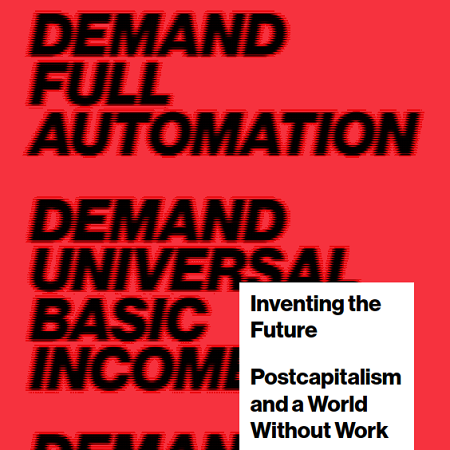
Today kicks off a symposium on our new book, Inventing the Future: Postcapitalism and a World Without Work. On a surface level, it is a book analysing post-work, the global crisis of surplus populations, and the challenges of rebuilding the contemporary left. Yet it is also a book designed to intervene in the current political conjuncture. It is written to produce discussions, rather than close them down; to spark debate, rather than dictate; and hopefully to persuade people of the utility of its prescriptions. As such, this blog event is the perfect avenue to inaugurate what we hope will be a series of productive engagements. Rather than simply summarising the book here, it is perhaps more useful if we briefly outline some of the debates we sought to contribute to.

The first such debate is the question concerning the dismal state of the left. While some find elements of hope in the contemporary left, for most it has been a series of marginal successes at best, and outright defeats at worst. In the book we attempt to offer a new explanation for why this is the case. Without rejecting the contributing factors of objective changes in the organisation of capitalism, and subjective changes in the self-understanding of class, we try to add a third explanation based upon a widespread common sense amongst the left. It is what we call ‘folk politics’: an intuitive set of beliefs that leads those on the left to instinctually turn towards immediacy as the solution to political problems. It finds greater and lesser expression in a series of recent movements, and while sometimes explicitly valorised, more often than not it goes on unconsciously in practices and habits. Our argument is that this folk political common sense tends to lead movements to organise and do politics in a way which constrains the possibility of escaping a global capitalism. This does not mean that folk politics should be rejected or dismissed; rather we simply try to point to its wide circulation and strategic insufficiency.

On a second level, the book seeks to generate discussion about what the future should look like. Too often, the activist and academic left only offers visions of the future in negative terms: the end of wage-labour, the end of racism, the end of sexism, the end of colonialism. These are all agreeable, of course, but ultimately remain empty signifiers. If we want a better world, we need to have some idea of where we are going. This doesn’t mean taking the opposite tack, and outlining a detailed plan for a future society (as with Parecon and New Socialism, for example). Rather it means setting out a series of broad proposals for what should be desired, what can be achieved, and how to get there. We have no illusions about the errors, biases, and limitations that our own proposals will include. We are, indeed, keenly aware of the limits of a small book written for a general audience. But the point of setting out a vision of the future and a series of demands is to lay our cards on the table for others to take up, critique, or reject. It is too easy to adopt a comfortable critical stance against the world.

Finally, discussions about the problems of the left and visions of the future must come together in debates over how to rebuild the power of the left and bring about a new future. To this end, our argument is for a counter-hegemonic strategy across an ecology of organisations, intervening in newly discovered and constructed points of leverage. While we try to give some concrete content to these broad proposals, we have also intentionally pitched these ideas at a level which allows them to be taken up in different forms across different countries and under different conditions. It is our hope that people who are convinced by our analysis and proposals will then take up these broad ideas and translate them into their own specific circumstances. We offer the book as a possibility – one among many – of what the future could look like.

-Nick Srnicek and Alex Williams
The Dissonance Of Things #3: The Arms Trade and Its Discontents

This month, I step into the role of host for our third ever podcast, on the topic of the arms trade, ways of thinking about it, and the various forms of opposition to it. Helping us make sense of all that are Chris Rossdale of the University of Warwick and Anna Stavrianakis of the University of Sussex. Chris is a participant observer of anti-militarist social movements and the author of numerous pieces on the politics of protest, as well as this post for us on political solidarity. Anna is the author of many pieces on the arms trade and militarism, including Taking Aim at the Arms Trade: NGOs, Global Civil Society, and the World Military Order (Zed, 2010).

The immediate context for our discussion is a whole series of protests against the Defence and Security Equipment International (DSEI) Exhibit, due to take place next week in London. One part of that was an academic ‘Conference at the Gates’ earlier today at the ExCeL Centre, and it is on the notion of activist academia that we begin the conversation.

As ever, consume, cogitate, share, discuss and share again. You can also follow past and future casts on soundcloud.


Further resources, including articles discussed in the podcast:

Why Syriza Failed

The following was originally posted on The Current Moment, a blog exploring contemporary politics and political economy in the West. Especially for those concerned with the Eurozone crisis and the impending British referendum on European Union membership, it is a must read!

*    *    *

Recent events in Greece have baffled many observers. At the end of June, Prime Minister Alexis Tsipras walked out of talks with Greece’s creditors, calling a snap referendum on their proposals. It appeared to be crunch time. Tspiras denounced the EU’s ‘blackmail-ultimatum’, urging ‘the Hellenic people’ to defend their ‘sovereignty’ and ‘democracy’, while EU figures warned a ‘no’ vote would mean Greece leaving the Euro. Yet, even during the referendum campaign, while ostensibly pushing for a ‘no’ vote, Tsipras offered to accept the EU’s terms with but a few minor tweaks. And no sooner had the Greek people apparently rejected EU-enforced austerity than their government swiftly agreed to pursue harsher austerity measures than they had just rejected, merely in exchange for more negotiations on debt relief. This bizarre sequence of events can only be understood as a colossal political failure by Syriza. Elected in January to end austerity, they will now preside over more privatisation, welfare cuts and tax hikes.

When nai means yes

How can we explain this failure? I argue three factors were key. First, the terrible ‘good Euro’ strategy pursued by Syriza, the weakness of which should have been apparent from the outset. The second factor, which shaped the first, is the overwhelmingly pro-EU sentiment among Greek citizens and elites, which created a strong barrier to ‘Grexit’ in the absence of political leadership towards independence. Third, the failure of the pro-Grexit left, including within Syriza, to win Syriza and the public over to a pro-Grexit position.

Continue reading

The Perpetual Financial Crisis of UK Higher Education

Higher Education in Britain – particularly in England – is now clearly in perpetual financial crisis. This may seem an odd claim, since universities appear to have higher incomes than ever, and are sitting on vast cash reserves. But this superficially calm macro-level picture obscures the broiling chaos at the micro level. Universities, and particularly their individual departments, have been deliberately exposed to enormous year-on-year fluctuations in their incomes – potential and actual – that vitiates any attempt at rational planning and leaves financially strapped units particularly vulnerable to savage, short-term cuts designed to rebalance the books.

The latest move in this direction comes in a remarkable missive from the Higher Education Funding Council for England (HEFCE) which, on instruction from the government, is cutting £150m in funding to English universities — not just in future financial years, but the present academic year (2014-15) and the next (2015-16). That means universities will not receive the funding they anticipated, and planned for, even for the year to September, let alone for the following year.

Continue reading

Governing Borderless Threats

Southeast Asia’s recent Rohingya refugee crisis, and the parallel and still-unfolding horrors in the Mediterranean, are stark and tragic reminders of how the nature of international security has changed in recent decades. Traditionally, security involved building military strength to deter or repel attacks by other states. Today, beyond a tiny handful of ‘flashpoints’, so-called ‘non-traditional’ security issues dominate: irregular migration, drug trafficking, terrorism, piracy, pandemic disease, environmental degradation, transnational organised crime and cybersecurity – to name but a few. How are states and international organisations dealing with these challenges, and what does this tell us about global politics today?

The latest “boat people” crisis

Continue reading

Capitalism: A History of Violence

Alexander Anievas and TDOT resident Kerem Nişancıoğlu introduce their new book How The West Came to Rule: The Geopolitical Origins of Capitalism.


‘For the last two decades, challenges to the inequalities and injustices of capitalism have been casually dismissed by a status quo swimming in hubris. From Margaret Thatcher’s infamous proclamation that ‘there is no alternative’ to Francis Fukuyama’s declaration of the ‘end of history’, the study and critique of capitalism has been relegated to margins of public discourse. More recently, Mark Hunter argued that any attack on capitalism is ‘an attack on human nature’, thereby reaffirming the now centuries-old conceit that capitalism is as ‘natural and organic’ as living and breathing.

However, as stock markets came crashing down in 2008, the force of history reasserted itself in a series of revolutions, square occupations, anti-austerity protests, strikes, riots, and anti-state movements taking place from London to Ferguson, Athens, Cairo, Istanbul, Rojava, Santiago and beyond. Such movements have torn at the certainties of ‘capitalist realism’ and started sporadically – if inconsistently – challenging such long-held ‘common sense’ truisms and the power structures that bolster them.

howthewest

Continue reading