White World Order, Black Power Politics: A Symposium

vitalis-e1458738905580This is the first post in the symposium on Robert Vitalis’s, White World Order, Black Power Politics: The Birth of American International Relations (Ithaca: Cornell University Press, 2015). Professor Vitalis (who also answers to ‘Bob’) teaches at the University of Pennsylvania. His first book, When Capitalists Collide: Business Conflict and the End of Empire in Egypt, was published in 1995. His second book, America’s Kingdom: Mythmaking on the Saudi Oil Frontier, published in 2005 was named a book of the year by The Guardian. He has been a fellow at the Woodrow Wilson International Center for Scholars (2009), Rockefeller Foundation (2003), the International Center for Advanced Study, NYU (2002), the American Council of Learned Societies (2002), and the MacArthur-SSRC International Peace and Security Program (1998). He was a MacArthur Award nominee in 1998. Below is his introduction to our symposium.

*Update*

Naeem’s response is here; Nivi’s is here and Srdjan’s is here.


80140100646100L

White World Order, Black Power Politics may well be the only book discussed in this symposium series that isn’t primarily concerned with theory, or at least the only one by an author who does not self identify as a theorist, teaching in a department that does not recognize what I do as “IR.”  It is also less an intellectual history, which might allow it to pass as theory, than it is an institutional history. So I am grateful for the interest in it here.

28522646._UY1280_SS1280_That said, it is indeed a critical history. The records of professors, schools, research organizations, and foundations in the early twentieth century United States reveal a past that bears scant resemblance to the “practitioner histories” or insider accounts of great debates invented about the discipline of international relations in the second half of the century, which are the ones most specialists tell themselves and their students until now. In fact, the more I learned and labored in the archives the more I came to see the problem as similar to the one I wrestled with in my last book, America’s Kingdom: Mythmaking on the Saudi Oil Frontier. The history that U.S. oil companies invented after World War II about their early and unshaken commitment to a “partnership in progress” with the Saudi people, at a moment when criticism of U.S. imperialism was on the rise in the Eastern Province and across the globe, is the one that books repeated uncritically for decades. The firms’ private records though revealed a dramatically different reality. I developed an account of the exploitative order in place in the oil camps, the racial science that justified it in the minds of the American engineers and managers, and the failed efforts of Arab and other workers to bring about its end. I likened what I did in that book to “reverse engineering” particular processes of mythmaking. I’ve done more or less the same thing for a sector of the U.S. academy in White World Order. Continue reading
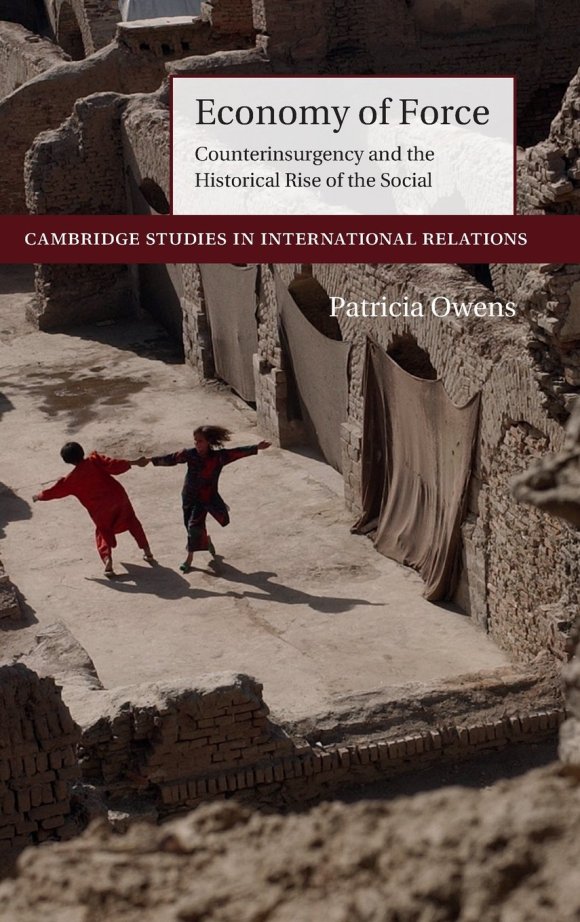
Critiquing the Social: Comments on Patricia Owens’ Economy of Force

The last commentary in our forum on Economy of Force, from Andrew Davenport. Andrew is Lecturer in International Politics at the University of Aberystwyth, where he works on International Theory, with particular emphasis on debates in Critical Theory, materialism and idealism, and modern social theory. He is the author most recently of ‘Marxism in IR: Condemned to a Realist Fate?’ in the European Journal of International Relations. Patricia’s rejoinder to the four commentaries (from Pablo, Jairus, Elke and Andrew) will follow tomorrow.


In the concluding section of Chapter Two of this book, Patricia Owens quotes Robert Nisbet to the effect that the essential concepts and perspectives of the sociological tradition “‘place it much closer to … philosophical conservatism’, than we might otherwise think.” A basic theme of the book is that it ought to be more clearly understood that prominent categories in the work of Durkheim, Weber and Marx – community, authority, alienation and status – are in fact just “conservative moral categories … but in scientific garb”.[1] The conservative character of sociology’s origins is in fact no secret. At much the same time as Nisbet was writing, Theodor Adorno also noted it: near the beginning of his introductory lectures on sociology, he emphasised that any assumption of an intrinsic connection between sociology and radical politics (that sociology = socialism) would be seriously mistaken: “if the concept of sociology is understood as it came into being, with the historical meaning it has, it can be said that the opposite is actually the case.” Sociology’s interest, from the start, was always the maintenance and preservation of the existing order, not its critique and change. What does the character of these origins mean for social theory? How should it affect or condition our understanding of social thinking and its basic concepts: precisely, ‘society’ and ‘the social’? Owens’ answer is unequivocal: it should lead to profound suspicion, if not outright rejection. Social thinking, from the start, contained a poison and its natural affinity to conservative thought, attitudes and practices is simply indicative of this noxious nature. Especially damaging in its consequences for IR theory, so the argument runs, has therefore been the unthinking naturalisation of ‘social’ terminology virtually across the spectrum, from statist Political Realism to Foucauldian biopolitics – as if society and the social were neutral terms that do not themselves colour or prejudice the discourse.

The language of ‘society’ is indeed widespread, and often perhaps unreflectively used, in IR, and so its critique is surely an important theoretical project. Not the least of the book’s merits is that it poses uncomfortable questions to critical theory about how far it is possible to adopt social thinking for purposes of critique. Owens directs some pointed remarks at Marxists, Foucauldians and other critical theorists for, in effect, supping with the devil, and in the chapters on counter-insurgency she marshals enough evidence of a ‘homology’ between social theory and imperial practices of counter-insurgency to give even the most committed sociologist pause. Further, in demonstrating that the emergence of distinctly social thinking was coeval with the development of capitalist society, there is at least the implication that those who would pursue critique of capital ought not to accept social categories at face value. Nevertheless, it seems to me that there are difficulties with the critique of the social elaborated in the book, both in how the argument is structured and with the categories employed, difficulties that lead to some of the work of critique remaining undone. As a result, the account of the social developed here, challenging and thought-provoking as it is, breaking new ground, nevertheless does not go as far as it might.

Continue reading

Economy of Force

We return from the holidays with gusto and a book symposium on Patricia Owens’ Economy of Force: Counterinsurgency and the Historical Rise of the Social (Cambridge, 2015). Patricia is Professor of International Relations at the University of Sussex, co-editor of European Journal of International Relations, and a former fellow of the Radcliffe Institute for Advanced Study at Harvard University and of Oriel College, Oxford. Patricia’s first book was Between War and Politics: International Relations and the thought of Hannah Arendt (Oxford, 2007). Economy of Force is in the Cambridge University Press series ‘Studies in International Relations’ and is out in paperback next summer (the introduction is available in full here). The book will also be the subject of a forthcoming special section of Security Dialogue.


Economy of Force

Economy of Force seeks to rekindle interest in one of the oldest but neglected languages and techniques of government administration – household governance – that it uses to write a new history and theory of counterinsurgency with broad implications for social, political, and international thought. The book is a study of oikonomia in the use of force, from oikos, ancient Greek for household. But it also makes a larger claim, that household governance underlies the relatively recent rise of distinctly social forms of government and thought more broadly. Since the late eighteenth-century, modern, capitalist state and imperial administrators have drawn on and innovated different forms of household governance, scaling up and transforming the units of rule in which populations are domesticated. To really understand the significance of households-as-government we need to dispense with the relatively recent and bourgeois notion of households as houses, homes, or family-as-kin. Instead, households are best understood through the nature of the hierarchical relations between people in a particular spatial arrangement. Households are the persistent but historically variable spaces in which the life processes of members – real, vulnerable bodies needing food, water, shelter – are administered and the household itself is maintained.

There is a very long tradition of thinking of households-as-government in the history of political and economic thought and in anthropology, archeology and comparative studies of different household forms. There is also excellent and wide-ranging scholarship in literary and gender studies on practices and ideologies of domesticity (from domus, Latin for house). In drawing on and extending these and other literatures, Economy of Force suggests that there is a far deeper significance of households and forms of domesticity than captured in International Relations debates about the so-called ‘domestic analogy’. Household administration is highly portable and plays a remarkably significant role in imperial and international relations. These are grounds to make a stronger claim than one based on mere analogy. I argue that there is a domestic homology connecting different households, despite their historical and geographical variability, based on the genealogy of household governance in the history of social and political thought, but also the human experience of basic life necessities and the stubborn but contingent attempts to domesticate people through the administration and control of life needs.

Continue reading

Myths of Invention

The fifth commentary, and sixth post, on Nick Srnicek and Alex Williams’ Inventing the Futurefrom DoT’s own Joe Hoover. A reply from Nick and Alex will follow.


Inventing the Future begins with a lament.

Where did the future go? For most of the twentieth century, the future held sway over our dreams. On the horizons of the political left a vast assortment of emancipatory visions gathered, often springing from the conjunction of popular political power and the liberating potential of technology.

The authors resent that they have been denied a future with more promise than the present. They mourn the absence of the object of their desire, the impossibility of its fulfilment, the lives to be lived in these lost leftist utopias. This seems to be a widely felt disappointment, if we are to judge by how often the complaint has been made of late. Disappointment leads to diffuse anger, directed at the status quo on the “Left”, its lack of vision. At the root of this discontent is anger at the world itself, for all of the ways it impedes us, frustrates our hopes and gives no comfort to our dreams – it is a world in need of re-making. I do not want to suggest that because the book’s narrative is motivated by such feeling that it can be reduced to an outburst against the vagaries of existence, the work is too focused and the problem it addresses too serious for such crude criticism. Yet, this fundamental emotional resentment colours the project in an important way.

Orpheus plays his lament

The lament shapes the inquiry itself. We are wounded by the loss of our desire – a future flush with possibility – and we are angry at capitalism for stealing our future. Obviously the detail is more sophisticated than this curt summary, but a stark statement of the underlining logic reveals the essential narrative. The problem of contemporary Left politics is not the desire for a universal utopian future but rather that this future has been lost, which runs counter to important criticisms of progressive leftism (a point taken up by Aggie Hirst and Tom Houseman). Therefore, the authors’  task is to remind us why we desire the future, then to consider where to look for a new one and how to seek after it. Inventing the Future is a quest to find what was lost, so we can become whole in our desires. We may set out on such a quest with great optimism but we still carry a worrisome anger with us.

There are a great many barbarities in our world attributable, at least in part, to “capitalism” but it is not a villain stealing away with our ladylove (the difficulties of determining what capitalism is are taken up later). Our lost future is not the exceptional crime of some neoliberal conspiracy. Yes, I know the book does not say anything quite so crude. Nonetheless, the narrative structure is driven by a conflict that finds its resolution with the us (the protagonist) achieving wholeness in a future fulfilment of our desire. The authors make the caveat that contestation will not end in this postcapitalist future, but this future still holds out the promise that the conflicts of today will melt away. The world is always messy, unfinished, stubborn, cruel, confused, and, I posit, resistant to the kind of  breaks with past ways of being that are suggested here (Sophie Lewis and David Bell look at the temporalities involved in greater detail). If we lament that, we risk resentment against the world itself, against human existence and against flesh and blood people who move slowly and impede our dreams. Love of the future sits dangerously close to hatred of the present – which is not to say we should have no love of the future, but rather that we ought to be wary of too much of it.
Continue reading

Postcapitalist Ecology: A Comment on Inventing the Future

The third post, and second guest, in the Disorder’s forum on Nick and Alex Williams’ Inventing the Future. Joseph Kay writes on climate change and libertarian communism with the collaborative blog Out of the Woods.


Having drafted the following comment on Nick Srnicek and Alex Williams’ (henceforth S&W) Inventing the Future: Postcapitalism and a World Without Work, it reads more critically than I expected. In mitigation, I should say that I’m on-board with many of the key themes of the book. I am wholly sympathetic to anti-work politics, generally in favour of automating away toil (with qualifications which will become apparent), and agree that the replacement of global capitalism requires scalability, comfort with complexity, long-term strategy, utopian imagination, and a plurality of organisational forms and infrastructure.

The critical tenor of what follows arises less from disagreement as such, than from my focus on what appear to be the ecological silences in the text. In particular, I focus on the implied conception of nature imported through S&W’s adoption of an avowedly modern rhetoric of progress and control, and on the unmentioned premises of both the project of full automation, and their more general contention that “we are usually not better off taking the precautionary path” (p.177). My argument is not to reject a high-tech, low-work future, but to outline some of the problems to be addressed in rendering such a ‘hyperstitional’ image ecological.

Modernity and the Ideology of Nature

Early on in Inventing the Future, S&W summarise their thesis:

If complexity presently outstrips humanity’s capacities to think and control, there are two options: one is to reduce complexity down to a human scale; the other is to expand humanity’s capacities. We endorse the latter position.

Read in an ecological light, the conjunction of ‘think and control’ affords two readings. The first and obvious reading is that their argument is situated within what Neil Smith called the ideology of nature. Smith argued that the ideology of nature had two poles. The first, a modernising politico-theological argument which saw scientific progress as the means to conquer and subdue nature. Here, the imaginary is mechanical, and separation from – as dominion over – nature is understood as an emancipatory process.

Continue reading

Three Theses on ISIS: The Universal, the Millenarian, and the Philistine

Nimer SultanyA warm welcome to Nimer Sultany who brings us a guest post on thinking about ISIS. Nimer is Lecturer in Public Law, School of Law, SOAS, University of London. He holds an SJD from Harvard Law School. He practiced human rights law in Israel/Palestine, and was the director of the Political Monitoring Project at Mada al-Carmel – The Arab Research Center for Applied Social Research. His recent publications include: “The State of Progressive Constitutional Theory: The Paradox of Constitutional Democracy and the Project of Political Justification” in the Harvard Civil Rights – Civil Liberties Law Review and “Religion and Constitutionalism: Lessons from American and Islamic Constitutionalism” in the Emory International Law Review.


The ruthless brutality of the Islamic State in Iraq and Syria (ISIS or ISIL) unfolds before our eyes on the screens. As commentators struggle to explain and understand it, it becomes convenient to revive old Orientalist tropes. Beyond the spectacular brutality, the reason that ISIS invites attention (both fascination and fear) is that it seems easy to fit in confrontational narratives of Islam (us v. them, anti-American, etc.). Muslims are clearly angry at something. In his infamous article “The Roots of Muslim Outrage”, Bernard Lewis simplistically explained that Muslims are envious of, and angry at, Western modernity and secularism. The U.S. magazine Newsweek illustrated this knee jerk reaction, and recourse to run of the mill thinking patterns, in a Muslim Rage cover in September 2012.

o-NEWSWEEK-MUSLIM-COVER-facebook

In his book “Covering Islam” (1981) Edward Said has effectively critiqued these binary simplifications that dominate not only journalistic discourse about “Islam”, but also expert-talk about Islam. For Said, all attempts to conceptualise other cultures are a value-laden interpretive exercise. He showed the deficiencies of orthodox writings on—and views of—Islam, and called for “antithetical knowledge” to challenge the orthodoxy’s claims of value-free objectivity.

It seems little has changed, however, since Said wrote his book in the wake of the Iranian revolution. In this brief commentary I want to examine three attempts to understand ISIS. These are long treatments in respected liberal media outlets. To use Said’s phrase, these are treatments that fit in different “communities of interpretation.” These three essays are all aware of the need to provide “context” for ISIS. However, their contextualisation differs. The success of this contextualisation in shedding a light on ISIS varies. Let me call these interpretive techniques: universalization; Millenarian confrontation; and intellectual bewilderment. These three attempts operate mostly on the ideational/ cultural domain.

Continue reading

Capitalism: A History of Violence

Alexander Anievas and TDOT resident Kerem Nişancıoğlu introduce their new book How The West Came to Rule: The Geopolitical Origins of Capitalism.


‘For the last two decades, challenges to the inequalities and injustices of capitalism have been casually dismissed by a status quo swimming in hubris. From Margaret Thatcher’s infamous proclamation that ‘there is no alternative’ to Francis Fukuyama’s declaration of the ‘end of history’, the study and critique of capitalism has been relegated to margins of public discourse. More recently, Mark Hunter argued that any attack on capitalism is ‘an attack on human nature’, thereby reaffirming the now centuries-old conceit that capitalism is as ‘natural and organic’ as living and breathing.

However, as stock markets came crashing down in 2008, the force of history reasserted itself in a series of revolutions, square occupations, anti-austerity protests, strikes, riots, and anti-state movements taking place from London to Ferguson, Athens, Cairo, Istanbul, Rojava, Santiago and beyond. Such movements have torn at the certainties of ‘capitalist realism’ and started sporadically – if inconsistently – challenging such long-held ‘common sense’ truisms and the power structures that bolster them.

howthewest

Continue reading

The Global Transformation: A Response

The final post in our forum on The Global Transformation, in which Barry Buzan and George Lawson respond to the points raised by Julian Go, Jeppe Mulich and Jamie Allinson. The original post, summarising the book is available here. The book will also be discussed further at the ISA conference in New Orleans and a launch at LSE.

[Editor’s note: The authors are not responsible for the images in this post. But it’s Friday.]


Given the ‘excess’ of contemporary academic production, it is a rare treat to have colleagues engage seriously with your work. We therefore offer our heartfelt thanks to Julian Go, Jeppe Mulich and Jamie Allinson for their close reading of our book and for their thoughtful critiques of it. We offer our equally heartfelt thanks to the editors of The Disorder of Things, particularly Meera Sabaratnam, for investing a considerable amount of time in organising and publishing these commentaries.

The interventions by Go, Mulich and Allinson raise two main issues: the first relates to our use of, and contribution to, theoretical debates, particularly those around imperialism, and uneven and combined development (UCD); the second concerns the relationship between history and theory, most notably our use of macro-historical frames such as ‘modernity’. We discuss these issues in turn.

On theory

Julian Go is right that The Global Transformation ‘expressly rejects any grand theoretical narratives or systems’. He is also right that we do not use ‘categories derived from a larger and more comprehensive theoretical system’. And, however tiresome it is to keep agreeing with your critics, Go is once more right in saying that our use of uneven and combined development is not meant to correct this shortcoming – as we discuss below, we use UCD as an analytical shorthand rather than as a theoretical schema containing a range of causal claims.

Why is this the case? The first reason is strategic. At the beginning of the project, we had several choices to make: whether to pitch the book primarily to an IR audience or whether to also take some swings at cognate disciplines; whether to get drawn into internal debates associated with particular theoretical schemas or seek out a position in-between, or perhaps above, the fray; how to balance big picture and fine-grained historical analysis, and more. In each of these instances we chose the easy option – easy not in the sense of being straightforward to do, but in the sense of ‘less is more’. For example, rather than spend much time on the shortcomings of disciplinary historical sociology when it comes to its ‘occlusion of the global’, we concentrated on what historical sociology (and economic and world history) contributes to IR debates. Given that the answer to this was ‘quite a lot’, we made this our primary concern. Similarly, rather than distract ourselves – and readers – with the minutiae of debates internal to the whys and wherefores of ‘the global transformation’, we constructed a composite argument that assembled diverse storylines into a single narrative. To be clear – we are not saying that we neither built on, nor took a stand on, many of these debates, not least around the ‘internalism’ and Eurocentrism of many existing accounts. Rather, we made a deliberate decision to take an ecumenical approach, building on insights from a variety of theoretical churches rather than sticking to a single tradition.

Hindu-Jesus Continue reading

Modernity Is Everything; Empires Are Everywhere

JMulich_squareJeppe Mulich brings us the third post in our forum on The Global Transformation by Buzan and Lawson. Jeppe is a doctoral candidate at the Department of History at New York University. He works on comparative empires, global history, and colonialism in world politics. His research on regionalism, law, and intercolonial networks in the eighteenth and nineteenth centuries has been published in the Journal of Global History and in the anthology The Uses of Space in Early Modern History (Palgrave Macmillan, 2015).

The authors’ original post, Julian’s response, Jamie’s response and the authors’ rejoinder are now live.


Let me start off by stressing that The Global Transformation is a fantastic book. Buzan and Lawson manage to pack a host of information and analysis into a relatively short and very readable book, while at the same time keeping their fundamental argument sharp and coherent. It is one of those works that leave you wondering why it has not already been written, particularly in a discipline so intent on retelling the wrong stories over and over again.[1] It is also, incidentally, a book that strongly argues in favor of the relevance of my own field, something that any aspiring scholar should welcome with open arms. With this in mind, my comments and critiques in the following piece might come off as nitpicky, but if they do this is only because I agree with so very much of Buzan and Lawson’s core argument. I am not trying to offer a counterargument or even a corrective to their account, but rather a few friendly jabs and perhaps an opening for further research into and discussion of some of the wider themes and implications of this important book.

I will primarily provide comments on the book from the perspective of a historian, with the theoretical underpinnings which that classification implies. My comments are divided into three broad sections. The first section will deal with issues of thinking in time, in particular how to date the type of global shifts that Buzan and Lawson are interested it and, related to this, how to disentangle the historical forces of change and continuity. The second section will delve more into the specific substance of the global transformation – namely the notion of modernity and the potential problems and benefits of using this nebulous concept. The third section will focus more on a particular part of the puzzle of the nineteenth century – that of colonial configurations and the multitude of state-forms emerging at this time – and consider this phenomenon vis-à-vis Buzan and Lawson’s treatment of rational state-building.

Periodization and Eurocentric Narratives

BelleyWhile Hobsbawm (1962) introduced the idea of a long nineteenth century more than half a century ago, in the first of his three books covering the period from 1789 to 1914, the past decade and a half has witnessed a resurgence of interest among historians and historical sociologists. Unlike Hobsbawm’s work, which focused almost entirely on events and developments within Europe, many of these new accounts are in various ways attempting to grapple with the inherent Eurocentrism of earlier histories. Such projects are often accomplished by telling decidedly global stories of the nineteenth century, with the most widely read example being C. A. Bayly’s The Birth of the Modern World, joined in the past year by Jürgen Osterhammel’s 1000-page behemoth The Transformation of the World.[2]

What the works of Bayly, Osterhammel, and Buzan and Lawson have in common is their focus on the transformative nature of the nineteenth century, apparent with just a cursory glance at their titles. While these authors might be interested in a certain kind of big history, their work focuses on shifts, breaks, origins, and turning points – not on continuities and long trajectories. This is in many ways true for most academic history, which often ends up as an exhausting chase to find the origins of specific phenomena or practices or, when coupled with the peculiar obsession with modernity, an endless argument over when and where the first example of a truly modern state/revolution/economy/philosophy/society/ideology/science/war should be found. Increasingly relegated to the sidelines are the crotchety old contrarians who insist that nothing much ever changed anyhow.[3] Continue reading