Why We Wrote Governing The Feminist Peace

This is the first post in a new book symposium, on Paul Kirby and Laura J. Shepherd’s Governing the Feminist Peace, which was published in 2024 by Columbia University Press.
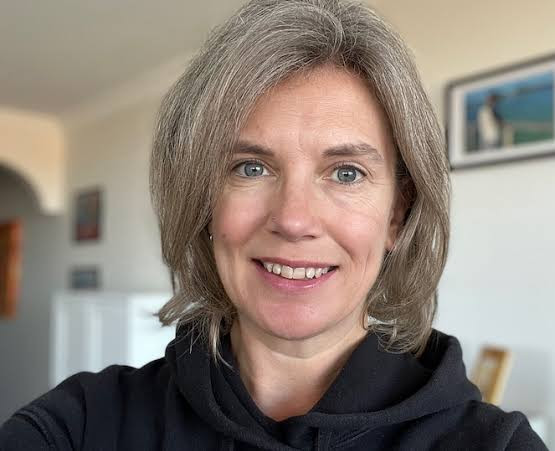
Laura is Professor of International Relations in the School of Social and Political Sciences at the University of Sydney, and served as President of the International Studies Association from 2023-2024. She is a former Australian Research Council Future Fellow (2018-2022), and has been a Visiting Senior Fellow at the LSE Centre for Women, Peace and Security in London, UK, since 2016. She is a member of The Disorder of Things authorial collective.

Paul is Reader in International Politics and a Fellow of the Institute for the Humanities and Social Sciences at Queen Mary University of London. He was until this year a Co-Director of the GCRF Gender, Justice and Security Hub, a multinational, interdisciplinary research consortium investigating the politics of gender justice and inclusive peace. A founding editor of this blog, he is our own Pablo K.

Following this opening post, we will share contributions from an august roster of colleagues over the coming days, followed by a response from the authors.


Book cover of Governing the Feminist Peace

In late April 2019, Nadia Murad addressed the United Nations Security Council during its annual open debate on sexual violence in conflict. Murad had gained an international profile as a courageous and articulate survivor of atrocities carried out by Da’esh – the so-called Islamic State – against the Yazidi ethno-religious community in northern Iraq. In her short speech, Murad urged the council to end its reliance on slogans and finally prosecute sexual violence and other grave crimes. Accompanying Murad was her lawyer, Amal Clooney, who challenged the Council to rise to its “Nuremberg moment, its chance to stand on the right side of history” by triggering an International Criminal Court or hybrid court process. The meeting culminated in a new resolution, the ninth in the series of Women, Peace, and Security (WPS) resolutions, consolidating the status of ‘the agenda’ as the most extensive of all the Security Council’s thematic commitments.

Murad’s six-minute speech was but one instance in a still-unfolding mosaic of events and relations, institutions and movements, talk and text, united by reference to conflict-related sexual violence. Similar constellations of actors may be found throughout the WPS agenda, working across boundaries of domestic and international, formal and informal, state and society, military and civil, lay and expert, public and private. Sexual violence is but one – and the most controversial – in a docket of gender issues, encompassing equal rights, the benefits of women’s substantive participation in promoting peace, the contribution of a ‘gender perspective’ to military planning, the urgent need for global disarmament, recognition of gender diversity, changes to humanitarian practice, inclusivity in refugee, disaster and climate change management, and more besides. As well as the national governments that are invariably the target of appeals for resources and action, the WPS circuit runs on an expansive cast of women’s groups, humanitarian agencies, freelance consultants, celebrity activists, academics, private philanthropic foundations, lawyers, investigative journalists, religious authorities, intergovernmental agencies, international courts, treaty bodies, think tanks, and military alliances.

Governing the Feminist Peace is our attempt to come to terms with this dizzying array of issues and agents. WPS is (still) celebrated as a success for feminists in that a coalition of civil society actors managed to get the Security Council to not just acknowledge the gendered quality of war and peace but to pledge – and on some accounts to legislate – for concerted global action towards feminist goals, from demilitarisation to indigenous peace-making. In formal policy terms it is embraced not only by the Security Council but by over a hundred countries, dozens of regional bodies, and, increasingly, a range of sub-national actors. An accompanying cottage industry has sprung up to track the pace of adoption. For all this energy, WPS is also frequently, almost reflexively, announced as partial, faltering, betrayed, coopted, and securitised. In our terms, a wellspring of vitality and a vortex of failure. These aspects of WPS are not mere opposites, with advocates celebrating vitality and cynics documenting failure. The relation is more intricate, with failure as often a spur to greater implementation efforts as a reason to abandon the agenda, and with vitality in the sense of official adoption to some extent dependent on the failure of the more radical versions of the agenda.

Continue reading
Sex, Power & Play at Europe’s Largest Arms Fair

A guest post from N.E.. N.E. is a PhD Candidate in International Relations at the University of Sussex (UK), researching militarism and ecological injustice. She is also an Advisor to Scientists for Global Responsibility, Associated Researcher with the World Peace Foundation and author of the new report Resisting Green Militarism: Building Movements for Peace and Eco-Social Justice


**Disclaimer: none of the people displayed in the photos are present in the text and should not be thought of as complicit with the sexual harassment discussed in the text.

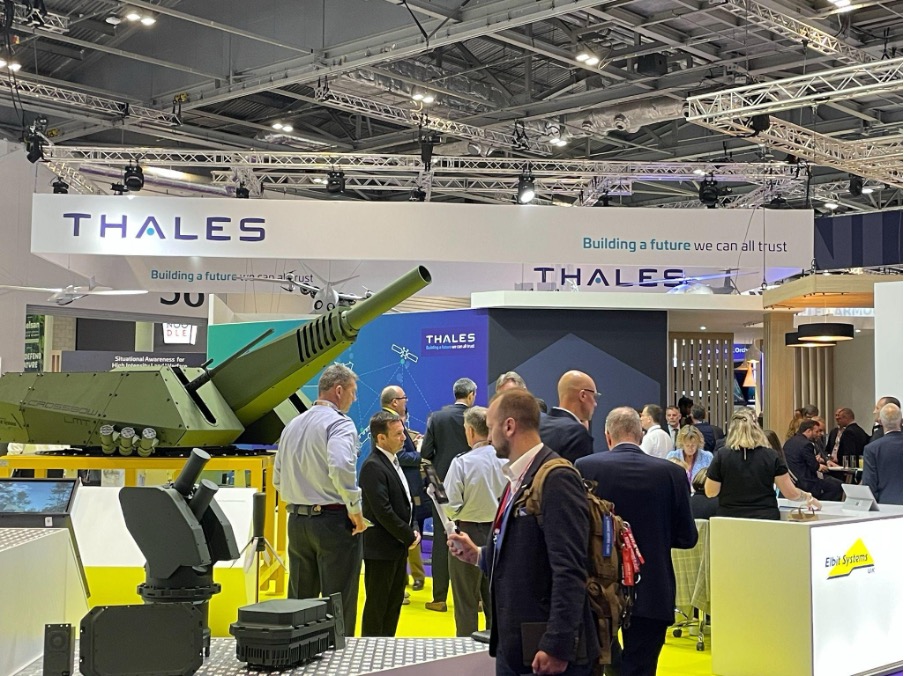
Thales and Elbit Systems, DSEI 2023. Credit: Nico Edwards
Thales and Elbit Systems, DSEI 2023. Credit: N.E.

Global headlines are once again seized by the outbreak of armed conflict, detailing indescribable suffering and destruction. War, it feels, is everywhere and always. To some, this means business. Many of the facilitators and profiteers of armed conflict globally attended the Defence and Security Equipment International (DSEI) in London, September 2023.

What follows is a personal story, but what it tells us about enduring systems of power and harm goes far beyond my person. That weathered feminist truth that the personal is always also political rings true still. What I experienced in the world of “defence men” – the global war elite – attending DSEI as a white woman, was highly demonstrative of the social, political and economic forces that enable and perpetuate armed violence. The personal behaviours of militarised business masculinities hold clues as to why decisionmakers keep hurtling toward global war at the expense of both people and the planet.

Setting the Scene: A Playground for Phallic Force 

Happening in London biannually, DSEI is one of the world’s biggest and most important arms fairs. I went there to research military sectors’ pivot toward environmental sustainability and how to “green” warfare – a key emerging feature especially of European and North American propaganda. The event oozed of hubris. Rob, an American war simulations expert and my main interlocutor, confirmed he’d never seen such a galore of impressive weapons tech exhibitions. Indeed, several arms company reps told me affirmingly: business is booming. Spread across 100,000 sqm. Rob and I were among almost 40,000 participants from all over the world. Including the usual array of repressive, human rights abusing regimes or states involved in active warfare.

You don’t have to be a polemicist to catch how DSEI is but one big bonding ritual for predominantly white men in suits enacting their obsession with force. DSEI puts the global war elite’s drastic detachment from the real-world needs of people and planet into sharp relief. Inside the fair, “defence” and “security” materialise as glaring euphemisms for military-industrial might and titillating experiments in how to model the future of warfare in line with Hollywood fantasies of high-tech battles between good and evil. Rather than signal a dedication – however deceptive – to keeping people safe, the event felt like an inferno of white men in suits blatantly driven by that boyish excitement for tech, kinetics, heroism, beauty, sex and money. And yet, there are enough of these men in power across the globe to make it seem as if they are the realists responding to real threats.

Continue reading

Governing Masculinity: A Call for Contributions

A two-day conference to be held at Queen Mary, University of London, 21-22 February 2024

Keynote by Professor Raewyn Connell

Deadline for abstracts: Monday 4 September 2023


Masculinity needs changing. As a manifestation of patriarchy, a predictor of violence, and a straight-jacket of identity, masculinity is widely identified as a culprit and symptom: problematic, traditional, ‘hyper’ and toxic. In response a loose network of feminists and allies, public health professionals, scholar-activists, social workers, civil society groups, international organisations and military and police forces have sought to reform masculinity for the better. Their efforts range from positive fatherhood campaigns to counter-terrorism measures, and from religious role models to queer theory. ‘Masculinity’ as a concept and configuration of practices is at the same time undergoing another round of crisis and change, split along axes of class, nation, racialisation, sexuality, gender identity and culture, torn between projects of restoration and abolition.

This two-day conference will gather academics, practitioners and activists to critically interrogate contemporary masculinity interventions in local, national and transnational layers. What new governance arrangements and sciences of public health are being formed? What power relations are at work, especially across shifting boundaries of global north and south? What is the role of specific political, economic and cultural institutions in propagating new varieties of good masculinity? How are these new masculine subjectivities being produced? And with what effects, whether generative, perilous or ambivalent? We hope that the conference will address these questions in relation to the production and/or policing of masculinity in its many variants, including (but not limited to) its traditional, trans, Black, ally, alt-right, postcolonial, hegemonic, survivor, migrant, postconflict, inclusive, violent, and toxic forms.

We invite contributions in three formats:

  1. Academic papers: Research from any disciplinary perspective on any aspect of masculinity interventions or the broader politics of changing or governing masculinities. Please submit a title and abstract of 200-300 words on the content of your paper. We anticipate that one outcome of the conference will be a journal special issue, with papers presented at the conference making up the majority of content.
  2. Reports from the field: Findings or reflections from practice and activism, addressing organisational models of change, successes or challenges in masculinity interventions, or personal experiences of transformative masculinity work. Please submit abstracts of 200-300 words including details of the intervention practice and experience plus any relevant support documentation (e.g. findings, theory of change, advocacy by your organisation or initiative).
  3. Creative: Media that capture some dimension of transforming masculinity. Please outline the content of the work, its medium (photography, film, poetry, etc.) and any space or technology requirements. Note that we are not able to pay screening or display fees without prior discussion.

The conference will take place at Queen Mary, University of London on Wednesday 21 and Thursday 22 February 2024. We are able to support a small number of international participants with flights, accommodation and visa costs, and to provide accommodation and travel support for a larger number of UK participants. Applicants are asked to indicate if they require flight, accommodation and/or visa support (if from abroad) or travel and/or accommodation support (if within the UK). For UK participants, priority will be given to early career and precariously employed participants.

Please submit abstracts by Monday 4 September 2023 to Paul Kirby (p.kirby@qmul.ac.uk) and/or Chloé Lewis (chloe.lewis@qmul.ac.uk). Inquiries in advance are welcome.

This call is also available as a PDF document.

This conference is an event of the UKRI GCRF Gender, Justice and Security Hub (http://thegenderhub.com / https://twitter.com/TheGenderHub).

The Body Politics of Covid-19

The fifth entry in our coronacrisis series, from Kandida Purnell. Kandida is Assistant Professor of International Relations at Richmond, the American International University in London. Having previously published on the body politics of aspects of the Global War on Terror, war commemoration, and army/artist collaboration, Kandida is currently finalising her monograph Rethinking the Body in Global Politics (Forthcoming 2020, Routledge Interventions). Kandida is also continuing to collaborate with Natasha Danilova and Emma Dolan on the Carnegie-funded ‘War Commemoration, Military Culture, and Identity Politics in Scotland’ project while her solo research into Bringing Bodies Back: Repatriation and War Performance within Forever War is ongoing.


Bodies are contested sites of global politics. Some of you realised this before I did; some of you might want to know more about body politics; and some of you may not be used to thinking about bodies and ‘embodiment’ (that is, the unending and intensely contested process through which bodies come to be) at all. You might also be wondering if and/or how these things (bodies and embodiment) ‘belong’ within the discipline of International Relations (IR).  This post is for you all, and reluctantly yet hopefully ‘uses’ the Covid-19 pandemic and responses to it as a way into and forward for the study of body politics within IR and beyond.

Given the gravity of events unfolding around us and written in haste, this short post is intended as a ‘teach in’ on and introduction to thinking about body politics highlighting and providing some initial analyses of two interrelated, crucial, and particularly disturbing aspects of responses to the Covid-19 pandemic currently playing out. In part 1 I explain and discuss the metaphoricity of the body politic in relation to the ‘British’ response to Covid-19 and in part 2, and again within the UK context (due to my situation and for ‘convenience’ within the scope of this blog post) I discuss the necropolitics of body (un-)counting. This analysis is preceded by the brief contextualisation and situation of my thoughts within existing IR and other literature and the provision of a brief overview of my arguments on body politics to date (feel free to skip this bit and jump straight to the Covid-19 analysis).

 On Bodies, briefly

Bodies are contested sites of global politics. However, for the most part, IR has left the politics out of bodies by denying and/or occluding intensely contested processes of (re)embodiment while preferring to analyse, scrutinise, and politicise, the contest other units arriving with and/or comprised of already made bodies (namely “man, the state, and war”). In my endeavour to ‘rethink the body in global politics’ (this it the title of my first book forthcoming 2020), I have therefore followed some in IR – namely, but not only, Lauren Wilcox (2015) on bodies and violence, Stefanie Fishel (2017) on the body politic, Jessica Auchter (2014) and Tom Gregory (2016) on dead bodies and body counting, and Jenny Edkins on missing bodies (2011) and trauma (2003) – but also many from beyond. These include Achille Mbembe (2003 and 2019) on Necropolitics, Sara Ahmed on emotion bodies, wilfulness, and use (2004, 2014, and 2019), Judith Butler on performativity (1993), precariousness (2004), and vulnerability (2015), Diana Coole (2005) on agency, Jane Bennett (2010) on the vibrancy of matter, and Kathleen Stewart (2007) and Teresa Brennan (2004) on affect.

Through this theory and intensive empirical research (see Purnell 2015, 2018, and forthcoming 2020), I have described bodies as performative, lively, and ontologically insecure – always a process and always in process and explained and underlined the role of emotion/affect in this. However, in my previous studies – into for example the 2013-2015 Guantanamo Bay hunger strike and treatment of suffering and dead American soldiers – I have researched and written about extremely exposed and very obviously contested bodies. However, I have done this as a means to reveal the more subtle ways and logics informing how every body is contested as a site of no ‘less’ amounts of global politics. As a crisis concerning everybody, the Covid-19 pandemic has therefore done a lot of work for me – by revealing the management, manipulation, and pervasive political interventions into the lives/deaths and (re)embodiments of not only ‘extremely’ placed and exposed bodies, but including the ‘everyday’ bodies of you and I. In the following paragraphs, intended to demonstrate the merits of thinking/re-thinking the body in global politics, I provide some initial analyses highlighting particular ways bodies are being (re)produced, (ab)used, and contested through responses to Covid-19 I am currently witnessing in the UK.

Continue reading

Some Thoughts on ‘Toxic Masculinity’

A guest post from four friends of the blog on the topic of (toxic) masculinity. Maria Tanyag is a Lecturer at the Department of International Relations, Coral Bell School of Asia Pacific Affairs, Australian National University. Twitter: @maria_tanyag. Ibrahim Bahati is Mastercard Foundation Graduate scholar at the American University of Beirut, Lebanon. Twitter: @Bahabris. David Duriesmith is Development Fellow at the School of Political Science and International Studies, The University of Queensland. Twitter: @DavidDuriesmith. Marysia Zalewski is Professor of International Relations in the School of Law & Politics at Cardiff University, UK. Twitter: @ProfMarysiaZed. Each shared their thoughts and reflections on two questions – (i) How do you understand the idea of ‘toxic masculinity’? and (ii) What can ‘we’ do about [toxic] masculinity?


How do you understand the idea of ‘toxic masculinity’?

Maria

I have many reservations about the increasing use of ‘toxic masculinity’ (noted in 2018 as the word of the year by Oxford Dictionaries). As a ‘buzzword’ it simply depoliticises wider inequalities and individualises and de-contextualises what specifically constitutes the ‘toxic’ in/with/through masculinit(ies). And for me, it is no coincidence that toxic has attracted wider applications to some of its original uses in relation to health and the environment at precisely a time when we are observing the rise of extremist ideologies, reversals in women’s and human rights, and environmental degradation. If we work with the feminist idea of a ‘continuum of violence’ we might be able to articulate how toxicity occurs on multiple levels or scales, as well as how it has come to represent a multi-dimensional phenomenon. The term toxic might reveal how it is not just individuals that incite a range of bodily harms, but also to gradual depletions in health and the environment. All of these are linked to power structures and embodied in gendered ways.

In my research on women’s bodily autonomy in the Philippines, I find that in social media, concepts such as toxic relationships, toxic politics, toxic workplaces, and even toxic ‘national’ culture (as in ‘toxic Filipino culture’) are increasingly used. I find this notion that there are toxic aspects of culture that can go hand in hand with nationalist sentiments and representations of ‘Pinoy Pride’.[1] I myself have started using ‘toxic’ in making sense of polarised politics in the Philippines under Duterte. Toxic is a very appropriate word to describe how my body reacts to hearing him speak and upon seeing images of him particularly as he interacts with women. Consequently, part of self-care for me has been to ‘detoxify’ or unplug from watching local news from time to time, though I know friends who do the opposite. They ‘rant’ or vent through social media to ‘purge’ the toxins out of their system.

Continue reading

States and Stilettos

The last commentary in our forum on Parashar, Tickner and True (eds.) Revisiting Gendered States: Feminist Imaginings of the State in International Relations from Shine Choi. Shine is Lecturer in Politics and International Relations at Massey University, where her work focuses on North Korea, visuality and aesthetics. She is also an Associate Editor for the International Feminist Journal of Politics and a co-editor of the Creative Interventions in Global Politics book series. Her recent publications include ‘Questioning the International: (Un)making Bosnian and Korean Conflicts, Cinematically’, (with Maria-Adriana Deiana) in Trans-Humanities Journal. The complete set of posts in this series is available here.


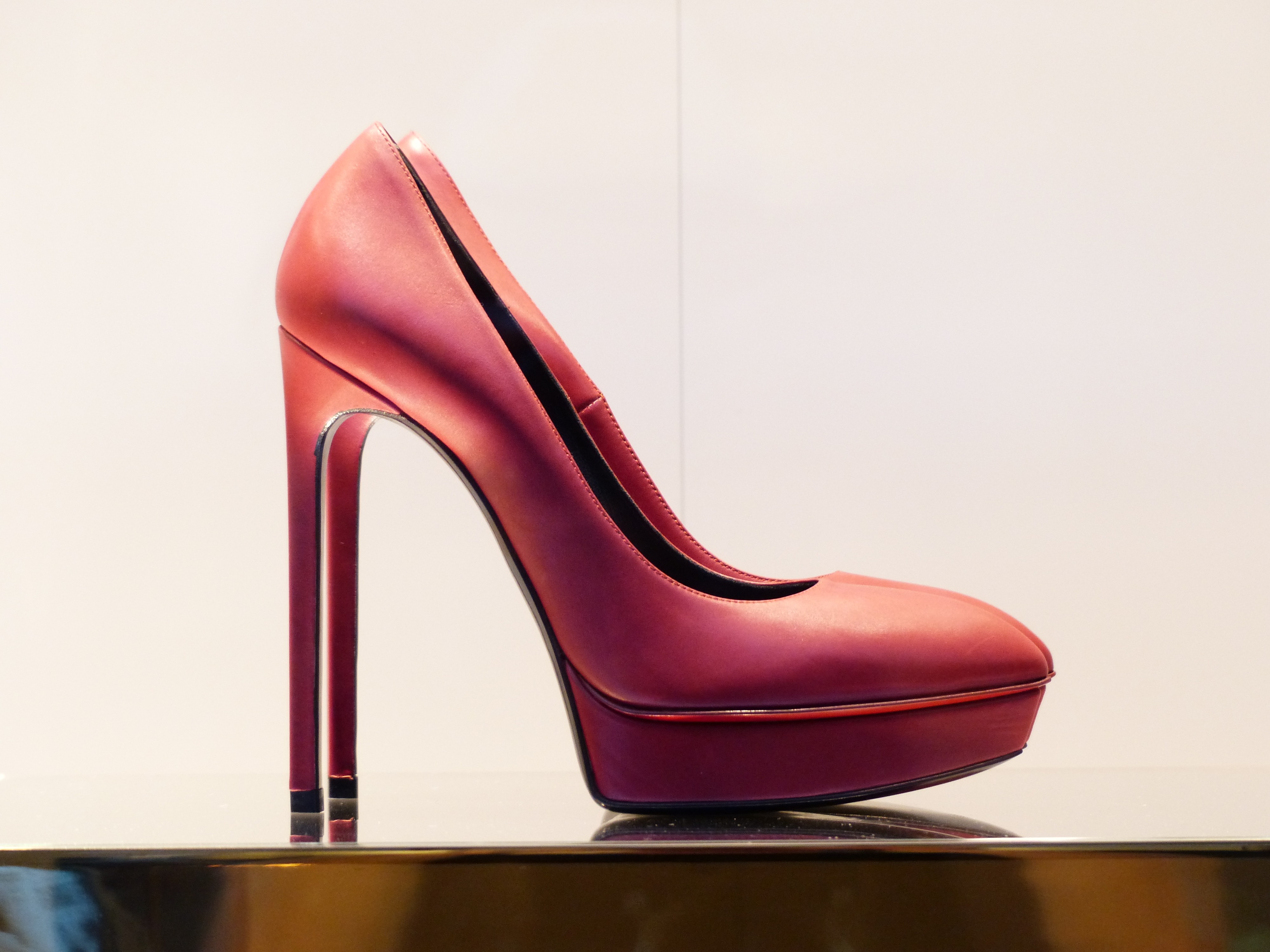
Choi Shoe

In the Afterward essay to Revisiting Gendered States, Christine Sylvester suggests feminists focus on people’s experiences of the state, and as an aside, also asks us to take off our stilettos. Taking the state as an agent or structure in our studies impedes feminist objectives; it is too snug with power even if we critique it. Fashion choice is telling.

This is now the second time, in the last month, that a feminist IR reading has nudged me, as a parenthetical in a larger argument, to reconsider my fashion choice in wearing heels. And now that I think about it, I recall at least two other conversations with academics (one was a fellow IR theory friend, the other a colleague in anthropology who has now retired) where they confide how they would personally never wear heels because their colleagues would never take them seriously if they did. I had assumed their colleagues in reference were men but now I am not so sure.

These shared assumptions about heels – and stilettos perhaps being an extreme, and as a result, an easy type of heels to dismiss – in these conversations/readings are curious. They got me wondering why serious thinking, and more importantly, serious feminist politics cannot be done wearing heels. This is not the lesson we are learning from drag queens about stilettos, and I cannot help but wonder why it takes drag queens to teach us that serious affective embodied thinking and doing do happen in most ridiculous of heels, full makeup and by ‘eccentric’ looking people. Why do we have all these social, cultural gendered ideas around what serious work/wear look like?

Continue reading

Gendered States: What We *Really* Talk About When We Talk About the State

The first of three critical commentaries on Revisiting Gendered States: Feminist Imaginings of the State in International Relations (the full series, including an introduction and posts from chapter authors Christine Agius, David Duriesmith and Katherine Brown, is here). This intervention comes from Megan MacKenzie, who is Professor of Gender and War at the University of Sydney. Megan’s research spans feminist theory, international security and transitional justice, and her latest publications explore (myths about) women in combat roles and masculinity nostalgia.


We talk about the state a lot within the field of International Relations. In fact, as a student of international relations I was taught that the state was the most important actor; everything below the state level was to be studied in other disciplines like sociology, anthropology, or development studies. But what are we really talking about when we talk about the state? It’s probably useful to state upfront- in a sort of full-feminist-disclosure-style- that I’m an unusual person to review a book focused on the state. I’ve always been suspicious and apprehensive about studying the state. I can trace the root of this apprehension back to my PhD training. I can still vividly remember taking an International Political Economy course from the formidable and amazing Professor Suzanne Soederberg. At some point during the first week I made an intervention into the class discussion, and used the word ‘state.’ Professor Soederberg stopped me and said, ‘what do you mean by the state?’ I was flummoxed. ‘Well, the state…you know…um, the institution…’ I’m sure I trailed off in embarrassment. Professor Soederberg then asked the rest of the class for a definition and got equally vague, yet more confident responses that included terms like ‘sovereignty,’ ‘borders,’ and ‘power.’ I can still remember her total exasperation as she drew a black box on the white board and explained that the state is not some singular “thing” that we can just lazily refer to and hope no one asks us what we mean. We were all busted.

Actually, most of IR as a discipline is busted when it comes to lazily using the term ‘state.’ From that moment on, there have been dozens of times I wished I had Professor Soederberg’s words recorded so I could play them at conferences, in other classes, and when reading articles. The state is consistently referred to as a given, or defined with such minimal attention or effort that it offers not much more than my answer back in my International Political Economy unit: ‘well, the state…you know.’ Years later, I still don’t know how most people are using the term ‘the state’ and often I don’t think they do either.

Rather than wade through the many, many definitions of the state, it is more useful to ask, ‘what do we talk about when we talk about the state?’

Continue reading

Promoting Ally Politics in the Liberal State during the Age of Paleo-Masculinism

The third in our series on Revisiting Gendered States: Feminist Imaginings of the State in International Relations (edited by Swati Parashar, J. Ann Tickner and Jacqui True). In this first set of posts, contributors to the volume recap their contributions. Today, it is the turn of David Duriesmith. David is a UQ Fellow at the University of Queensland, where his research focuses on masculinities, peacebuilding and new wars. His latest article is ‘Hybrid Warriors and the Formation of New War Masculinities: A Case Study of Indonesian Foreign Fighters’, in Stability. The full series on Revisiting Gendered States may be viewed here.


Feminist activism often appears to bump up against the desire to appeal powerful masculine actors to use their privilege for good. These appeals are unavoidable for those who want to achieve concrete and immediate change due to the power that patriarchy affords masculine actors on the basis of gender. The success of these appeals in the international arena create uncomfortable alliances between feminist activists on one hand and state actors on the other, the latter of whom are increasingly keen to position themselves as feminists on the international stage.

My contribution to Revisiting Gendered States came out of my discomfort at some of the successes in getting state actors to adopt the language of feminism and gender equality. In particular, I was provoked by the emergence of Sweden’s feminist foreign policy and the rise of state leaders positioning themselves as feminist ‘agents of change’ through initiatives like #HeForShe.

These developments seem seductive, in that they utilise state power for feminist goals, while reinforcing the legitimacy of these state actors as protectors of the oppressed. However, the adoption of the label ‘feminist’ does not require that states are substantially remade, nor that they change the masculinist nature of their institutions, but instead seems to occasionally result in the cynical use of gender programming to legitimise other forms of violence that they themselves inflict. Continue reading

Right-Wing Populism, Anti-Genderism, And Real US Americans In The Age Of Trump

This is a guest post from Cynthia Weber, who is a Professor of International Relations at the University of Sussex. Cindy is the author, most recently, of Queer International Relations: Sovereignty, Sexuality and the Will to Power which was the subject of a symposium hosted by The Disorder of Things. 

The US satirical website The Onion recently ran a fake testimonial video featuring a remorseful Donald Trump supporter. The 2-minute clip is entitled ‘Trump Voter Feels Betrayed By President After Reading 800 Pages of Queer Feminist Theory’. The video features the character ‘Mike Bridger, Former Trump Supporter’, a middle-aged, working class, cishet white male from a small steel town in Pennsylvania. The balding Mike is shot in documentary talking-head style. Mike sits facing the camera, both so that his truthfulness can be evaluated by viewers and so that what US Americans will recognize as his iconic working-class garb is fully in view – dark tan zip-up jacket, olive-green button-down shirt open at the collar, white t-shirt visible underneath. Accompanied by slow music which sets a troubled, post-catastrophe tone, Mike tells his story.

‘I voted for Donald Trump,’ Mike tells us. ‘I voted for Trump because I thought he’d create a better America for everyone. But after reading 800 or so pages on queer feminist theory, I realize now just how much I’ve been duped.’

Continue reading

‘You are fired!’ Towards the Hegemony of Neoliberal Hypermasculinity

This is the final post in a series of posts by several guest authors  for The Disorder Of Things symposium on Ali Bilgic‘s new book Turkey, Power and the West: Gendered International Relations and Foreign Policy, released in late 2016. In this post, Ali Bilgic responds to the previously published posts and makes some concluding remarks. The full series is collected here.


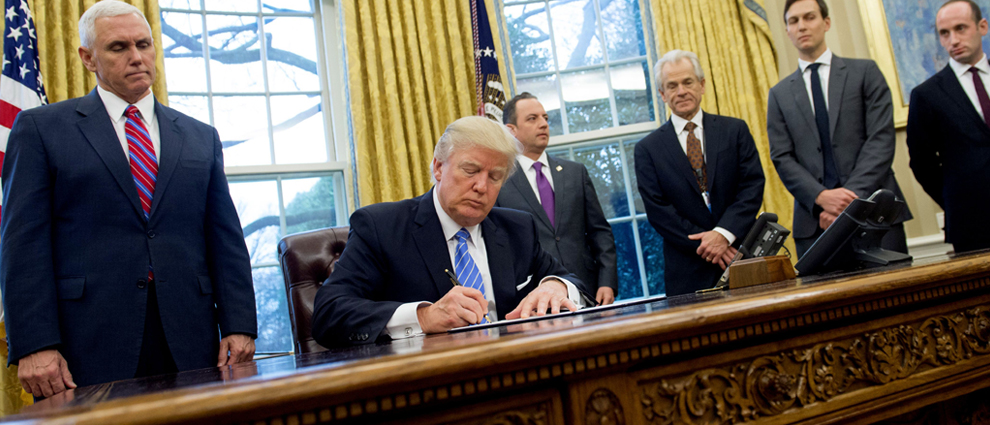
He is signing a document. Men standing behind him are all serious, looking over the shoulder of the one who he is performing the ceremony, a TV show par excellence. One of them passes the black folders; one after another, one signature after another. When he signs, his eyebrows rise a little, probably to see better. In this moment, it is possible to notice the blankness in his eyes that complements the expressionless face of the new Commander-in-Chief: there is no sign of affect in them, a staunch wall, like the one to be built on the border with Mexico, or the one in Palestine/Israel.

US President Donald Trump signs an executive order in the Oval Office of the White House in Washington, DC, January 23, 2017.
Trump on Monday signed three orders on withdrawing the US from the Trans-Pacific Partnership trade deal, freezing the hiring of federal workers and hitting foreign NGOs that help with abortion. / AFP / SAUL LOEB (Photo credit should read SAUL LOEB/AFP/Getty Images)

One expects he would abruptly say ‘You are fired’; one wonders whether he has learned and practised this masculine emotionless performance during his years in the world of entertainment: in a reality show where young men and women wildly competed against each other to prove themselves to the neoliberal finance capitalism. Otherwise, they are fired, they vanish, do not exist anymore, neither for the audience nor for the market. This kind of decision requires rational thinking; in other words, a solid emptiness, a wall.

Continue reading