Trump’s new empire: Thoughts on American imperialism in the age of Trump. A sneak peek from Israel/Palestine

A guest post by Hagar Kotef and Merav Amir. Hagar Kotef is a Senior Lecturer of Political Theory and Comparative Political Thought at the Department of Politics and International Relations, SOAS, The University of London. She is the author of Movement and the Ordering of Freedom (Duke University Press, 2015). Dr Merav Amir is a Lecturer (Assistant Professor) of Human Geography at the School of Natural and Built Environment, Queen’s University Belfast. Her recent publication is titled “Revisiting Politicide: State Annihilation in Israel/Palestine”, and is due to be published in Territory, Politics, Governance.

In trying to understand the horror that unfolds post Trump election, two main threads seem to dominate left discourse and blogosphere. The first rightly focuses on the horror itself, on the unprecedented coup-d′état unfolding before our eyes, on the attacks on the constitution, on fascism or other forms of totalitarianism or authoritarianism, and on brute institutionalized racism of a regime that does not even seek to pretend it adheres to the rule of law and good governance.

Credit: GPO

Credit: GPO

All this is true, and yet this narration often fails to account for three main facts. (i) Such brutal constitutional changes and violent re-demarcations of the contours of the polity are hardly unheard-of, both historically, and at this very political moment in many places across the globe. Portraying this horror as unprecedented and unique, indeed as an unbelievable horror, is a form of American exceptionalism that plays into the normalization of violence in regions that are not considered part of the ‘West’. (ii) Many of these violent regime-changes across the globe have been occurring with at least the passive, if not the very active, involvement of consecutive US administrations. Finally, (iii) such modes of foreign “interventions” (we might want to call them wars or imperialism—“neo” or just that, “imperialism”) are often what allowed the Western metropoles of the American empire to remain largely peaceful and relatively prosperous. That is, it is by externalizing its violence that the US could be “exceptional” in the meaning suggested in (i). We should therefore be careful in reproducing a pattern in which “the real crime”, as Arendt put it in regard to a previous age of totalitarianism, was when totalitarian violence moved out of Africa (at first to Asia and then to Europe) “since here [unlike in the case of “African savages who had frightened Europeans literally out of their wit”] everyone ought to have known what they were doing.”[1]

Continue reading

Societies Under Siege: A Reply

I am extremely grateful to Elin, Clara and Katie for writing such thoughtful and  thought-provoking engagements with Societies Under Siege, and to Joe Hoover for kindly organising this forum. It is not easy to set aside the time during a busy teaching term. Here is my reply!

Continue reading

Between Truth-Telling and Doom-Saying: Sanctions and Activism

933This is the fourth in a series of posts on Lee Jones’ Societies Under Siege: Exploring How International Economic Sanctions (Do Not) Work. We are delighted to welcome Dr Katie Attwell, she is the Capstone Co-ordinator at Sir Walter Murdoch School of Public Policy and International Affairs, Murdoch University. Her book, Jewish-Israeli National Identity and Dissidence: The Contradictions of Zionism and Resistance, considers the contradictions faced by left-wing Israeli Jews trying to connect with their Palestinian Other. Ethnicity, nationalism and identity politics remain her fundamental academic interest, but she now focuses on health policy, pursuing research into how to engage with vaccine-hesitant parents. Lee’s original post can be found here. With responses from Dr Elin Hellquist here, and Dr Clara Portela here.


I became familiar with the project that would become Societies Under Siege in 2013. A mutual friend shared a conference paper by Lee Jones, reflecting on the Boycott, Divestment and Sanctions (BDS) campaign called for by Palestinian nationalist activists, and eagerly adopted by their international counterparts. I was one such international enthusiast, in addition to being a political scientist researching how progressive Israeli Jews were attempting to reform their society from the inside. My work took a different approach to Lee’s, looking at how discourses of identity, nationalism and ethnicity constrain notions of what is morally and politically possible. I never saw much crossover between our approaches, though some of my subjects were BDS advocates. I suppose my work could contribute to an understanding of the kind of impact that sanctions might have (or not) on a fraction of the target society.

I was far more captivated by what Lee’s early conference paper meant for activism. Outside of academia, I wanted to talk about Palestine with anyone who’d listen, and I had been inspired to join a tiny collective of mostly radical leftists in my home city of Perth, Western Australia. Working within this collective, I believed that the first step to changing minds was education and awareness, and soon BDS became the catchphrase by which we’d do this. Or so we thought.

By the time I read Lee’s paper – soon to be a chapter in Sanctioning Apartheid: Comparing the South African and Palestinian BDS Campaigns, edited by David Feldman and out next year with Palgrave Macmillan – I had dropped out of activism for Palestine somewhat, primarily due to life (a young family and a PhD) getting in the way. But the fire still burned within. I read Lee’s contribution with eagerness and interest. It elicited in me the same sentiments that followed my consumption of Societies Under Siege: enlightenment and admiration, combined with frustration. Thanks to this work, I understand the world in ways that I did not before – which has to turn on any academic who genuinely enjoys engaging with inquiry, wherever it may lead. However, thanks to that new understanding, I also understand – to quote another colleague’s rather jaded perspective on Social Conflict Analysis – that everything is f$*#ed. This is somewhat less a cause for celebration. Continue reading

Mind the Gap: Evaluating the Success of Sanctions

This is the third in a series of posts on Lee Jones’ Societies Under Siege: Exploring How International Economic Sanctions (Do Not) Work. We are delighted to welcome Dr Clara Portela,  she is Assistant Professor of Political Science at Singapore Management University. She is the author of the monograph European Union Sanctions and Foreign Policy, for which she received the 2011 THESEUS Award for Promising Research on European Integration. She recently participated in the High Level Review of United Nations sanctions, in the EUISS Task Force on Targeted Sanctions and has consulted for the European Parliament on several occasions.
A further response will follow from  Katie Attwell, followed by a response from Lee. You can find Lee’s original post here and Elin Hellquist’s here.


The volume undoubtedly makes a key contribution to the field – indeed, one that was sorely needed: an evaluation of how sanctions interact with the economic and political dynamics in the target society, and more specifically, how they affect domestic power relations. This agenda is not entirely new in sanctions scholarship. It had been wisely identified by Jonathan Kirshner in a famous article as far back as in 1997. However, having pointed to the need to ascertain how sanctions affect the internal balance of power between ruling elites and political opposition, and the incentives and disincentives they faced, this analytical challenge had not been taken up by himself or any other scholar so far. The book also contributes to a highly promising if still embryonic literature: that of coping strategies by the targets, briefly explored in works by Hurd or Adler-Nissen.

Departing from the idea that whether sanctions can work can only be determined by close study of the target society and estimating the economic damage required to shift conflict dynamics in a progressive direction, the study proposes a novel analytical framework: Social Conflict Analysis. The volume concludes that socio-political dynamics in the target society overwhelmingly determine the outcomes of sanctions episodes: “Where a society has multiple clusters of authority, resources, and power rather than a single group enjoying a monopoly, and where key groups enjoy relative autonomy from state power and the capacity for collective action, sanctions may stand some chance of changing domestic political trajectories. In the absence of these conditions, their leverage will be extremely limited” (p.182).

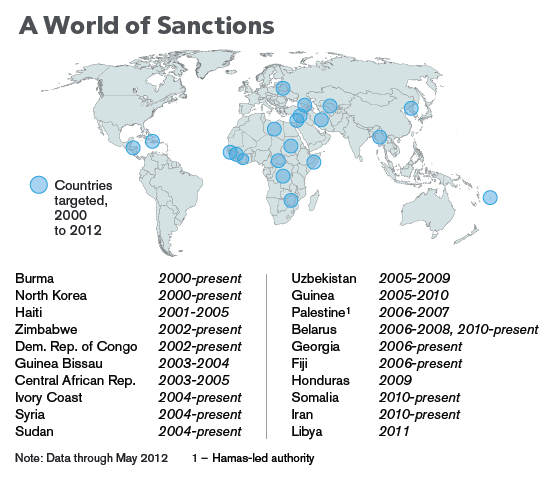
World of Sanctions

Source: Peterson Institute for International Economics

Continue reading

Ethics in the Service of Violence in Israel/Palestine

A guest post from James Eastwood. James is a PhD candidate at the School of Oriental and African Studies (SOAS). This post is partly based on his latest article, ‘”Meaningful Service”: Pedagogy at Israeli Pre-Military Academies and the Ethics of Militarism’, forthcoming in the European Journal of International Relations.


Die you fuck, die you son of a whore, die, die, die you son of 66 whores.

These are the words that Ahmad Salih Manasra, a 13-year-old Palestinian boy, heard as he lay bleeding in the street on 12th October 2015. The insults were yelled by an Israeli passer-by, who recorded the child on video as he lay helpless on the ground. Ahmad was taken to hospital in a critical condition. His cousin Hasan Khalid, who was shot at the same time, is dead.

Israeli police later released a video depicting the alleged chain of events leading up to these incidents. It shows two young boys carrying knives attempting to attack a passer-by, followed by an alleged stabbing which takes place off-camera. In the ensuing pursuit, the elder of the two boys – Hasan – appears to run at the police with a knife. They shoot him dead, without attempting to immobilise him. According to Israeli media, Ahmad was hit by a car as he ran away. But the video circulated on social media shows him lying some distance from the road on a tramline. Palestinian news sources, which had originally claimed that Ahmad was shot dead, now suggest that he was run down by an Israeli patrol car and then beaten.

The graphic video of Ahmad Manasra is only the most shocking to emerge from a series of shootings of Palestinians by Israeli police and soldiers as they scramble to respond to a spate of un-coordinated knife-attacks. 50 Palestinians have been shot dead since the beginning of October, with hundreds more injured. Meanwhile, 9 Israelis have been killed in stabbing and traffic ramming incidents, with dozens more wounded. Last Tuesday witnessed the most serious escalation of the attacks, with separate incidents occurring almost simultaneously across Israel and the occupied territories. Protests have erupted in the West Bank and Gaza, while Israeli authorities have ramped up police and military presences and have introduced checkpoints and barriers around Palestinian neighbourhoods in East Jerusalem.

The wave of public panic over the stabbings has re-ignited a longrunning controversy in Israel over the rules of engagement for police officers and soldiers dealing with suspects, wanted assailants, and protestors.

Continue reading