The Anglosphere, Part One: What’s in a Name?

What do you get when you intersect indices that rank top two dozen nations of the world by political freedoms, GDP per capita, productivity, literacy, and patent applications in late 2000s? The answer is you get some kind of an “Anglosphere” – usually the quartet of Australia, Canada, the UK, and the U.S., but also, depending on the underlying measures and thresholds, New Zealand, Ireland, Singapore and so on.

Using data from the World Development Indicators, The Economist Intelligence Unit, and International Labour Organisation, among others sources, I’ve played this game in my research methods classes quite a bit. No methods textbook endorses such mindless empiricism, but students, from what I can tell, tend to appreciate the loose structure of the exercise. This is because the objective – familiarizing students with comparison, measurement, scaling, and so on – almost always shifts onto the “why?” questions, at which point everyone (ok, not everyone) tries to come up with his/her social scientific narrative on what makes this or that grouping “interesting,” “different,” or “special.”

Joel Kotkin, one of America’s premier demographers, and his nine collaborators have shown me how this game can be played at an infinitely more sophisticated level. Their argument – developed primarily in a collection of the Legatum Institute papers entitled “The New World Order”, but also in two shorter pieces penned by Kotkin and Shashi Parulekar at NewGeography.com and in City Journal – is that globalized economy by and large operates in and through three large “tribal groupings” or “spheres”: the Indosphere, the Sinosphere, and the Anglosphere [1]. As the authors note, their narrative can claim a formidable intellectual pedigree: “we have followed the great Arab historian Ibn Khaldun’s notion that ethnic and cultural ties are more important than geographic patterns or levels of economic development.”

Kotkin et al offer no shortage of interesting and novel observations and analytical points, but one of the project’s key punchlines is in the title of the Anglosphere section in the New World Order: “We are not dead yet.” The project’s foil, in other words, is the current wave of American declinism:

The era of unipolar domination by the United States and its key allies — which dates from the fall of the Soviet Union — has come to an end. Yet despite this, the core Anglosphere remains by far the largest cohesive economic bloc in the world. Overall it accounts for more than 18 trillion dollars, one quarter of the world’s GDP, far more than any other cohesive global grouping.
Continue reading

Mapping the (In)Visibility of Gender in Politics and International Relations

Do elite institutions teach the global politics of gender and sexuality on any scale or in any depth? Emma Foster, Peter Kerr, Anthony Hopkins, Christopher Byrne and Linda Åhäll (all of Birmingham, at least when they did the research) have an Early View piece up at The British Journal of Politics and International Relations addressing just this question. Surveying the course content of the 16 top Politics and IR Departments in the UK (‘top’ meaning either in the top 10 in student satisfaction scores or in REF scores), they give some empirical confirmation of what many of us might have known anecdotally:

Our findings…show, in our view quite strikingly, that few political science and international relations departments offer extensive or in-depth coverage of gender and sexuality issues. As a result, many political science and international relations undergraduates merely experience a brief introduction to ‘feminism’ as their only encounter with key debates over gender inequalities and sexual identity.

Of 629 modules in IR and Politics identified across those Departments, only 9 existing full modules related to gender or sexuality (increasing to 12 if Aberystwyth’s ‘forthcoming’ courses are included). That’s 1.4%. Only an estimated 8.9% of all surveyed modules offer at least one week on feminism/gender as part of their wider sweep. The study also shows up some noteworthy cases where there is Departmental expertise but no teaching provision. Warwick and Oxford both have seven staff listing gender/feminism as a core research interest, but Warwick hosts only one gender-related module and Oxford none. Although the paper does not pursue this in great detail, the suggestion is that the relative paucity of courses is not a result of absent expertise, since the progress of feminist and gender studies has been sufficient that all Departments surveyed (with the exception of de Montfort) have staff members with a gender interest. Indeed, on the average of these 16 elite institutions, there are some 3.9 gender specialists in each one (although numbers are always, of course, shifting).

The overall picture, then, is of some progress (perhaps surprisingly limited) in getting gender (but not sexuality) included as the spectral “week on feminism”, presumably primarily in theoretical survey modules. But this vague and introductory inclusion is not supported by more concentrated work either theoretically (as in a module on different perspectives on gender) or empirically (as in an issue-by-issue survey of gender in global politics). Although Foster et al. do not map changes in Faculty composition, this appears to be happening at the same time as gender and feminist academics are increasing in strength within IR.

As is to be expected, this leaves a number of issues unaddressed. Continue reading

What We Talked About At ISA: Researching Sexuality in ‘Difficult’ Contexts

In September 2009, Ugandan Parliamentarian David Bahati introduced a draft ‘Anti Homosexuality Bill’ that proposed enhancing existing punishments for homosexual conduct in the Ugandan Penal Code, introducing new ‘related offences’ including ‘aiding and abetting’ homosexuality, ‘conspiracy to engage’ in homosexuality, the ‘promotion of homosexuality’, or ‘failure to disclose the offence’ of homosexuality to authorities within 24 hours, and mandating the death penalty for a select class of offences categorized as ‘aggravated homosexuality’. The bill remained bottled up in parliamentary committees for the duration of the 8th Parliament, thanks in large part to a sophisticated local campaign that sought to bring international pressure to bear on the government of President Yoweri Museveni, but has since been reintroduced in the current 9th Parliament and therefore remains a live concern. In August 2010, I travelled to Uganda to interview a range of actors associated with ongoing debates over sexuality in the country. Rather than commenting on the urgent and pressing substantive concerns at issue in these debates, at an ISA panel entitled ‘Researching sexuality in difficult contexts’, I chose to reflect on some of the methodological dilemmas I encountered in the field, for which my training in international relations had left me unprepared. Emboldened by recent ISA panels on storytelling and auto-ethnography (and utterly bored by what passes for mainstream IR), these reflections take the form of excerpts from my diary (italicized), interspersed with the more censorious, academic voice that I trotted out at ISA. (I make no apology for not writing about the more ‘serious’ issues at stake—on this occasion—because it occurs to me that where sexuality is concerned, the pursuit of fun can raise deadly serious questions, making distinctions between the trivial and the serious difficult to sustain.)

Uganda, August 2010: I am here to do interviews and I spend most of my day setting them up, preparing for them, travelling to or from them, or conducting them. The rest of the time I hang out, people watch, trying to piece together a picture of how life outside heteronormativity survives in a climate that seems—on the surface at least—as inhospitable as Uganda is supposed to be. On Friday, Al (name changed, and this account provided with permission) invited me to a strip-tease. This was going to be a straight strip-tease, but one that some of the gay men went to so that they could watch the straight men getting off on watching the women strip. It sounded convoluted, but unmissable. Plus, I’d never been to a straight strip-tease, so it seemed important to plug this gaping orifice in my sexual history. We entered a dimly lit hall and took seats at the back in a group near the bar. I think I was the only brown man there. There was also one white man in the whole place, in our group. He had evidently been to the place before, and because he came with the same motivations as Al, he had been traumatized on a previous occasion by the way the women flocked to him (money?). So Al was instructed to tell the emcee (a short guy dressed in a white track suit) to make sure that the women didn’t come to our corner. The real attraction, from the point of view of the gay guys, was that the women sometimes got the straight guys to get on stage and strip. Al told the emcee to do his best to encourage this possibility. Call it Straight Guy for the Queer Eye. I was impressed by the brazenness with which Al communicated all this to the emcee. As for the show, let’s just say it took the ‘tease’ out of strip-tease. The first woman (girl? all the performers looked like they were in their 30s, but they could have been younger and prematurely aged by their work) danced to some vaguely familiar Western pop number. She was followed by another woman with bigger hips. Somebody in the group, setting himself up as my informant, tells me that she is ‘a real African woman’. She danced to Shania Twain’s ‘From this Moment On’ (a song I played to my last (and final, I think) girlfriend on the first day I met her, after a year-long correspondence). Just when Shania reached the second verse, the woman dropped her panties. None of the performers took off their bras. ‘African men aren’t interested in breasts’, my self-appointed informant intones. The next half-hour is a blur of female anatomy. So here I am, in a country that people have been calling ‘conservative’ and that American evangelist Rick Warren has decided is ripe for transformation into the world’s first ‘purpose driven’ nation, looking at more naked women in ten minutes than I have seen in ten years, to the soundtrack of my failed romantic history.

Continue reading

What We Talked About At ISA: The U.S. Military-Industrial Complex, Part 2

Part two of a post on my presentation at this year’s ISA. Part one is here.


So what would be the normative-political case for the Military-Industrial Complex (MIC)? As Ledbetter notes, the defence industry never had a shortage of defenders, proponents, beneficiaries, and apologists. Various critiques of the MIC notwithstanding, numerous American commentators are now firmly united in the belief that their country needs a large defence budget in order to protect and project its identities and interests in the world. According to Maddow, this collective belief had a lot to do with the discursive and institutional success of the infamous “Team B” reports on Soviet power, which so profoundly enthused Ronald Reagan and his administration, leading to the gigantic military buildup in the 1980s. Maddow’s assessment is worth citing at length:

The Think Tanks and Very Important Committees of the permanent national security peanut gallery are now so mature and entrenched that almost no one thinks they’re creepy anymore, and national security liberals have simply decided it’s best to add their own voices to them rather than criticize them. But like we lefties learned in trying (and failing) to add a liberal network to the all-right-wing, decades-old medium of political talk radio, the permanent defense gadfly world can’t really grow a liberal wing. It’s an inherently hawkish enterprise. Where’s the inherent urgency in arguing that the threats aren’t as bad as the hype, that military power is being overused, that the defense budget could be safely and wisely scaled back, that maybe this next war doesn’t need us? The only audience for defense wonkery is defense enthusiasts, and they’re not paying the price of admission to hear that defense is overrated.

But knotted into the right-wing discourse on defence spending is a number of corollary arguments that are associated with a variety of lefty positions in the U.S. context.  America’s mainstream media outlets rarely fail to acknowledge how the twinning of the country’s economic and armed forces not only creates high-skilled jobs, but also – and critically – keeps them in the country. The move is mainly rhetorical. Not only have successive U.S. administrations encouraged American defence industry to globalize, but there is also little evidence to suggest that defence spending creates more jobs relative to spending on, say, health care or education (see, for example, Pollin and Garrett-Peltier, 2011). I would suggest, then, that what lies behind contemporary pro-MIC arguments is, in fact, a creative and complex combination of certain economic theories, (realist?) beliefs in war (or the threat of war) as a manifest destiny of the international system, as well as an overarching (liberal?) commitment to a powerful, sovereign state capable of exercising global leadership (aka., a “force for good”, in still favoured New Labour parlance.)

Let us revisit the pro-MIC rhetoric from the era of “Team B.” In a footnote, Ledbetter directs the reader to The Lonely Warriors (1970) by John Stanley Baumgartner, who is described as “one notable true defender of the MIC.” Written by an expert in public management and business administration, Baumgartner’s book makes three arguments for the MIC: 1) defending the free world is a moral thing to do (“Sputnik is only one example of the reasons for MIC”); 2) by definition, defence is a big enterprise and all big enterprises (directly or indirectly, the MIC employs one in ten Americans) occasionally make big mistakes, especially when they respond to the murky and changing specifications set by the government (“the tiger” or “the monster”) and its contracting officers; and last, 3) “unconscionable profit” is not so unconscionable in comparative terms (profit on sales, profit on investment, price/earning ratios etc. tend to be below the industrial average).

Continue reading

What We Talked About At ISA: From #occupyirtheory to #OpenIR?

A write up of my comments at the #occupyirtheory event in San Diego. The event itself was both hope-filled and occasionally frustrating, not least for the small group of walk-outs, apparently ‘political’ ‘scientists’ lacking in any conception of what it actually means to engage in the political (note: this bothered me especially, but was a rather minor irritation in the grander scheme of things). Despite the late hour, there were between 40 and 60 people there throughout, and a number of very positive things have come of it. It looks like there’ll be some gathering at BISA/ISA to discuss further, and we’re pitching something for the Millennium conference on some of the themes addressed below, and there will of course be ISA 2013 too. In the meantime, there’s the Facebook group, the blog, and a mailing list. The term OpenIR is owed to Kathryn Fisher, and seems to several of us to be a better umbrella term for the many things we want to address in the discipline and the academy. I also just want to give a public shout-out to Nick, Wanda, Robbie and Meera for doing so much on this.


The #occupy practice/meme has antecedents. Physical manifestations of a ‘public’, horizontalism, prefigurative politics and more can be traced in all sorts of histories. One such lineage is the foreshadowing of Zucotti Park in recent struggles over education. Take the slogan in March 2010 over privatisation at the University of California, which was ‘STRIKE / OCCUPY / TAKEOVER’. Or Middlesex, where students resisting the dismantling of the Philosophy Department in that same year unfurled a banner during their occupation, one that proclaimed: ‘THE UNIVERSITY IS A FACTORY! STRIKE! OCCUPY!’.

I want briefly, then, to think about the space of the university in our discussions of #occupy. There have been rich and suggestive calls to re-politicise ourselves as academic-activists, to look again at our work and its claims, and to turn our abilities, such as they are, to projects of resistance and transformation. But we risk a displacement. When we talk of ‘the street’, or politics enacted in the reconfigured space of #occupy, or of the ‘real world’ that we must be relevant to, we already miss the university itself as that factory in which we labour. We are tempted by a view of ourselves as leaving ivory towers to do politics, instead of seeing those towers themselves as spaces of politics. As if our institutions and practices were not already part of the world.

Whether you see #occupy as transformational or nor, or whether you simply prefer a different vocabulary, I think a demand remains: a demand to politicise our own positionality. This politicisation can have many dimensions, but I want to suggestively highlight four, each being a sphere in which we should be diagnosing and transforming our own practices.

Continue reading

#occupyirtheory, International Studies Association (San Diego) Edition

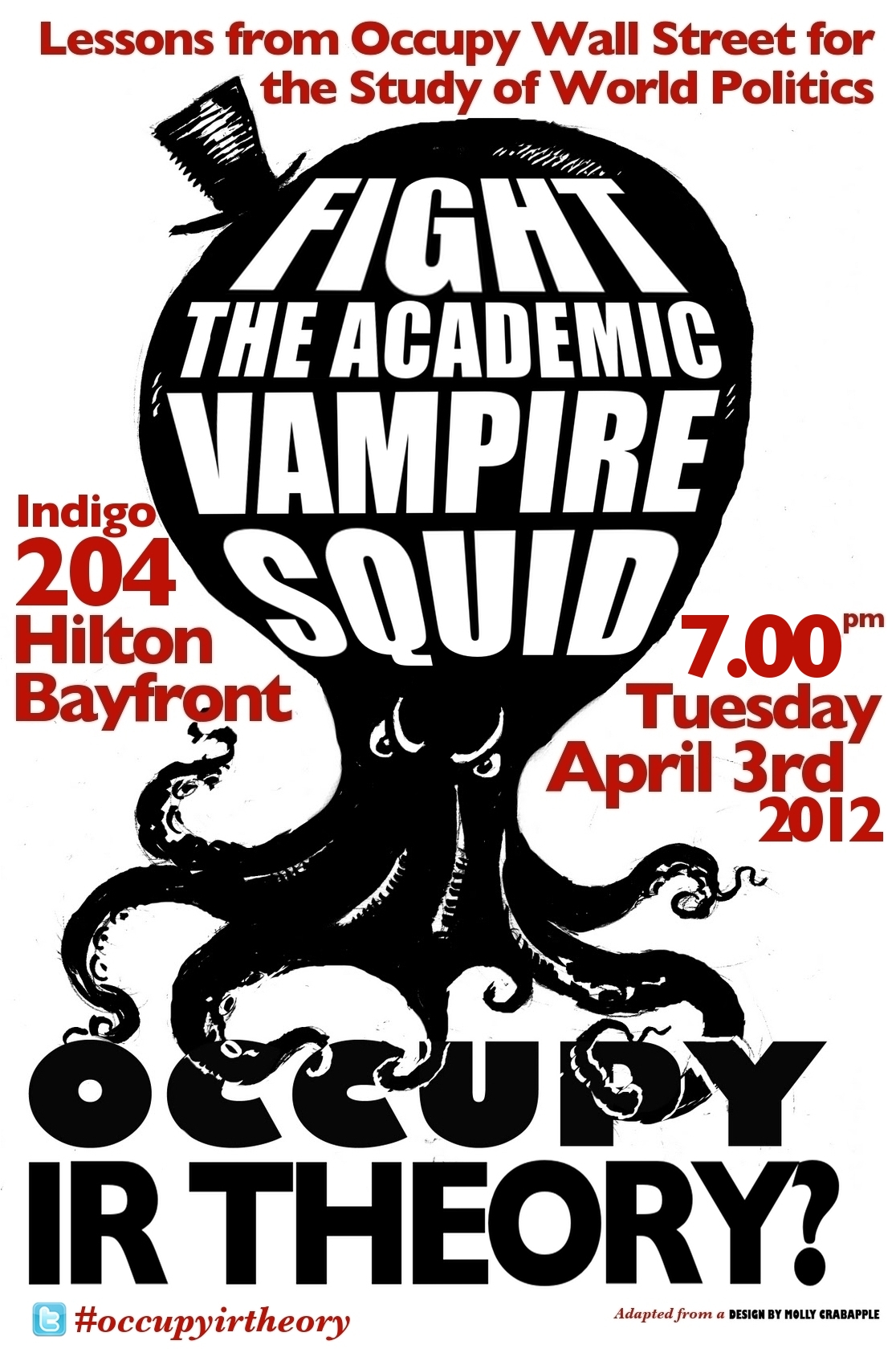
ISA 2012 is just around the corner, and it will doubtless be as hectic and awkward and joyous as ever. Robbie and I will be appearing at an event on #occupy and its relevance for IR on Tuesday at 7 in Indigo 204 at the Hilton Bayfront. We’ll be joining Lucian Ashworth, Lara Coleman, Nicholas Kiersey and Wanda Vrasti (all chaired by Jason Weidner) for what I’m sure will be an exciting roundtable discussion. More importantly, it will be brief, with most of the session given over to a General Assembly-style discussion of what IR can learn from #occupy, what #occupy might get from IR, and how we might take the spirit and organisational form into the discipline itself (or not).

The hope is that the slightly later starting time will allow people to go both to the various Section receptions and meetings (briefly) and to come to this, whilst still leaving reasonable evening time for food and the rest. Please do get involved over at Facebook (see also the #occupyirtheory group and #occupyirtheory blog) and let interested IR-types know. Readers may also be (should also be!) interested in a recent forum from the Journal of Critical Globalisation Studies on ‘Occupy IR/IPE’, featuring Nick and Wanda (as well as Colin Wight, Michael J. Shapiro, Patrick Jackson and others), which I’ve parcelled together as a single pdf for your delectation here.

Hope to see you there!

Dr Sabaratnam, I Presume?

Hot on Roberto’s heels, and the third of us to achieve doctorhood since the inception of The Disorder Of Things, our very own Meera today survived the critical questioning of Robbie Shilliam and Christopher Cramer. She is henceforth Dr Sabaratnam, certified by virtue of her thesis: Re-Thinking the Liberal Peace: Anti-Colonial Thought and Post-War Intervention in Mozambique. For the record, I’m assured that any violence inflicted was purely intellectual.

Call for Contributions: The Global Political Economy of the 1%

Tim Di Muzio (Wollongong) is putting together an edited volume on The Global Political Economy of the 1% which Disordered readers might be interested in contributing to. The full call is here. Abstracts of 250 words or less are due by 30 April 2012 with first full drafts by 1 November 2012. Tim can be emailed with submissions or for more details here.

While the internationalized Occupy Wall Street movement faces many strategic and organizational challenges, one of its major accomplishments has been its ability to draw global attention to the massive disparity of income, wealth and privilege held by 1% of the population. Such attention comes amidst a relatively synchronized global financial crisis, a mounting first world debt crisis in parts of Europe and the United States and the intensification of neoliberal policies. While political science and sociological study has shed light on elites and the wealthy in the past, with some recent popular exceptions, there has been a dearth of research on the culture, politics, built environments and psychology of the global rich in the new gilded age.

To redress this gap in the literature, this edited volume calls for a more focused and engaged study on what could be called the global political economy of the 1%. Such a project could help shed light on the massive chasm between this elite class of wealth holders and the rest of the global working class – the majority of whom subsist on less than US$2 a day and increasingly live in informal settlements as the dialectic of dispossession and urbanization continues its historical dance. Of course, it should be emphasized that a global political economy of the 1% does not preclude (and nor should it) the unavoidable social relations between the 1% and the 99%. However, recent literature has already enriched our understanding of how poverty, unprotected workers, and the everyday life practices of the seemingly mundane impact upon the wider global political economy. So a keen, yet nonrestrictive, focus on the political economy of 1% and the global income/wealth hierarchy is welcome.

All abstracts will be accepted and reviewed with sincerity. Selections for inclusion in the volume will be evaluated on the basis of original content, coherence and consistency with the general theme as well as the necessity of creating coherent sub-themes. Sub-themes are suggested here to organize research questions but are not necessarily the themes of the volume (contingent upon contributions).

Topics and questions that could be addressed in such a volume include but are not limited to the following: The Usual Suspects: Identifying the 1%The Social Reproduction of the 1%; Culture, Consumption and the 1%; and Power, Resistance and the 1%.

Dr Roccu, I Presume?

The second of us to achieve doctorhood since the inception of The Disorder Of Things, our very own Roberto this afternoon survived interrogation by Charles Tripp and Toby Dodge to become a fully certified Doctor of Philosophy in International Relations. His thesis being entitled Gramsci in Cairo: Neoliberal Authoritarianism, Passive Revolution and Failed Hegemony in Mubarak’s Egypt, 1991-2010. Timely and on trend, awarded sans corrections.

Human Rights Contested – Part I

This post (presented in two parts) is drawn from a review article that will be forthcoming in The Journal of Intervention and Statebuilding, which looks at a recent set of critical writings on human rights in order to consider the profound limitations and evocative possibilities of the contested idea and politics of human rights.

Human Rights in a Posthuman World: Critical Essays by Upendra Baxi. Oxford: Oxford University Press, 2009.

Surrendering to Utopia: An Anthropology of Human Rights by Mark Goodale. Stanford, CA: Stanford University Press, 2009.

The Divided World: Human Rights and Its Violence by Randall Williams. Minneapolis, MN and London: University of Minnesota Press, 2010.

After Evil: A Politics of Human Rights by Robert Meister. New York, NY: Columbia University Press, 2011.

The central tension of human rights is that they propagate a universal and singular human identity in a fragmented political world. No one writing about human rights ignores this tension, but the most important question we face in judging the value of human rights is how to understand this tension and the divisions it creates. The expected divisions between good and evil, between moral universalists and dangerous relativist, between dignified interventionists and cowardly apologists, have long given shape to human rights, as both an ideal and a political project. Seeing the problems of (and for) human rights in these habituated ways has dulled our capacity for critical judgment, as few want to defend evil or violent particularisms or advocate passivity in the face of suffering. Even among serious and determined critics our inherited divisions are problematic (and increasingly over rehearsed), whether we think of human rights as the imposition of Western cultural values, or in terms of capitalist ideology serving the interests of neo-liberal elites, or as an expression of exceptional sovereign power at the domestic and global levels. The ways that these divisions deal with the tension at the heart of human rights misses the ambiguity of those rights in significant ways.

     Rather than trying to contain the tensions between singularity and pluralism, between commonality and difference, in a clear and definitive accounting, the authors of the texts reviewed here allow them to proliferate. Rather than trying to resolve the problem of human rights, they attempt to understand human rights in their indeterminate dissonance while exploring what they might become. To create and invoke the idea of humanity is not a political activity that is unique (either now or in the past) to the ‘West’. The people most dramatically injured by global capitalism sometimes fight their oppression by innovating and using the language and institutions of human rights. Political exceptions – the exclusion of outsiders, humanitarian wars and imperialist conceits – are certainly enabled by the same sovereign power that grants rights to its subjects, which is a metaphorical drama all too easily supported by human rights, but it is only a partial telling of the tale, a telling that leaves out how human rights can reshape political authority and enable struggles in unexpected ways. The work of these authors pushes us to reject the familiar divisions we use to understand the irresolvable tension at the centre of human rights and see the productive possibilities of that tension. If human rights will always be invoked in a politically divided world, and will also always create further divisions with each declaration and act that realises an ideal universalism, then our focus should be on who assumes (and who can assume) the authority to define humanity, the consequences for those subject to such power, and the ends toward which such authority is directed. Continue reading