Symposium On Radhika Mongia’s ‘Indian Migration And Empire: A Colonial Genealogy Of The Modern State’

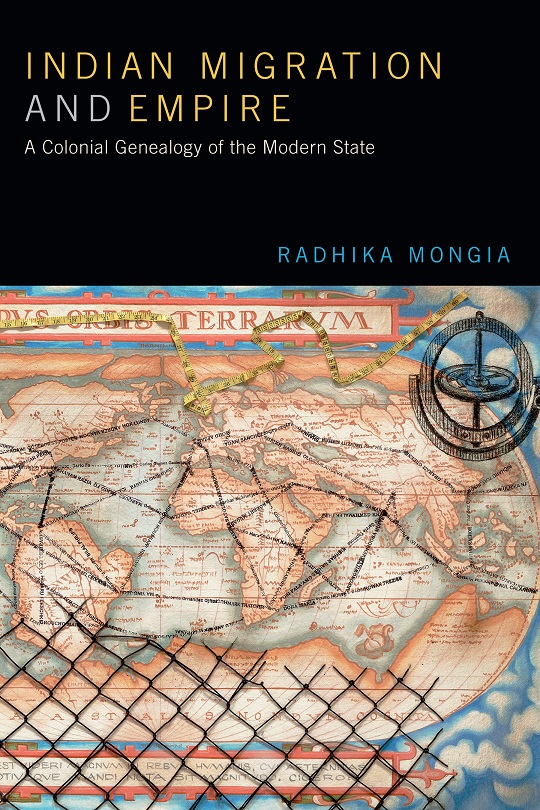
The Disorder of Things is pleased to host a symposium on Radhika Mongia’s Indian Migration and Empire: A Colonial Genealogy of the Modern State (Duke University Press, 2018 and Permanent Black Press, 2019), the introduction to which can be read here. Radhika Mongia is Associate Professor in the Department of Sociology at York University, Toronto. Her current research examines recent transformations in the citizenship regime in India. In this introductory post, she outlines some of the key arguments of the book.


This set of blog posts on my book, Indian Migration and Empire: A Colonial Genealogy of the Modern State, is the result of a panel held at Birkbeck, University of London, in the halcyon days before the Covid-19 pandemic. My very sincere thanks to Sarah Keenan and, especially, Nadine El-Enany, co-directors of the Centre for Race and Law at Birkbeck, for organising the panel, to the panelists, Bridget Anderson, Luke de Noronha, Nadine El-Enany and Sanjay Seth, for their generous and generative readings of the book, and to the audience for their astute engagements. Unfortunately, it isn’t possible to capture the warmth and conviviality of the evening in these remarks. My thanks also to the forum provided by The Disorder of Things, to respond in more depth, and with more care, to the panel’s provocations, which I do in the closing post. In this introductory post, I briefly outline some of the chief arguments of the book.

Indian Migration and Empire: A Colonial Genealogy of the Modern State is an investigation into the history of state control over migration. At the heart of the book are two main questions: First what histories can we chart of the increasing and incremental state control over migration that culminate, by the early decades of the twentieth century, in a state monopoly over migration? Second, what can these histories tell us about state formation, inter-state relations, state sovereignty and modern subject constitution? The book considers colonial Indian migration from about 1834, when Britain abolished slavery in its plantation colonies, up to about 1914, when, with the onset of World War I, the world confronted a new geopolitical reality. In the course of less than a century, we see profound transformations in the logics, rationales, institutions and legal forms of state control over mobility. My analysis argues that the formation of colonial migration regulations was dependent upon, accompanied by and generative of profound changes in normative understandings of the modern state. Traversing a diverse array of British colonial formations, including Mauritius, the Caribbean, India, Canada and South Africa, the book foregrounds the analytical modality of co-production to inquire into the relational processes, across these varied sites, that produced a state monopoly over migration. This monopoly, accompanied by the ‘nationalisation’ of migration, is an integral part of a fundamental shift, in the twentieth century, from a world composed of empire-states to a world composed of nation-states.
Mongia Cover Small

Studies of Indian indentured migration note that the system followed the abolition of slavery. However, with rare exceptions, the scholarship has simply seen abolition as a mere backdrop and not adequately examined what the regulation of indenture can tell us about state (trans)formation or how indenture was implicated in redrawing the contours of the central antinomy that haunted and shaped the nineteenth century: the distinction between freedom and slavery. By tracking how slavery was at the heart of the contentious legal debates on how to facilitate Indian migration in the aftermath of abolition, the book shows how various features of ‘freedom’ were thoroughly recalibrated. In particular, we see a decidedly profound change in what constituted a valid ‘free labour’ contract, where the nebulous, metaphysical notion of ‘consent’ becomes the most significant characteristic of the contract and of freedom—dispensing with notions of ‘fairness’ or ‘equality-in-exchange’, as minor elements. In other words, the regulation of Indian indentured migration that followed in the wake of abolition would irrevocably transform both the meaning of freedom and the extent of state authority in regulating migration.
Continue reading

Subjects and (Dis)obedience

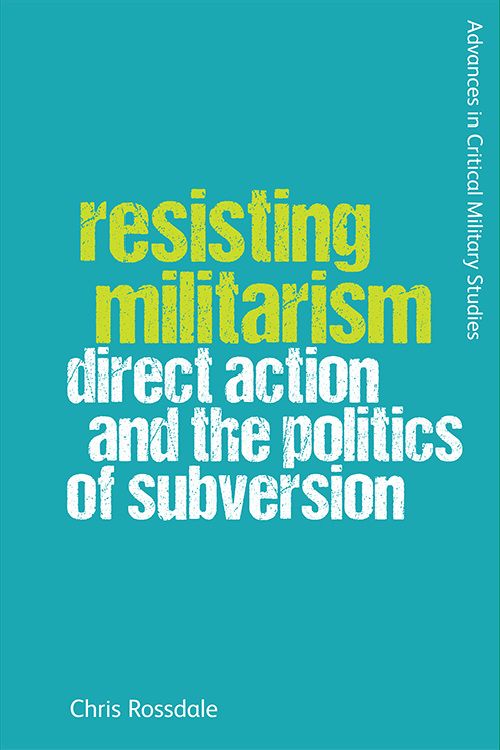
The last commentary in our symposium on Chris Rossdale’s Resisting Militarism: Direct Action and the Politics of Subversion (Edinburgh, 2019), from Elena Loizidou. Elena is Reader in Law and Political Theory at the School of Law, Birkbeck College. Her research interests range from anarchism and political theory to theories of gender and sexuality, law and culture. Her recent publications include Disobedience: Concept and Practice (edited, 2013), Judith Butler: Ethics, Law, Politics (2007), ‘What is Law?’’ in The Anarchist Imagination: Anarchism Encounters the Humanities and the Social Sciences (2019), ‘Law, Love and Anarchism’ (2018), and ‘Dreams and The Political Subject’, in Vulnerability in Resistance (2016). A rejoinder will follow shortly; all posts will be collected for future perusal here.


Chris Rossdale’s Resisting Militarism: Direct Action and the Politics of Subversion is a beautifully written book and one of those very rare academic books where the concrete (ethnographic) and the theoretical critique each other and reveal the complexity of socio-political phenomena such as anti-militarist actions. The contributions to knowledge that this book offers is immense: (a) it provides us with an ethnography of anti-militarist groups in Britain including, Campaign Against the Arms Trade (CAAT), Stop the Arms Fair (STAF); Smash EDO; Plowshares (or Ploughshares) and Space Hijackers emanating either from Rossdale participating or study over the last 12 years; (b) it widens our understandings of concepts such as (but not only) militarism (through linkage of war, conflict, state violence “to more intimate relations of power, authority domination” (p. 4), anti-militarism (through questioning the prefigurative claims of the groups he has studied) and disobedience (by drawing our attention to its attachment to obedience); and (c) it expands the methodological teachings of ethnographical studies by relating them to theoretical claims. Indeed Rossdale should be congratulated for his ability to navigate effortlessly between the concrete and the theoretical and challenge our perceived notions of concepts and politics.  His method of study will guide and should guide ethnographic studies in the future.

Anyone that studies social movements, whether it is the anti-militarist, anti-capitalist or anarchist movements (as I do), tends to present such movement in radical and pure ways. More specifically we tend to present such movements them as being diametrically opposite to what the social/political order that it is contesting. Resisting Militarism presents us with a delicate and nuanced reading of the anti-militarist movement. In doing so it exposes that there is a much more intimate relationship between the anti-militarist movement and militarism, or as Rossdale puts it anti-militarist actions and militarism are ‘mutually constitutive’ of each other (p. 12).  I will go a step further and suggest that as the book reveals they are not only  ‘mutually constitutive’ but rather they depend upon each other in the way in which Judith Butler interpreted Hegel’s ‘masterand servant dialectic’ in Subjects of Desire (1999); the existence of both parties (master (militarism) and servant (anti-militarism) ) somewhat paradoxically– as the former produces and sustains war, domination, authority and the latter contests them – depends on the non-destruction of each other.  If the servant for example annihilates the master their existence – as it is inextricably link to the master’s recognition, will cease to be. Rossdale very carefully tracks down how our protesting, direct actions, blockades, and other activist actions at times resemble the very master that we may want to undo, and how prefigurative politics (politics associated with anti-militarist movements) at times fall short of their very aspirations, namely not reproducing the violence associated with militarism.  Rossdale for example, shows how gender hierarchies may permeate such groups and how such a hierarchy works against the anti-hierarchical structures and aspirations of anti-militarist groups. Nevertheless, the intention of the book is not to suggest that anti-military resistance should be abandoned. On the contrary, by demonstrating the distance between word (e.g. anti-hierarchy aspiration in the structure and organisation of resistance) and the practice Rossdale, is asking us to cultivate a more mindful ‘ethic of resistance’. It is possible as he suggests that if we become more reflective of our actions that we stop from reproducing militarism – racism, sexism, homophobia and authority, the very things that anti-militarist actions desire to challenge and change. Put differently the book teaches how we are all implicated in the production of violence despite our desires or best intentions and how we can attend to this problematic.

Continue reading

Deconstructing Power and Resistance: A Response to Rossdale

A third commentary in our symposium on Chris Rossdale’s Resisting Militarism: Direct Action and the Politics of Subversion (Edinburgh, 2019), from Rachel Zhou. Rachel is a Phd candidate in the Department of International Relations, London School of Economics and Political Science. Her doctoral research focuses on the making of female soldiers in the post-WWII era. Rather than taking the “existence” of female soldiers for granted, she examines “female soldiers” as historically constructed subjects which are constitutive of the politics of war. In particular, she looks at how “small” wars in the post-1945 era as transnational and imperial encounters render thinkable and possible the emergence of female soldiers and shape the subjectivities/experiences of (different) female soldiers. She takes a multidisciplinary approach that encompasses the fields of military/war history, poststructuralist feminist, critical race and postcolonial theories. She is the review article editor of Millennium: Journal of International Studies. Rossdale’s Resisting Militarism is currently discounted with use of the code NEW30 at the EUP site, and the last reply and a rejoinder will follow in the next days; all posts will be collected for future perusal here.


Is resistance possible? How could resistance be carried out? Is resistance outside or external to power it resists? Is a radical escape from power possible? These questions are perennial but now further ignited by movements taking place during a global pandemic which accentuates and exposes systems of power. Chris Rossdale’s Resisting Militarism: Direct Action and the Politics of Subversion offers answers but poses more questions.

This book is rooted in an intimate and careful interrogation of “the performances, negotiations, and debates which surround” anti-militarist direct action in UK, but transcends the ethnography with its major contributions to debates on the politics of resistance and the relations between power and resistance. Treating direct action practices as “a fruitful site through which to read the politics of both militarism and resistance” (p. 6), it successfully and provocatively unpacks how anti-militarist politics resist, subvert, are shaped by, and reproduce militarism. The intimacy between militarism and anti-militarism is critically reflected on through meticulous accounts of the “internal” politics of antimilitarist resistance, which are read in relation to, not apart from, what it is against. Sherry Ortner points out there is an “impulse to sanitize the internal politics” of resistance in studies of resistance so that “the ambivalent complexity” of resistance is usually rendered invisible, which contributes to an inadequate analysis (1995, pp. 176-180). Resisting Militarism does not repeat this pitfall and also moves beyond just taking the “internal” politics of anti-militarist practices seriously. Instead, it would challenge the very binary between “internal” and “external”. The “internal” politics identified by Ortner is “within all the local categories of friction and tension” (p. 177). But Rossdale reads these frictions and tensions among anti-militarists, including those surrounding how an anti-militarist group is organised, whether focusing on the spectacular, how to approach security, illegality, pacifism and nonviolence, and the gendered and racialised politics of the movement”, not as “internal” politics per se. In Resisting Militarism they are interrogated in relation to “external” politics not only because how “internal” politics matters to its engagements with militarism, but more importantly as attempts to determine the particular nature and micro-politics of militarism and the imperatives of resistance as well as the relationship between militarism and anti-militarism (pp. 6-7). With a particular understanding of power and the concept of prefiguration, the book provocatively disrupts the boundaries between means and ends and between resistance and power.

Thus, Resisting Militarism brilliantly demonstrates how militarism and anti-militarism are antagonistic and co-constitutive (or antagonism is always already co-constitutive) and that while power relations can be revealed by examining attempts to uproot them, spaces and practices of resistance are always already produced by and, “potentially, reproductive of precisely that which is resisted” (p. 139). This move is rare even among the works situating power and resistance in the same analytical framework and taking their intimate relationships seriously. Usually they only focus on how a certain form of resistance is produced by a form of power but not on how resistance is complicit and reproduces what it is against. Thus, they still tend to eschew a deconstructive approach to resistance taken by Resisting Militarism, as if being critical of resistance could give more ground and energy to power. Starve and Immolate: The Politics of Human Weapons by Banu Bargu (2016) is another example which places power and resistance in one framework. Similarly, it also successfully demonstrates how resistance is shaped by power. However, its analysis might be criticised for overlooking how necroresistance could reproduce the logics of a “biosovereign assemblage” (Bargu, p. 53) that it is against. Rendering resistance innocent could simplify the operations of power as well as the complex relationships between power and resistance, and create spaces for imaginations of easy and straightforward resistance and thus a clean escape from power. Resisting Militarism is more cautious and actively seeks to be self-reflective. Not only (some) antimilitarist practices take a deconstructive approach to militarism. Resisting Militarism also seeks to deconstruct anti-militarism and calls for keeping antagonistic contestation in play as well as “a ceaseless openness to deconstruct that contestation” (p. 270). Remaining open to deconstruction and affirmative gestures in resistance could be the best hopes for resisting in a world where the subject, freedom and resistance are shaped and fundamentally entangled with power.

The brilliant book thus has made significant contributions to debates on the politics of resistance. My review should stop here. Also, to offer any critique is difficult because of its constant self-reflections. However, no critique could be exactly against what this book calls for — “antagonistic contestation and a ceaseless openness to deconstruct that contestation” (p. 270). The critiques may not be antagonistic since they follow the approach Resisting Militarism takes but seeks to make some implications more explicit, ask what could be further elaborated on and whether it reproduces what it critiques, and thus they are immanent critiques.

Continue reading

Resisting the Attractions of Anti-Militarism

After an overlong hiatus, we return to our mission with a symposium on Chris Rossdale’s Resisting Militarism: Direct Action and the Politics of Subversion (Edinburgh, 2019). The introductory chapter of Resisting Militarism is available to read here, and the whole book is soon to be released in paperback, discounted with use of the code NEW30 at the EUP site. For the first post in our series we are joined again by Anna Stavrianakis, Professor of International Relations at the University of Sussex, UK, where she researches and teaches on the international arms trade, (in)security and militarism. Anna is the author of Taking Aim at the Arms Trade. NGOs, Global Civil Society and the World Military Order (Zed, 2010) and co-editor (with Jan Selby) of Militarism and International Relations. Political Economy, Security Theory (Routledge, 2012)She is an editor at Security Dialogue, where she co-edited (with Maria Stern) the special issue on “Militarism and Security: Dialogue, Possibilities and Limits” (2018). Anna is currently working on a variety of projects associated with the arms trade and the war in Yemen, one recent result being ‘Controlling Weapons Circulation in a Postcolonial Militarised World’ in Review of International Studies. Further posts will follow this week; all will be collected for future perusal here.


As a fellow traveller in the world of anti-militarist activism, it was both a pleasure and an education to engross myself in Chris Rossdale’s new book, Resisting Militarism. I happened to see Chris on a sunny summer’s day in Brighton in June 2019, shortly after the Court of Appeal issued its judgment that the UK government had acted unlawfully in continuing to licence weapons exports to Saudi Arabia given its conduct in the war in Yemen. I wanted to raise a toast to the tenacious persistence of Campaign Against Arms Trade and to celebrate their legal victory. But even with my caveat that the hard work of translating a legal decision into meaningful political change remained, Chris was reluctant to savour the moment and curious as to how I could be in celebratory mood, given what we both know about the UK government’s commitment to arms sales, in particular those to the Middle East. Resisting Militarism helps me better understand Chris’ sceptical curiosity and his relentless questioning of what constitutes success and what an anti-militarist politics entails.

Through the combination of detailed, fine-grained ethnographic description that can only emerge from years of being part of a movement, and high theory dispatched with a light touch, Resisting Militarism helps readers understand (anti)-militarism as both concept and practice. Chris is very much present in the analysis but unassumingly so. Centering gender, sexuality and race as the social relations that scholars and activists need to foreground in understanding, engaging with and challenging militarism, he outlines a prefigurative politics of engagement with power, authority and domination as the thread that weaves the intimate and the geopolitical together.

There are two core contributions that I find particularly compelling about Chris’ analysis. First is the way he breathes life into abstract definitions of militarism. Mobilising the definition that Jan Selby and I gave in our 2012 edited volume Militarism and International Relations, of militarism as “the social and international relations of the preparation for, and conduct of, organised political violence”, Chris gives purchase to it for the study of contemporary British anti-militarism by filling it with a focus on gender, sexuality and race as the core social relations that variously bolster and challenge, and always permeate, militarism and anti-militarism. In short, “militarism is not a thing that can be smashed, but a series of social relations that must be disassembled by relating otherwise” (p. 38). Crucially, this means there is no ‘outside’ of militarism: there is no separating everyday life from the preparation for organized violence. No-one is exempt from it – not even the anti-militarist movement. Chris is interested in “the depths of our imbrication within militarised relations of power” (p38) – and once we acknowledge that, the question of how we agitate for an anti-militarist present and future looks rather different from what many accounts of militarism and anti-militarism offer.

Continue reading

Is IR Theory White? Racialised Subject-Positioning in Three Canonical Texts

This post is a little introduction to my recently published (open access) article in Millennium: Journal of International Studies, in which I use the scholarly literature on whiteness to examine three highly influential books in International Relations (IR) – Kenneth Waltz’s Theory of International Politics, Robert Keohane’s After Hegemony and Alexander Wendt’s Social Theory of International Politics.

Of course, the answer is what you might expect (duh); but I hope the route to reaching that conclusion might be something worth considering, and maybe not exactly what you were expecting. It articulates an account of whiteness which is ultimately less pessimistic than the oft-caricatured ‘identity politics’ framings of race – indeed it argues that it is absolutely possible to overcome the limitations of whiteness as a standpoint, but that this would not be transformative without other structural changes.

Screenshot 2020-11-29 at 12.37.32

I began thinking about this issue because I was simultaneously excited, provoked by and wary about a framing emerging from the student movement at UCL: “Why is My Curriculum White?” – a moment in which both Nathaniel Coleman and Adam Elliott-Cooper played leading roles. We were also increasingly having conversations with students and colleagues at SOAS about race and decolonisation in the curriculum whilst we witnessed what was going on in South Africa and elsewhere.

Despite the care and precision with which the UCL collective expressed itself on the question of whiteness as an ideology, the media and the Right concocted a fevered moral panic around the issues, proclaiming an attack on Western Civilisation, free speech and academic freedom by the ungrateful, and the emergence of ‘reverse racism’ and so on. It did not help that some contributions from elsewhere in the movement seemed to be rather essentialist around the questions of race and racism (in ways which had been long abandoned with respect to gender, for example). From a political point of view, the ‘culture wars’ framing of matters was eliciting a set of destructive emotional responses anticipated in the whiteness literature itself – shame, guilt, anger, denial – which were a (sometimes intentional) distraction from more transformative and productive conversations.

Continue reading

Loving Exclusions: Marriage, Emotional Attachments and Global Inequalities

A guest post from V. Spike Peterson. Spike is Professor of International Relations at the University of Arizona. She is a critical social theorist whose research interests stem from anti-war, civil rights and feminist activism in the US and many years of work/travel/residence ‘outside’ of the West. Background studies in anthropology, historical sociology and communications inform her work in IR, which queries how structural hierarchies of gender, sexuality, class, ethnicity/race and nation are historically produced, ideologically normalized, continuously intersecting, and potentially transformed. Her publications span genealogies of sex, family, science and state formation; critiques of informalization, global political economy and its in/securities; intimate-global relations, racial logics, citizenship regimes, alt-right nationalisms, and the politics of im/migration in our fraught neoliberal, neo-imperial present. Her most recent work aims to raise critical awareness of how power relations of privilege operate to reproduce intentional and – surprisingly and importantly – unintentional resistance to transformative social change.


Ah, love! Fairy tales and romantic comedies promote living the quest for love and its idealized consummation in the ‘happily ever after’ of married life. What could be better than love? The ‘sanctity of marriage’ and ‘love of family’ are touted by conservatives, love of god by religious believers, love of one’s nation by patriots, love of oneself by self-help manuals and consumerist advertising, and love of prosperity by economists. Academics too are on board, urging closer attention to emotional investments and erotic practices in studies of social life, and asking how institutions idealizing love also foster inequalities and exclusions. I explore here the loving exclusions of marriage: the state-sanctioned institution widely presumed to epitomize love, its passionate commitments, and its importance for happy couples, healthy families, thriving communities, and stable nations.

Lauren Berlant observes that ‘intimacy builds worlds,’1 and I argue that the intimacy of marriage has built a world of inequalities. The heteropatriarchal premises of marriage are deeply ingrained, not only in laws but in hearts and minds worldwide. Given these premises, it is no surprise that feminists and queers have developed trenchant critiques of the institution. I endorse these critiques but argue that even more is at stake: that the institution of marriage produces not only inequalities of gender and sexuality but also, and inextricably, of race, class and national prosperity. That these inequalities are geopolitically problematic is readily acknowledged, but how marriage figures in producing, exacerbating or complicating them is rarely addressed. The point is not to judge individuals – who have varying reasons for supporting and/or participating in marriage – but to critically assess the political work that institutions do.

I recap several entwined inquiries: how marriage matters constitutively to the intergenerational continuity of states/nations; how Eurocentric manipulation of marriage figures in producing modernity’s ‘race difference’; and how fluid, ‘mobile essentialisms’ of race matter affectively, culturally and materially in our colonial present of increasing global inequalities, migration pressures, nationalist populisms and xenophobic hostilities. The hope is to illuminate unfamiliar terrain: how marriage historically and currently re/produces inequalities through the state/nation’s regulation of sexual practices, ethnic/racial relations, resource distributions, and citizenship (hence, im/migration) options.2

Continue reading

Disordering the Intimacies of Four Continents: A Reading Group

Many Disorder-ers recently enjoyed the 2020 Annual Conference of Millennium: Journal of International Studies, held online last month on the theme of ‘Entanglements and Detachments in Global Politics’. A welcome excuse to meet up, we put together a roundtable on Lisa Lowe’s widely celebrated book The Intimacies of Four Continents (Duke University Press, 2015) and recorded it for posterity in this podcast. Enjoy!


Disordering “The Intimacies of Four Continents”: A Reading Group

Chair: Meera Sabaratnam
Participants: Rahul Rao, Joe Hoover, Paul Kirby, Nivi Manchanda, Charmaine Chua, Srdjan Vucetic

This panel brings together members of the collective blog The Disorder of Things to read and comment on Lisa Lowe’s book The Intimacies of Four Continents. Centrally concerned with the nature of historical entanglements, Lowe’s work locates what has been understood as liberal humanism within the matrix of empire, racial hierarchies and interconnectedness that transformed the world in recent centuries. The contributors to this round table will read the book and discuss its general arguments plus the specific contributions of each chapter, as well as reflecting on how the methods, analysis and conclusions of Lowe’s book may contribute to shifting our understanding of the international and future directions for research.

Race, Racism and Academia: A view from Denmark

Earlier in the year, just as the COVID-19 pandemic began taking lives and livelihoods across the world, the backlash to a published article on racism at the roots of securitization studies was picked up by the Danish press. The resulting narratives and racist cartoons produced to illustrate the backlash were at once shocking and unsurprising, considering the cultivated racial innocence of the Danish context and the collective denial of racism within the country, especially among the cultured intellectuals within the university system. This short series of reflections emerges out of collective conversations around that time among scholars of colour with experiences of the Danish academy. Over the coming days, Somdeep Sen, Chenchen Zhang, and Mahvish Ahmad share testimonies which movingly illustrate how structural and interpersonal racism are experienced in everyday academic life in Denmark. These testimonies indirectly situate the racist backlash to critical IR scholarship in its broader context of structural and societal racism in spaces where such racism is innocently disavowed.

This first post is authored by Dr Somdeep Sen of Roskilde University and the series is edited by Lisa Tilley.


In late March 2015 I ran into a fellow PhD student in the hallway outside my office. I was looking for a pair of scissors and asked him if he had one I could borrow. He said, “I don’t, but I am sure you can find one at the [department’s] reception.” I had been working non-stop in order to submit my dissertation that day and was exhausted. So, I said, “The reception seems so far away. I’m too tired.” He responded, “You’re such a lazy n*****!”.

This wasn’t my first experience of racism in Denmark. In fact, my first encounter with everyday racism in the country happened the day after I arrived in Copenhagen to start my PhD. It was a Friday afternoon in late September 2011, and I was standing in front of a furniture store talking to the owner about buying a cupboard that was displayed outside. Suddenly an old woman hit me with her tote bag and began yelling at me in Danish, while pointing to her (white) skin. At the time, I knew that racism was an unavoidable feature of my everyday life in Europe. Still, I naively believed that I would be sheltered from such incidents on the elevated (intellectual) plateau where the academy seems to reside. “Educated people,” my (lower) middle class Indian upbringing assured me, “would never behave like that.”

Of course, through a slew of experiences of racism in the past nine years I have come to realize that the color lines are just as prominent “up here”. Here are a few examples: I was having drinks with a few colleagues on a Friday night at a bar in downtown Copenhagen. We were discussing the dating experiences of non-Danes, when one of them, a postdoc, said to me, “You are fine, but I think most Indian men smell bad”. On another occasion, I was discussing the skills and qualifications of incoming migrants in Denmark with a tenured professor at a conference and he said to me, “You’re Indian. I guess your skill is raping women”. At another university organized social event, a PhD student insisted on calling me a “black baby”. He was (drunkenly) concerned that if he was unable to have a child with his partner, they would have to adopt a “black baby”. While rubbing his hands on my head, he kept repeating, “what would I do with a black baby like this one?”. Once, when leaving my office on a Friday evening, a colleague noticed that I was carrying books in a plastic bag. He commented, “It will be funny to see how many people think you are a bottle collector”. More recently, when I asked a colleague how the previous semester had been in terms of his teaching load, the conversation quickly devolved into him proclaiming that the biggest challenge to Danish society and culture was the “trend” of Danes marrying foreigners. He knew well that I was married to a Dane.

To be sure, everyday racism in academia is not a uniquely Danish problem. In fact, my experiences are all but commonplace for BAME (Black, Asian and minority ethnic) scholars in largely white academic institutions in the Global North. This is evidenced not least by the experiences shared by black scholars on Twitter with the hashtag  #BlackInTheIvory and the treatment that has been meted out to Errol Henderson for authoring an op-ed titled “Being Black at Penn State”. Neither is any of this surprising.  Academic institutions are intimately involved in the making of the hierarchies that inform the international political order. Furthermore, as social scientists, we are well aware that the very foundations of our disciplines are racialized and deeply formed by an effort to marginalize indigenous and non-white perspectives on politics and society.

But, as is often the question, so what?

Continue reading

An Essay on Pandemic Borders: From ‘Immunitary Dispositif’ to Affirmative Ethics

An eighth entry in our coronacrisis series, from Umut Ozguc. Umut is postdoctoral research fellow in International Ethics at the School of Humanities and Social Sciences, University of New South Wales, Australia. She is a critical IR scholar working on critical security and border studies, settler colonialism, spatial theory, resistance and posthumanism. Currently, she is working on a research project on the ecological impacts of border walls. Her current research aims to challenge the overly anthropocentric focus of the contemporary debates over borders and mobility.


Those applying for temporary or permanent residency in Australia know well that you can only be granted a visa if you meet the health requirements set by the Australian Government. That is to mean, you should not pose a threat to the public health of the nation. The Department of Home Affairs website states that  it says, if you have any health condition it should not pose a significant cost to the Australian community ‘in terms of the health care or community services required to manage [the] condition.’ The result of the health examination is not revealed to applicants; it is a confidential document used only for migration purposes and a powerful document that as determines whether you are eligible to cross the border. I cannot recall how many times I had to undergo a medical examination for my visa applications, but I do remember the anxiety I felt each time. The medical examination is not a neutral process; it is a performative act that classifies, occupies and eventually transforms your body into a border- line between you and Australia.

Borders are not lines on the map, they are an affective experience produced by our everyday movements, narratives and codes that simultaneously define our relations with the world. We tend to think of borders as legal administrative lines separating sovereign units. They are indeed lines, but not simply legal and administrative ones. And they are certainly not straight lines, but floating ones that could act as boundaries between life and death. For some, borders are everywhere. For others, they are imperceptible. That is why, as Achille Mbembe (2019, 99) suggests, it is necessary to talk about the process of ‘borderization’—how certain spaces are turned into ‘impassable places’ for certain people, while always being accessible to others.

This essay is about how, during the current public health crisis, certain bodies are turned into a border between life and death and how different practices of ‘borderization’ continue to operate to intensify global inequalities, racism and narcissistic celebration of established modes of politics and its economy of violence. My aim is to define the pandemic border from the perspective of those who experience it. I argue that the pandemic border, like all other borders, is not a static construction having a final form, but an affective experience. It changes our perception of time and space and is altered by those perceptions. It shapes our bodily experiences and is affected by our bodily movements. And, perhaps most importantly, the border determines who we are and is determined by our encounters with others. In the contemporary operation of biopolitical borders, COVID-19 operates as a political actor, as an ‘actant’, which is, as Bennett (2010, 9) reads it, ‘neither an object nor a subject, but as an ‘intervener’,  or a ‘parasite’ (Serres, 2007), an intermediary, a mediator that causes disruption and a new system within the system. Continue reading

Are We at War? The Rhetoric of War in the Coronavirus Pandemic

The seventh contribution to our growing collection of writings on Covid-19 and this moment of crisis. Federica Caso is currently a teaching assistant at the University of Queensland, where she also completed her PhD in 2019. Her expertise is on militarisation and war memory in liberal societies. She also works on the politics of culture, art, and gender. Her most recent publication is titled “The Political Aesthetics of the Body of the Soldier in Pain” which features in Catherine Baker’s edited volume  Making War on Bodies.


In this pandemic, the war rhetoric has spread as fast as the coronavirus itself. Recently, US President Donald Trump has characterised himself as a wartime president. Hospitals are preparing for war and healthcare workers are heralded as the frontline soldiers in the war against COVID-19. Economists ask how the coronavirus war economy will change the world. Wartime terms such as shelter-in-place, panic-buying, and lockdown have entered our daily and most mundane conversations.

The language of war is so normalised that in a recent episode of the New York Times’ podcast The Daily, a medical doctor answers questions from US American children about the coronavirus using war metaphors. We have come to believe that these children, aged no more than 6 and raised in ‘peacetime’ and prosperity, naturally know about invasion, bombing, weapons, and strategic warfare. We have come to believe that this is the best language to teach them about life processes.

It is important to pay attention to the language that we use to describe the coronavirus pandemic because it determines how we respond to it.

The War Metaphor

This is not the first time that the language of war is stretched to contexts that are not legalistically wartimes. In the last fifty years, we have heard of the war of drugs, the war on poverty, the war on crime, and the war on plastic.

War is a powerful metaphor. It is an effective, immediate, and emotive tool to communicate urgency to the general public. It also conveys a sense of struggle and righteousness that can justify exceptional measures.

Continue reading