A Political Ethnography of the Visual

4379-Simukai_Chigudu_(423586)-1The second post in our symposium on Sophie Harman’s Seeing Politics. This contribution is from Simukai Chigudu, who is Associate Professor of African Politics at the University of Oxford. Simukai is principally interested in the social politics of inequality in Africa, which he examines using disease, public health, violence, and social suffering as organising frameworks for both historical and contemporary case studies. His forthcoming book entitled The Political Life of an Epidemic: Cholera, Crisis and Citizenship in Zimbabwe (Cambridge University Press, 2020) is a study of the social and political causes and consequences of Zimbabwe’s catastrophic cholera outbreak in 2008/09, the worst in African history. He has published articles in a number of peer-reviewed scholarly journals including African AffairsGlobal Health GovernanceHealth EconomicsPolicy and Law, the International Feminist Journal of PoliticsHealth Policy and PlanningSeizure: The European Journal of EpilepsyFeminist Africa, and The Lancet. Prior to academia, Simukai was a medical doctor in the UK’s National Health Service where he worked for three years.


Political science as a discipline, including the branch of international relations, has been slow to grapple with the AIDS crisis. It seems that the HIV-AIDS issue has been conceived of as too private, too biological, too microlevel and sociological, too behavioral and too cultural to attract the attention of many political scientists.

Catherine Boone & Jake Batsell, Africa Today, 2001

It is tempting – and certainly not altogether misguided – to think that in our contemporary digital age, the ubiquitous infrastructures of the Internet, of mobile phones, and of cheap audio and video technologies have radically democratised economies of representation in various (global) public spheres. After all, it is often claimed, mobile phones have profoundly transformed how we acquire and exchange information. In Africa, where most have gone from no phone to mobile phone (‘leapfrogging’), many have believed that improved access to telecommunication would enhance everything from entrepreneurialism, to democratisation, to service delivery, all the while ushering in socio-economic development (Archambault 2016). As part of this package of social transformation through innovation, techno-utopians praise communication technologies and social media for opening up important avenues for popular oral and visual circuits of storytelling.

But how far can these circuits of storytelling go? Where do they meet their limits? What are the structures that enable and inhibit storytelling in public arenas? Sophie Harman’s Seeing Politics offers a fascinating exploration of these questions through her foray into the commercial world of narrative film production. Film is both a microcosm and a macrocosm of the intimate but also vexed interrelationships between technology, economy and the politics of storytelling. Harman shows in riveting detail how a blind optimism in capitalism’s logic of progress and innovation belies the socio-economic structures, patronage politics and gatekeeping practices that govern the making, dissemination and consumption of narrative films.

A simple illustration. The visual landscape of representations of Africa in narrative film, Harman argues, remains largely defined by Hollywood cinematic tropes of ‘“the dark continent” full of “tribal” conflict (Black Hawk Down), ruthless dictators (Last King of Scotland), inner-city violence (Tsotsi), genocide (Hotel Rwanda), government corruption and collusion with capitalist interests (The Constant Gardener), and resource plunder (Blood Diamond)’ (p. 34). Even Black Panther – and I say this cautiously as an enthusiastic Marvel fanboy – can only subvert these tropes through a computer-generated spectacle that, despite being a compelling comic-book movie, offers little by way of a textured and rich (dare I say real?) Africa while the prolific film-makers of Nollywood, Swahiliwood, and Bongo film industries simply can’t compete with the Hollywood behemoth.

Where might ‘we’ (taken here to mean a global audience) then see ordinary African people, in their diversity and uniqueness, reconfiguring and pluralising images of the continent? Harman’s debut film, Pili, is a place to start.

Continue reading

Rising to the Challenge: Critical IR in the Corbyn Moment

David WearingA new post in our loose series on left foreign policy, this time from David Wearing. David is a Teaching Fellow in International Relations at Royal Holloway, University of London, where he specialises in UK foreign relations in the Middle East. David is author most recently of AngloArabia: Why Gulf Wealth Matters To Britain (Polity, 2018), reviewed in a recent issue of the LRB, and of many interventions on the arms trade, the war in Yemen, and the Gulf monarchies. He is also a frequent commentator at The Guardian.


In the academic field of international relations, up until recently, the division of labour was pretty clear. Some of us were engaged in ‘problem solving theory’ and others in ‘critical theory’, as per the distinction famously drawn by Robert Cox.[1] Here, I want to address those friends and colleagues who count themselves in the latter group, arguing that the current historical moment presents us with a unique (perhaps fleeting) opportunity to have a significant impact on British politics and international relations, but one which also demands a willingness to recognise the urgency of that moment, and adapt.

According to Cox’s distinction, problem solving theory ‘takes the world as it finds it, with the prevailing social and power relationships’, and looks for patterns or regularities within those parameters. It is a small-c conservative, technocratic approach, suited to advising policymakers on how best to manage the status quo. Therefore, notwithstanding claims made by those who fall under this heading to be apolitical, objective and scientific, problem solving theory has an inescapably political character, attracting those on the right and centre of the political spectrum, and primarily serving those who benefit most from the ‘prevailing social and power relationships’.

Critical theory, by contrast, ‘does not take institutions and social and power relations for granted but calls them into question by concerning itself with their origins and how and whether they might be in the process of changing’. As such it attracts those further to the left on the political spectrum, for whom the point of interpreting the world is not to manage it better but to change it in fundamental and transformative ways. Under the hitherto familiar division of labour in IR, our task was not to advise policymakers, but step back from and critique the historical conditions within which policymaking takes place: shedding light on what is taken for granted, looking for moments of disruption and crisis in the established patterns, and engaging with those civil society actors who shared our commitment to challenge the ‘prevailing social and power relationships’ head on.

I say ‘the hitherto familiar division of labour’ because we in the UK are now living through precisely one of those moments of disruption and crisis that much of our analysis seeks to identify. Call it ‘the Corbyn moment’, for want of a better term. And if our focus and activities as scholars are defined by our ‘position in…social and political time and space’, as Cox says, and if the present moment is different from the familiar norm, then our focus and activities must surely be different as well.

What is the nature of that moment?
Continue reading

Reinventing Language

Catherine Charrett BiopicA guest post from Catherine Charrett. Catherine is a Lecturer in Politics and International Relations at Queen Mary University of London and will be teaching at the University of Westminster from September 2019. Catherine uses transdisciplinary methods to explore and present research on technologies of security and policing in the Occupation of Palestine and is the author of The EU, Hamas and the 2006 Palestinian Elections: A Performance in Politics (Routledge, 2019). Catherine created a 45-minute solo performance piece based on the material in this blog post and entitled The Vein, the Fingerprint Machine and the Automatic Speed Detector. You can view a trailer for the show here. Please get in touch with Catherine for further information about booking or viewing the performance piece.


Invent a hope for speech,
invent a direction, a mirage to extend hope.
And sing, for the aesthetic is freedom/
***
I say: The life which cannot be defined
except by death is not a life”

(Darwish, 2007)

The poetic means that form is loosened from technical function.

(Larkin, 2013: 335)

Below are two texts. The first is a deconstruction of a transcribed Israeli ‘start-up’ competition in the weapons industry. I attended this event in the Dan Panorama Hotel, Tel Aviv (Jaffa) on 18 July 2018. I witnessed and recorded the technologisation and capitalisation of killing Palestinians and other racially marked bodies – hosted by Israel, attended by international spectators. To take a break from this show I walked down the street, and I came across a sigh of relief in the shape of a mosque, the Hasan Bek Mosque, Jaffa. The second text below is a historical rendering of that mosque as described in the Journal of Palestine Studies by the late Shafiq al-Hout. Al-Hout, born and raised in Jaffa, was a founding member of the Palestinian Liberation Organisation (PLO), and never ceased to fight for the Palestinian right to return.

In this intervention, my hope is to play with the form of language to disrupt what Carol Cohn described as the internal ‘logic’ of technostrategic language. As academics of international relations often we are prone to repeating the technostrategic language, which Cohn says has been invented by mathematicians, salesmen, economists and political scientists to invent a truth, which makes it possible to think the unthinkable (1987: 715).  This language capitalises upon and reproduces phallic imagery, competitive male sexuality and the promise of male creationism. In the first text I offer a deconstructive parody of some of these mechanisms. Non-official tongue, slang, sarcasm, colloquialism resist the totalitarianism of administrative language, says Herbert Marcuse. In playing with language, I hope to performatively critique the techno-fetishization that continues to circulate around Israel’s high-tech industry, and around high-tech solutions in the security industry more generally.

The reference for the ‘logic’ of technostrategic speech, argues Cohn is the weapon itself ‘(1987: 715). There is however, another reference point, the one who will be targeted, the one who will be ‘sacrificed’ for apparent technological evolution, those who will serve as the “literal raw materials” for white security (Agathangelou, 2013 cited in Howell and Richter-Montpetit, 2019). Drawing inspiration from Katherine McKittrick (2011; 2014) I include the second text as an expression of Palestinian life before and beyond the rupture of violent European/ Israeli expansionism, dispossession and racial extraction into Palestinian livelihoods.

Poetry is often unquantifiable in terms of material weight, but the fact that it has lasted for as long as humankind has been using language suggests that its value lies in its presence as a fact of language within which people search for meaning, for echoes to the sounds of their souls and the music of their minds.

(Alshaer 2016).

***

Continue reading

Fight to Live, Live to Fight: Veteran Activism after War

A guest post from Ben Schrader, on the topic of his new book, Fight to Live, Live to Fight: Veteran Activism After War, published today with SUNY Press. Ben recently completed a visiting professorship with the Bard Globalization and International Affairs program in conjunction with Central European University. He is a war veteran turned peace activist turned academic. He has published in the Journal of Narrative Politics on ‘Auto-Archeology and Political Affect of War’ (2014) as well as in Critical Military Studies on ‘The Affect of Veteran Activism’ (2017). Ben has a number of other published non-academic works, from think pieces to poetry. He is currently living precariously on the job market. Ben is also a board member for the anti-war organization About Face: Veterans Against War.


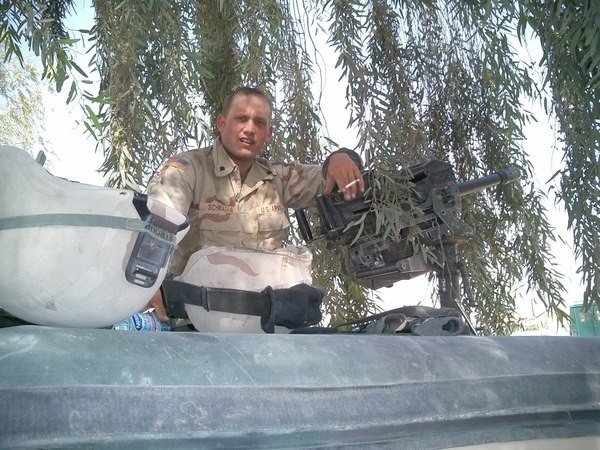
Me in Iraq

Taking in some shade while on patrol in Iraq.

From 2001-2005 I served in the US Army as a 19D Cavalry Scout. I was stationed in Vilseck, Germany and went on two deployments, one to Kosovo from 2002-2003 for a peacekeeping mission, and one to Baqubah, Iraq, where I was a part of my units Quick Reaction Force, so if anything happened in our sector we were the first people that were called. Needless to say I saw a lot of combat. While in Iraq, I began to become disillusioned with the mission, as the reasons we had been given for why we were in Iraq did not seem to align with what we were seeing on the ground. I left the military upset, confused, and as if I had been betrayed by my own country, so to understand my experience I did two things. First and foremost, I joined the group Iraq Veterans Against the War (IVAW), now known as About Face: Veterans Against War. This gave me a tool to channel much of my anger and also connected me with other veterans who were questioning the things they experienced in Iraq. One of the primary tactics I found with IVAW, parrhesia—speaking truth to power—worked to expose the lies that I saw (as well as the truths that have been hidden from civil society), while also working to help me heal by releasing the burden of these truths.

Me at RNC with Rage

IVAW marching with the Prophets of Rage at the 2016 Republic National Convention

The second thing I did was I went back to school. I studied sociology to understand the human and societal impacts of war, and I studied political science to understand the gears and processes of war. Between my activism and academia, I began to see many connections not just on an international level but also on a local level, whereas many of the inequities that Americans face could be tied to different aspects of militarism. This drove me deeper into understanding these connections, as I learned about them in the classroom as a student, and on the streets as an activist. I began to expand my activism and my formal learning beyond just understanding militarism as I got an MA in ethnic studies; examining intersectionality, white supremacy, and colonialism; as well as marching for racial justice, advocating for gender equality, and fighting against homophobia. I then moved on to a PhD where I would work to tie all this together into the project I’m writing about today: a look at military veterans who came home to be social justice activists.

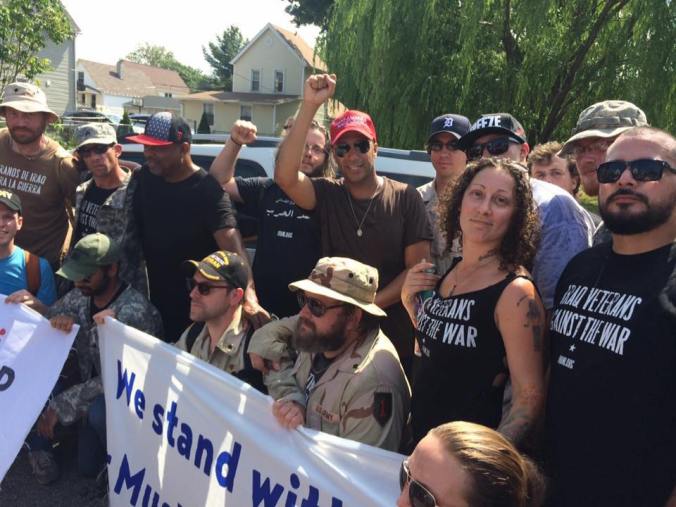
While the project is entangled with my own experiences as a soldier and an activist (as I utilize embodied auto/ethnographic research), my examination of other activists took place over the course of a year. In 2013-2014 I drove around North America interviewing veterans from all walks of life. I started by reaching out to veteran activists that I knew to see if they knew other veterans who would be willing to be interviewed. My only requirement was that they considered themselves “social justice activists,” and that they had served in the US military. In all I ended up interviewing twenty-two veteran activists, twenty of them being in the US, one in Mexico, and one in Canada. I hadn’t begun with the categories of activism I wanted to understand but as one interview led to another categories began to form, as I found veterans who were not only engaged in antiwar activism but also a part of the Occupy movement, doing environmental work, addressing issues of sexual assault in the military, working on immigration issues, and trying to help veteran communities heal from the traumas of war. In some cases, I spent an hour with them conducting an open-ended interview, in other cases I spent a day or two with them observing the work that they were doing. Each interview was different, but all were fruitful. Within the book I primarily highlight two veterans per chapter and their work as an activist, as I do what my former advisor Michael Shapiro calls staging encounters between theory and event. I draw much inspiration from Critical Military Studies as I examine the many ways that war and the military effect the self, groups, and society. Furthermore, these veterans are what Victoria Basham and Paul Higate call geocorporeal actors, not only as soldiers, but also afterwards as veteran activists. I therefore weave these veterans’ stories with my own, from my experiences in war to my engagement with them as interviewees. I try to tell these stories in a manner that is accessible for anyone to grasp both the impacts of war and some of the theoretical concepts around identity formation, militarism, and problems these veterans are addressing around social justice issues.

Continue reading

The case against Woodrow Wilson, after 100 years

This guest post is a collective statement, written by Philip Conway in consultation with several other current and former PhD candidates at the Aberystwyth University Department of International Politics. It is co-signed by a number of current and former Aber PhD candidates, not all of whom were directly involved in the drafting process. It does not, therefore, necessarily present a consensus. However, it does, we hope, present a constructive and forceful contribution to an important debate.

At Aberystwyth University, the year 2019 marks the Centenary of the Department of International Politics. A century, that is, since the philanthropists David, Gwendoline, and Margaret Davies donated a sum of £20,000—more than £1m in today’s money—in order to establish a Chair of International Politics (the first of its kind in the world). The Chair was established “in memory of the fallen students of our University.”[1] It was to be named after the then-current US President, Woodrow Wilson.

This was, and is, an appellation heavy with significance. At the end of the War, as Lord David Davies himself later wrote:

“Among the protagonists of the new Jerusalem stood President Wilson, towering head and shoulders above them all. […] By all those who sincerely desired a permanent peace and were prepared to sacrifice their imperialistic conceptions, he was acclaimed as the leader.”[2]

On 25th October last year, as part of the Department’s Centenary celebrations, a roundtable seminar was held, titled “Reflections on Woodrow Wilson.” It was instigated by the current incumbent of the Woodrow Wilson Chair of International Politics, Andrew Linklater.

This instigation had, in turn, been prompted by a student request to take the occasion of the Centenary as an opportunity to re-evaluate the Department’s association with this particular historical figure.

Continue reading

Property Abolitionism: Race, Colony, Body, Land

For the final post in our symposium on Colonial Lives of Property, Brenna Bhandar replies to her interlocutors. Brenna is Senior Lecturer in Law at SOAS, University of London. She is author of Colonial Lives of Property: Law, Land and Racial Regimes of Ownership (DUP: 2018) and co-editor (with Jon Goldberg-Hiller) of Plastic Materialities: Politics, Legality and Metamorphosis in the Work of Catherine Malabou (DUP: 2015). She is currently completing Thinking Liberation: anti-racist feminist practice, a book on critical race feminisms with Rafeef Ziadah.


Thanks to all five contributors for these incredibly thoughtful interventions. It is a real gift to have such expansive and thorough responses to one’s work, and to have been given the opportunity to consider the questions they raise about the potential for some of the ideas in the book to travel into domains unexplored in the text. It is impossible to respond to each of the issues raised, but I have chosen 4 different themes to discuss which I think connect many of the articles.

One of the themes arising from the responses to the book is a question about the extent to which the concept, “racial regimes of ownership” is adequate to grasp the realities of colonialism outside of the sphere of British colonial and imperial rule.  To what extent has the co-emergence of racial subjectivities and capitalist property relations been a central part of the advent of colonial modernities beyond the settler colony?

Continue reading

(Post)Colonial Lives of Property and the Contradictions of ‘Use’

The fifth post in our symposium on Colonial Lives of Property is by Lisa Tilley. Lisa is Lecturer in Politics and Leverhulme Early Career Fellow at Birkbeck, University of London. She is also co-convenor of the Colonial, Postcolonial, Decolonial Working Group of the British International Studies Association (CPD-BISA); co-founder of the collaborative research project Raced Markets; and Associate Editor of the pedagogical resource Global Social Theory.Her work draws on various theoretical approaches to ‘the colonial question’ in analyses of processes of accumulation and expropriation, especially along urban and rural extractive frontiers in Indonesia.


Brenna Bhandar’s thoughtful and detailed work, Colonial Lives of Property, is a vital reference for anyone seeking to understand land and property in historical, juridical, and economic perspective. This text has application well beyond the disciplinary boundaries of Law and should be given a central place within the Political Economy canon too, especially as it illuminates the long-disregarded, yet undeniably constitutive, relations between the formations of property and race. The text also has a wonderful pedagogical order to it, owing to the way it is structured around central chapters on Use, Propertied Abstractions, Improvement, and Status. I can fully imagine planning a module on the political economy of property around each of those rich and weighty concepts, guided by Bhandar’s exemplary way of thinking them through.

Continue reading

Property as Futurism

The third post in our symposium on Brenna Bhandar’s Colonial Lives of Property is by Sara Salem. Sara is an Assistant Professor in Sociology at the London School of Economics. Sara’s research interests include political sociology, postcolonial studies, Marxist theory, feminist theory, and global histories of empire and imperialism. She is particularly interested in questions of traveling theory, postcolonial/anti-colonial nationalism, and feminist theory. She has recently published articles in journals such as Signs; Interventions: A Journal of Postcolonial Studies; Review of African Political Economy; and the European Journal of Women’s Studies, among others.


Brenna Bhandar’s ‘Colonial Lives of Property’ is an incisive and exciting book on questions of race, empire, property and the law. Drawing on multiple settler-colonial contexts—Palestine, Australia and Canada—and various time frames, Bhandar meticulously unpacks the loaded legal and social concept of ‘property’ to reveal its entanglements with histories of settler colonialism and race. Bhandar shows us that there cannot be a history of private property law that is not also at the same time a history of land appropriation in the colonies. The colonial drive to appropriate indigenous land—often in the process exterminating indigenous peoples—did not only have specific social, political and economic effects, but also produced legal understandings of land, property and citizenship. Bhandar notes, “Property law was a crucial mechanism for the colonial accumulation of capital, and by the late nineteenth century, had unfolded in conjunction with racial schemas that steadfastly held colonized subjects within their grip. Property laws and racial subjectivity developed in relation to one another, an articulation I capture with the concept of racial regimes of ownership,” (p. 2).

The book demonstrates that by unveiling these processes of appropriation and extermination, we come closer to understanding the categories we today so often work with, such as property and private ownership, and who belongs in the category of the ‘modern human’ and can thus access these. It shows us that the law was developed in and through colonialism, and that “there cannot be a history of private property law, as the subject of legal studies and political theory in early modern England that is not at the same time a history of land appropriation in Ireland, the Caribbean, North America, and beyond,” (pp. 3). This is a particularly important project because of the ways in which property is often associated with freedom. To purchase property means to secure freedom from various calamities, including economic insecurity. Private property has long served as the bulwark of modern liberalism, and one only has to think of the various institutions that were set up primarily to defend private property, among these the police forces.

Continue reading

On the British Empire Among Empires, and on Property Beyond Sovereignty

This guest post, from Kerry Goettlich, is the second contribution to our symposium on Brenna Bhandar’s  Colonial Lives of Property. Kerry is a PhD candidate in the IR Department at the London School of Economics. His research is on the historical relationship between space and international politics, particularly the origins and consequences of linear borders. His latest work is ‘The rise of linear borders in world politics’ in the European Journal of International Relations. He was also recently co-editor of Millennium: Journal of International Studies.


As part of the fieldwork for Colonial Lives of Property, Brenna Bhandar witnessed the seventieth razing of the Bedouin village of Al-Araqib by the Israel Land Authority since 2010 (p. 116). Some Bedouin living under Israeli authority are now so used to having their homes destroyed that they have begun building them with particularly pliable materials in order to make reconstruction easier. Others destroy their own homes in order to avoid being charged bulldozing costs by the state. One of Bhandar’s interviewees ‘paid for someone to build his house and paid the same person to destroy it’ (p. 117).

This is just one of many ways in which Colonial Lives of Property powerfully demonstrates the meaning of a ‘history of the present’. The book is a compelling history of private property regimes in settler colonial contexts which never loses sight of what makes this material important for scholars—and, I think, particularly IR scholars—today. It takes us through many centuries of different articulations of the concept and practice of property, each abstracting land space in different ways, and shows us historically how property came to be the upholder of racial and gender inequalities that it is today. It brings together a wealth of theoretical resources to do this, from legal studies scholars such as Cheryl Harris and Alain Pottage to more general social theorists such as Stuart Hall and Cedric Robinson, and many more. The book without a doubt demolishes any account of property as natural, as somehow separate from race and gender, or as emerging fully formed within a self-generating Europe. These, in my reading, would be the main counterarguments, and after reading this book, it would be quite difficult to sustain any of them.

With that in mind, what I want to offer in this post is less of a critique of Colonial Lives of Property than some reflections on some relevant questions it raises. In particular, I focus on two things that are not as prominent here as one might expect: non-Anglophone imperialism and the sovereign or imperial centre. The point here is not that these things are missing, but rather to think about how their relatively subdued roles might help us appreciate the book’s significance differently.

Continue reading

Colonial Lives of Legality and Possibilities for Resistance?

The Disorder of Things is delighted to host a symposium on Brenna Bhandar’s new book, Colonial Lives of Property: Law, Land, and Racial Regimes of Ownership. First up is the symposium organiser, Alvina Hoffmann, a PhD student in IR at King’s College London. She is review article editor, social media officer and member of the editorial board of Millennium: Journal of International Studies. She is co-convenor of the research group Doing International Political Sociology. Her thesis investigates the annexation of Crimea, the Sami people’s struggle over land rights and the Internet users’ claims over digital spaces through the lens of rights claims practices which intersect in various institutional settings such as the UN.


Brenna Bhandar’s Colonial Lives of Property takes its readers on an analytical journey through various empirical and temporal contexts, excavating the racial assumptions underpinning the development of modern property law which animate contemporary settings of settler colonialism. In Bhandar’s own words, the book’s main focus lies “on the political ideologies, economic rationales, and colonial imaginaries that gave life to juridical forms of property and a concept of human subjectivity that are embedded in a racial order” (p. 22). The book is an impressive study which skilfully combines archival material, legal cases and fieldwork to showcase the various practices of appropriation of land and its rationalisation through property law regimes. It will appeal to scholars from various disciplines studying the development and contemporary manifestations of racial capitalism, Indigenous people’s dispossession and resistance struggles, and the history of property, territory and sovereignty more broadly. This interdisciplinary form of inquiry not only helps shed new light on questions surrounding the enduring forms of racial and economic inequalities, but also offers thoughtful reflections on new political imaginaries of property.

In this post, I want to draw out three points that Brenna Bhandar’s rich and thoughtful book raises. First, I will show how her historical analysis of processes of racialisation constituted political subjects in colonial settings. Then I will focus on practices of legality and consider ways in which her analysis can be applied in international law with regards to Indigenous peoples and their claims to land rights. The final part will consider Bhandar’s conclusive thoughts on alternative political imaginaries of property which draw on an array of scholars and resources which inspire critical theories and practices of such imaginaries.

Continue reading