Is it Time to Abandon International Interventions and International Relations? A Response to Sabaratnam

This post is part of a symposium on Meera Sabaratnam’s Decolonising Intervention. Meera’s original post, with links to the other contributions, is here. If tweeting, please use #DecolonisingIntervention! [Photo selection – LJ]


Megan MackenzieMegan Mackenzie is an Associate Professor in the Department of Government and International Relations at the University of Sydney. Her research is broadly- and humbly- aimed at reducing and, eventually ending war; it bridges feminist theory, critical security studies, and critical/post development studies. Megan has contributed research on topics including sexual violence in war, truth and reconciliation commissions, military culture, images and international relations, and women in combat.


When I was briefly living in Sierra Leone I was invited on a boat trip off the coast of Freetown with a range of women, including a translator at the Special Court for Sierra Leone, a “high-ranking” official within the World Bank who was visiting for three days, a photographer, and a “low-ranking” UN staffer. At one point on the boat trip, we passed what is known as Kroo Bay or Kroo Town, one of the largest “slums” in central Freetown. The Nigerian World Bank official clucked her tongue, seemingly irritated, and said “things just don’t get better here – I don’t get it.” The rest of us sat in silence, including the local male boat driver, who may in fact have lived in the area. This woman was not asking why things “don’t get better,” what “better” might look like, or for responses from those of us in the boat – not least from the driver, who was silent the entire trip. She was making a declaration: “things just don’t get better”, period.

I’ve often thought back to this trip and wondered what this woman did for the rest of her three-day visit to Freetown and what other “poor” country she visited afterward. This small interaction remains a signal to me of two endemic features of both international intervention and international relations. First, it is easy to ask silly questions and draw simple conclusions when you are sitting in a boat looking into a community from the outside. In this story, we were a group of privileged women floating by Freetown. Similarly, I often think of the “discipline” of International Relations (IR) as this boat. IR scholars rely on the stability of “established” knowledge and approaches from which to ask questions and observe “the international.” Second, the encounter signalled the complex relationship between “interveners” and “locals.” The World Bank official was objectively the most powerful person in the boat. Her confidence was impressive, yet she asked no questions, stuck to her set research and work agenda, made many assumptions, and dismissed the local Sierra Leonean as an ignorant worker who should, and did, remain silent. When it comes to powerful IR scholars and approaches, I still can’t help but see the comparisons.

boat

Meera Sabaratnam’s Decolonising Intervention: International Statebuilding in Mozambique calls out IR scholars for continually floating by “case” countries and concluding, with a “tsk, tsk”, that “interventions keep failing”. What is remarkable and inspiring about Sabaratnam’s contribution is the way she weaves several rich intellectual contributions together. First, she makes the case that existing work on international interventions (including critical, “edgy” work) conducts uninspired, repetitive, and theoretically light analyses that ignore the history of intervention and its roots in imperial, racist logics. Second, Sabaratnam speaks back to the discipline of IR by mapping out IR’s commitment to a) Eurocentrism, b) “core” approaches, c) a laughably generous reading of its own history. Sabaratnam argues that these features of IR limit the study not just of international interventions, but of – well, international relations. In other words, Sabaratnam reminds us of the ways that IR scholars remain fiercely committed to a discipline that is parochial, provincial, and often unhelpful in understanding global politics. In short, IR often doesn’t help us understand international relations. This echoes Ann Tickner infamous conclusion: “International Relations is neither international nor relational.”

Continue reading

Of Privileged Viewpoints and Representation of Subordinated Experiences: A Response to Sabaratnam

This guest post, from Marta Iñiguez de Heredia, is part of our symposium on Meera Sabaratnam’s Decolonising Intervention. Meera’s opening post is here.  If tweeting, please use #DecolonisingIntervention! [Photo selection – LJ]


person_boxMarta Iñiguez de Heredia is a Marie-Sklodowska Curie Fellow at the Institute Barcelonaof International Studies. She holds a PhD from the London School of Economics and Political Science (LSE). She has taught at the University of Cambridge, the LSE, Rouen Business School, Deakin University and La Trobe University.  Her research concentrates on the historical sociology of peacebuilding processes, with a focus on the relationship between order, violence, state-making and resistance, and on Africa in particular. She draws on historical sociology, critical Africanist and practice literatures, as well as on extensive fieldwork. Current research is focused on EU’s peacebuilding policies, the militarisation of peacebuilding and political transitions through the emergence of African social movements.

In his opening chapter of The Invention of Africa, V.Y. Mudimbe states that a very basic question animating the book is “to what extent can one speak of an African knowledge, and in what sense?” (p.88) By unearthing what he calls African gnosis (“structured, common, and conventional knowledge”), Mudimbe seeks to explore the conditions of the possibility of knowing Africa otherwise; that is, outside the colonial library, that body of knowledge that keeps negating all that Africa is by constructing it as the ultimate other of Europe. What Mudimbe incisively captures is the politics of knowledge whereby, as Ngũgĩ wa Thiong’o puts it, “how we view ourselves, our environment even, is very much dependent on where we stand in relationship to imperialism in its colonial and neo-colonial stages.”

Decolonising Intervention theorises intervention from the perspective of relations of race and empire. Through the case of Mozambique, the global colonial structure of power is revealed not just in how interveners put in place programmes that debilitate state institutions, go to waste, or do not address actual material needs, but also in how the literature has theorised intervention so far. The “habit” of disregarding the historicity and politics of subjects and of thinking from the West is directly linked to how hierarchies of being and having are reproduced. Decolonising Intervention not only helps us looking at intervention in critical, decolonial ways, it also makes a crucial contribution to taking IR out of its colonial, Eurocentric origins and turning it into a critical tool for social change. This is all the more compelling due to the rich and nuanced theoretical framework it uses, by the detailed, impressive and thorough empirical research it draws upon, and by the refreshing writing style that makes the pages flow. Continue reading

Feminist Allies: The Good, The Bad and The Ugly?

Profile photo

Columba

AG photo

Amy

We welcome a guest post from Columba Achilleos-Sarll and Amy Galvin-Elliott from Warwick. Columba is an ESRC funded PhD student at the University of Warwick in the Politics and International Studies department. Her research lies at the intersection between feminist and postcolonial theory, UK foreign policy and the Women, Peace and Security (WPS) agenda. She recently published in the Journal of International Women’s Studies: Reconceptualising Foreign Policy as Gendered, Sexualised and Racialised: Towards a Postcolonial Feminist Foreign Policy (Analysis). Amy is completing her PhD in the History department at the University of Warwick. Her project on female experience of parliamentary spaces is generously funded by the ESRC and is jointly supervised by Warwick and the Parliamentary Archives. Her main research interests include gendered experiences of space and the 19th century political culture of Britain.


This year’s International Feminist Journal of Politics conference (IFJP) provoked serious thought about a question that was posed during a plenary session by Professor. Brooke A. Ackerly from Vanderbilt University: “How can I be a ‘good’ feminist ally, and is it better for me to be a ‘bad’ feminist ally than no ally at all?”

Feminism promotes equality, tolerance, understanding, and facilitates a space for the voices of those otherwise oppressed or marginalised. However, as academics, Ackerly’s question requires us to hold a mirror to our professional selves and ask just how far our work within the academy creates a space for the narratives of marginalised groups? And, where it does, do we allow them to speak for themselves? The very nature of academia serves to ‘legitimise’ certain forms of knowledge production, deciding, based on an assumed authority, whose voices are recorded and whose are not. As feminist scholars operating in and beyond academia, how can we conduct ourselves in a way that makes us a ‘good’ ally? And, what does it even mean to be a ‘good’ ally?

Responses to Professor Ackerly’s question were complex and a thoughtful reminder of how we, as academics and/or activists, position ourselves in relation to others. Perhaps this quote from Panellist Anasuya Sengupta best summarises the tensions around feminist allyship:

The conversation that followed prompted a number of questions: Who is a feminist ally? How are they produced? Where are alliances formed? Who has the power to be a feminist ally? And, what distinguishes a ‘good’ from a ‘bad’ feminist ally? Continue reading

Dear Hurt Male Egos

A guest post from Linda Åhäll on a recent controversy. Linda is Lecturer in International Relations at Keele University. Her forthcoming publications include the textbook chapters ‘Poststructuralism’ in Security Studies: an introduction (3rd edition, Williams and MacDonald eds.), ‘Gender’ in Visual Global Politics (Bleiker ed.), and the journal article ‘Affect as Methodology: Feminism and the Politics of Emotion’ in International Political Sociology.


Dear Hurt Male Egos, if I may

I am poststructuralist feminist security studies scholar inspired by and indebted to the work of American philosopher and political theorist Judith Butler. I am also Swedish and have spent the autumn term on research leave in the Political Science Department at Lund University in Sweden where, regrettably, Butler has been dragged into an internal conflict about teaching practice by a Hurt Male Ego. A conflict then turned into a national ‘debate’ by a journalist with, in my view, an anti-feminist agenda: on how, supposedly, ‘Gender Studies is taking over Swedish universities’. A national debate then not only picked up, but seriously misrepresented, in international news media. The conflict and subsequent media attention is framed as a tension between gender mainstreaming policies on the one hand and ‘academic freedom’ on the other. But, above all, what has sparked my feminist curiosity is how a tiny number of people, in a twisted series of events, have managed to use Butler – one of the world’s most prominent feminist and queer theorists – for anti-feminist purposes.

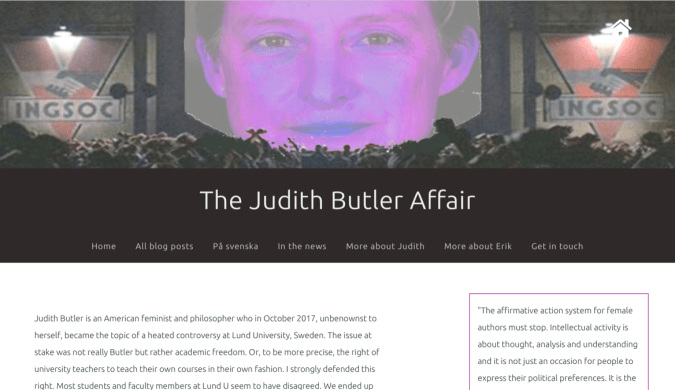
For me, it all started when the Hurt Male Ego at Lund wrote an Open Letter addressed to Butler (‘Dear Judith, if I may’), posted on his blog. In it The Hurt Male Ego talked about a ‘Campus War’ and about ‘campus feminists’ as those infringing on his academic freedom. Crucially, the Hurt Male Ego refers to this incident about teaching practice at the Political Science Department at Lund University as ‘The Judith Butler Affair’ on his website, accompanied by photos of Butler. Some days later, the Hurt Male Ego changed the photo of Butler on his website to one where her face was replacing the (authoritarian) leader in the film 1984. Launching this update of the website, the Hurt Male Ego tweeted ‘Big Sister is Watching’. (He has since changed the photo back to a less provocative one.)

Ahall - Butler Big Sister is watching

Then, the Hurt Male Ego’s PhD Student at Lund University interviewed Judith Butler over email (maybe she knew who he was, maybe she didn’t). In that interview, Butler was asked to respond to the following question: ‘How do you regard having your work imposed on a university lecturer in the name of gender equality?’ She answered, understandably, that she was not in favour of having her work imposed by quotas. But, unfortunately, Judith Butler was misled in that interview. Because, in fact, as I explain below, the policy at the Political Science Department at Lund University was never about the enforcement of gender quotas. There is more to the story. (See also this where Butler clarifies that it would be a mistake to use her remarks about academic freedom as a critique of gender studies.)

Continue reading

Critique In Hysterical Times

This is a slightly edited version of an essay that was published in The Black Book of FYTA, ed. Athanasios Anagnostopoulos & FYTA (Athens: Nefeli, 2017), 34-40, a collection marking the fifth anniversary of the conceptual audiotextual performance duo FYTA. It was written in February 2017 and revised in April. Think of it as bits of the year gone by. Thanks to FYTA for the invitation to write this, and to Jordan Osserman for useful chats.

In their performance/situation entitled ‘nEUROlogy’, presented at Geneva’s Bâtiment d’Art Contemporain in October 2015, FYTA attempted a far-right medico-theological resuscitation of the European project. The performance was staged in a confined room that FYTA describe as ‘something between the basement of a cult and Clockwork Orange’s reform clinic’—perhaps as apt a description as any of the contemporary European Union as seen from the perspective of its more disgruntled members. In Part I of this triptych, entitled ‘Eden’, FYTA assume the role of the high priests of the European right. Dressed in the red robes of cardinals, they stand before the altar of ‘Europe’, performing the rituals and incantations on which its very sustenance seems to depend. The soundscape of the performance in this segment is revealing in the way FYTA give voice to the utterly banal sentiments of xenophobic nationalists (‘Our environment is our home, our blood is what connects us to the soil, earth is our blood; when we defend our land we defend our blood’) against a disorienting musical backdrop of what sounds like Mongolian throat singing—as if to draw attention to the naturalisation of the arbitrary that is constitutive of all nationalisms. In Part II (‘The Garden’), Europe lies prostrate on a stretcher, covered by her flag. She might be dead, although the beep of machinery suggests life support. Here FYTA appear in the garb of medics who, even as they mill around the patient to no great effect, intone ‘we must remain free’. On the wall hangs a sign that reads ‘Rester Frei!’, the unfamiliar linguistic mashup seeming to gesture at the discontents of Franco-German alliance (or maybe this is just how the Swiss speak). Who killed Europe? On this question the cardinals are unambiguous: barbarians, cultural relativism, immigrants (‘how many people can you fit in the smallest of all continents!’), Islam. On the ground lies a pile of blood spattered posters—mass-produced, as if for a large protest—that read ‘Je suis Voltaire’. Beethoven’s ‘Ode to Joy’, the Anthem of Europe, ushers in Part III (‘Hell’). One thinks of the orchestra of the Titanic playing music to calm the passengers as the ship sinks.

Continue reading

Speaker Vulnerability and The Patriarchal University: A Response and Tribute to Pamela Sue Anderson

Lara ColemanLara Montesinos Coleman is Senior Lecturer in International Relations and International Development at the University of Sussex. This article was originally written for the alumni magazine of Regent’s Park College, Oxford, where Anderson was based before her death and where the author read Philosophy and Theology, and has been featured on the Women in Parentheses blog.


I never quite crossed paths with Pamela Sue Anderson. She returned to Oxford in 2001 to take up a post at my former college the year after I finished my undergraduate studies. In February 2017, we were both invited to speak at a British Academy conference on Vulnerability and The Politics of Care. Anderson’s paper was read by a friend, just weeks before her death.

All of us spoke about vulnerability, but Anderson’s contribution stood out in that she addressed our own vulnerability as speakers. She began by recounting an occasion, earlier in her career, when her audience was unable to receive her as an expert on feminist philosophy. The story stayed with many of us, because it reflected the painful, hidden histories of speakers who do not conform to preconceptions of how a ‘knower’ ought to look, be or think. These stories, if they are told at all, are normally the topic of hushed and anxious conversations, where the speaker’s close friends and colleagues express outrage and reassurance. Anderson, however, put her vulnerability on display.

Her story was about a talk at Durham on feminist philosophy. Before she arrived, the posters announcing the event had been defaced with the image of another Pamela Anderson: the Playboy model and actress who rose to fame in the 1990s. Anderson’s talk was particularly well attended – by mostly male students and philosophers drawn to it by interest in the other Pamela. From the outset, Anderson was not quite believed to be a philosopher because of her name. However, she was also accused by a prominent male philosopher of ‘disappointing’ her audience because of the content of what she said: her account of epistemology was deemed to lack the ‘particularity, concreteness and relationality required for women, and so, for “feminism”’.[1]

Of course, even the most privileged and celebrated speakers can feel vulnerable when addressing an audience. We all depend upon our audiences to hear us and to recognise us as ‘knowers’ and we all run the risk of being silenced when this recognition is absent. Some of us, however, have a greater material and social exposure to being silenced or dismissed. If we are not embodied or do not perform in a way that fits with stereotypes of the philosopher (male, white, well-spoken and able bodied), then we are often not recognisable as ‘a knower who is trustworthy’.[2] The ‘joke’ of ‘Pamela Anderson’ speaking on philosophy is instructive. It relies upon stereotypes that cannot coincide: a ‘model’ is ruled out in advance as a potential ‘philosopher’.

How do we respond when an audience is unable to recognise us as a knower? Continue reading

Right-Wing Populism, Anti-Genderism, And Real US Americans In The Age Of Trump

This is a guest post from Cynthia Weber, who is a Professor of International Relations at the University of Sussex. Cindy is the author, most recently, of Queer International Relations: Sovereignty, Sexuality and the Will to Power which was the subject of a symposium hosted by The Disorder of Things. 

The US satirical website The Onion recently ran a fake testimonial video featuring a remorseful Donald Trump supporter. The 2-minute clip is entitled ‘Trump Voter Feels Betrayed By President After Reading 800 Pages of Queer Feminist Theory’. The video features the character ‘Mike Bridger, Former Trump Supporter’, a middle-aged, working class, cishet white male from a small steel town in Pennsylvania. The balding Mike is shot in documentary talking-head style. Mike sits facing the camera, both so that his truthfulness can be evaluated by viewers and so that what US Americans will recognize as his iconic working-class garb is fully in view – dark tan zip-up jacket, olive-green button-down shirt open at the collar, white t-shirt visible underneath. Accompanied by slow music which sets a troubled, post-catastrophe tone, Mike tells his story.

‘I voted for Donald Trump,’ Mike tells us. ‘I voted for Trump because I thought he’d create a better America for everyone. But after reading 800 or so pages on queer feminist theory, I realize now just how much I’ve been duped.’

Continue reading

Militarism in the Age of Trump, Part II

Based on a paper I am co-authoring with Bryan Mabee. See Part I here.

Nation-statist militarism is the default (‘normal’) setting for militarism in international and global life.  Following Mann, this manifestation of militarism is characterized by some form of civilian control over the armed forces and a state-led economic and social mobilization of ‘destructive’ forces. (Alternative labels are ‘Westphalian militarism’ and even ‘Keynesian militarism’). In claiming the monopoly of legitimate violence, the nation-state prioritized territorial defence; planned, built and consumed from its own arsenals; and engaged in military recruitment practices that reflected and reinforced the prevailing social structures of the nation (whether professionalized or constricted).

This type subsumes what Mann refers to ‘authoritarian militarism’ and ‘liberal militarism’, his main examples coming from Europe–the absolutist polities and their twentieth century authoritarian descendants (e.g. Germany, Russia) versus the polities deriving from the constitutional regimes (e.g. Britain, France).  It even subsumes the militarisms of the post-1945 nuclear age, which include, in Mann’s terminology, sub-types like ‘deterrence-science militarism’ (‘techno-scientific militarism’) and ‘spectator sport militarism.’

Continue reading

‘You are fired!’ Towards the Hegemony of Neoliberal Hypermasculinity

This is the final post in a series of posts by several guest authors  for The Disorder Of Things symposium on Ali Bilgic‘s new book Turkey, Power and the West: Gendered International Relations and Foreign Policy, released in late 2016. In this post, Ali Bilgic responds to the previously published posts and makes some concluding remarks. The full series is collected here.


He is signing a document. Men standing behind him are all serious, looking over the shoulder of the one who he is performing the ceremony, a TV show par excellence. One of them passes the black folders; one after another, one signature after another. When he signs, his eyebrows rise a little, probably to see better. In this moment, it is possible to notice the blankness in his eyes that complements the expressionless face of the new Commander-in-Chief: there is no sign of affect in them, a staunch wall, like the one to be built on the border with Mexico, or the one in Palestine/Israel.

US President Donald Trump signs an executive order in the Oval Office of the White House in Washington, DC, January 23, 2017.
Trump on Monday signed three orders on withdrawing the US from the Trans-Pacific Partnership trade deal, freezing the hiring of federal workers and hitting foreign NGOs that help with abortion. / AFP / SAUL LOEB (Photo credit should read SAUL LOEB/AFP/Getty Images)

One expects he would abruptly say ‘You are fired’; one wonders whether he has learned and practised this masculine emotionless performance during his years in the world of entertainment: in a reality show where young men and women wildly competed against each other to prove themselves to the neoliberal finance capitalism. Otherwise, they are fired, they vanish, do not exist anymore, neither for the audience nor for the market. This kind of decision requires rational thinking; in other words, a solid emptiness, a wall.

Continue reading

Decoding Gender in Turkish Foreign Policy: How Ali Bilgic Gets it Right

This is the fifth and penultimate post in a series of posts by several guest authors  for The Disorder Of Things symposium on Ali Bilgic‘s new book Turkey, Power and the West: Gendered International Relations and Foreign Policy, released in late 2016. The full series is collected here.  Swati Parashar is a Senior Lecturer in the Peace and Development program, School of Global Studies, University of Gothenburg, Sweden. She is an Adjunct Senior Research Fellow, Monash University, Australia.


There is something fundamentally reassuring about reading a book on gendered hierarchies and foreign policy, at a time when we have just witnessed the inauguration of the Donald Trump Presidency in the United States of America. It is reassuring, because it tells us that the global gendered order of states is not going to be replaced anytime soon and gendered hierarchies will remain at the heart of all political contests, resistance and acts of solidarity. After all the biggest challenge to the Trump presidency is going to come from women’s groups who successfully organized the Global March on 21 January 2017.

Continue reading