What We Talked About At ISA: Abstraction, Authenticity, Objection

Our traditional post-conference binge series returns, with posts on talks given at the International Studies Association conference (this one was in Toronto, in March 2014).


Far Side Anthropologists

0. Prelude

Since our theme is accidental fieldwork, I will begin with an account of my accident. In the course of a PhD thesis mainly on concepts, theories and narratives of wartime sexual violence, I spent three and a half weeks in the Eastern Democratic Republic of Congo. That time barely deserves the term ‘fieldwork’, but it wasn’t desk work, and it wasn’t familiar. Working partly for an NGO, I spoke principally to agents of the humanitarian international, from ActionAid to various branches of the UN. I was partly working for others, and partly scoping out a more in-depth period of fieldwork, one that never materialised. I socialised in the same bars as those internationals, and sat by the same hotel pools. But I did not then seek to interrogate their peculiar brand of international practice. Nor have I returned to it since.

Perhaps this accounts for why my over-riding sense was one of discomfort. At some level I expected that my time away would enrich the thesis by locating my abstractions in concrete situations and real persons. Perhaps I would experience what so many seem to, and fall for the location itself, returning again and again, and slowly acquiring language, cultural cues, a taste for the food and the air. Instead I felt strangely detached, and implicated in performances not of my choosing (the expert, the knowing colleague, the route to international support, the disaster tourist). I returned more attached to conceptual inquiry, and more suspicious (I was already quite suspicious) of appeals to ‘the real world’ and its informants. My disconnection (from other ‘internationals’, from locals, from Goma itself) became clearer sometime later, sitting in a hotel suite at an ISA panel, listening to others talk about the same place, and some of the same buildings, in terms of their own discomfort and dislocation.

1. Narrative Is A Metacode

Not all representations of the field are alike. Let us distinguish three. Continue reading

A Crisis of Immediacy

I wonder if other writers feel as though they are throwing words by the hopeful fistful into a void, into the place where an audience might be. This hoped-for-reader is on my mind because I feel I should apologise for having taken so long to think these thoughts and align them so that I can throw them into that void.

There is no reason for apologies, however, because my hoped-for-reader doesn’t know that my current thoughts are inspired by a planned but only partly written series of posts from two-and-a-half years ago. Yet I feel I am writing an overdue assignment on the last day of class.

My thoughts are not timely. I worry this means they are no good. This is a strange feeling, to worry not that the words that carry our thoughts are inadequate but rather that they have gestated too long, such that tossing them into the void ceases to be a hopeful act of communication and becomes rather like dropping a crumpled page into the nearest bin.

Artwork from wraphome.org

Artwork from wraphome.org

Those many months past I wanted to write more about the economic crisis, about the disaster in the making that was “austerity”. In particular I wanted to consider what virtues might help us to navigate what seemed an all-encompassing crisis. But the moment has passed, surely. Right? There’s talk now of recovery even in Britain and signs of changing attitudes in Europe. Continue reading

Living Knowledge Traditions and the Priestly Caste of the Western Academy

comte

The Western Academy, especially in its social science and humanities wings, incorporates as a priestly caste. Perhaps Kant is the first high priest of this caste when he argues for the Aufklärer to become a corporate entity equivalent to the hierocracy and nobility but exceptional in its duty to provide a truly public service of reasoning. The psalm of this priestly caste is “have the courage to use your own understanding”, its catechism: to singularly possess and hold aloft the flame of revelation, known as science, or, nowadays, the modern episteme. Even Marx holds the flame aloft when he takes Hegel’s Philosopher, who breathes world spirit, and makes him inhabit the skin of the Communist.

This priestly caste, as it founds the church of modernity, is instantly and integrally involved in founding a broader colonial division of labour.  These new priests conjure up the traditional/modern divide by the use of history –  differentiating old and new European Western societies – and by the use of anthropology (later, sociology too), by differentiating the colonized from the colonized. The living knowledge traditions of the colonized are pronounced dead on arrival in the present. And their cosmologies, philosophies, social practices – are entombed into opaque “cultures” the contents of which can only be clearly illuminated by the keepers of the flame. 

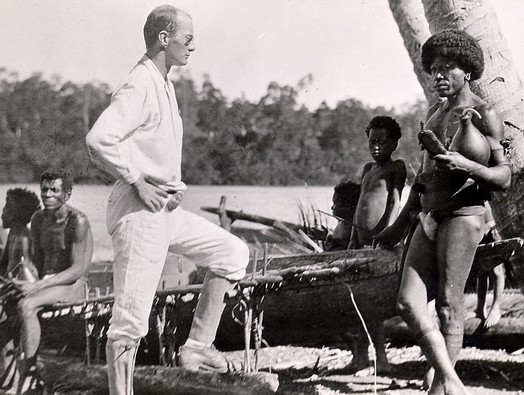
19_malinowski

Ultimately this mapping of difference works through race, gender and class coordinates so that even the “poor” living in the West, as well as un-mastered women and single mothers intersect with (post-)colonized subjects to become part of this opacity. The episteme of the Western Academy thus differentiates between the knowers and the known.

In this respect, the modern episteme is as seminal as gunboats to the maintenance of colonial difference. Key to this difference is not just the attribution of extra-ordinary exploitation, oppression and dispossession to colonized peoples but also their epistemic erasure, i.e., the outlawing of the possibility and desirability of intentional self-determining community amongst the colonized and their post-colonized descendents. It is in the colonial world and not Europe where Europeans develop the art of objectifying peoples into populations such that the basic competency of the colonized to self-define is deemed absent by the instruments and mores of European sanctioned international law. Postcolonial populations have only been able to become peoples under very specific conditionalities; and many who make the transition become the new police of colonial difference. Those who fall between or prefer a third way become the ungoverned, or ungovernable.

Continue reading

Dr Schwarz, I Presume?

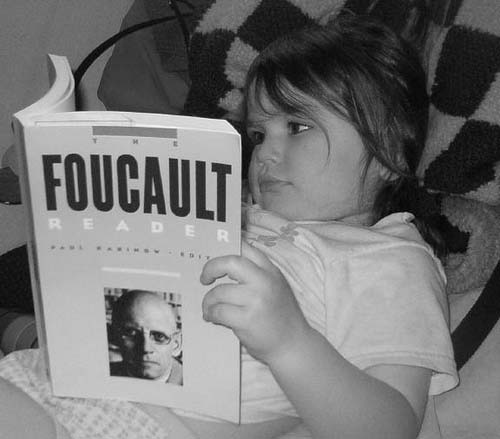
And so, after some delay due to storm, and just a month after The Disorder Of Things turned three, our own Elke was closely quizzed by Professors Patrick Hayden and Chris Brown. The cause? The defence of her doctoral thesis: The Biopolitical Condition: Rethinking the Ethics of Political Violence in Life-Politics. Arendt, Foucault, and drones. Now passed, certified, set free. Without corrections. Henceforth, Dr Schwarz.

Elke Foucault

Not actually Elke.

Struggling with Precarity: From More and Better Jobs to Less and Lesser Work

Once a French neologism, precarity is now a household name describing in equal measure the fate of low-wage, part-time holders of bullshit jobs, seasonal and migrant workers, creative entrepreneurs of the self, “graduates with no future,” foreclosed homeowners, debtors and increasingly even segments of the salaried bourgeoisie. At its most basic, a term for the economic uncertainty and existential angst associated with the dissolution of fixed employment, precarity also suggests the disintegration of stable societal bonds, occupational identities, social protections and a sense of entitlement and belonging characteristic of the old proletariat. In short, then, precarity is the experiential dimension of the crisis of the society of work dating back to the 70s and 80s.

Diego Rivera Detroit Industry Mural 1923

Increasingly advanced production methods, introduced since the 70s to tame shop-floor insubordination as well as reap the untapped potentials of global competition, have caused a decline in growth rates, which no amount of privatization, financialization and austerity measures has been able to make up for since. Andrew Kliman and others have argued that it is this real crisis in capitalist productivity that lies at the heart of the current slump, and not simply unrestrained financial gluttony, as the more short-termist analysis offer. As capitalist production develops, machines replace people and the rate of profitability, which is given by the human labor theory of value, drops, causing sluggish investment and slow growth. This is essentially Marx’s theory of economy crisis, aka the tendency of the profit rate to fall, but also a story we should know by now from Autonomist accounts about the transition from Fordism to post-Fordism (Hardt and Negri) or from profit extraction to rent-becoming-profit (Christian Marazzi), and from David Harvey’s accumulation by dispossession.

If we shift the scale of our focus from capital to labor, though, we see that the crisis of capitalist productivity is, in fact, a crisis of work or a crisis of a society built around work as the only legitimate point of access for income, status and citizenship rights. Again, Marx is instructive here: “Capital itself is the moving contradiction, [in] that it presses to reduce labour time to a minimum, while it posits labour time, on the other side, as sole measure and source of wealth.” Socially necessary labor is reduced to a minimum (through things like automation, outsourcing, and financialization) at the same time that human participation in paid work continues to remain our only measure and source of wealth. Work doesn’t disappear as a result. It becomes fragmented, devalued, and wasteful, ceasing to provide a social identity or a collective language of experience.

Image

Precarity is a word for our time. It describes the slow disintegration of the historic bond between capitalism, democracy and the welfare state. But it also entails a rallying cry to reverse this situation. Continue reading

The Pay Strike And Its Discontents

Breaking Bad Pay Teachers More Money

The ballots are out, the wheels are in motion. Union members have until Thursday 10 October to vote on strike action over the latest derisory pay offer of 1% (if you haven’t received a ballot, go here). The justness of the cause seems clear enough. Since 2009, every pay award has been several percentage points below inflation, leading to a consistent real terms drop in pay. And some of those paltry increases were only attained after negotiations. Yet, despite the protests from above (and excepting a brief dip in student numbers), British higher education is in fine financial health. The overall wage bill is decreasing at the same time that surpluses are growing. And for “growing” read “more than doubling”, from £488 million in 2007/8 to £1.1 billion in 2011/2012. Managers are reaping their rewards accordingly, and a significant portion of Vice-Chancellors are seeing their pay go up by 10-20%. At Sussex, for example, Michael Farthing is now paid £280,000 (including pensions contributions), as compared to £178,000 in 2007 (that’ll be a 57% increase then).

And yet there is a foreboding. Fear is a factor, nondescript anxiety another. Perhaps an awkward sense that any level of action is somehow at odds with the academic code.

Articulated objections come in two stripes. First, the we-haven’t-got-it-so-bad defence. Beyond the usual ‘all in it together’ austerity ideology, there are pay increments (which most permanent academic staff get automatically). Real wages aren’t declining so hard if you move up a pay step each year. This is on its own a pretty restricted ambition, since it amounts to a kind of career “progression” that leaves you standing still. It is also, for all the talk of solidarity with lower-paid workers, a selfish analysis.

In the last 5 years, the pay for new lecturers and tutors has dropped 13% in real terms. Following the USS pension saga, they (we) have each had tens of thousands of pounds taken from them over the course of their careers, while staff that retained their old rights are paying more every month into a scheme that was, let us recall, nowhere near crisis. There are fewer scholarships and research grants than before, and an increase in teaching-heavy posts. Consumer-driven logics are set to make that worse. On the horizon, just over there, is a US-style expansion based on precarity, a prestige elite, and debt bubbles. Some at the top are already breaking from the national pay spine, inaugurating a two-tier system. Consider this trend alongside the state of university finances. What is it to look at this and say things aren’t so bad? I put it to you that such a position is detached, complacent, and irresponsible.

Second, there is the strikes-change-nothing complaint. This has better justification. Local actions over the last years have not reversed policies. Pensions were stripped down anyway. And there is something peculiar, isn’t there, about the idea of day-long walkouts and picket lines in a sector so based on relatively scattered student-teacher interactions. There is no machinery to fall silent, no buzzing shop floors to stand empty. Just a day of saved wages for management and probably a whole stack of reorganised lectures, academics not really being the types to withhold knowledge (or, rather, unwilling to see knowledge as labour). There is a sense that the old tactics are dead, and should be left in their graves.

On the one hand, this is an argument for more radical action. If employers can handle strike days, we need more. Or, alternatively, forms of action that do not fetishise the picket line. Something that will make VCs pay attention, like a marking boycott or withholding final grades. In a customer-orientated culture this is the pressure point, especially if action begins to alter the results of the National Student Survey, that Big Other of the academic scene (what do students really want?). The complaint goes up that the national union lacks the imagination to instigate these actions, and that we should therefore turn to more vibrant kinds of opposition. But new forms of resistance nevertheless confront established modes of punishment. When full pay is withheld day on day, when even partial performance leads to the forfeit of full wages, how quickly will we really buckle? We know something has to break the pattern, but we’re not sure we’re capable of it, or that the sacrifice is worth it. In other words, we find ourselves a little too close to text-book academic bitching: something more fundamental needs doing, but we’re not likely to be the ones to do it.

On the other hand, the fear and the paralysis can be found closer to home. Complaints about the union form do not produce their alternative ex nihilo. There are possible replacements, but no actually-existing ones. Nor does the appetite for creating one seem to exist. And for good reason. The paradoxical character of academic subjectivity is both to consider ourselves in a position of real epistemic and social privilege and to be so despondent about our influence on things as to merely absorb the changes thrust upon us (working conditions, impact agendas, research restrictions). The legal protections of strike action have no parallel, truncated as they are. Creative alternatives have raised energy, and served as political classrooms in their own right, but they haven’t actually stymied ‘reforms’ (whether on fees, outsourcing or investment portfolios). And, strange as it may sound, universities are probably happier taking draconian action against their workers than their students. A faculty occupation, if we could even imagine such a thing, would not end well.

None of that is to say that we (there’s that intangible collective again) should walk zombie-like to the picket. Fersure, let the rejuvenation of academic democracy proceed apace. In the meantime, we have to ask ourselves seriously what the consequence is of another pliant year. There are murmurings that a failure to win this ballot will endanger collective bargaining itself. If we cannot muster the resolve to deliver a strong yes on action short of a strike, and a strong yes on strike – if we cannot even deliver a serious turnout – that’s probably as much as we deserve.
The Queer Art of Whistle Blowing

What should we make of the fact that Bradley Manning has become Chelsea, that Glenn Greenwald is gay, that David Miranda loves a man enough to submit to the harassment incurred by his partner’s work, that Greenwald’s detractors sought to tarnish him by association with—of all things—a porn company? Possibly nothing generalisable, except that gender is doing work here.

There has been no shortage of voices denying a straightforward connection between sexual orientation, gender identity, and patriotism. (Part of the reason I feel compelled to write about this is that there isn’t one.) San Francisco Pride Board notoriously repudiated Manning’s election as a Grand Marshall in the 2013 Pride in that city, declaring: ‘even the hint of support for actions which placed in harms [sic] way the lives of our men and women in uniform—and countless others, military and civilian alike—will not be tolerated by the leadership of San Francisco Pride.’ That statement has not been retracted, notwithstanding its now patent inaccuracy in light of the prosecution’s inability to cite any evidence that Manning’s leaks led to any deaths and the court’s decision finding her not guilty of the charge of ‘aiding the enemy’. Kristin (formerly Chris) Beck, ex-US Navy Seal who recently announced her gender transition, has been harsher in her condemnation of Manning: ‘For this person, whether male or female to use gender identity to act “BADLY” is a slap in the face to me and everyone who does not fit the “Binary Gender Norm.” It is not an excuse for anything illegal or unjust.’ Pablo K is right to point out the dangers of the temptation, for those who see a link between sex/gender and truth-telling, to make the reverse move—’to relegate Beck to a minority report, and so to re-inscribe the hierarchy of authenticity, this time with Manning as the actual face of resistance, and Beck the mere puppet of militarism’—while pointing out, also, that the gap between these contrasting appropriations is constitutive of the space of contemporary politics. So let’s talk politics.

Continue reading

Washington, DC: a human rights city?

Below are some initial reflections on the work I’ve been doing in Washington DC on the human right to housing. They are not terribly substantive and serve as much as a tribute and thank you to those who hosted me as disquisition on the topic. But I wanted to post the piece for those who might be interested in my broader project, or what’s going on in Washington DC. Enjoy.

In December 2008 Washington DC was declared a human rights city. The DC City Council passed the resolution, pushed for by the American Friends Service Committee. While this is a lovely idea, it leaves one wondering what does it mean to be a human rights city. In particular, what does it mean in a city defined by inequality, where more than 15,000 citizens do not have homes, where 20% of the population lives in poverty, where housing is more unaffordable than anywhere in the United States, and where public and affordable housing is under constant threat. Perhaps the declaration of DC as a human rights city would seem less cynical if the DC City Council or the Federal Government had shown themselves committed to protecting the human rights of residents of the District, particularly the right to housing.

Housing is a Human Right

Human rights promise us many things. The right to housing, however, is perhaps the most fundamental. What do our rights mean if we do not have a place to call home? Article 25 of the Universal Declaration of Human Rights promises that

Everyone has the right to a standard of living adequate for the health and well-being of himself and of his family, including food, clothing, housing and medical care and necessary social services, and the right to security in the event of unemployment, sickness, disability, widowhood, old age or other lack of livelihood in circumstances beyond his control.

The right to housing is fundamental because it is in our homes that we find the space to rest, to pursue wellness, to find love, to raise families, and build communities, to collect our energy and thoughts so that we can participate in democratic politics, and it is where we find the safety, security and privacy that make a dignified life possible. Continue reading

Bodies in Pain: Yasiin Bey and the Force-Feeding of Hunger Strikers at Guantanamo Bay

Lauren WilcoxA guest post from Lauren Wilcox, currently Charles and Amy Scharf Postdoctoral Fellow in the Department of Political Science at Johns Hopkins University. Lauren is starting a new job as a University Lecturer in Gender Studies at the University of Cambridge this fall. Her  work is located at the intersections of international relations, political theory, and feminist/queer theory in investigating the consequences of thinking about bodies and embodiment in the study of international practices of violence and security. She is the author of articles in Security Studies, Politics & Gender and, most recently, International Feminist Journal of Politics. Lauren’s current book manuscript is entitled Practices of Violence: Theorizing Embodied Subjects in International Relations.


Mos Def Nose Tube

Earlier this month, the UK human rights organization Reprieve released a video in which Yasiin Bey, formerly known as Mos Def, a well-known and critically acclaimed American hip-hop artist and actor, underwent (or attempted) the force-feeding procedure undergone by hunger strikers imprisoned at Guantánamo Bay. In this five minute video, Bey dresses in an orange jumpsuit like those worn by prisoners at Guantánamo Bay, and states simply that this is the ‘standard operating procedure’ for force-feeding hunger striking prisoners. He is then shackled to a chair resembling those used to force-feed prisoners (such as those pictured below). Bey is approached and held down by two people who attempt to insert a nasogastric tube down his nasal passage way. The video shows Bey struggling against the nasogastric tube, crying out, protesting, yelling for it to stop, and ultimately the force feeding is not carried out. The video is extremely emotional and difficult to watch. After the attempted force-feeding ends, Bey struggles to describe what it feels like, describing it as ‘unbearable’. It ends as it begins, with Bey stating ‘peace’ and ‘good morning’.

For some background context, 166 prisoners remain in Guantánamo Bay: of these, 126 have been cleared for release as not posing any threat to US national security, but are still being imprisoned. To protest their treatment and indefinite confinement prisoners have engaged in hunger strikes since the prison camp opened in July of 2002, the first wide scale hunger strike reached a peak in June 2005, when between 130-200 out of approximately 500 prisoners at Guantánamo Bay began refusing food. Hunger strikes again reached a peak in the spring and summer of 2013, and are ongoing with around 100 prisoners refusing food, and of those, between 44 and 46 are being force-fed (pictured above is an image of an inmate being hauled to the medical facilities to be force-fed), a number so high that the military had to send a back-up team of medical personnel to assist with the force-feeding of prisoners. While the force-feeding of hunger strikers when virtually unnoticed in the media in 2005/6, and again in 2009, the latest months have brought renewed attention to the plight of those who have been held at Guantánamo Bay, some for over a decade, with seemingly no progress made on holding tribunals or securing release of the remaining prisoners. Prisoners have spoken out, including an op-ed published in the NY Times by Samir Naji al Hasan Moqbel entitled “Gitmo is Killing Me”. While President Obama has recently renewed his pledge to close Guantánamo Bay, and a federal judge has even more recently stated that while she had no power to stop the force-feedings, Obama could himself order the force-feedings stopped.

What are the effects of Bey’s action? Continue reading

On Rejecting Journals

Kertesz - Man and Abandoned Books

Any excuse for an André Kertész image.

Yesterday, in an act of minimal defiance, I declined a request for peer review on the grounds that the journal was owned by Taylor and Francis, and therefore charges authors £1,788 per piece for open access, or imposes an 18 month restriction on repository versions. In the wake of the OA debate, this situation seems increasingly ludicrous: for the short term at least, an increase in journal profit streams, made possible by the sanctity of unpaid academic input. The principle (saying no to closed journal peer review) is not inviolable, but a reluctance to subsidise shareholders with free labour seemed an appropriate response to the current balance of forces.

So far so good, you might think, but there is a lingering issue of ethics. It was suggested, following a previous act of review rejection, that some hypocrisy might be at work. Am I not proposing the withdrawal of a service that others would perform for me without complaint? Since the infrastructure of the academy rests on the provision of reviews, and since academics benefit from having their published work certified, submission to any closed journal, without providing reviews to the same, is tantamount to parasitism. A use of colleagues’ labour without returning the favour, all easily accomplished in an accounting system that positively celebrates the anonymity of authors and reviewers.

The most forceful of open access advocates would point out at this stage that the answer to this dilemma is pretty straightforward: don’t review for closes access journals and don’t publish in them. Simply move your labour – writing, reviewing, editorial board-ing – as quickly as possible to the more open journals. The more of us who do that, the quicker the transition to proper open access will be. This is true, but it won’t quite do. For two reasons.

First, whatever is to be wished for, the Arts, Humanities and Social Sciences currently lack open access journals prestigious enough to make submission to them a low cost option in the economy of reputation. This is a corollary of the market dominance enjoyed by closed journals: scholars are penalised if they step outside of this reputational system. This point that has been raised before, and clearly depends considerably on the exact field, and the national context. On the UK scene, even where academics stress that they themselves would never pre-judge a piece by publication venue, they usually hold that someone else (the Big Other of the REF, policy makers, ranking systems, managers) will, and so they are driven to conform in any case, thus becoming entangled in a chronic game of second-guessing. More clearly still, this disproportionately affects junior and precarious scholars, who have most to lose by moving outside a system still primarily functioning according to logics that precede them.

Second, and more crucially, journals are not just empty vessels, and are not interchangeable in content, editorial policy or audience. Continue reading