Kissingerian Contempt: Realism, Statism and Other People’s Genocides

For a blog apparently devoted to global politics, we have so far rather neglected its voguish scandals and intrigues. Disciplinary exposure therapy has evidently done its work, particularly where the amorphous theory-cum-policy-manual of Realism is concerned. After all, what could be more mutually disappointing than a lengthy online discourse on the neo-neo ‘debate’ or its ilk? So much somnabulatory exegesis.

That said, last month’s fracas over ‘criminal psychopath’ and one-time ‘elegant wit’ Dr Henry A. Kissinger deserves a mention. In new releases from the Nixon tapes, his fawning jingoism in the name of some clear-cut national interest rather caught the eye:

The emigration of Jews from the Soviet Union is not an objective of American foreign policy…And if they put Jews into gas chambers in the Soviet Union, it is not an American concern. Maybe a humanitarian concern.

Bushite polemicist Michael Gerson took the opportunity to indict Realism, denouncing its shallow moral compass in favour of a vision of more righteous foreign policy (neo-conservative manifest destiny branch). Stephen Walt responded, pointing out that Kissinger is not the delegated representative of Realists, that many who self-describe as such opposed both the Vietnam and Iraq wars, and that hand-wringing by culpable members of the Bush administration over the human costs of foreign policy is straight-up hypocrisy. Henry Farrell at Crooked Timber rightly stressed that this was besides the point, since what makes Kissinger Realist in the relevant sense is his instrumentalist attitude to the lives of others and the over-riding importance of material power in his world view. Along the way, he also provided a particularly apt description of this particular peace-prize winning carpet-bomber as in thrall to “a scholar’s fantasy of Metternich, in which cynicism, duplicity, and clandestine brutality were not foreign policy tools so much as a demonstration of one’s ‘seriousness’ as a statesman“. Nice. Enter Christopher Hitchens, spraying invective like it was the old days and usefully dismantling the apologetics now apparently emanating from several quarters [1].

Naturally, the seriousness of Kissinger’s servile indifference is as nothing next to his actual and extensive crimes, if legal language can be made to fit the special character of his achievements. And one can hardly credit that the good doctor’s snivelling before the anti-Semitism of Richard Milhouse Nixon should matter half as much as his responsibility for the deaths visited on Kien Hoa or the euphemistic and not-so-euphemistic barbeques served up as part of operations ‘Breakfast’, ‘Lunch’, ‘Dinner’, etcetera. Continue reading

The Racial Empire of International Relations

Primarily, our action is based on national self-interest. In other words, it is patriotic. A certain limited number of persons are fond of decrying patriotism as a selfish virtue, and strive with all their feeble might to inculcate in its place a kind of milk-and-water cosmopolitanism. These good people are never men of robust character or imposing personality, and the plea itself is not worth considering. Some reformers may urge that in the ages’ distant future patriotism, like the habit of monogamous marriage, will become a needless and obsolete virtue; but just at present the man who loves other countries as much as he does his own is quite as noxious a member of society as the man who loves other women as much as he loves his wife. Love of country is an elemental virtue, like love of home, or like honesty or courage. No country will accomplish very much for the world at large unless it elevates itself. The useful member of a community is the man who first and foremost attends to his own rights and his own duties, and who therefore becomes better fitted to do his share in the common duties of all. The useful member of the brotherhood of nations is that nation which is most thoroughly saturated with the national idea, and which realizes most fully its rights as a nation and its duties to its own citizens.

Theodore Roosevelt, The Monroe Doctrine (1896)

Roosevelt’s imperial condescension is but one of the historical anecdotes mobilised in a recent paper by Robert Vitalis to trace the legacy of empire and race in the development of International Relations as a discipline. Although eschewing a direct critique of the contemporary field (since “the likelihood is small that self-identified specialists in international relations will seek out an account of the discipline’s past in a journal that has no standing in the field”), he nevertheless provides a wealth of historical detail on the complicity of scholarly ancestors in ‘colonial administration’ and its attendant euphemisms.

Take A. Lawrence Lowell, a political ‘scientist’ who went on become President of Harvard and used that lofty perch to impose a  dormitory colour bar for freshman in 1915 (and a man now also revealed as the convener of homophobic secret trials). A proponent of professionalised training for colonial administrators, Lowell also set legal arguments before Congress explaining that the requirements of the Constitution need not be upheld in those violently-acquired territories where the racial capacities of the indigenes fell short of proper statehood. And, like a rather more recent over-flattered Harvard globetrotter, he was particularly interested in the wisdom to be gleaned for such bold endeavours from British experiments

Or take the institutional delivery rooms of International Relations itself. At the first ever APSA conference in 1904, ‘Colonial Administration’ was designated one of the five fundamental branches of Politics. One prominent speaker that September was William Frank Willoughby, an APSA founder, its 10th President, and the author of Territories and Dependencies of the United States (1905). He crafted this work in a particularly applied setting (pay heed ye  assembled bridgers of theory and practice), serving as both Treasurer and Secretary of Puerto Rico from 1901-1907. It seems reasonable to assume that auto-ethnographic reflexivity did not feature heavily in his work. A decade later he became director of a new research body, soon re-christened as The Brookings Institution.

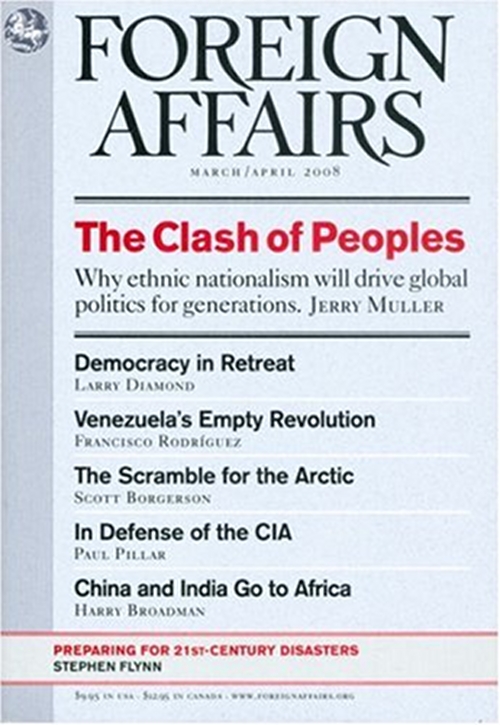
And what of our learned fora? Perhaps most symbolically of all, the debates over the proper governing of lesser peoples were carried out in the discipline’s first publication, The Journal of Race Development. It was founded in 1910 by G. Stanley Hall, who headed up a centre on the psychology of the races at Clark University, and who also pioneered the idea that the developmental stages of individual humans mirror the hierarchies of race, with children being to adults as savages are to the civilized. The twist being that in 1922 The Journal of Race Development became Foreign Affairs, still the go-to publication on global ‘administration’ (although this particular legacy is mysteriously absent from its current autobiography).

Several general themes emerge from the detail. First, far from positing states as the central actors of global politics, the comprador intellectuals of the early 20th century saw race, both within and without the United States, as the salient frontier. The earliest IR scholars all included American racial relations (to wit, the Southern ‘Negro problem’) within their disciplinary remit. In a racial supremacist twist on W.E.B. Du Bois’ ‘colour line’ “the world’s biological boundaries mattered much more to theory-building than did territorial boundaries”.

Second, the centrality of race as a category was not a mere function of scientific ignorance. Continue reading

‘The only answer was slaughter, and the only way to do it was fast’; In which others read the autohagiography of Anthony Charles Lynton Blair so I don’t have to

The publication of Blair’s recollections and rationalisations has been a gift to many of us. Not content with the material for satire he provided during office, he has now furnished us with further damning evidence in his own hand. A weighty (non est) mea culpa. Pat psychologising, quasi-religious conviction, the hamfisted use of historical analogy and that overwrought prose (now infamous: “I needed that love Cherie gave me, selfishly. I devoured it to give me strength. I was an animal following my instinct, knowing I would need every ounce of emotional power to cope with what lay ahead“). All of this has enabled some incisive commentary, and some barely contained rage: Tony as Captain Stanhope; Tony as the ‘preacher on a tank’ (Dick Cheney’s apposite barb); Tony as delusional Christ-Pope in waiting.

Three thoughts. First, there is the question of how we can now read Blair, and Iraq as the exemplar of his style of thought. What were the mechanisms that allowed the clear advice of experts of all stripes, and the opposition of most of the population, to be translated into an unbending commitment to the projection of American power? A familiar answer is that the New Labour project was driven by the energies of Blair’s religious (or religious-like) faith, his commitment and earnestness and belief. But the scene set by A Journey and its deconstructions is far more prosaic. On the one hand, there is plenty of garden-variety ‘misperception’. Actors chose the analogies that fit their pre-established understandings, over-emphasised the pressures for action in their calculations, and failed in their responsibility to examine situations from more than one angle. These are the kind of slippages that pop up enough for some systems- and cognitively-minded scholars to trace their role in wars across the ages.

On the other hand, there is Blair’s extraordinary decisionism. Something must be done, and someone must do it. But this is in some ways the reverse of a faith-based politics. It was not belief that guided Blair, and certainly not carefully delineated actions set out by dogma or doctrine. It was the absence of such a schema which mattered, at least on his own account. “The pieces are in flux”. Hence the insistence on leadership, on grasping the truth and necessity of the moment. What continues to intrigue is this movement between an over-abundance of values and the hardened core of Machiavellianism. The necessity was never one dictated by the ends of justice, but only that of power and its demands.

Yes, ideology was at play. But structurally so. Not in the bible readings and personal psycho-dramas of two little rich boys from New Haven and Edinburgh, but in a much less appreciated, and much more insidious sense. A subjectivity with a sociology. There is something typically Žižekian about this apparent paradox. As with others nominally committed to grand projects, the issue is not one of hypocrisy, so much as of the means by which raw power and purity of purpose can be experienced as synonymous:

the figure of the ‘big Other’ as a background against which [to] exert… ruthlessness and drive for power. They had displaced their belief onto this Other, which, as it were, believed on their behalf. Continue reading