Myths of Invention

The fifth commentary, and sixth post, on Nick Srnicek and Alex Williams’ Inventing the Futurefrom DoT’s own Joe Hoover. A reply from Nick and Alex will follow.


Inventing the Future begins with a lament.

Where did the future go? For most of the twentieth century, the future held sway over our dreams. On the horizons of the political left a vast assortment of emancipatory visions gathered, often springing from the conjunction of popular political power and the liberating potential of technology.

The authors resent that they have been denied a future with more promise than the present. They mourn the absence of the object of their desire, the impossibility of its fulfilment, the lives to be lived in these lost leftist utopias. This seems to be a widely felt disappointment, if we are to judge by how often the complaint has been made of late. Disappointment leads to diffuse anger, directed at the status quo on the “Left”, its lack of vision. At the root of this discontent is anger at the world itself, for all of the ways it impedes us, frustrates our hopes and gives no comfort to our dreams – it is a world in need of re-making. I do not want to suggest that because the book’s narrative is motivated by such feeling that it can be reduced to an outburst against the vagaries of existence, the work is too focused and the problem it addresses too serious for such crude criticism. Yet, this fundamental emotional resentment colours the project in an important way.

Orpheus plays his lament

The lament shapes the inquiry itself. We are wounded by the loss of our desire – a future flush with possibility – and we are angry at capitalism for stealing our future. Obviously the detail is more sophisticated than this curt summary, but a stark statement of the underlining logic reveals the essential narrative. The problem of contemporary Left politics is not the desire for a universal utopian future but rather that this future has been lost, which runs counter to important criticisms of progressive leftism (a point taken up by Aggie Hirst and Tom Houseman). Therefore, the authors’  task is to remind us why we desire the future, then to consider where to look for a new one and how to seek after it. Inventing the Future is a quest to find what was lost, so we can become whole in our desires. We may set out on such a quest with great optimism but we still carry a worrisome anger with us.

There are a great many barbarities in our world attributable, at least in part, to “capitalism” but it is not a villain stealing away with our ladylove (the difficulties of determining what capitalism is are taken up later). Our lost future is not the exceptional crime of some neoliberal conspiracy. Yes, I know the book does not say anything quite so crude. Nonetheless, the narrative structure is driven by a conflict that finds its resolution with the us (the protagonist) achieving wholeness in a future fulfilment of our desire. The authors make the caveat that contestation will not end in this postcapitalist future, but this future still holds out the promise that the conflicts of today will melt away. The world is always messy, unfinished, stubborn, cruel, confused, and, I posit, resistant to the kind of  breaks with past ways of being that are suggested here (Sophie Lewis and David Bell look at the temporalities involved in greater detail). If we lament that, we risk resentment against the world itself, against human existence and against flesh and blood people who move slowly and impede our dreams. Love of the future sits dangerously close to hatred of the present – which is not to say we should have no love of the future, but rather that we ought to be wary of too much of it.
Continue reading

Pyrrhic Victories: The Endgames of Accelerationist Efficacy

The fourth commentary, and fifth post, on Nick and Alex Williams’ Inventing the Future, delivered by Aggie Hirst and Tom Houseman. Aggie is a Lecturer in International Politics at City University London. She works on issues relating to violence and international theory/philosophy, including war and wargaming, US foreign policy, Derrida, Nietzsche, and post-foundational ethics/politics. Tom is a Lecturer in International Politics at the University of Manchester, focusing on capitalism, development, and ideology. He is variously interested in (in no particular order) the politics of epistemology, apocalypticism, Adorno, international development, and concepts of science.


In a climate of successive defeats, missed opportunities and the consolidation (and even exacerbation) of unequal and exploitative social relations, there are few acts more thankless than turning the weapons of iconoclasm against those already waging a struggle against insurmountable odds. Inventing the Future seeks to rescue the Left from what its authors term ‘folk politics’: a commitment to horizontal, local, consensual and prefigurative forms of political action, which the authors claim result ultimately in impotence and irrelevance, aimlessness and lack of focus. In condemning a host of the post-68 Left’s most dearly held praxiological and ethical commitments, Srnicek and Williams wilfully risk aggravating and alienating those they seek to influence.

There will be many readers who will find their prescriptions – the revival of universalism, the aspiration to hegemony, the mobilisation of state power – outdated, odious and even obscene. And for good reason: the attack on ‘folk politics’ doesn’t end after the critique that opens the book. Instead, the sheer audacity of the authors’ wager – essentially that our only hope of defeating the Godzilla of neoliberal capitalism is the creation of an equally powerful Mechagodzilla capable of supplanting the former’s hegemony with its own – performs an ongoing rejection of a parochialism and modesty they see as having corrupted Leftist activism and academia. Like all iconoclasm, such a move is necessarily scandalous in response to the perceived sanctity of that at which it takes aim.[1]

It is precisely this scandalous character of both the book and its precursor, the ‘Manifesto for an Accelerationist Politics’ (MAP), which goes some way to accounting for the attention the authors have generated across the Left. The book’s stated goals are both vast in scope and highly controversial, yet its tone is one of consistent and calm self-assuredness. The magnitude of the risks associated with the project – the casualties of automation (both human and environmental), the tyrannies of engineering consent, the violences of assuming the task of constructing people’s very identities, to point to just a few – would suffice to make most recoil in dread. The authors’ composed confidence in the face of such potential horror makes reading and responding to the seductions of such book a complex and disorientating task.

Continue reading

Can Metrics Be Used Responsibly? Why Structural Conditions Push Against This

Not waving, exactly, but...

Not waving, exactly, but…

Today, the long-awaited ‘Metric Tide’ report from the Independent Review of the Role of Metrics in Research Assessment and Management was published, along with appendices detailing its literature review and correlation studies. The main take-away is: IF you’re going to use metrics, you should use them responsibly (NB NOT: You should use metrics and use them responsibly). The findings and ethos are covered in the Times Higher and summarised in Nature by the Review Chair James Wilsdon, and further comments from Stephen Curry (Review team) and Steven Hill (HEFCE) are published. I highly recommend this response to the findings by David Colquhoun. You can also follow #HEFCEMetrics on Twitter for more snippets of the day. Comments by Cambridge lab head Professor Ottoline Leyser were a particular highlight.

I was asked to give a response to the report at today’s launch event, following up on the significance of mine and Pablo’s widely endorsed submission to the review. I am told that the event was recorded by video and audio so I will add links to that when they show up. But before then, a short summary record of the main points I made: Continue reading

Ethical Encounters – Parsing the Pluriverse: empathy and deliberation in a post-MDG ethics of international development

DSC00921

Our fifth post in the forum is a guest post from Diego de Merich. Diego got his PhD from LSE and is now an LSE 100 Fellow and a research associate at the Institute for Intersectionality Research and Policy at Simon Fraser University. His work focuses on human empathy and the ethics of care in service of alternative frameworks for International Development (post-Millennium Development Goals). For earlier posts in the forum do look for Myriam’s here, Joe’s here, Elke’s here and Jillian’s here. Kim’s discussion post can be found here.


With the Millennium Development Goals (MDGs) set to expire in 2015, focus has turned to a new framework which might replace them. Heavily influenced by the Human Capabilities Approach (HCA), the MDGs and the recently-proposed ‘Golden Thread’ frameworks posit a relatively monolithic, liberal understanding of what ‘development’ is meant to signify. As such, each new iteration of an international agreement on development seems destined to miss the potential for more creative and context-appropriate political action in response to the shortcomings of the approaches which preceded them. Using as a starting point Arturo Escobar’s Encountering Development, I suggest that his notion of the pluriverse – which stands in opposition to the ‘universal and homolingual thrust of modernity’ – both challenges the post-2015 discourse and implies the need for different ethical practices upon which ‘development’ might instead be re-cast. Realisation of the pluriverse and notions of care, responsibility, democracy and pluralism would require that closer attention be paid to narrative voice and to the role that empathic processes should play in the deliberation surrounding development.

The ‘promise’ of empathy in pursuit of a post-MDG development practice can be understood by contrasting two approaches to deliberative democracy – one which would hold the HCA as its guiding ethical impulse and one which suggests that an ethics of care and responsibility in international development requires a better appreciation for the role that empathy and narrative play in understanding the development possibilities and realities of the constituent elements of Escobar’s pluriverse. Here, the focus of ethical enquiry is shifted from a more abstract notion of social justice to a recognition of shared/lived vulnerability, alternatively-imagined ways of being and thus, to an ‘international development’ which is differently understood and practiced.

Untitled Continue reading

Ethical Encounters – The Special Ambiguity of Humanity

This is the second post in a series reflecting on contemporary global ethics that was originally organised as the Ethical Encounters in a Changing World panel for the 2015 ISA convention in New Orleans. Myriam Fotou’s original post can be accessed here, Elke’s is here, and Jillian’s here. Kim’s discussion post is here.


Encountering Humanity

Humanity is special. This sounds like a very conventional claim. We are used to hearing appeals to our common humanity. The appeal works on the presumption that there is something in human beings that we not only share as humans but which also calls us to respond in particular ways when we encounter each other. We are said to have human rights that exceed any of our particular belongings to states, faiths or ethnicities. We intervene to protect human beings beset by violence and catastrophe, disregarding the norms of sovereignty that prevent outside interference. We appeal to our common humanity to solicit resources for distant strangers, often depicted in their suffering as vulnerable human bodies to shake us from our everyday disregard. Humanity is appealed to as a matter of routine, but what does our humanity consist in?

Reflection on the meaning of humanity is less common than our appeals to it, yet this deeper rumination also comes with practiced ease. Knowing what our humanity is has long been a matter of divining what is distinctive about human beings and then moving to grant our distinctively human capacities an exalted status, claiming it as our essential nature. Humanity, as something to which we appeal, is conventionally a judgment on what is prized in human nature, marking out what is elevated amongst all the contradictions of our all too human nature.

Huge Manatee

Humanity then works not only as an appeal – “for the love of humanity!” – but also as a standard to which we should be held. Knowing what is properly human provides a guide to our interactions. What do we owe each other? To be treated in accordance with our essential nature. In a typically modern and Western formulation: to be treated as rational beings, to have our individual freedom respected. These sorts of claims have long echoes and many sources. They also have dissonant reverberations because the standard of humanity not only marks off the human from the animal or the divine, but also differences between those human beings recognised as fully and properly human and those denied recognition, and in their denial degraded as sub-human, primitive and savage. This exclusion from full humanity of the non-human negates the appeal and standard of humanity, opening up the non-human to forms of violence, degradation and abuse. Women, savages, barbarians, Jews, Muslims, Asians, Africans, queers, lunatics, cripples; a brutal list of exceptions to the defining standard, such that even its partial enumeration raises questions about humanity as a standard. Nearly as insidious is the way the self-appointed arbiters of humanity use such distinctions to exculpate themselves. Those who fight for humanity against savagery are always noble in their own eyes. Continue reading

The Politics of the UK HE Marking Boycott

Academics in pre-1992 universities who are members of the University and College Union (UCU) will tomorrow be commencing a marking boycott in response to a planned attack by employers on our USS pension scheme.

By any reasonable measure, and despite losses suffered during the global financial crisis (GFC), USS is in good financial health, persistently taking in much more in contributions than it pays out to retirees. However, the arbitrary valuation method favoured by the UK Pensions Regulator – which has an interest in a highly conservative approach, to avoid employers running schemes down then leaving the regulator to carry the can – perversely shows the scheme in deficit. The ridiculous nature of the assumptions behind this valuation have been well explained elsewhere, as has the mendacity of Universities UK, the employers’ association, in using data misleadingly. Put simply, the claim that USS is unsustainable is based on the scenario of all contributing universities simultaneously ceasing to pay into the scheme, e.g. as a result of bankruptcy. By any reasonable measure, the scheme is not in serious difficulty in the short to medium term. Nonetheless, the employers have seized on the valuation to demand radical changes to USS, which will result in a cut in pensions of up to 27%. This follows changes imposed by the employers in 2011, which closed the final salary scheme to new entrants, put new staff onto a vastly inferior ‘career average’ scheme (which was even worse than the Teachers Pension Scheme (TPS), which is used in secondary, further and post-1992 higher education institutions), and shifted the burden of contributions from the employers to employees. It also follows years of minimal or zero pay increases, such that in the years since 2009, real pay has fallen by about 13% nationally and 17% in London.

Given this context, it is obvious that employers are seizing the opportunity of the perverse USS valuation to further cut staff costs. Insofar as the scheme faces difficulties because of the GFC, this represents yet another shunting of the costs inflicted by hyper-capitalism onto workers. And insofar as universities are trying to cut staff costs because of vast reductions in the public subsidy to higher education, it represents yet another indirect effect of austerity, which is again about socialising the costs of bailing out Britain’s financial institutions.

At stake in this industrial action is not just the fate of our pensions, but of our trade union. The marking boycott is just the latest in a recurrent spate of industrial action over pay and conditions, including on pensions in 2011 and pay in 2013/14. This time around, 78% voted for strike action and 87% for action short of a strike, on a 45% turnout – the highest since UCU’s formation in 2006, though still disappointingly low, given the stakes. However, each period of industrial strife was  botched by UCU’s national leadership, leaving the union progressively weaker. The earlier action on pensions was lost: despite some minor concessions from employers, they successfully rammed through changes to USS. The UCU Left grouping rightly warned that accepting this would only encourage the employers to come back for more later – as they are now doing. On pay, UCU itself declared that the principle of national collective bargaining – the union’s main raison d’etre – was at risk: UCU’s rejection of miserly annual pay offers had repeatedly been ignored, and employers were increasingly departing from the national pay scale and trying to tempt UCU branches into local-level settlements.

Yet, a comprehensive strategy on escalating industrial action, democratically determined by the union’s Higher Education conference, was simply ignored by the leadership. Continue reading

Among the Atavists

If there is one especially lazy characterization among the many about Scotland’s independence referendum, it is the description of the Yes movement as motivated by ‘atavistic ethnic tribalism’ or the like. Toss a pebble at the UK commentariat and you will come across it soon enough: from the Guardian to the Financial Times, the argument is the same. Britain is the outward-looking future, an independent Scotland a reversion to the barbaric past.

Taken literally, the idea of reverting to a period before Scot and Englishman jointly exported the apparatus of colonial power and racial supremacy they forged in Ireland to the rest of the world does not seem at all regressive. One can scarcely imagine an Indian or Ghanaian, for example, objecting to the move on these grounds. In the same breath as condemning the Yes campaign’s alleged ethnic tribalism, Unionist commentators give as their prime reason for retaining the UK its 300 years of success. Of what, in large part, does that success consist? Why, expanding into other territories and enforcing a hierarchy by which the indigenous inhabitants were plundered of their resources and denied self-government on the grounds of their alleged genetic or cultural inferiority. A textbook case of ethnic nationalism, you might say. One might think that someone celebrating centuries of such behaviour would baulk at condemning the ‘tribalism’ of others.

There is no insincerity in such condemnations. We can have no doubt that when Sir Jeremy Greenstock says of the referendum:

in this ­complex, unpredictable and sometimes threatening environment, the instinct to return to the tribe is understandable. Yet it is creating momentum for global chaos.

he believes it. So profound a substratum is British nationalism that men such as these, its prime beneficiaries, cannot see that their tribe – easily identified by its common modes of dress, speech and rituals of adolescent sequestration – dominate all the institutions of the British state and therefore articulate their interests as universal. Were a Kenyan of Gikuyu heritage, or a Syrian of the Alawite faith to do the same, we can imagine what would be made of her.

Continue reading

Living Knowledge Traditions and the Priestly Caste of the Western Academy

comte

The Western Academy, especially in its social science and humanities wings, incorporates as a priestly caste. Perhaps Kant is the first high priest of this caste when he argues for the Aufklärer to become a corporate entity equivalent to the hierocracy and nobility but exceptional in its duty to provide a truly public service of reasoning. The psalm of this priestly caste is “have the courage to use your own understanding”, its catechism: to singularly possess and hold aloft the flame of revelation, known as science, or, nowadays, the modern episteme. Even Marx holds the flame aloft when he takes Hegel’s Philosopher, who breathes world spirit, and makes him inhabit the skin of the Communist.

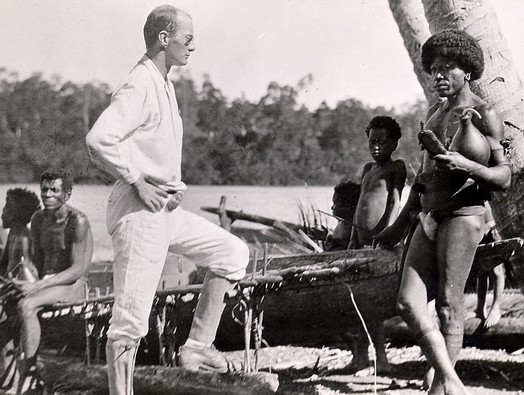
This priestly caste, as it founds the church of modernity, is instantly and integrally involved in founding a broader colonial division of labour.  These new priests conjure up the traditional/modern divide by the use of history –  differentiating old and new European Western societies – and by the use of anthropology (later, sociology too), by differentiating the colonized from the colonized. The living knowledge traditions of the colonized are pronounced dead on arrival in the present. And their cosmologies, philosophies, social practices – are entombed into opaque “cultures” the contents of which can only be clearly illuminated by the keepers of the flame. 

19_malinowski

Ultimately this mapping of difference works through race, gender and class coordinates so that even the “poor” living in the West, as well as un-mastered women and single mothers intersect with (post-)colonized subjects to become part of this opacity. The episteme of the Western Academy thus differentiates between the knowers and the known.

In this respect, the modern episteme is as seminal as gunboats to the maintenance of colonial difference. Key to this difference is not just the attribution of extra-ordinary exploitation, oppression and dispossession to colonized peoples but also their epistemic erasure, i.e., the outlawing of the possibility and desirability of intentional self-determining community amongst the colonized and their post-colonized descendents. It is in the colonial world and not Europe where Europeans develop the art of objectifying peoples into populations such that the basic competency of the colonized to self-define is deemed absent by the instruments and mores of European sanctioned international law. Postcolonial populations have only been able to become peoples under very specific conditionalities; and many who make the transition become the new police of colonial difference. Those who fall between or prefer a third way become the ungoverned, or ungovernable.

Continue reading

Stop and Search: Race and the Politics of Suspicion

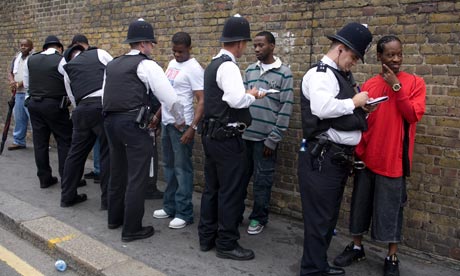
banksy-searchStop and search at Notting Hill carnival

BETWEEN me and the other world there is ever an unasked question: unasked by some through feelings of delicacy; by others through the difficulty of rightly framing it. All, nevertheless, flutter round it. They approach me in a half-hesitant sort of way, eye me curiously or compassionately, and then, instead of saying directly, How does it feel to be a problem? they say, I know an excellent colored man in my town; or, I fought at Mechanicsville; or, Do not these Southern outrages make your blood boil? At these I smile, or am interested, or reduce the boiling to a simmer, as the occasion may require. To the real question, How does it feel to be a problem? I answer seldom a word.

– W. E. B. Du Bois, The Souls of Black Folk, (1905)

Video from excellent activist group Stop-Watch.

The political pause over Stop and Search

The riots of 2011, and the research that was conducted afterwards, have had multiple political effects. Of these, one of the most important has been a clearer public exposure of the deep animosities generated by police use of stop and search powers against young people and especially those of black and Asian backgrounds. Whilst the idea that stop and search causes animosity is not news to anyone interested in British race relations or human rights, it has unusually become the focus of increasing political attention. For many years the Independent Police Complaints Commission has warned that the use of stop and search powers may be being exercised in a discriminatory and unaccountable way, and the Equalities and Human Rights Commission have been investigating police forces on this front.  Yet it was only following the riots that the Metropolitan Police Commissioner Sir Bernard Hogan-Howe began a large overhaul of the use of the power in London in 2012. Following this, parliamentary briefings were issued which pointed to the broader ineffectiveness and abuse of the powers, and the Home Office has launched a consultation into the use of stop and search. In launching this consultation, equality-sceptic Home Secretary Theresa May acknowledged, in very measly terms, the discriminatory ways in which these powers had been exercised:

The official statistics show that, if someone is from a black or minority ethnic background, they are up to seven times more likely to be stopped and searched by the police than if they are white. Now we should not rush to conclusions about those statistics, but everybody involved in policing has a duty to make sure that nobody is ever stopped just on the basis of their skin colour or ethnicity. The law is clear that in normal circumstances, stop and search should only ever be used where there is a reasonable suspicion of criminality—and that is how it should be. I am sure we have all been told stories by constituents and members of the public about what it is like to be a young, law-abiding black man who has been stopped and searched by the police on more than one occasion. If anybody thinks it is sustainable to allow that to continue, with all its consequences for public confidence in the police, they need to think again.

House of Commons Debate, 2 July 2013 Continue reading

The Queer Art of Whistle Blowing

What should we make of the fact that Bradley Manning has become Chelsea, that Glenn Greenwald is gay, that David Miranda loves a man enough to submit to the harassment incurred by his partner’s work, that Greenwald’s detractors sought to tarnish him by association with—of all things—a porn company? Possibly nothing generalisable, except that gender is doing work here.

There has been no shortage of voices denying a straightforward connection between sexual orientation, gender identity, and patriotism. (Part of the reason I feel compelled to write about this is that there isn’t one.) San Francisco Pride Board notoriously repudiated Manning’s election as a Grand Marshall in the 2013 Pride in that city, declaring: ‘even the hint of support for actions which placed in harms [sic] way the lives of our men and women in uniform—and countless others, military and civilian alike—will not be tolerated by the leadership of San Francisco Pride.’ That statement has not been retracted, notwithstanding its now patent inaccuracy in light of the prosecution’s inability to cite any evidence that Manning’s leaks led to any deaths and the court’s decision finding her not guilty of the charge of ‘aiding the enemy’. Kristin (formerly Chris) Beck, ex-US Navy Seal who recently announced her gender transition, has been harsher in her condemnation of Manning: ‘For this person, whether male or female to use gender identity to act “BADLY” is a slap in the face to me and everyone who does not fit the “Binary Gender Norm.” It is not an excuse for anything illegal or unjust.’ Pablo K is right to point out the dangers of the temptation, for those who see a link between sex/gender and truth-telling, to make the reverse move—’to relegate Beck to a minority report, and so to re-inscribe the hierarchy of authenticity, this time with Manning as the actual face of resistance, and Beck the mere puppet of militarism’—while pointing out, also, that the gap between these contrasting appropriations is constitutive of the space of contemporary politics. So let’s talk politics.

Continue reading