Open Access: Time for Action

This is the last in our recent series of posts this week on open access. Pablo covered the big questions and rationales for open access; Colin explored the potential consequences of the current policy direction; David raised serious questions about its fit for social sciences; Nivi highlighted the implications for early career academics and Nathan extended the discussion to the broader problems of academic precarity.


What do we do now? I will not labour over diagnostic points made eloquently and at length elsewhere on this blog (and also in the comments sections). In part, because there just isn’t time. At least in the UK, right now, we are facing a critical juncture where open access policy is being solidified by the Finch ‘Implementation Groups’, and solidified in the wrong direction. Indeed, there is a Academy of Social Sciences Conference in London on 29th and 30th November on the implementation of OA policy, which will likely further reinforce the direction of travel laid out by the Finch Report. Dame Janet Finch is the keynote on the first day, and the second day is ‘aimed at’ publishers, learned societies and their representatives. I am also somewhat concerned at the speed of travel on this, which suggests that Government have not taken the time to seriously reflect on it, and that most wider academic ‘stakeholders’ are being left behind on discussions and decisions which seriously affect all of our futures.

Briefly, though, my concerns around an endorsement of Article Processing Charges mirror questions raised by Colin. Having said that, I am rather more certain/pessimistic than him that these pose a very substantial threat to academic freedom and the overall integrity of the journal system. I am also concerned that they will increase the costs of research without increasing its quality, and waste a lot of academic time as Universities and Departments try to administer them (as will have to happen for most Arts/Humanities/Social Science research which is not funded by grant-money). Finally, I am highly disappointed that nowhere does the Finch Report seriously reflect on possible Government action to further protect copyright over the Version of Record.

So, what is to be done?  Continue reading

Queerly Global Politics: Some Events

Normal blogging service soon to be resumed. In the meantime, two gender and world politics events of note. First, on Friday 2 November, a roundtable on gender, militarisation and violence at LSE, featuring Cynthia Enloe, Aaron Belkin, Kim Hutchings,and others. It will be excellent. Second, the call for papers for the 2nd International Feminist Journal of Politics is out. The conference is a way away (17-19 May 2013 at the University of Sussex), but early paper/panel submissions are encouraged. Details below the model military aesthetic.

(Im)possibly Queer International Feminisms

Feminists taught us that the personal is political. International Relations feminists taught us that the personal is international. And contemporary Queer Scholars are teaching us that the international is queer. While sometimes considered in isolation, these insights are connected in complex and sometimes contradictory ways. This conference seeks to bring together scholars and practitioners to critically consider the limits and possibilities of thinking, doing, and being in relation to various assemblages composed of queer(s), international(s), and feminism(s).

Questions we hope to consider include: Who or what is/are (im)possibly queer, (im)possibly international, (im)possibly feminist, separately and in combination? What makes assemblages of queer(s), international(s) and feminism(s) possible or impossible? Are such assemblages desirable – for whom and for what reasons? What might these assemblages make possible or impossible, especially for the theory and practice of global politics?

We are interested in papers and panels that explore these questions through theoretical and/or practical perspectives, be they interdisciplinary or located within the discipline of International Relations. Sub-themes include (Im)Possibly Queer/International/Feminist:

  • Heteronormativities/Homonormativities/Homonationalisms
  • Embodiments/Occupations/Economies/Circulations
  • Temporalities/‘Successes’/‘Failures’
  • Emotions/Desires/Psycho-socialities
  • Technologies/Methodologies/Knowledges/Epistemologies
  • Spaces/Places/Borders/(Trans)positionings
  • States/Sovereignties/Subjectivities — Crossings/Migrations/Trans(gressions)
  • (In)Securities

We invite submissions for individual papers or pre-constituted panels on any topic pertaining to the conference theme and sub-themes. We also welcome papers and panels that consider any other feminist IR-related questions. Send abstracts (250 words) to: Joanna Wood (j.c.wood [at] sussex.ac.uk)

Deadline for submissions: 31 January 2013

The End Of IR Theory As We Know It…

A guest post on the state of International Relations from Felix Berenskoetter. Felix is Lecturer in International Relations at SOAS, University of London. He holds a PhD from the LSE and works on theories and concepts in IR; politics of space and time; critical approaches to European Security, and dynamics of friendship and estrangement in transatlantic relations. Felix has published articles in various journals, is a former editor of Millennium and co-editor of Power in World Politics (Routledge, 2007). He is also co-founder and current chair of the ISA Theory Section.


In case you missed it, recent ISA and BISA conferences saw panels contemplating whether ‘IR Theory’ has come to an end. This question, posed by the editors of EJIR, was discussed by a range of distinguished scholars whose answers ranged from ‘yes’ to ‘no’, in the process reflecting on the meaning of ‘theory’ and ‘end’. While state of the art exercises can be tiring, the contributions will be worth reading when they appear in an EJIR special issue later this year.

Yet I could not help wondering what the answers would have been had the panels featured not established professors, but junior scholars at the start of their career. Indeed, would it not be more adequate to have the latter group engage this question? After all, they tend to be the ones teaching introductory IR courses, which are expected to give an overview of theoretical arguments and debates. And they enter the profession with a significant research project under their belt (the PhD), which informs their first wave of publications and likely influences future projects that will shape the field. So what does that generation think of ‘IR Theory’? What theories and what kind of theorizing is prevalent in their teaching and writing? Continue reading

Materialism and World Politics conference

Materialism and World Politics

20-22 October, 2012
LSE, London, UK

Registration is now open here for anyone who wants to attend.


Scheduled Speakers:

Keynote: The ontology of global politics
William Connolly (Johns Hopkins University)

Opening Panel: What does materialism mean for world politics today?
John Protevi (Louisiana State University)
More TBC

Closing Panel: Agency and structure in a complex world
Colin Wight (University of Sydney)
Erika Cudworth (University of East London)
Stephen Hobden (University of East London)
Diana Coole (Birkbeck, University of London)

ANT/STS Workshop keynote:
Andrew Barry (University of Oxford)

ANT/STS Workshop roundtable:
Iver Neumann (LSE)
Mats Fridlund (University of Gothenburg)
Alberto Toscano (Goldsmiths, University of London)
More TBC

*******

The annual conference for volume 41 of Millennium: Journal of International Studies will take place on 20-22 October, 2012 at the London School of Economics and Political Science. This includes 2 days of panels and keynotes on the weekend, and a special Monday workshop on actor-network theory (ANT), science and technology studies (STS), and alternative methodologies. Space for the latter is limited though, so let Millennium know of your interest in attending it as soon as possible.

The theme of this year’s conference is on the topic of materialism in world politics. In contrast to the dominant discourses of neorealism, neoliberalism and constructivism, the materialist position asks critical questions about rational actors, agency in a physical world, the role of affect in decision-making, the biopolitical shaping of bodies, the perils and promises of material technology, the resurgence of historical materialism, and the looming environmental catastrophe. A large number of critical writers in International Relations have been discussing these topics for some time, yet the common materialist basis to them has gone unacknowledged. The purpose of this conference will be to solidify this important shift and to push its critical edges further. Against the disembodied understanding of International Relations put forth by mainstream theories, this conference will recognize the significance of material factors for world politics.

What We Talked About At ISA: Researching Sexuality in ‘Difficult’ Contexts

In September 2009, Ugandan Parliamentarian David Bahati introduced a draft ‘Anti Homosexuality Bill’ that proposed enhancing existing punishments for homosexual conduct in the Ugandan Penal Code, introducing new ‘related offences’ including ‘aiding and abetting’ homosexuality, ‘conspiracy to engage’ in homosexuality, the ‘promotion of homosexuality’, or ‘failure to disclose the offence’ of homosexuality to authorities within 24 hours, and mandating the death penalty for a select class of offences categorized as ‘aggravated homosexuality’. The bill remained bottled up in parliamentary committees for the duration of the 8th Parliament, thanks in large part to a sophisticated local campaign that sought to bring international pressure to bear on the government of President Yoweri Museveni, but has since been reintroduced in the current 9th Parliament and therefore remains a live concern. In August 2010, I travelled to Uganda to interview a range of actors associated with ongoing debates over sexuality in the country. Rather than commenting on the urgent and pressing substantive concerns at issue in these debates, at an ISA panel entitled ‘Researching sexuality in difficult contexts’, I chose to reflect on some of the methodological dilemmas I encountered in the field, for which my training in international relations had left me unprepared. Emboldened by recent ISA panels on storytelling and auto-ethnography (and utterly bored by what passes for mainstream IR), these reflections take the form of excerpts from my diary (italicized), interspersed with the more censorious, academic voice that I trotted out at ISA. (I make no apology for not writing about the more ‘serious’ issues at stake—on this occasion—because it occurs to me that where sexuality is concerned, the pursuit of fun can raise deadly serious questions, making distinctions between the trivial and the serious difficult to sustain.)

Uganda, August 2010: I am here to do interviews and I spend most of my day setting them up, preparing for them, travelling to or from them, or conducting them. The rest of the time I hang out, people watch, trying to piece together a picture of how life outside heteronormativity survives in a climate that seems—on the surface at least—as inhospitable as Uganda is supposed to be. On Friday, Al (name changed, and this account provided with permission) invited me to a strip-tease. This was going to be a straight strip-tease, but one that some of the gay men went to so that they could watch the straight men getting off on watching the women strip. It sounded convoluted, but unmissable. Plus, I’d never been to a straight strip-tease, so it seemed important to plug this gaping orifice in my sexual history. We entered a dimly lit hall and took seats at the back in a group near the bar. I think I was the only brown man there. There was also one white man in the whole place, in our group. He had evidently been to the place before, and because he came with the same motivations as Al, he had been traumatized on a previous occasion by the way the women flocked to him (money?). So Al was instructed to tell the emcee (a short guy dressed in a white track suit) to make sure that the women didn’t come to our corner. The real attraction, from the point of view of the gay guys, was that the women sometimes got the straight guys to get on stage and strip. Al told the emcee to do his best to encourage this possibility. Call it Straight Guy for the Queer Eye. I was impressed by the brazenness with which Al communicated all this to the emcee. As for the show, let’s just say it took the ‘tease’ out of strip-tease. The first woman (girl? all the performers looked like they were in their 30s, but they could have been younger and prematurely aged by their work) danced to some vaguely familiar Western pop number. She was followed by another woman with bigger hips. Somebody in the group, setting himself up as my informant, tells me that she is ‘a real African woman’. She danced to Shania Twain’s ‘From this Moment On’ (a song I played to my last (and final, I think) girlfriend on the first day I met her, after a year-long correspondence). Just when Shania reached the second verse, the woman dropped her panties. None of the performers took off their bras. ‘African men aren’t interested in breasts’, my self-appointed informant intones. The next half-hour is a blur of female anatomy. So here I am, in a country that people have been calling ‘conservative’ and that American evangelist Rick Warren has decided is ripe for transformation into the world’s first ‘purpose driven’ nation, looking at more naked women in ten minutes than I have seen in ten years, to the soundtrack of my failed romantic history.

Continue reading

What We Talked About At ISA: The U.S. Military-Industrial Complex, Part 2

Part two of a post on my presentation at this year’s ISA. Part one is here.


So what would be the normative-political case for the Military-Industrial Complex (MIC)? As Ledbetter notes, the defence industry never had a shortage of defenders, proponents, beneficiaries, and apologists. Various critiques of the MIC notwithstanding, numerous American commentators are now firmly united in the belief that their country needs a large defence budget in order to protect and project its identities and interests in the world. According to Maddow, this collective belief had a lot to do with the discursive and institutional success of the infamous “Team B” reports on Soviet power, which so profoundly enthused Ronald Reagan and his administration, leading to the gigantic military buildup in the 1980s. Maddow’s assessment is worth citing at length:

The Think Tanks and Very Important Committees of the permanent national security peanut gallery are now so mature and entrenched that almost no one thinks they’re creepy anymore, and national security liberals have simply decided it’s best to add their own voices to them rather than criticize them. But like we lefties learned in trying (and failing) to add a liberal network to the all-right-wing, decades-old medium of political talk radio, the permanent defense gadfly world can’t really grow a liberal wing. It’s an inherently hawkish enterprise. Where’s the inherent urgency in arguing that the threats aren’t as bad as the hype, that military power is being overused, that the defense budget could be safely and wisely scaled back, that maybe this next war doesn’t need us? The only audience for defense wonkery is defense enthusiasts, and they’re not paying the price of admission to hear that defense is overrated.

But knotted into the right-wing discourse on defence spending is a number of corollary arguments that are associated with a variety of lefty positions in the U.S. context.  America’s mainstream media outlets rarely fail to acknowledge how the twinning of the country’s economic and armed forces not only creates high-skilled jobs, but also – and critically – keeps them in the country. The move is mainly rhetorical. Not only have successive U.S. administrations encouraged American defence industry to globalize, but there is also little evidence to suggest that defence spending creates more jobs relative to spending on, say, health care or education (see, for example, Pollin and Garrett-Peltier, 2011). I would suggest, then, that what lies behind contemporary pro-MIC arguments is, in fact, a creative and complex combination of certain economic theories, (realist?) beliefs in war (or the threat of war) as a manifest destiny of the international system, as well as an overarching (liberal?) commitment to a powerful, sovereign state capable of exercising global leadership (aka., a “force for good”, in still favoured New Labour parlance.)

Let us revisit the pro-MIC rhetoric from the era of “Team B.” In a footnote, Ledbetter directs the reader to The Lonely Warriors (1970) by John Stanley Baumgartner, who is described as “one notable true defender of the MIC.” Written by an expert in public management and business administration, Baumgartner’s book makes three arguments for the MIC: 1) defending the free world is a moral thing to do (“Sputnik is only one example of the reasons for MIC”); 2) by definition, defence is a big enterprise and all big enterprises (directly or indirectly, the MIC employs one in ten Americans) occasionally make big mistakes, especially when they respond to the murky and changing specifications set by the government (“the tiger” or “the monster”) and its contracting officers; and last, 3) “unconscionable profit” is not so unconscionable in comparative terms (profit on sales, profit on investment, price/earning ratios etc. tend to be below the industrial average).

Continue reading

What We Talked About At ISA: From #occupyirtheory to #OpenIR?

A write up of my comments at the #occupyirtheory event in San Diego. The event itself was both hope-filled and occasionally frustrating, not least for the small group of walk-outs, apparently ‘political’ ‘scientists’ lacking in any conception of what it actually means to engage in the political (note: this bothered me especially, but was a rather minor irritation in the grander scheme of things). Despite the late hour, there were between 40 and 60 people there throughout, and a number of very positive things have come of it. It looks like there’ll be some gathering at BISA/ISA to discuss further, and we’re pitching something for the Millennium conference on some of the themes addressed below, and there will of course be ISA 2013 too. In the meantime, there’s the Facebook group, the blog, and a mailing list. The term OpenIR is owed to Kathryn Fisher, and seems to several of us to be a better umbrella term for the many things we want to address in the discipline and the academy. I also just want to give a public shout-out to Nick, Wanda, Robbie and Meera for doing so much on this.


The #occupy practice/meme has antecedents. Physical manifestations of a ‘public’, horizontalism, prefigurative politics and more can be traced in all sorts of histories. One such lineage is the foreshadowing of Zucotti Park in recent struggles over education. Take the slogan in March 2010 over privatisation at the University of California, which was ‘STRIKE / OCCUPY / TAKEOVER’. Or Middlesex, where students resisting the dismantling of the Philosophy Department in that same year unfurled a banner during their occupation, one that proclaimed: ‘THE UNIVERSITY IS A FACTORY! STRIKE! OCCUPY!’.

I want briefly, then, to think about the space of the university in our discussions of #occupy. There have been rich and suggestive calls to re-politicise ourselves as academic-activists, to look again at our work and its claims, and to turn our abilities, such as they are, to projects of resistance and transformation. But we risk a displacement. When we talk of ‘the street’, or politics enacted in the reconfigured space of #occupy, or of the ‘real world’ that we must be relevant to, we already miss the university itself as that factory in which we labour. We are tempted by a view of ourselves as leaving ivory towers to do politics, instead of seeing those towers themselves as spaces of politics. As if our institutions and practices were not already part of the world.

Whether you see #occupy as transformational or nor, or whether you simply prefer a different vocabulary, I think a demand remains: a demand to politicise our own positionality. This politicisation can have many dimensions, but I want to suggestively highlight four, each being a sphere in which we should be diagnosing and transforming our own practices.

Continue reading

What We Talked About At ISA: The U.S. Military-Industrial Complex, Part I

Earlier this year, the U.S. government set out to reduce its vast defence budget. On 5 January, Barack Obama became the first U.S. president to hold a press conference at the Pentagon. What prompted it was the release of Sustaining U.S. Global Leadership: Priorities for 21st Century Defence, a “strategic guidance” document outlining the national blueprint for “deterring and defeating aggression,” while reducing record budget deficits “through a lower level of defence spending.” (The document also attracted much media attention because it offered a rare glimpse into the strategic thinking of a president who seems to refuse to be associated with a “doctrine.”) In his State of the Union address three weeks later, Obama reinstated his belief that paring defence sending could help “pay down our debt.” The Pentagon’s FY2013 budget projection followed on 13 February, with a request for $614 billion in funding: $525 billion for the base budget and $88 billion for the so-called overseas contingency operations. FY2012 budget request, the Pentagon noted, was bigger.

Pundits in the US have been debating the meaning of the coming defence cuts, starting with the question of whether there will, in fact, be any cuts in the first place. This debate will probably intensify as the election date approaches, although, indicatively, Obama’s strategic guidance contains no “East of Suez” moments, and his Pentagon speech was a candid expression about the need to stay the course: “Over the next 10 years, the growth in the defence budget will slow, but the fact of the matter is this: It will still grow, because we have global responsibilities that demand our leadership… I firmly believe, and I think the American people understand, that we can keep our military strong and our nation secure with a defence budget that continues to be larger than roughly the next 10 countries combined” (emphasis mine; also, “10” appears to be way too low).

Much remains to be said about the type, magnitude, and sequence of the coming changes to America’s defence, and the electoral 2012 will be too short to say it all. The first round of projected budget cuts (“$487 billion”) takes into consideration the provisions of the self-flagellating Budget Control Act from August 2011. The second round of cuts (“$500 billion”) refers the so-called automatic sequestration cuts, also specified in the Act, which will take effect in January 2013 if Congress does find “alternative” ways to control the budget. U.S. Secretary of Defense Leon Panetta described these automatic cuts as the “doomsday scenario,” a label that Congress’s bipartisan supercommittee will no doubt keep in mind as it looks for those alternatives (such as, for example, legislation to reverse the Act). In the end, what will change is the ordering of America’s military priorities, but not the militarization of America’s “global responsibilities” (to use Obama’s own label) as such. Behind it, after all, are multiple and reinforcing structural factors that make real cuts difficult. One of them is “defence industry,” which some pundits and watchdog organizations like to call, somewhat retrospectively, the “military-industrial complex” (MIC).

As a conceit, the MIC goes back at least to World War I, but it is popularly dated to Eisenhower’s ‘Farewell Address’ in 1961. As far as US presidential speeches/speechwriting goes, Eisenhower’s was a tour de force in every respect, but the reason why we read it today – or, rather, search for it on YouTube – is for the parts where the president urges the American citizens to pay attention to the “conjunction of an immense military establishment and a large arms industry [that is] new in the American experience,” while advising the American government to “guard against the acquisition of unwarranted influence, whether sought or unsought, by the military-industrial complex.”

Continue reading

#occupyirtheory, International Studies Association (San Diego) Edition

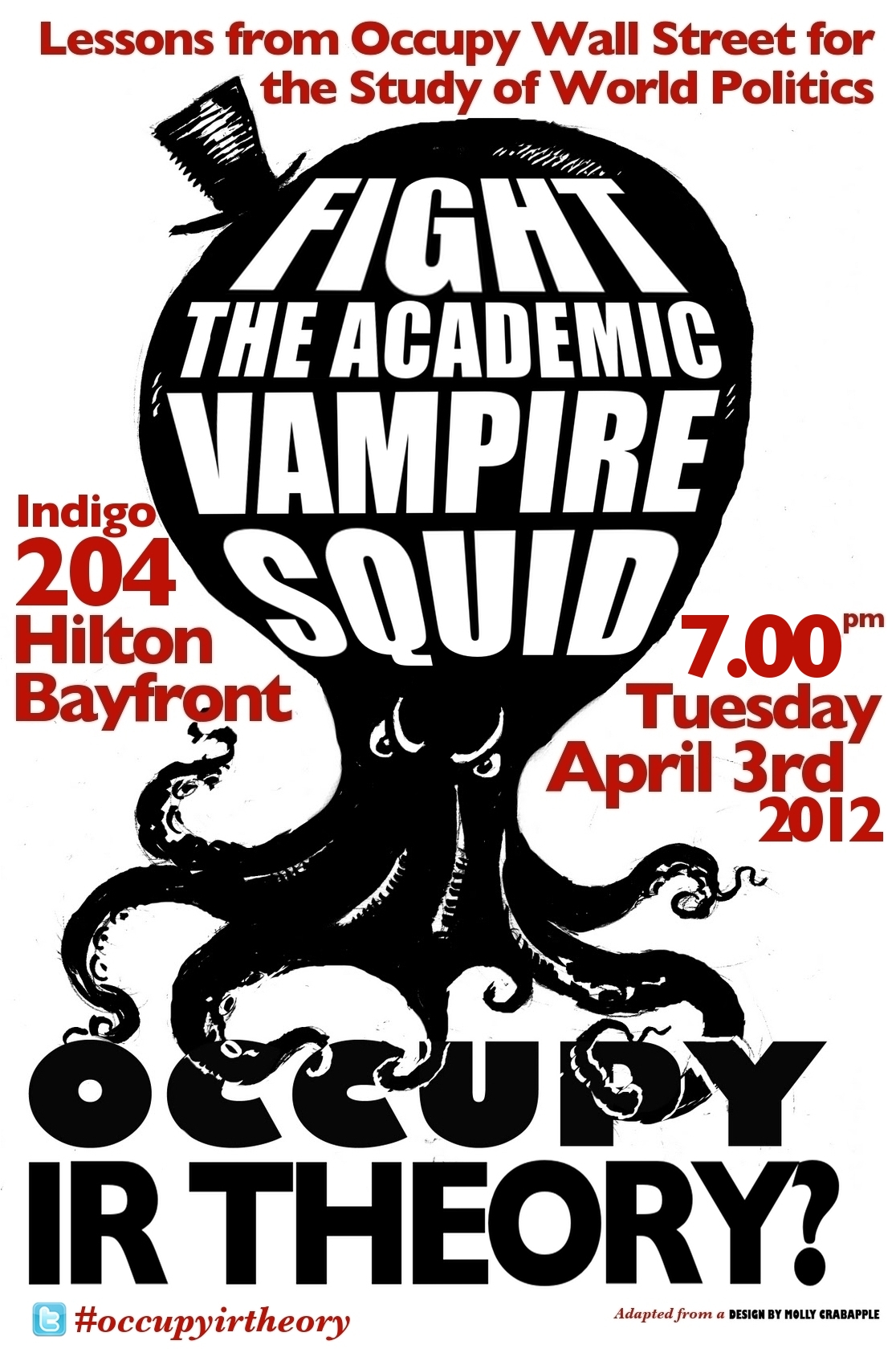
ISA 2012 is just around the corner, and it will doubtless be as hectic and awkward and joyous as ever. Robbie and I will be appearing at an event on #occupy and its relevance for IR on Tuesday at 7 in Indigo 204 at the Hilton Bayfront. We’ll be joining Lucian Ashworth, Lara Coleman, Nicholas Kiersey and Wanda Vrasti (all chaired by Jason Weidner) for what I’m sure will be an exciting roundtable discussion. More importantly, it will be brief, with most of the session given over to a General Assembly-style discussion of what IR can learn from #occupy, what #occupy might get from IR, and how we might take the spirit and organisational form into the discipline itself (or not).

The hope is that the slightly later starting time will allow people to go both to the various Section receptions and meetings (briefly) and to come to this, whilst still leaving reasonable evening time for food and the rest. Please do get involved over at Facebook (see also the #occupyirtheory group and #occupyirtheory blog) and let interested IR-types know. Readers may also be (should also be!) interested in a recent forum from the Journal of Critical Globalisation Studies on ‘Occupy IR/IPE’, featuring Nick and Wanda (as well as Colin Wight, Michael J. Shapiro, Patrick Jackson and others), which I’ve parcelled together as a single pdf for your delectation here.

Hope to see you there!

Affect! Biopolitics! Technology! Ecology!: A Call for Papers

A brief pre-holiday announcement of the next Millennium annual conference, to be convened on the theme of Materialism and World Politics. Full details below the fold. The range of suggested topics looks both fascinating and much-needed, and I am assured by well-placed sources that there will also be some stellar speakers, for those who are tempted by such things. As always, papers submitted in the wake of the conference which survive the rigours of peer review will be published in a resulting special issue (Vol. 41, No. 3). Also, don’t forget about the Northedge Essay Competition (deadline 30 January 2012).

Continue reading