Critiquing the Social: Comments on Patricia Owens’ Economy of Force

The last commentary in our forum on Economy of Force, from Andrew Davenport. Andrew is Lecturer in International Politics at the University of Aberystwyth, where he works on International Theory, with particular emphasis on debates in Critical Theory, materialism and idealism, and modern social theory. He is the author most recently of ‘Marxism in IR: Condemned to a Realist Fate?’ in the European Journal of International Relations. Patricia’s rejoinder to the four commentaries (from Pablo, Jairus, Elke and Andrew) will follow tomorrow.


In the concluding section of Chapter Two of this book, Patricia Owens quotes Robert Nisbet to the effect that the essential concepts and perspectives of the sociological tradition “‘place it much closer to … philosophical conservatism’, than we might otherwise think.” A basic theme of the book is that it ought to be more clearly understood that prominent categories in the work of Durkheim, Weber and Marx – community, authority, alienation and status – are in fact just “conservative moral categories … but in scientific garb”.[1] The conservative character of sociology’s origins is in fact no secret. At much the same time as Nisbet was writing, Theodor Adorno also noted it: near the beginning of his introductory lectures on sociology, he emphasised that any assumption of an intrinsic connection between sociology and radical politics (that sociology = socialism) would be seriously mistaken: “if the concept of sociology is understood as it came into being, with the historical meaning it has, it can be said that the opposite is actually the case.” Sociology’s interest, from the start, was always the maintenance and preservation of the existing order, not its critique and change. What does the character of these origins mean for social theory? How should it affect or condition our understanding of social thinking and its basic concepts: precisely, ‘society’ and ‘the social’? Owens’ answer is unequivocal: it should lead to profound suspicion, if not outright rejection. Social thinking, from the start, contained a poison and its natural affinity to conservative thought, attitudes and practices is simply indicative of this noxious nature. Especially damaging in its consequences for IR theory, so the argument runs, has therefore been the unthinking naturalisation of ‘social’ terminology virtually across the spectrum, from statist Political Realism to Foucauldian biopolitics – as if society and the social were neutral terms that do not themselves colour or prejudice the discourse.

The language of ‘society’ is indeed widespread, and often perhaps unreflectively used, in IR, and so its critique is surely an important theoretical project. Not the least of the book’s merits is that it poses uncomfortable questions to critical theory about how far it is possible to adopt social thinking for purposes of critique. Owens directs some pointed remarks at Marxists, Foucauldians and other critical theorists for, in effect, supping with the devil, and in the chapters on counter-insurgency she marshals enough evidence of a ‘homology’ between social theory and imperial practices of counter-insurgency to give even the most committed sociologist pause. Further, in demonstrating that the emergence of distinctly social thinking was coeval with the development of capitalist society, there is at least the implication that those who would pursue critique of capital ought not to accept social categories at face value. Nevertheless, it seems to me that there are difficulties with the critique of the social elaborated in the book, both in how the argument is structured and with the categories employed, difficulties that lead to some of the work of critique remaining undone. As a result, the account of the social developed here, challenging and thought-provoking as it is, breaking new ground, nevertheless does not go as far as it might.
Continue reading

All Means, No End? Economies of Life Management

The fourth piece in our forum on Patricia Owens’ Economy of Force. One more to follow before Patricia’s rejoinder this weekend.


Economy of Force provides an insightful and provocative re-reading of Anglo-American imperialism and counterinsurgency. Unlike conventional accounts, which for the most part remain trapped within the hermeneutic limits of political theory, Owens undertakes a historical sociology of ‘the social’ itself, tracing out its attendant mechanisms of political rule over time. Central to her account is the notion of ‘the household’, which, she suggests, functions as a dominant form of administration and rule within both modern and contemporary imperialisms. ‘Despotism’, ‘governance’, ‘ruler-ship’, ‘sovereignty’, ‘administration’, ‘life processes’, ‘violence’, ‘hierarchy’, ‘patriarchy’, ‘pacification’, ‘domestication’, ‘domesticity’ – this language of household rule is crucial in order to better understand the politics that underpin different forms of imperial practice. For this, we must also understand that it is the oikos, and not politics, that stands at the heart of imperial and counter-insurgency campaigns. Indeed, for Owens, such campaigns are best grasped as “armed social work”.

One clear target of this argument is mainstream IR, which all too often works with an ahistorical conception of society. Owens firmly rejects this approach by identifying: (1) the origins of ‘the social’ in a concept of household rule; (2) the transformation of household rule over time; and (3) the historically-specific influence that different forms of household rule exert over political practices in the present. In so doing she also rejects the folk wisdom that household rule and management has been eliminated or pushed to the margins of politics through various processes of modernisation. Rather, she argues, household rule is sozialpolitik rendered as politics, and that IR scholars would do well to engage with the changing logics of household rule if they want any purchase on the political world.

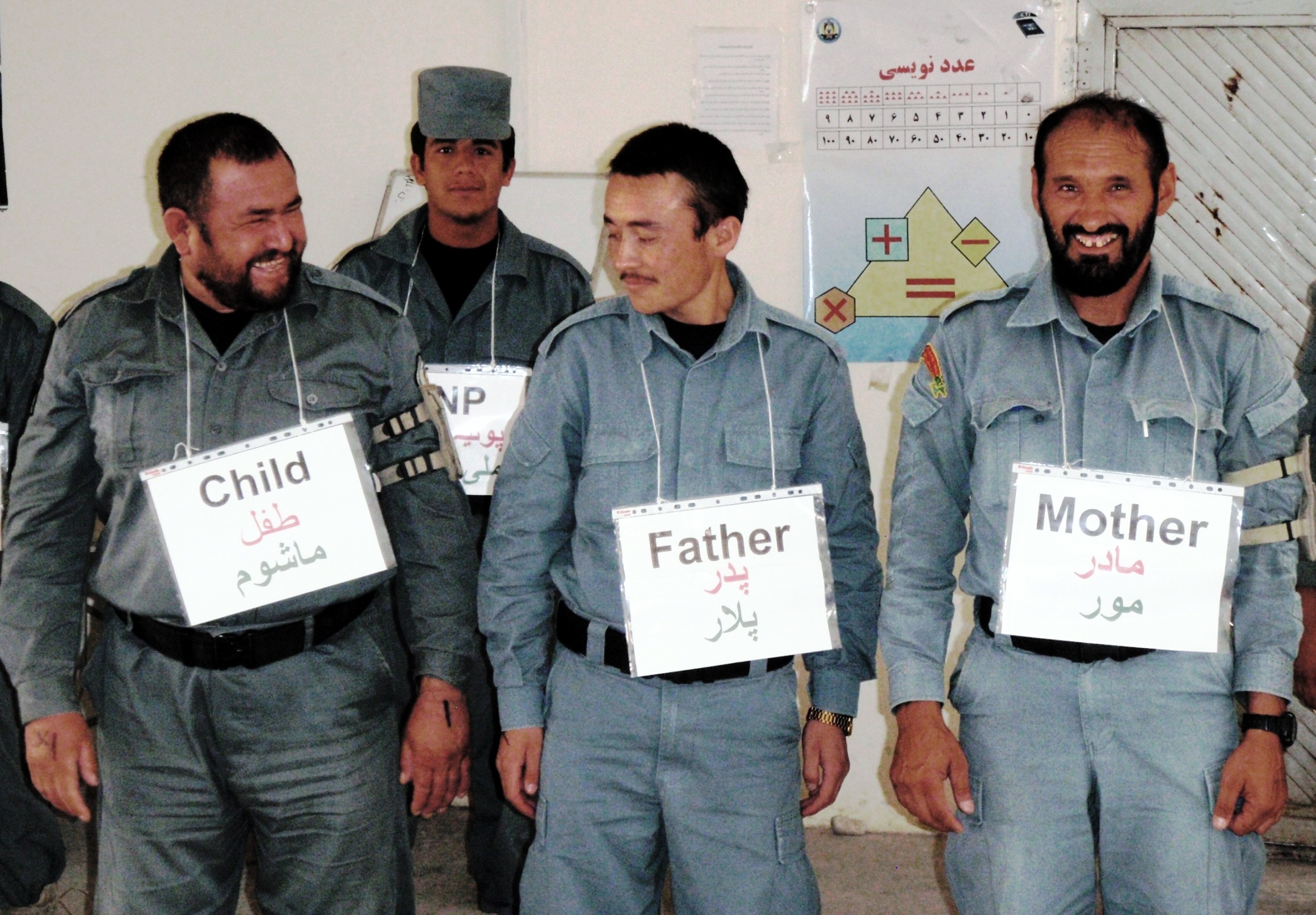
Afghan National Policemen participating in an interactive exercise during Counter Insurgency Training

Afghan National Policemen participating in an interactive exercise during Counter Insurgency Training

Owens grounds this bold claim in the close relation between the social and an ancient modality of household rule: oikonomia. This is an important move and I, for one, am convinced that an engagement with household management can provide a powerful lens through which to understand the entwinement of the social and the international. Such a lens resonates with Hannah Arendt’s insight that, in modernity, “we see the body of peoples and political communities in the image of a family whose everyday affairs have to be taken care of by a gigantic, nation-wide administration of housekeeping” (The Human Condition, p.28). And for Arendt too, ‘the social’ is infused with the logic of household management, turning modern ‘society’ into a mode of government based on specific and historically situated relations of reproduction. In fact, I would argue that Arendt’s proto-biopolitical argument has much to offer to Owens’ project.

Continue reading

Home-ology; Being a Comment On Patriarchs and Patriarchy in Economy of Force

This is the second contribution to a forum on Patricia Owens’ Economy of Force. More to follow in the coming days.


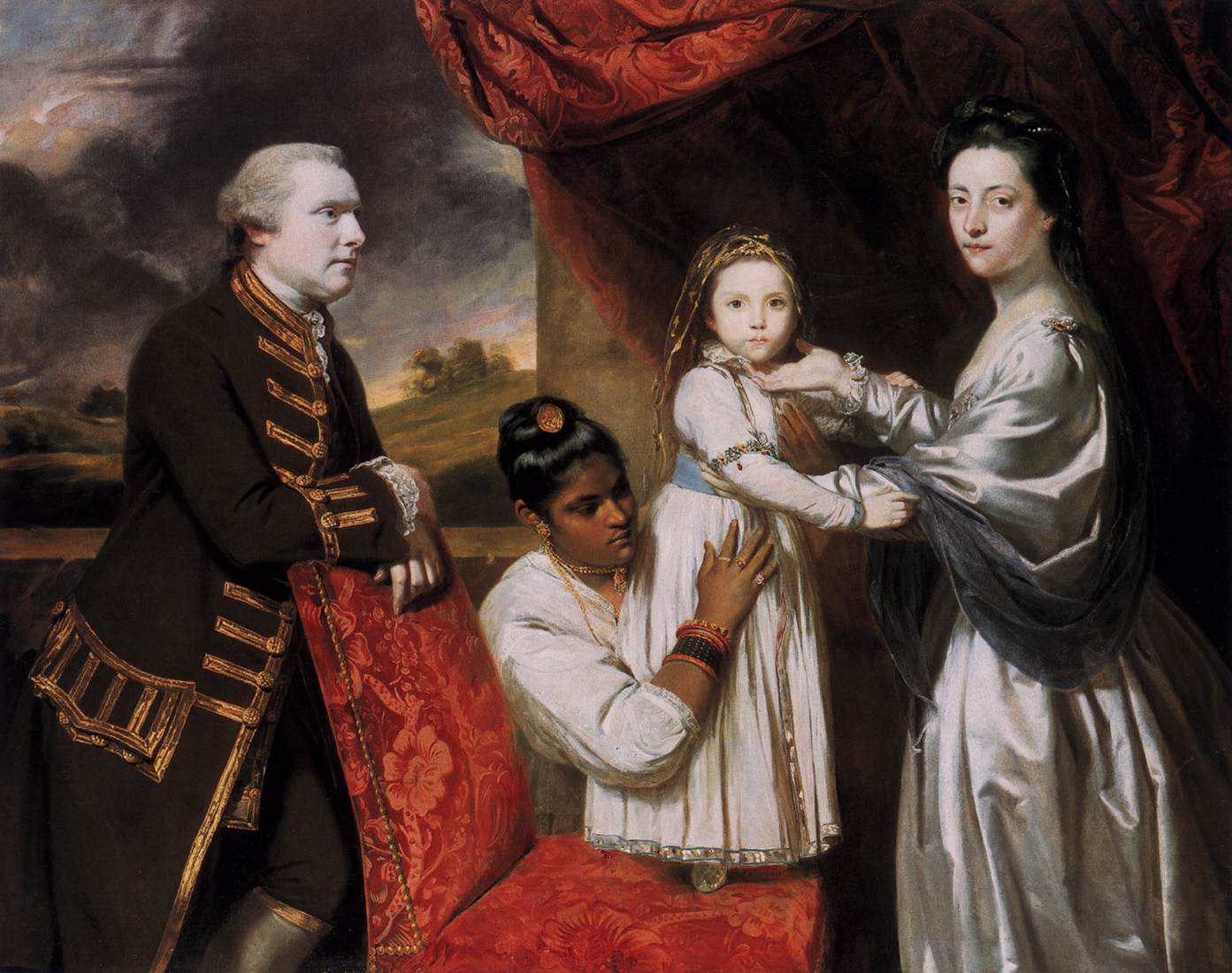
Joshua Reynold's portrait of Clive of India, director of the East India Company, c. 1765

Joshua Reynold’s portrait of Clive of India, director of the East India Company, c. 1765

What to say about Economy of Force, Patricia Owens’ wildly ambitious contribution to international political theory?[1] A book that threatens to overwhelm, whether with the vast literature it marshals or in its brazen assault on (almost all) social theory. A book that consistently degrades the “intellectual crutch” of sociality, offers an arresting agenda for historical and political analysis, and then delivers a revisionist account of late colonial and ‘post-colonial’ counterinsurgency of its own. Amidst the parade of detail and argument, a book in which you will also discover a nascent theory of patriarchy. Arguably more, Economy of Force presages nothing less than the groundwork for a unification of feminist and international political theory.

As we have already seen, Owens’ critique of ‘the social’ as a category of thought and practice involves reviving the alternative to it: oikonomia, economy in its original sense. More precisely, Economy of Force dispenses with the usual distinction between a time when the family household was the primary site of power (feudal, certainly pre-modern, personalist, and status-based) and the contemporary distribution of political, economy and civil power in something we call ‘society’ (properly modern, bureaucratic or networked, and contract-based). Instead of telling stories in which the household is overcome by society, we should, on this account, recognise that ‘the social’ is a historical transformation of the household form. The change in the form of household governance is real, but the stories told about the change are fictions. The current hegemonic story – social theory itself – has as its effect the obscuring of power as domestication. In other words, our conventional narrative of how the household disappeared provides ideological cover for the fact that the household is still very much with us.

Oikonomia, or household governance, is rule characterised by a father figure (paterfamilias) whose power is more or less that of a despot. Since despot means ‘master of the house’, you might expect International Relations scholars to have noticed, or to be alert to their own repeated tendency to name as ‘domestic’ whatever is not part of global politics proper. Instead, these threads must be uncovered, recovered, constructed and mapped anew.

Continue reading

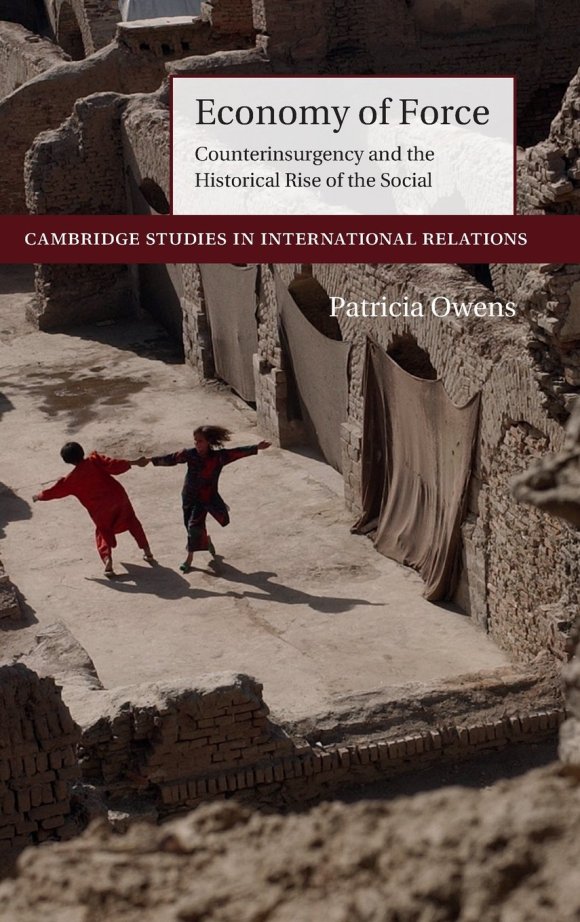
Economy of Force

We return from the holidays with gusto and a book symposium on Patricia Owens’ Economy of Force: Counterinsurgency and the Historical Rise of the Social (Cambridge, 2015). Patricia is Professor of International Relations at the University of Sussex, co-editor of European Journal of International Relations, and a former fellow of the Radcliffe Institute for Advanced Study at Harvard University and of Oriel College, Oxford. Patricia’s first book was Between War and Politics: International Relations and the thought of Hannah Arendt (Oxford, 2007). Economy of Force is in the Cambridge University Press series ‘Studies in International Relations’ and is out in paperback next summer (the introduction is available in full here). The book will also be the subject of a forthcoming special section of Security Dialogue.


Economy of Force

Economy of Force seeks to rekindle interest in one of the oldest but neglected languages and techniques of government administration – household governance – that it uses to write a new history and theory of counterinsurgency with broad implications for social, political, and international thought. The book is a study of oikonomia in the use of force, from oikos, ancient Greek for household. But it also makes a larger claim, that household governance underlies the relatively recent rise of distinctly social forms of government and thought more broadly. Since the late eighteenth-century, modern, capitalist state and imperial administrators have drawn on and innovated different forms of household governance, scaling up and transforming the units of rule in which populations are domesticated. To really understand the significance of households-as-government we need to dispense with the relatively recent and bourgeois notion of households as houses, homes, or family-as-kin. Instead, households are best understood through the nature of the hierarchical relations between people in a particular spatial arrangement. Households are the persistent but historically variable spaces in which the life processes of members – real, vulnerable bodies needing food, water, shelter – are administered and the household itself is maintained.

There is a very long tradition of thinking of households-as-government in the history of political and economic thought and in anthropology, archeology and comparative studies of different household forms. There is also excellent and wide-ranging scholarship in literary and gender studies on practices and ideologies of domesticity (from domus, Latin for house). In drawing on and extending these and other literatures, Economy of Force suggests that there is a far deeper significance of households and forms of domesticity than captured in International Relations debates about the so-called ‘domestic analogy’. Household administration is highly portable and plays a remarkably significant role in imperial and international relations. These are grounds to make a stronger claim than one based on mere analogy. I argue that there is a domestic homology connecting different households, despite their historical and geographical variability, based on the genealogy of household governance in the history of social and political thought, but also the human experience of basic life necessities and the stubborn but contingent attempts to domesticate people through the administration and control of life needs.

Continue reading

Societies Under Siege: A Reply

I am extremely grateful to Elin, Clara and Katie for writing such thoughtful and  thought-provoking engagements with Societies Under Siege, and to Joe Hoover for kindly organising this forum. It is not easy to set aside the time during a busy teaching term. Here is my reply!

Continue reading

Between Truth-Telling and Doom-Saying: Sanctions and Activism

933This is the fourth in a series of posts on Lee Jones’ Societies Under Siege: Exploring How International Economic Sanctions (Do Not) Work. We are delighted to welcome Dr Katie Attwell, she is the Capstone Co-ordinator at Sir Walter Murdoch School of Public Policy and International Affairs, Murdoch University. Her book, Jewish-Israeli National Identity and Dissidence: The Contradictions of Zionism and Resistance, considers the contradictions faced by left-wing Israeli Jews trying to connect with their Palestinian Other. Ethnicity, nationalism and identity politics remain her fundamental academic interest, but she now focuses on health policy, pursuing research into how to engage with vaccine-hesitant parents. Lee’s original post can be found here. With responses from Dr Elin Hellquist here, and Dr Clara Portela here.


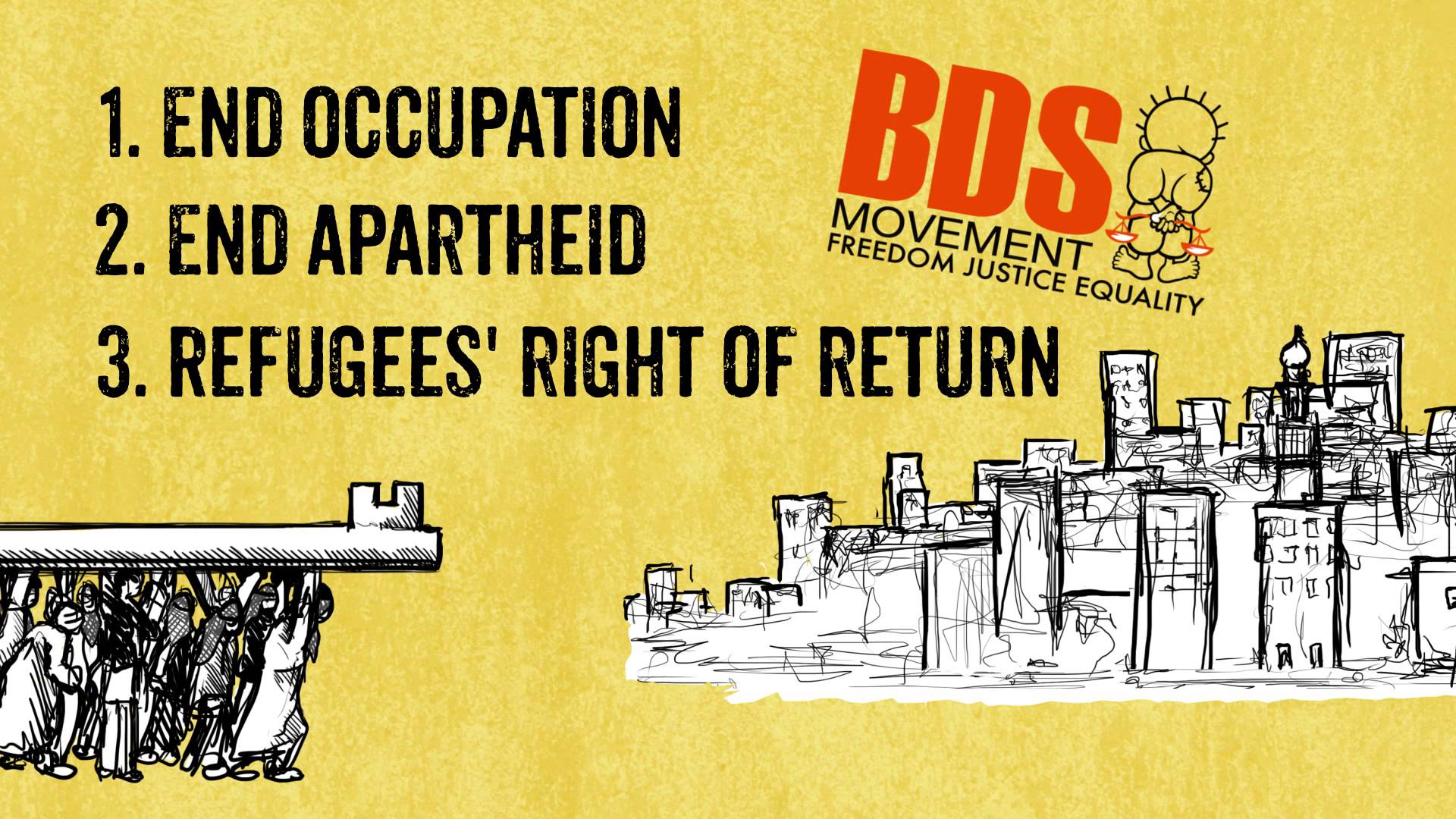
I became familiar with the project that would become Societies Under Siege in 2013. A mutual friend shared a conference paper by Lee Jones, reflecting on the Boycott, Divestment and Sanctions (BDS) campaign called for by Palestinian nationalist activists, and eagerly adopted by their international counterparts. I was one such international enthusiast, in addition to being a political scientist researching how progressive Israeli Jews were attempting to reform their society from the inside. My work took a different approach to Lee’s, looking at how discourses of identity, nationalism and ethnicity constrain notions of what is morally and politically possible. I never saw much crossover between our approaches, though some of my subjects were BDS advocates. I suppose my work could contribute to an understanding of the kind of impact that sanctions might have (or not) on a fraction of the target society.

I was far more captivated by what Lee’s early conference paper meant for activism. Outside of academia, I wanted to talk about Palestine with anyone who’d listen, and I had been inspired to join a tiny collective of mostly radical leftists in my home city of Perth, Western Australia. Working within this collective, I believed that the first step to changing minds was education and awareness, and soon BDS became the catchphrase by which we’d do this. Or so we thought.

By the time I read Lee’s paper – soon to be a chapter in Sanctioning Apartheid: Comparing the South African and Palestinian BDS Campaigns, edited by David Feldman and out next year with Palgrave Macmillan – I had dropped out of activism for Palestine somewhat, primarily due to life (a young family and a PhD) getting in the way. But the fire still burned within. I read Lee’s contribution with eagerness and interest. It elicited in me the same sentiments that followed my consumption of Societies Under Siege: enlightenment and admiration, combined with frustration. Thanks to this work, I understand the world in ways that I did not before – which has to turn on any academic who genuinely enjoys engaging with inquiry, wherever it may lead. However, thanks to that new understanding, I also understand – to quote another colleague’s rather jaded perspective on Social Conflict Analysis – that everything is f$*#ed. This is somewhat less a cause for celebration. Continue reading

Mind the Gap: Evaluating the Success of Sanctions

This is the third in a series of posts on Lee Jones’ Societies Under Siege: Exploring How International Economic Sanctions (Do Not) Work. We are delighted to welcome Dr Clara Portela,  she is Assistant Professor of Political Science at Singapore Management University. She is the author of the monograph European Union Sanctions and Foreign Policy, for which she received the 2011 THESEUS Award for Promising Research on European Integration. She recently participated in the High Level Review of United Nations sanctions, in the EUISS Task Force on Targeted Sanctions and has consulted for the European Parliament on several occasions.
A further response will follow from  Katie Attwell, followed by a response from Lee. You can find Lee’s original post here and Elin Hellquist’s here.


The volume undoubtedly makes a key contribution to the field – indeed, one that was sorely needed: an evaluation of how sanctions interact with the economic and political dynamics in the target society, and more specifically, how they affect domestic power relations. This agenda is not entirely new in sanctions scholarship. It had been wisely identified by Jonathan Kirshner in a famous article as far back as in 1997. However, having pointed to the need to ascertain how sanctions affect the internal balance of power between ruling elites and political opposition, and the incentives and disincentives they faced, this analytical challenge had not been taken up by himself or any other scholar so far. The book also contributes to a highly promising if still embryonic literature: that of coping strategies by the targets, briefly explored in works by Hurd or Adler-Nissen.

Departing from the idea that whether sanctions can work can only be determined by close study of the target society and estimating the economic damage required to shift conflict dynamics in a progressive direction, the study proposes a novel analytical framework: Social Conflict Analysis. The volume concludes that socio-political dynamics in the target society overwhelmingly determine the outcomes of sanctions episodes: “Where a society has multiple clusters of authority, resources, and power rather than a single group enjoying a monopoly, and where key groups enjoy relative autonomy from state power and the capacity for collective action, sanctions may stand some chance of changing domestic political trajectories. In the absence of these conditions, their leverage will be extremely limited” (p.182).

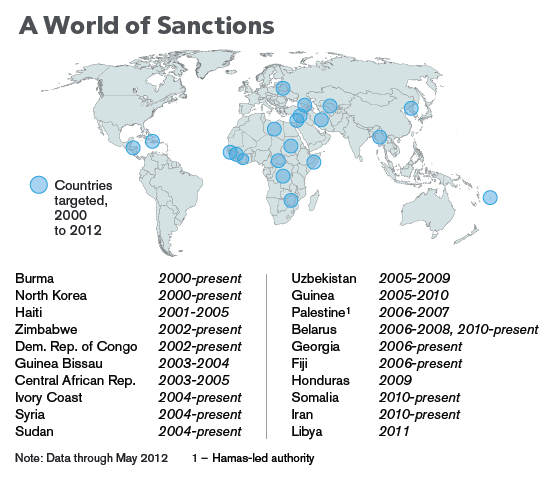
World of Sanctions

Source: Peterson Institute for International Economics

Continue reading

Shoddy Sanctions

photoEH

This is the second in a series of posts on Lee Jones’ Societies Under Siege: Exploring How International Economic Sanctions (Do Not) Work. We are delighted to welcome Dr Elin Hellquist, a Swedish Research Council International Postdoctoral Fellow at the Freie Universität, Berlin and the Department of Political Science, Stockholm University. Elin’s research is currently focused on the historical origins of different regional sanctions policies. She is also interested in the prospect that sanctions used by regional organizations against members could mature to take ground from foreign policy sanctions, as well as the implications of such a development for international relations at large.  Her most recent article is in International Relations.

Further responses will follow from guest authors Clara Portela and Katie Attwell over the next few days. You can find Lee’s original post here.


The debate about the effectiveness of sanctions is among the most tired in international relations scholarship. Rather than tackling the big political, social and ethical issues related to the practice of punishing one another in international relations, the literature has relentlessly debated what percentage of sanctions cases have been successful. Articles on sanctions in our finest journals have battled measurement technicalities and how to design maximally efficient sanctions instruments. In the real world, change always comes. Sooner or later, with or without sanctions, regimes fall, political prisoners are released, nuclear deals are made, and elections are held. If sanctions are involved, sanctions optimists are quick to attribute such changes to their use. Yet, it is hardly ever possible to say whether sanctions specifically, among an infinite number of co-existing factors, have caused a certain political outcome.

At first view, Lee Jones’ book Societies under Siege might appear yet another book on sanctions effectiveness. It is not. Instead, Lee brings us behind the scenes of three of the most influential sanctions cases in modern times: South Africa, Burma/Myanmar, and Iraq. Relying on a thorough historical-sociological analysis, we are led deep into these societies to understand how sanctions have worked to reshape social conflicts and thereby possibly influence politics (for better or worse).  The message is clear: in order to understand sanctions we have to understand the domestic context inside out. This message is both timely and timeless. It is an extremely timely wake-up call reminding any remaining intervention optimists of the moral and practical responsibility that follows from using sanctions without a qualified idea of how they will work on the ground. Highlighting the importance of local conditions is also a timeless message to an IR audience that far too often disregards qualitative difference in the search for quantifiable measurements. Sanctions do transform societies, Lee argues, but they can only be expected to contribute to political change if a number of favourable conditions allow so (e.g. the South African case).

This post will not repeat or summarize the arguments that Lee makes with wit and skill. Buy the book, or ask your library to do so. You will have the pleasure to read an unusually elegant and thought-provoking piece of solid scholarly work. What I would like to do is to pick up the ball where I think that Lee left it and draft a few propositions that complement and sometimes challenge Societies under Siege. I will propose that beyond their workings in the target states, sanctions also operate by (re)drawing normative boundaries in international relations. I will use the example of blacklists to underscore how sanctions work through a combination of material and symbolic features. Finally, I will follow-up on Lee’s discussion of the ethics of sanctions. In light of his findings, I will argue that the use of foreign policy sanctions should be minimized in accordance with the ‘harm principle’. Continue reading

Societies Under Siege: Exploring How International Economic Sanctions (Do Not) Work

This is the first in a series of posts on Lee Jones’ Societies Under Siege: Exploring How International Economic Sanctions (Do Not) Work. Responses will follow from guest authors Elin Hellquist, Clara Portela and Katie Attwell over the next few days.


It doesn’t seem to matter what the international crisis is: be it an inter-state war (Russia-Ukraine), civil strife (Syria), gross violations of human rights (Israel), or violent non-state actors on the rampage (ISIS, al-Qaeda), the ‘answer’ from governments and civil society always seems to be the same: impose economic sanctions. In the mid-20th century, only five countries were targeted by sanctions; by 2000, the number had increased tenfold. Once an obscure, rarely used and widely dismissed form of statecraft, sanctions are now clearly central to the exercise of power in international relations – particularly when dominant powers are reluctant to put ‘boots on the ground’.

My new book, Societies Under Siege: Exploring How International Economic Sanctions (Do Not) Work, is the first comparative effort to explore how these sanctions ‘work’ in practice – on the ground, in target states. This post introduces the book and the forum that will follow.

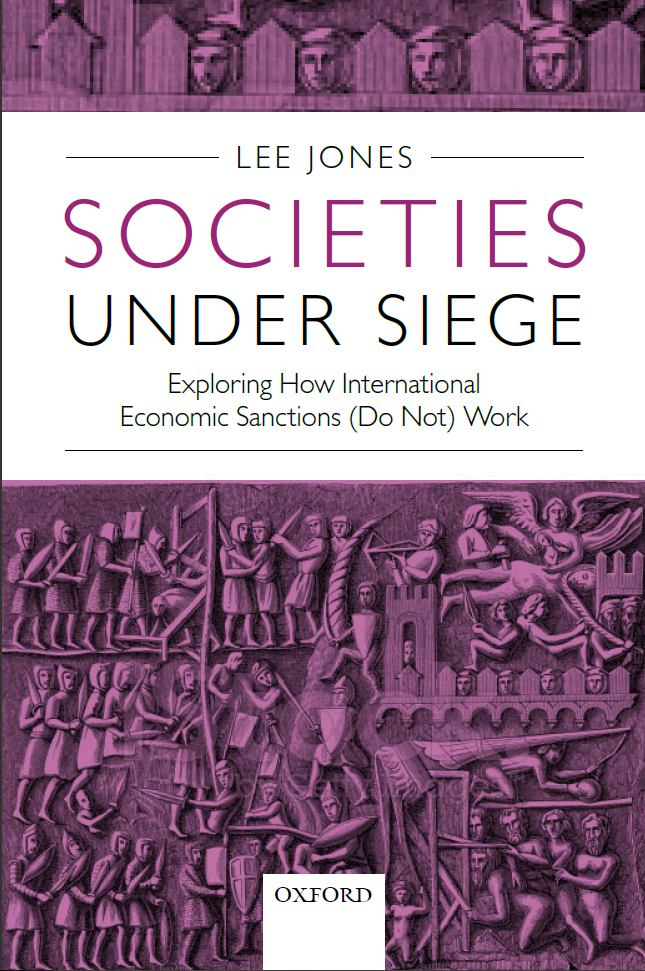
Societies Under Siege cover. The image is an engraving of a (failed) siege during the Albigensian crusade.

Societies Under Siege cover. The image is an engraving of a (failed) siege during the Albigensian crusade.

Continue reading

Reinventing the Future

It is an honour to have had Inventing the Future considered in such depth and detail, and we want to begin by extending our thanks to everyone who contributed to this symposium. This response is a useful moment for us to clarify our argument, to respond to the most significant questions, to acknowledge limitations of the book, and to correct some misunderstandings. We do so in a spirit of humility, given that – as we wrote in the introductory post – we see this book as a contribution to a larger debate and hopefully the spark for reflection on what we think are important issues for the contemporary left.

Post-Work Futures

In Joseph, Sophie and David’s pieces, some fundamental questions are raised about what precisely a post-work world entails, particularly with respect to concerns around the environment, labour, social reproduction, and colonialism. Does a high-tech post-work world entail the exhaustion of resources and the decimation of the earth’s climate? Does a post-work world mean the continued oppression and subjugation of low-income countries? These are essential questions to ask. In responding to these queries, it will be useful to draw up a series of alternative possible futures indicating how a post-work project may play out. Roughly speaking, we can imagine four broad and potentially intersecting futures: a neocolonial and racist post-work world, an ecologically unsustainable post-work world, a misogynist post-work world, and a leftist post-work world.

Continue reading