Something in the Way of Things

Hip-Hop Head

When you look at it head on, from just the right distance, the world seems solid. The order of things presents itself as impenetrable. Yet a change in the angle of vision reveals fissures, fusions, flukes – a world of pieces shifting ceaselessly. One vision of the world promises stability and order, the other freedom and creativity. Which of these is more attractive depends on where one finds oneself: pressed upon by the weight of the world, or abraded by the shifting fragments.

Which of these worlds is real? This is the metaphysician’s diagnosis: “If you want to calm your nerves, then find the arrangement of the world as it really is.” But the physician can only prescribe convalescence or catharsis: “Accept the reality of the given world or realise the subliminal essence of the immanent world.” This regiment exhausts us rather than making us well. It lacks the vigour of creative activity. We don’t need to know; we need to make.

William Connolly suggests that the political condition of late-modernity is to experience this impasse without means to bridge the gap.

In our times we can neither endure our thoughts nor the task of rethinking them. We think restlessly within familiar frameworks to avoid thought about how our thinking is framed. Perhaps that is the ground of modern thoughtlessness.

Creativity requires us to leave the metaphysician behind – the making of the world requires dreams, contradictions, promises, lies, empty space, messy abundance. Turning away from knowing does not force us to apologise for the durable architecture of the world – this is the vice of Richard Rorty’s ironic liberalism. He calls on poets of the self to write their lines on the walls of the world as if they were solid, so not to upset things too much – a consolation of the comfortable, irony in the face of human disaster.

The condition of the world impels those caught between the monuments of the given to return to the fissures, fusions and flukes, in hopes of exercising our creativity on the social architecture. We need world makers. We need lovers.

It is with these thoughts in mind that I return to The Roots. Phrenology, the follow-up to Things Fall Apart, explores the creative challenge the band faced after producing an album that reconstructed hip-hop – trying to avoid becoming a parody of themselves or reducing their message to braying didactic verses. The difficulty of achieving real creativity is political as well as artistic and it demands not knowledge but love, desire and risk; it is the Roots’ exploration of how to make worlds anew that offers up lessons of wider import.

Continue reading

This Courage Called Utopia

(wild bells) A warm Disordered welcome to Wanda Vrasti, who previously guested on the topic of the neoliberal tourist-citizen imaginary, and now joins the collective permanently. And glad we are to have her. Her academic writings thus far include Volunteer Tourism in the Global South: Giving Back in Neoliberal Times (which came out with the Routledge Interventions series a few months ago), ‘The Strange Case of Ethnography in International Relations’ (which caused its own debate), ‘”Caring” Capitalism and the Duplicity of Critique’, and most recently ‘Universal But Not Truly “Global”: Governmentality, Economic Liberalism and the International’.


It’s often been said that this is not only a socio-economic crisis of systemic proportions, but also a crisis of the imagination. And how could this be otherwise? Decades of being told There Is No Alternative, that liberal capitalism is the only rational way of organizing society, has atrophied our ability to imagine social forms of life that defy the bottom line. Yet positive affirmations of another world do exist here and there, in neighbourhood assemblies, community organizations, art collectives and collective practices, the Occupy camps… It is only difficult to tell what exactly the notion of progress is that ties these disparate small-is-beautiful alternatives together: What type of utopias can we imagine today? And how do concrete representations or prefigurations of utopia incite transformative action?

Javier Lozano Jaén

First thing one has to notice about utopia is its paradoxical position: grave anxiety about having lost sight of utopia (see Jameson’s famous quote: “it has become easier to imagine the end of the world than the end of capitalism”) meets great scepticism about all efforts to represent utopia. The so-called “Jewish tradition of utopianism,” featuring Adorno, Bloch, and later on Jameson, for instance, welcomes utopianism as an immanent critique of the dominant order, but warns against the authoritarian tendencies inherent in concrete representations of utopia. Excessively detailed pictures of fulfilment or positive affirmations of radiance reek of “bourgeois comfort.” With one sweep, these luminaries rid utopianism of utopia, reducing it to a solipsistic exercise of wishing another world were possible without the faintest suggestion of what that world might look like.

But doing away with the positive dimension of utopia, treating utopia only as a negative impulse is to lose the specificity of utopia, namely, its distinctive affective value. The merit of concrete representations of utopia, no matter how imperfect or implausible, is to allow us to become emotionally and corporeally invested in the promise of a better future. As zones of sentience, utopias rouse the desire for another world that might seem ridiculous or illusory when set against the present, but which is indispensable for turning radical politics into something more than just a thought exercise. Even a classic like “Workers of the World Unite!” has an undeniable erotic (embodied) quality to it, which, if denied, banishes politics to the space of boredom and bureaucracy. It is one thing to tell people that another world is possible and another entirely to let them experience this, for however shortly.

Most concrete representations and prefigurations of utopia from the past half century or so have been of the anti-authoritarian sort. Continue reading

A Global Story of Psalms 68:31 | Against the Provinciality of the Twenty Years Crisis

‘Moses and his Ethiopian Wife’, by Jacob Jordaens, c. 1650

Princes shall come out of Egypt; Ethiopia shall soon stretch out her hands unto God

Psalms 68:31 is part of the global story of colonialism, enslavement, the “civilizing mission” and self-liberation. It is a story that is central to the Twenty Years Crisis that constitutes the originating point of International Relations as a self-proclaimed discipline. But it is a story that is largely absent when this originating point is commemorated.

We can pick up the story of Psalms 68:31 with the King James version of the Bible, translated into the vernacular in 1611. At this time it is practice to denote things African through the name Aethiops. More than just a polity south of Egypt, Ethiopia also encompasses Black Africa as a whole. By 1773, catechisms are being developed around Psalm 68:31 that directly address African enslavement in the Americas and the prospects of abolition, emancipation and liberation.

There are two key interpretations. One, cultivated by white abolitionists and subsequently used by Europeans who embark upon an African “civilizing mission”, holds that it is they – white/Europeans – who are God’s children. Hence, it is white/Europeans to whom Ethiopia is stretching for her hands for deliverance from slavery and primitivism. The other, cultivated by the enslaved and their downpressed descendants, holds that the Bible is their story –  the “half never told“. Africans will therefore righteously deliver their own selves from bondage.

The first catechism appears as early as 1773 in the letters of Anthony Benezet, a French-born Quaker living in North America. Scouring through the Bible to find  divine authority for the abolitionist cause, Benezet notes: “beloved friend, the passage we are seeking for is Psalms 68, 31.”; and “the people called Ethiopians are definitely African negros due to Jeremiah 13,23 – “can the Ethiopian change his skin?”. Abolitionists – especially British ones – are most concerned that the enslavement practised by white and European “Christians” would denigrate their status as the most civilized amongst humanity. By Benezet’s time, it is already a belief amongst the intellectual caste of  white/Europeans that they are the people chosen by God to express his Providence, through commerce and colonisation.

Continue reading

Navigating Neoliberalism: Political Aesthetics in an Age of Crisis

For those who are interested, here’s a copy of the talk I gave last weekend on the technological sublime, machine perception, and cybernetic economies. Held in the beautiful Treignac area at The Matter of Contradiction: Ungrounding the Object event, it was a lot of fun and filled with some fascinating discussions. Many thanks to the Treignac Projet for inviting me and organizing the event. Check out more of their work here.

What We Talked About at ISA 2012: A Human Right to Housing

Housing is a Human Right Exhibition, Philadelphia (original photo by Annie Seng)

I ain’t got no home. I’m just a roamin’ round, just a wandering worker, I go from town to town. And the police make it hard wherever I may go. And I ain’t got no home in this world anymore.

My brothers and my sisters they’re stranded on this road. A hot and dusty road that a million feet have trod. Rich man took my home and drove me from my door. And I ain’t got no home in this world anymore.

Was a farmin’ on the shares and always I was poor. My crops I lay into the banker’s store. My wife took down and died upon the cabin floor. And I ain’t got no home in this world anymore.

Now as I look around it’s mighty plain to see this world is such a great and funny place to be. Ah, the gamblin’ man is rich and the working man is poor. And I ain’t got no home in this world anymore.

-“I Ain’t Got No Home in this World” by Woodie Guthrie

Beginnings Are Difficult

How to start something new? This question troubles the academic as well as the activist. At the moment it troubles me both as a question of inquiry and as a meta-question of method.

In my previous work I have argued that human rights should be judged first and foremost by the consequences they bring about. Do human rights enable new forms of politics? Do they enable politics that increase the control we have over our lives, or that reduce the suffering and humiliation we are exposed to? Or do they confine us in a liberal subjectivity that makes wider visions of justice impossible, which push us to reconcile our beautiful revolutionary dreams to the limited horizon that contemporary liberal capitalism imposes?

I have offered a qualified defense of human rights as a democratising ethos, which suggests that human rights can enable everyday people to challenge the terms of legitimate political authority, including the institutional shape of their government and the makeup of their communities. This is done by formally opening up the identity of “rights holder” to anyone, regardless of their social position. This opening, however, is only formal and in that formality human rights have an ambiguous significance. For this reason, I have argued that to think of human rights as a democratising ethos also requires that we attend to the politics of human rights. This means that ensuring that human rights support democracy and equality is a political struggle as well as an ethical vision.

Continue reading

Friday is for Beautiful Revolutionary Dreams and Pragmatist Notes

Imagination is the chief instrument of the good. It is more or less a commonplace to say that a person’s ideas and treatment of his fellows are dependent upon his power to put himself imaginatively in their place. But the primacy of the imagination extends far beyond the scope of direct personal relationships. Except where “ideal” is used in conventional deference or as a name for a sentimental reverie, the ideal factors in every moral outlook and human loyalty are imaginative. The historic alliance of religion and art has its roots in this common quality. Hence it is that art is more moral than moralities. For the latter either are, or tend to become, consecrations of the established order. The moral prophets of humanity have always been poets even though they spoke in free verse or by parable. Uniformly, however, their vision of possibilities has soon been converted into a proclamation of facts that already exist and hardened into semi-political institutions. Their imaginative presentation of ideals that should command thought and desire have been treated as rules of policy. Art has been the means of keeping alive the sense of purposes that outrun evidence and of meanings that transcend indurated habit.

-John Dewey, Art as Experience

What We Talked About At ISA 2012: How Music Brings Meaning to Politics

At this year’s ISA conference, I presented on the panel ‘The Social Technologies of Protest’, with George Lawson, Eric Selbin, Robbie Shilliam and our discussant Patrick Jackson. The full text of the draft paper is available here. Thanks go to the panel and audience for some fascinating questions and discussions.


Music is a world within itself
With a language we all understand
With an equal opportunity
For all to sing, dance and clap their hands
But just because a record has a groove
Don’t make it in the groove
But you can tell right away at letter A
When the people start to move

–          ­‘Sir Duke’, Stevie Wonder, Songs in the Key of Life (1976)

Music is an old and effective technology of politics. This was highly visible in both the recent uprisings and the attempts at counter-revolution; whilst from the beginning Tunisian activists sang their national anthem in the street in anti-regime protest, Assad blasted the Syrian anthem into the cities as a reminder of his position. Rappers and older musicians shared platforms in Tahrir Square, and DJs parodically remixed Gaddafi’s final public speeches into technotronic nonsense. Whilst not all political music is sung of course, songs and the act of singing are particularly powerful in political situations as means and symbols of mobilisation and unification.  Moreover, songs tend to linger in the brain.

But there are at least two ways of thinking about the relationship between politics and music. The question which is perhaps most often asked and answered is: how, when and where is music political? So, why did the Tunisian protesters sing the national anthem in front of the courthouse, how did music support the anti-apartheid struggle, and why did the Haitian revolutionaries sing the Marseillaise? How did the musical character of these expressions facilitate a particular kind of political act? Lots of excellent writers, both scholarly and otherwise, have turned their attentions to the nature of political music, and especially protest music, in a variety of times and places.

However, the question that I want to focus on mainly here though is slightly different: how, when and where is politics musical? This question was stimulated by the general observation that when we try to make sense of politics, we often use metaphors related to music. A common phrase is that a political statement or value ‘struck a chord’ with an audience, or that protesters are ‘banging a drum’. Politicians may or may not be ‘in tune’ with publics, and relations may be ‘harmonious’ or not. Coups will be ‘orchestrated’.

Perhaps surprisingly, in moving from vernacular to scholarly modes of understanding politics, the metaphors of music are no less important. In fact, in some cases they seem to be more important. The genre-defining work of the historical sociologist Charles Tilly in the study of contentious politics is a revealing and fascinating case in point.

Continue reading

Open Access, Harvard Delight Edition

An extraordinary and delightful communiqué from Harvard on journal pricing has surfaced (early reactions here and here and here). It was actually issued almost a week back, but the Twitter hive mind (or my corner of it) appears only now to have noticed (h/t to JamieSW for that). The contents are pretty extraordinary, even too good to be true. The preamble is brutal about the current state of the journal system, observing that Harvard spent almost $3.75 million last year on bundled journal provision from some publishers (10% of all collection costs and 20% of all periodical costs for 2010); that “profit margins of 35% and more suggest that the prices we must pay do not solely result from an increasing supply of new articles”; that “[t]he Library has never received anything close to full reimbursement for these expenditures from overhead collected by the University on grant and research funds”; and that “[i]t is untenable for contracts with at least two major providers to continue on the basis identical with past agreements. Costs are now prohibitive” (I’m guessing one provider at least is Elsevier).

Then some options-cum-recommendations for Faculty are laid out:

1. Make sure that all of your own papers are accessible by submitting them to DASH in accordance with the faculty-initiated open-access policies.

2. Consider submitting articles to open-access journals, or to ones that have reasonable, sustainable subscription costs; move prestige to open access.

3. If on the editorial board of a journal involved, determine if it can be published as open access material, or independently from publishers that practice pricing described above. If not, consider resigning.

4. Contact professional organizations to raise these issues.

5. Encourage professional associations to take control of scholarly literature in their field or shift the management of their e-journals to library-friendly organizations.

6. Encourage colleagues to consider and to discuss these or other options.

7. Sign contracts that unbundle subscriptions and concentrate on higher-use journals.

8. Move journals to a sustainable pay per use system.

9. Insist on subscription contracts in which the terms can be made public.

Note in particular point 3. Harvard is asking its academics to seriously consider resigning from major journals if substantive good-faith moves are not made towards open access or “sustainable subscription costs” (read: a major reversal of current practice). As previously suggested, only serious insurgencies within major centres of academic prestige will undo the private stranglehold on knowledge-in-common. On those grounds, I’m tempted to giddy excitement. The question, of course, is which other major institutions (and which serious academic figures) will have the solidarity and good sense to follow this example. As a rallying point, social sciences and social theory need some version of The Cost Of Knowledge manifesto that spans the entire issue of journals and knowledge production. At the very least, we now have a new rhetorical device: open access is good enough for Harvard: why isn’t it good enough for you?

What We Talked About At ISA: From #occupyirtheory to #OpenIR?

A write up of my comments at the #occupyirtheory event in San Diego. The event itself was both hope-filled and occasionally frustrating, not least for the small group of walk-outs, apparently ‘political’ ‘scientists’ lacking in any conception of what it actually means to engage in the political (note: this bothered me especially, but was a rather minor irritation in the grander scheme of things). Despite the late hour, there were between 40 and 60 people there throughout, and a number of very positive things have come of it. It looks like there’ll be some gathering at BISA/ISA to discuss further, and we’re pitching something for the Millennium conference on some of the themes addressed below, and there will of course be ISA 2013 too. In the meantime, there’s the Facebook group, the blog, and a mailing list. The term OpenIR is owed to Kathryn Fisher, and seems to several of us to be a better umbrella term for the many things we want to address in the discipline and the academy. I also just want to give a public shout-out to Nick, Wanda, Robbie and Meera for doing so much on this.


The #occupy practice/meme has antecedents. Physical manifestations of a ‘public’, horizontalism, prefigurative politics and more can be traced in all sorts of histories. One such lineage is the foreshadowing of Zucotti Park in recent struggles over education. Take the slogan in March 2010 over privatisation at the University of California, which was ‘STRIKE / OCCUPY / TAKEOVER’. Or Middlesex, where students resisting the dismantling of the Philosophy Department in that same year unfurled a banner during their occupation, one that proclaimed: ‘THE UNIVERSITY IS A FACTORY! STRIKE! OCCUPY!’.

I want briefly, then, to think about the space of the university in our discussions of #occupy. There have been rich and suggestive calls to re-politicise ourselves as academic-activists, to look again at our work and its claims, and to turn our abilities, such as they are, to projects of resistance and transformation. But we risk a displacement. When we talk of ‘the street’, or politics enacted in the reconfigured space of #occupy, or of the ‘real world’ that we must be relevant to, we already miss the university itself as that factory in which we labour. We are tempted by a view of ourselves as leaving ivory towers to do politics, instead of seeing those towers themselves as spaces of politics. As if our institutions and practices were not already part of the world.

Whether you see #occupy as transformational or nor, or whether you simply prefer a different vocabulary, I think a demand remains: a demand to politicise our own positionality. This politicisation can have many dimensions, but I want to suggestively highlight four, each being a sphere in which we should be diagnosing and transforming our own practices.

Continue reading

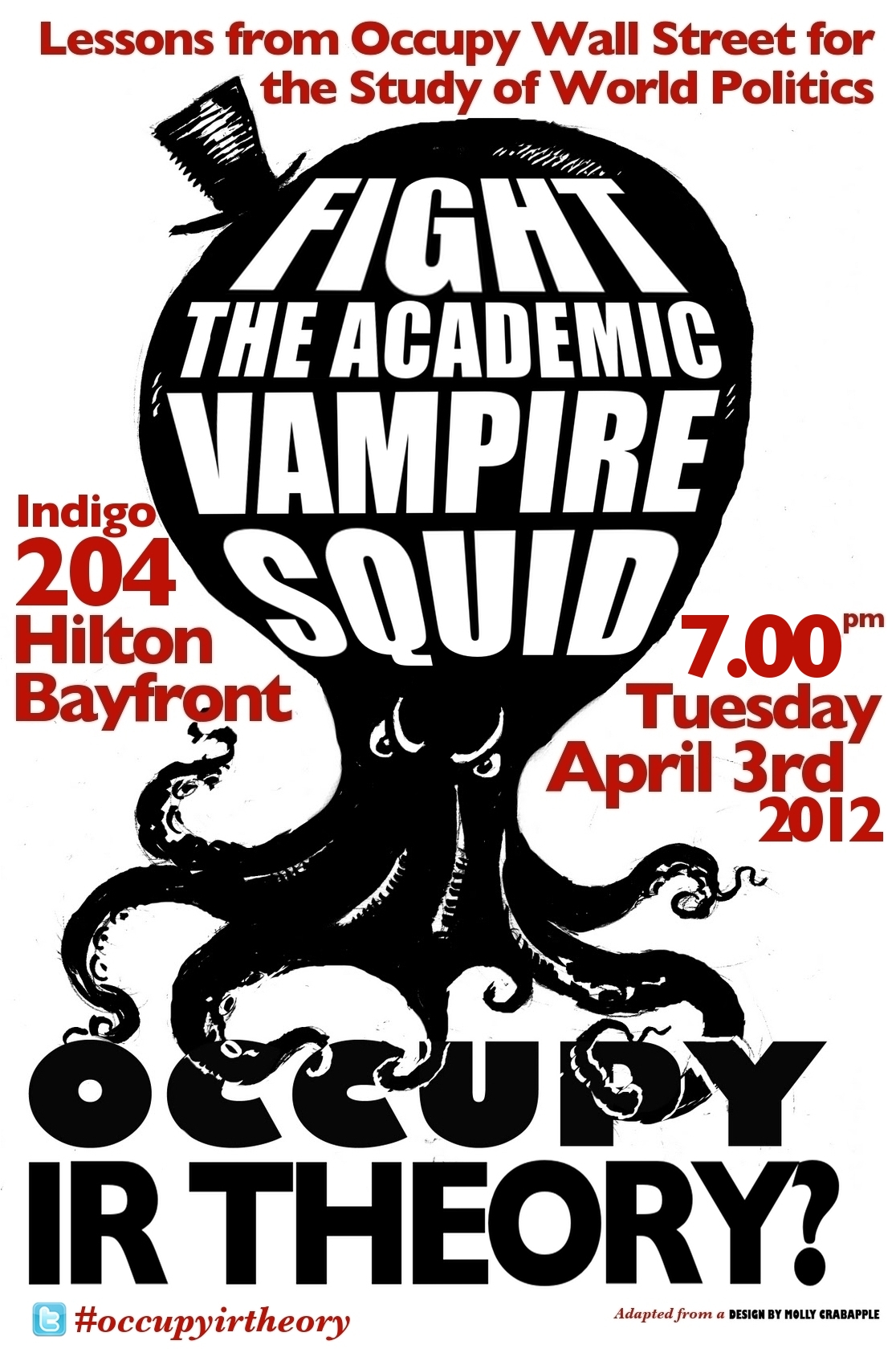
#occupyirtheory, International Studies Association (San Diego) Edition

ISA 2012 is just around the corner, and it will doubtless be as hectic and awkward and joyous as ever. Robbie and I will be appearing at an event on #occupy and its relevance for IR on Tuesday at 7 in Indigo 204 at the Hilton Bayfront. We’ll be joining Lucian Ashworth, Lara Coleman, Nicholas Kiersey and Wanda Vrasti (all chaired by Jason Weidner) for what I’m sure will be an exciting roundtable discussion. More importantly, it will be brief, with most of the session given over to a General Assembly-style discussion of what IR can learn from #occupy, what #occupy might get from IR, and how we might take the spirit and organisational form into the discipline itself (or not).

The hope is that the slightly later starting time will allow people to go both to the various Section receptions and meetings (briefly) and to come to this, whilst still leaving reasonable evening time for food and the rest. Please do get involved over at Facebook (see also the #occupyirtheory group and #occupyirtheory blog) and let interested IR-types know. Readers may also be (should also be!) interested in a recent forum from the Journal of Critical Globalisation Studies on ‘Occupy IR/IPE’, featuring Nick and Wanda (as well as Colin Wight, Michael J. Shapiro, Patrick Jackson and others), which I’ve parcelled together as a single pdf for your delectation here.

Hope to see you there!