Washington, DC: a human rights city?

Below are some initial reflections on the work I’ve been doing in Washington DC on the human right to housing. They are not terribly substantive and serve as much as a tribute and thank you to those who hosted me as disquisition on the topic. But I wanted to post the piece for those who might be interested in my broader project, or what’s going on in Washington DC. Enjoy.

In December 2008 Washington DC was declared a human rights city. The DC City Council passed the resolution, pushed for by the American Friends Service Committee. While this is a lovely idea, it leaves one wondering what does it mean to be a human rights city. In particular, what does it mean in a city defined by inequality, where more than 15,000 citizens do not have homes, where 20% of the population lives in poverty, where housing is more unaffordable than anywhere in the United States, and where public and affordable housing is under constant threat. Perhaps the declaration of DC as a human rights city would seem less cynical if the DC City Council or the Federal Government had shown themselves committed to protecting the human rights of residents of the District, particularly the right to housing.

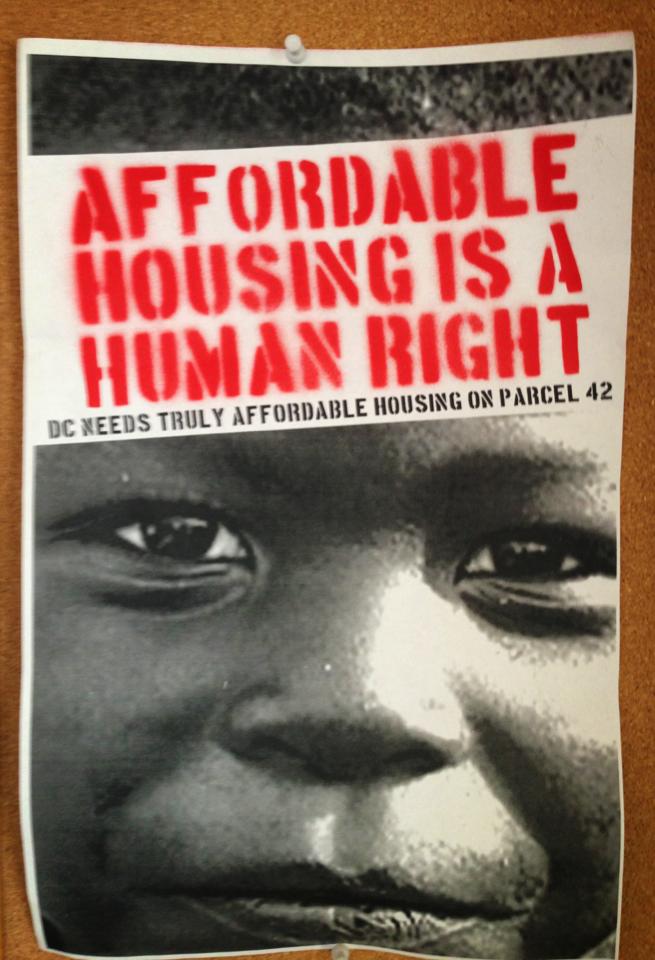
Housing is a Human Right

Human rights promise us many things. The right to housing, however, is perhaps the most fundamental. What do our rights mean if we do not have a place to call home? Article 25 of the Universal Declaration of Human Rights promises that

Everyone has the right to a standard of living adequate for the health and well-being of himself and of his family, including food, clothing, housing and medical care and necessary social services, and the right to security in the event of unemployment, sickness, disability, widowhood, old age or other lack of livelihood in circumstances beyond his control.

The right to housing is fundamental because it is in our homes that we find the space to rest, to pursue wellness, to find love, to raise families, and build communities, to collect our energy and thoughts so that we can participate in democratic politics, and it is where we find the safety, security and privacy that make a dignified life possible. Continue reading

What Does It Mean To Edit An Open Access Journal?

Yet another post on open access, but this time featuring a non-Disorder voice. I recently exchanged emails with Dr Eva Erman of Uppsala University on the possibilities and constraints of open access publishing. Eva is the Chief Editor of Ethics & Global Politics, a fully open journal that not only attracts authors of note in normative international political theory (Zygmunt Bauman, Saskia Sassen, Bruno Latour, John Agnew, R.B.J. Walker, Heikki Patomäki, Lea Ypi, Catherine Lu, and our own Rahul Rao!), but has also achieved an Impact Factor above that of many well-known and ‘closed’ journals (0.808, putting it 20th in Ethics and 53rd in Political Science).[1] As we have already discussed, fully open journals of this kind (what might be termed ‘No APC Gold’ journals) can face serious resource constraints, so it is worth understanding what might be possible. My exchange with Eva is book-ended with some thoughts on what it all means.


Ethics and Global Politics

1. Who began the journal, and why?

I got the opportunity to start the journal in 2007. A woman from a newly established publishing company, Anne Bindslev who runs Co-Action Publishing, who knew about my work, asked if I thought there was a subfield/niche within political science that was lacking among prominent journals. And I thought that back then, journals in ethics were not very good at publishing articles in political philosophy and, more specifically, on international political theory and global politics; and journals in international affairs, such as Ethics & International Affairs, were not very theoretically impressive. So, this is why I said yes to launch Ethics & Global Politics. Another reason was that I became interested in open access (OA) as a publishing model, and also for normative reasons thought that a journal that publishes in global ethics, global justice and so on, should do so open access to all people.

2. How is the journal funded? Are Editors or their assistants paid? 

Together with Co-Action publishing (who now run more than 25 OA journals in natural and social sciences), I have managed to get funding for OA publication from two different Swedish funders, the Swedish Research Council and FAS. The last year, FAS has been replaced by funding from Uppsala university, where the journal is editorially based. Of course, this is an insecure situation, economically, since I have to apply for renewed funding every year, which is always a bit uncertain.

The exact budget for 2013 consists of 165,000 Swedish crona (from the Swedish Research Council) and 70,000 Swedish crona from Uppsala university. This is in total an annual cost of around £23,500 or $36,000.

Pretty much everything goes to Co-Action Publishing, who are responsible for production management, webpage, copyediting and type-setting, as well as getting everything out on professional proof reading. Co-Action Publishing do not make any profit from running OA journals. Of course, the voluntary or almost voluntary work on the editorial side, by me mostly, is more difficult to measure.

3. How do you organise, and pay for, your online presence?

Continue reading

Pacific Redemption Songs

Te Hau

“Te Hau” by Abby Wendy

A few years ago I was reasoning with members of Ras Messengers, a reggae-jazz band who had in 1979 toured Aotearoa New Zealand. The Rastafari musicians recollected their experiences with various Māori communities. Occasionally female Māori elders (kuia), in introducing themselves to the band, would connect their genealogies back to Africa. The kuia did this as part of an indigenous practice called whakapapa, which literally means to “make ground”. It is a practice that allows diverse peoples who might never have met to find a genealogical route through which they are already personally related.

Chauncey Huntley from Ras Messengers showing the Rakau (traditional sticks) that he was gifted thirty years previously

Rastafari also have a practice called “grounding”, which is to collectively reason on the meaning and challenges of contemporary life. Over– or inner- standing (instead of under- standing) is cultivated through the guidance of natural laws and – often with the help of drums, fire and holy herb – the intuition provided by spiritual agencies (Irits) that allows ones to pierce the veil of deathly inequality, oppression and dehumanization so as to redeem living energies and relationships that might help with healing in the present. When I think of Irits I also think of a key concept of Māori cosmology called hau. Overstood by Māori Marsdenhau is the breath or wind of spirit which is infused into the process of birth to animate life and associated with the intention to bind peoples together in righteous living.

A key stone of the Rastafari faith is that adherents collectively redeem their African genealogy so as to breathe life back into their suffering condition and leave behind the death of enslavement and its contemporary legacies. So when I heard of this story of the kuia and Ras Messengers, I imagined how this practice might have given strength to the Ras. After all, in those days (and perhaps still today), peoples of various African heritages were often forced (directly or indirectly) to disavow those connections themselves.

Whakapapa is an art practised collectively. Yet it is not free play, nor is it the manufacturing of fiction. It is a creative retrieval. It could even be a redemptive act.

Keskidee 13

Keskidee perform in New Zealand

This was certainly the intention of those who organized the tour of Ras Messengers alongisde the Black British theatre group, Keskidee (the name of a Guianese bird known for its resilience). The organizers were a group of New Zealand activists that came together under the banner Keskidee Aroha (Aroha being the Māori word for love, sympathy, nurturing affection etc). Their intention was to learn from and work with the artistic tropes of Black Power and Rastafari so as to catalyse a cultural revolution and renaissance amongst young Māori and Pasifika peoples thereby strengthening them in their confrontation with a racist post-settler society.

Continue reading

The Manning Trial, Truth-Telling, and The Precariousness of Democractic Society

The following is a piece written as part of an interview I did at City University on the political and ethical significance of the Bradley Manning trial currently ongoing (links to potentially embarrassing video to follow).

I think that the most important thing that the Bradley Manning trial shows us is the gap that opens up between our legal institutions and our sense of right and wrong, between the law and morality. Many people around the world are shocked by Manning’s imprisonment. People are shocked partly because he has been held under conditions that the UN said violated his human rights, but also because Manning is being tried for exposing the actions of US soldiers and diplomats, including evidence of many potential and confirmed human rights violations. Manning’s supporters are incredulous and view the proceedings now taking place at Fort Meade as illegitimate.Bradley Manning War Crimes

I understand this incredulity and on a level I share it. What I want to suggest, however, is that what we are seeing in the trial of this young man is even more troubling than the corruption of the law by politics – it reveals that the law is always suffused with politics. The law is a technical code. Yes, it is also a normative system that is supposed to determine right and wrong, guilt and innocence. But it is vital that we do not forget that it is a technical code first and foremost, a code that political authorities use to justify their power. Therefore, those with the capacity to influence and manipulate the legal code will always be at an advantage, will always be able to shape that code not towards the pursuit of justice but towards their own interests. This is what Finnish legal scholar Martti Koskenniemi calls this the gap between apology and utopia. The law has its utopian moments and this is especially true of human rights law – for example, Manning supporters see him as a hero who has exposed the grievous crimes of the US government and its military, particularly in Iraq and Afghanistan. They appeal to human rights standards that are quintessential moral claims, but which sadly lack the force of political authority and so are not reliably protected. This is important, but the law also has its moment of apology, where it serves the interests of established authorities, of powerful actors like the US government.

Continue reading

What We Talked About At ISA: Teaching Gender and War: Some Reflections on Negotiating the Five Stages of Feminist Consciousness/Grief in Undergraduate Students

Victoria BashamA guest post in our current series on ISA presentations from Victoria Basham, who is Senior Lecturer in Politics at the University of Exeter. Victoria’s research draws on feminist and sociological theory to explore militaries, militarism and militarization. In War, Identity and the Liberal State (Routledge, 2013), she draws on original fieldwork research with members of the British Armed Forces to offer insights into how their everyday experiences are shaped by, and shape, a politics of gender, race and sexuality that not only underpins power relations in the military, but the geopolitics of wars waged by liberal states. Victoria is also a working towards the launch of a new interdisciplinary and global journal called Critical Military Studies which seeks to provide a space for dialogue among scholars questioning the very idea of military organisation and armed force, and seeking to offer new insights into organised and state-sanctioned violence by exploring its wider significance and effects.


Despite the burgeoning literature highlighting the significance of gender to global politics, research into international studies curricula suggests that gender is rarely dealt with extensively or even adequately by ‘top ranking’ UK Politics and International Relations (IR) departments. A cursory glance at popular, introductory undergraduate textbooks in Politics and International Relations also reveals that whilst feminism may be included as an approach, accounts of power as institutionally situated remain dominant. As such, many undergraduates only experience brief introductions to feminism, gender, and issues of sexual identity, if anything at all. So when I was given the chance to design and teach two research-led undergraduate courses in 2009, I saw it as an important opportunity: both to provide students with insights into how gender animates global politics, and to engage in a form of ‘feminist pedagogy’ by encouraging students to look at themselves and the world around them critically and analytically, through the interlocking lenses of gender, race, class and sexuality.

My experience of delivering these courses over the past few years has been largely positive. On more than one occasion students have commented that engaging with feminist theories and praxis had ‘opened their eyes’. However, in other students the experience of studying the global through gendered and postcolonial lenses elicited confusion, anger and pain on their part, at least initially. Indeed, as I have continued to teach these courses, I have often thought of student reactions as akin to Kübler-Ross and Kessler’s five stages of grief or what Patti Lather has aptly called ‘stages of feminist consciousness’.

One possible reason for this is that for feminists, the question of ‘What is Politics?’ necessarily includes accounts of power that are personal, emotional, and everyday. Given that trying to account for how power shapes and is shaped by people’s daily lives is not always readily accessible through a focus on institutions and the like – the usual stuff of politics and IR analysis – many feminist teachers are likely to encourage their students to think through how ‘the personal is political’ in their experiences and to re-personalise an often depersonalised and sanitised set of issues including war. Many of my students (though not all, and rarely, it should be said, in a linear fashion) experience moments of denial, anger, bargaining, depression and acceptance when taking my courses. Moreover, in reacting to their comments and in trying to anticipate their turmoil I often find myself angry, disbelieving, in negotiating mode, saddened and sometimes having to accept, and very grudgingly I’ll admit, that not all of them believe that gender is as significant to war as I do.

Continue reading

If I Was Crooked Timber, I’d Demand A Recount…

Disordered Ducks

Despite our justified renunciation of audit culture and academic hierarchy, we cannot not acknowledge the receipt tonight of OAIS (Outstanding Achievement in International Studies Weblogging) awards for both categories in which we were entered: best individual blog post (for John Hobson’s guest post on race and Eurocentrism) and for best group blog. How we won out over Cohen, Green and Wood on sexual violence and the Human Security Report will remain one of the great mysteries of democracy (seriously, go read), but we’re grateful nevertheless. Shout-outs too to Wronging Rights and Justice In Conflict, unjustly neglected.

May the stale halls of established academia shake with the news of our collective arrival.

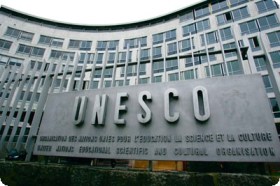
UNESCO and Research Agendas Concerning Race

Antigua was settled by human rubbish from Europe, who used enslaved but noble and exalted human beings from Africa (all masters of every stripe are rubbish, and all slaves of every stripe are noble and exalted; there can be no question about this) to satisfy their desire for wealth and power, to feel better about their own miserable existence, so that they could be less lonely and empty – a European disease … Of course, the whole thing is, once you cease to be a master … you are no longer human rubbish, you are just a human being, and all the things that adds up to. So, too, with the slaves. Once they are no longer slaves, once they are free, they are no longer noble and exalted; they are just human beings.

Jamaica Kincaid suggests that abolition and emancipation are bitter-sweet affairs. For the enslaved, freedom furnishes them with a human being that nevertheless awaits a meaningful personhood. Out of slavery the master fares better, redeeming his human being from being human rubbish. Kincaid’s suggestion is insightful. After all, abolition had a vibrant nineteenth century afterlife. White abolitionists enthusiastically allowed their humanitarianism to colonize Africa so that God’s chosen could sanctify themselves through the act of saving the natives from their selves. Meanwhile, William Wilberforce et al, convinced that slaves were human biologically yet lacked the social and cultural competencies of humanity, looked on fascinated at the experiment of self-government in Haiti. From this point onwards all future failings would be attributed to the epidermis, not the colonial relation. Presently, argues Kincaid, the landscapes of the old Caribbean plantations have been consumed by a white tourist gaze that has once again disavowed the living legacies of enslavement and colonization and denied meaningful personhood to its peoples. What remains of these places and peoples is only an “unreal”, picture-book beauty.

What are our narratives of race and racism? Whom do we follow in order to tell the tale: the masters or the enslaved – the humanitarians or the “sufferers”? Which tale confesses the episteme –the scientifically valid study – of race?

The 1950-51 UNESCO “statements on race” answered such questions in favour of the master’s narrative. Announcing a new era in human understanding after the terrors of war and irrationalities of genocide, the main purpose of the statements was to separate the “biological fact” of race from its “social myth”. The biological fact in and of itself was rendered harmless, pertaining only to “physical and physiological” classifications. Thus genetic inheritance, it was affirmed, could have no bearing on mental or cultural competencies and capabilities. Conversely, the social myth of race was considered extremely dangerous in that it rendered cultural difference as biological thus sundering the “unity of mankind”. This myth had to be dispensed with; hence ethnicity – as a social/cultural classifier – was proposed as a preferable classificatory regime to that of race. Ethnicity, after all, had not been tainted with supremacist hierarchy and could signify instead non-hierarchical diversity.

Although the scientists who collectively produced the statements on race were by no means all white, the majority hailed from Western academies. And the particular kind of anti-racism evident in UNESCO’s statements had already been formulated by famous Western anthropologists such as Franz Boas. They had sought to undermine scientific racism on its own grounds, i.e. by proving the un-scientific nature of the social myth of race. And this endeavour required debunking racialized identity – that which confessed their legal and natural inequality – as myth not fact. However, as part of this manoeuvre these identities had to be subsumed under a harmless social science of ethnic categorization. While this move redeemed white identities, it de-politicized the meanings of the sufferers’ cultural complexes and complexions, extricated them from inherited hierarchies of power, and thus segregated them from the inherited and living struggles against (post-/neo-)masters. In short, as Alana Lentin puts it, the effect of the statements was to separate race from politics.

Continue reading

Narrative, Self, Agency: Reflections on a Workshop

Richard JacksonRichard Jackson offers the fifth post in the Methodology and Narrative mini-forum. Richard is Professor of Peace Studies and Deputy Director of the National Centre for Peace and Conflict Studies, University of Otago, New Zealand. He is the author of Writing the War on Terrorism: Language, Politics and Counterterrorism (Manchester University Press, 2005), Conflict Resolution in the Twenty-first Century: Principles, Methods and Approaches (Ann Arbor MI: Michigan University Press, 2009; co-authored with Jacob Bercovitch), Terrorism: A Critical Introduction (Palgrave-Macmillan, 2011; co-authored with Marie Breen Smyth, Jeroen Gunning and Lee Jarvis), and numerous related articles. He is also the Editor-in-Chief of the journal, Critical Studies on Terrorism. He blogs at Richard Jackson Terrorism Blog, where part of this post originally appeared.


Any scholar who has ever reflected on their academic career can identify a number of key transformative turning points along the way – those moments when some new insight or experience turned you from the path you were on and sent you in an exciting new direction. It may have been a particular lecture, a book, a chance conversation, a teacher. Either way, it altered your thinking and set you on a new course. Reading Joseba Zulaika and William Douglass’s Terror and Taboo in the days after September 11, 2001 was one such turning point for me. I never would have become interested in critical terrorism studies if I hadn’t found a sale copy of that book in the Otago University Bookshop exactly when the world seemed to be going crazy about the ‘new’ threat of terrorism. The books I later wrote, the journal I helped to start, the conferences and panels I helped to organise – all that might not have happened if I hadn’t picked up that particular book when I did. Sometimes our lives turn on a simple moment that seems utterly ordinary at the time.

Attending a workshop on ‘Critical Methodologies: Narrative Voice and the Writing of the Political – The Limits of Language’ organised by Elizabeth Dauphinee, has proved to be another of these important turning points in my academic career. It has transformed me to a degree I never imagined; I feel that I am no longer the scholar or person I was before I went to Toronto for what I thought would be just another interesting but not necessarily out of the ordinary kind of academic workshop. I’m on a different path now. I want to do different things than I did before. It’s not that I have it all mapped or know where I will end up. I just know that I don’t want to continue to be the same kind of scholar I was before or pursue my work and academic career in the same way.

In preparing for the workshop, and during the workshop discussions, I had a genuine moment of revelation about how powerful narrative can be – as a mode of thinking, a way of writing, a method of teaching, a way of seeing and being in the world. I hadn’t really grasped it before, but I learned that narrative can help you connect more deeply with students in teaching situations, and also help them to learn in new ways; it can engender deeper levels of affective understanding and insight of subjects like war and politics; it can help to de-subjugate silenced voices and knowledges; it can challenge dominant political narratives and reveal the operations and effects of discipline and power; it can make your work more interesting and accessible to the reader. During the workshop, we discovered a great many reasons for considering narrative as a powerful tool and approach to IR which ought to be more widely used and legitimised in our discipline.

In relation to critical terrorism studies, the field I am most deeply involved in, I had already started to think that we needed other forms of production apart from scholarly books and articles to make a greater impact on the wider culture – such as films, novels, plays, art, music and so on. However, until I met the other writers and scholars at the workshop and heard their stories and experiences, and how narrative has affected them and impacted on their research, I hadn’t really understood just how powerful and transformative narrative writing could be.

Among other things, perhaps the most important revelation for me was when I came to see that narrative writing – especially auto-ethnographic narrative writing – can be an important step in understanding how your own subjectivity has been constructed, and how in turn, this can be an essential step towards greater individual agency and a kind of personal emancipation. For example, soon after the workshop I began to reflect upon, and write about, how my experiences had shaped my academic and political outlook, leading me down a particular path – and also how those experiences had enriched my understanding of some of the political phenomena I study as an IR scholar. Partly as a result of this auto-ethnographic reflection, I subsequently ‘came out’ in relation to my pacifist beliefs. I wrote the following piece not long after the workshop and published it on my blog.

Continue reading

To Yahya

The fourth in our mini-forum on critical methodology and narrative (the full series is here). This entry is authored by A—, a student and activist who shall remain nameless, the political realities and personal dangers of our world being as they are.


To Yahya,

I remember your eyes, your fearful and tired eyes. Your shaking voice is in my ear, repeatedly asking “do you think they want to kill me?” And my desperate answer “no they won’t; we will not allow them”. I am sorry Yahya. When I came to Canada there was no information about you, they had removed you from the…. And took you to an unknown place. We had tried so hard to find you but we could not. I am sorry. I know you thought I forgot you, but I did not. After I heard you were executed I was devastated. Your and other political prisoners’ (who we were trying to help) death embedded in me an incredible pain and weakness. I lost everything that I had believed before, my power, my self-esteem. Everything seemed hollow and reasonless. I lost my faith in humanity, International Law, NGO’s, the UN, Human Rights, the media… and all the places I wrote to and never got any response or any practical help. I see my weakness and I understand that beyond that hollow propagandas nothing actually exists that can do something. After that, I hated all of them, I hated the government and I hated the world for not seeing your pain, for not hearing your voice. Yahya, I hated myself as well. You were such a young and bright man that I could not tell you the truth: that we could do nothing to stop them. That our effort is useless, a waste of time, a waste of life and it does not come from power it only came from the fact that we wanted to make the world see what is happening here. “So what?” you might ask and I do not have any answer for you except to say I am so sorry, I am so terribly sorry.

When I came to Canada, I deliberately tried to keep you and the memory of other prisoners in the distance to avoid the pain. However, your face, your eyes, your fear, your anxiety, are embedded in my mind and will not leave me alone. It creates such a guilt that even If I feel that I am happy for a second, I feel terrible afterward. You come to my mind and I nag myself “shame on you!” and then I think: ‘how afraid were you when they were taking you to hang? Did you scream? Did you cry? How did you feel, Yahya? Because I feel an unimaginable pain in my chest when I think about it. Then everything goes black again and nothing remains to make me happy. Afterward, I feel good about myself, “you had better grieve, A–” I tell myself, “you did not do anything, you deserve to grieve”. Yahya, do you hate me? Do you hate me that I am still alive and you are dead? Do you hate me that you were being tortured but I have not?

When I talk to my fellow students about political prisoners in Iran I try to be so mature and rational to not make them think I am wounded or emotional. However, I wonder if you guys would hear me in that moment and think that I lost my emotions about you. Sometimes I curl up in a corner of the room and start to create creepy voices as if I am dying, pretend to be dead, just to see if I understand you and others’ feelings when you were being hanged and could not breathe. I am not saying these things to you in self- pity. I am just saying them to make you understand that I did not forget you, I won’t. Your voice is here, all over my head, and I do not want it to disappear, I want to yell and cry out your words, but they stick in my throat and only tears come out.

I am writing this letter to let you know that I am so sorry, that I am in pain as well, that I want you to stay and have a voice. I left my loved ones, Yahya. I know it is not comparable with your pain. But I was punished as well. I forced to be alienated from all that is familiar to me and isolated from all the kindness of my loved ones. I remained breathless like you did Yahya, but my breathlessness was only emotional while yours was both physical and emotional. I was punished like you, for seeking my rights, for helping you, and for having a voice. How odd it is for the people here, you know? How odd it is for an eighteen-year-old boy here to do what you have done. To sacrifice his life for a political purpose. When I see a young boy in my school I remember you. Then, I feel terrible for so many beauties in the world that you did not see, for all your ambitions that you could not achieve, and for all your dreams and lost opportunities. How cruel was the cord that took your breath away and how cruel is the world to not care about that action.

I want to shout, Yayha, that you are always remembered, that you are always part of this world and that you are always part of a beautiful chapter of my narrative. I could not save you but I can save your voice. At least I promise you this time…

—–

I sit on my coach, lean back with a pen and paper on my hand, staring at my white piano that I have not touched for few months. “Where should I start?” I think. I am repeatedly asking this question of myself but every time I try to write I find myself overwhelmed with a painful ache in my heart and tears in my eyes. “Let’s try looking through some pictures,” I think, they could inspire me. I take my phone from the table, and I start looking at my pictures. “I did not take very many pictures in Canada,” I wonder why; maybe I do not have enough time. Suddenly, I stop by the picture of Sahand (a mountain in the northwest of Iran, near the city that I used to live). I took the picture from the airplane while I was coming to Canada, it is the picture of its highest peak surrounded by clouds. My eyes get wet again. When you are being forced to leave a place that you were born and raised, everything about that city or region gets a sacred place in your heart. When you understand that you might not see them again you start missing them so much. Sahand is the highest mountain in the province where I lived (East Azerbaycan) and it is called ‘the beautiful mountain’ because it is full of shaghayegh (Anemone Coronaria) in spring. Shaghayegh is the symbol of dead people in Iran. People in my region take a full fist of the soil of the graves of their dead and spread it on the Sahand to turn their loved ones to flowers, so they can be born again all over the Sahand’s body. My tears start to drop again. Yes, I missed Sahand, but it is something more. Something is digging at me from inside. A sense of being useless, or being guilty. My purpose here is to narrate my own past activism to free political prisoners who were sentenced to death, but something is preventing me. Guilt, this is the emotion, I could not let go. Will I be able to finally forgive myself? To stop punishing myself and to truly justify my deeds? Maybe I am starting from the wrong side, maybe I should justify myself to you, may be I should beg forgiveness from you. Then I could rest, then I could forgive myself…
Sour Lips: A Review

Anyone who followed the controversy over the fictitious Gay Girl in Damascus blog, created by Edinburgh-based US graduate student Tom MacMaster writing as Amina Arraf, might have despaired of the prospects of subalterns speaking for themselves. Female, lesbian, Arab, and an anti-Assad protester, MacMaster’s Amina quickly became a posterchild of the Arab Spring for a wide swath of the liberal media and activist blogosphere. For those cognizant of contemporary critiques of homonationalism against the backdrop of pervasive homophobia, Amina’s dispatches from the frontline seemed a perfect embodiment of left liberal fantasies about the possibilities for progressive sexual politics in a time of revolution. Yet if critics such as Joseph Massad have been accused of dismissing subjects who don’t conform to their theoretical predilections, the Amina hoax gestured at an opposite, if no less insidious, temptation: that of desperately seeking subjects who confirmed theoretical utopia.

Continue reading