What We Talked About At ISA: Rhythm, Time and History

With thanks to Elisabetta Brighi and Xavier Guillaume for putting together the Rhythms of the International roundtable and their inspiring contributions, to Robbie Shilliam for his song, and Kyle Grayson for his spirited and thoughtful engagement. And by no means least, to the pleasingly sizeable and lively crowd who gave the last panel of the last day such a buzz.

Below is a write-up of my contribution to the roundtable, in which I reflected on the relationship of rhythm and history, and drew out some of the potential disruptions that a different rhythmic sensibility might have on our conception of history.


What is rhythm?

To my shame, colleagues, and partly out of curiosity, I looked it up in the dictionary. Shame, because if you are looking something up in a dictionary before giving a talk on it, you probably shouldn’t be giving a talk on it. Curiosity, because I wanted to know how they would define ‘rhythm’ in words rather than in noises.

The dictionary answers were not particularly edifying. One definition spoke of ‘repeated, regular beats’, another of a ‘regulated succession’ of beats. Thud, thud, thud. Boom, boom, boom. Boom, thud, boom, thud. These definitions felt flat, and rather forbidding. But I suppose this is because they were the generic definitions of all kinds of ‘rhythm’, and not just the samba playing in my head.

Using some thinking developed earlier in some work on music and politics, I started again, with a different question:

What is the relationship of rhythm and time?

This yielded a much more direct answer: it is the production of rhythm that makes time itself knowable. In the making of music, rhythm generates movement and flow, and makes it possible for sounds to synchronise and arrange themselves. Continue reading

What We Talked About At ISA: Abstraction, Authenticity, Objection

Our traditional post-conference binge series returns, with posts on talks given at the International Studies Association conference (this one was in Toronto, in March 2014).


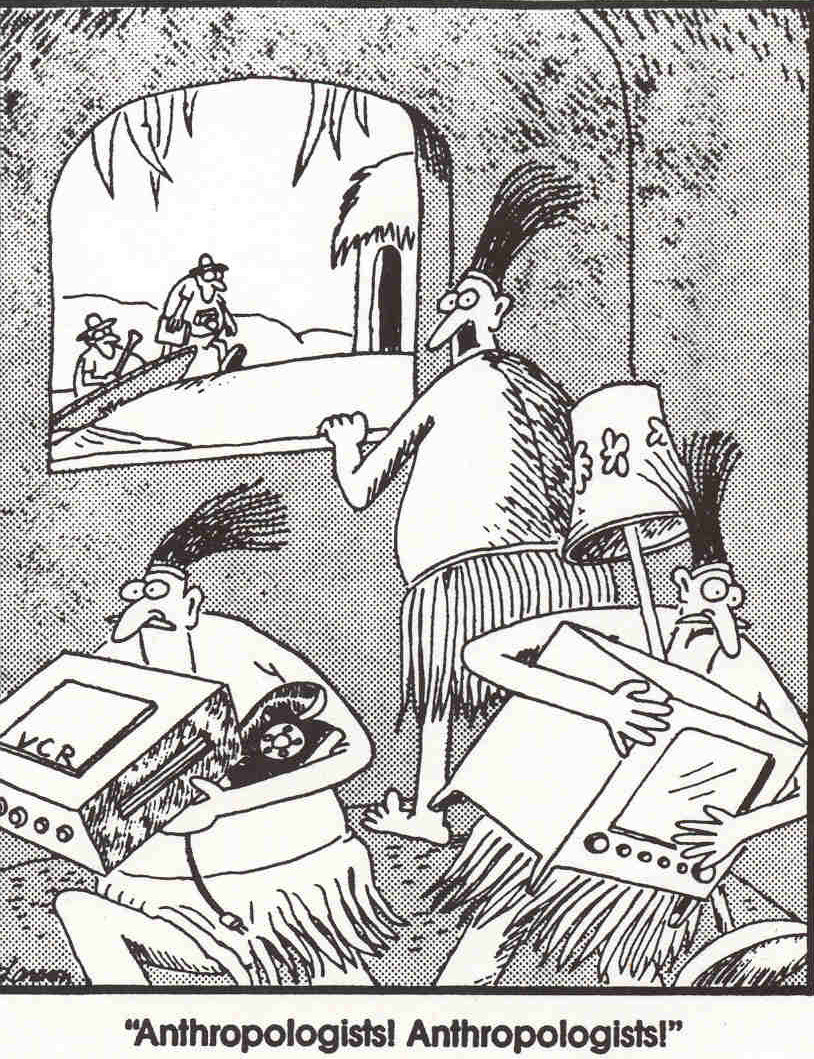
Far Side Anthropologists

0. Prelude

Since our theme is accidental fieldwork, I will begin with an account of my accident. In the course of a PhD thesis mainly on concepts, theories and narratives of wartime sexual violence, I spent three and a half weeks in the Eastern Democratic Republic of Congo. That time barely deserves the term ‘fieldwork’, but it wasn’t desk work, and it wasn’t familiar. Working partly for an NGO, I spoke principally to agents of the humanitarian international, from ActionAid to various branches of the UN. I was partly working for others, and partly scoping out a more in-depth period of fieldwork, one that never materialised. I socialised in the same bars as those internationals, and sat by the same hotel pools. But I did not then seek to interrogate their peculiar brand of international practice. Nor have I returned to it since.

Perhaps this accounts for why my over-riding sense was one of discomfort. At some level I expected that my time away would enrich the thesis by locating my abstractions in concrete situations and real persons. Perhaps I would experience what so many seem to, and fall for the location itself, returning again and again, and slowly acquiring language, cultural cues, a taste for the food and the air. Instead I felt strangely detached, and implicated in performances not of my choosing (the expert, the knowing colleague, the route to international support, the disaster tourist). I returned more attached to conceptual inquiry, and more suspicious (I was already quite suspicious) of appeals to ‘the real world’ and its informants. My disconnection (from other ‘internationals’, from locals, from Goma itself) became clearer sometime later, sitting in a hotel suite at an ISA panel, listening to others talk about the same place, and some of the same buildings, in terms of their own discomfort and dislocation.

1. Narrative Is A Metacode

Not all representations of the field are alike. Let us distinguish three. Continue reading

Between Fetishization and Thrift? A Response to Dave Eden’s Autonomy: Capitalism, Class and Politics.

Nick faceAhoi, Disorders! We’re thrilled to host a guest post by Nicholas J. Kiersey, Assistant Professor at Ohio University, indefatigable student of Foucault, Italian Autonomism and Deleuze and Guattari, plus a die-hard fan of Battlestar Galactica. Nick is the author of papers on governmentality in Global Society, the biopolitics of the war on terror in New Political Science, everyday neoliberalism in the Journal of Critical Globalisation Studies, and is due to be published on the occupy movement and affective labour in the financial crisis in Global Discourse and Global Society respectively. Oh, and he’s also Irish. That’s also important. Below is Nick’s review of Dave Eden’s new book on Autonomist thought, which one can only hope has not gone entirely unnoticed because it’s one of the finest on the subject!

All quotes in the below are to Eden’s text, unless otherwise stated.


Eden Autonomy

No doubt, a return to the commodity is a risky venture. As Dave Eden puts it in his exceptional new book, certain framings of the power of the commodity can lead to an embrace of austerity, a “romanticization of poverty” or, worse, “a reactionary anti-capitalism”. Nevertheless, he asserts, a return to the commodity may ultimately be required. Currently popular framings of social movements, such as those of Hardt and Negri, he notes (citing Franco Berardi), offer very bright and “jolly” interpretations of the possibilities of the age, pretty much ignoring the need for a critique of the commodity form altogether. As such, they appear to have little sense of what it is that keeps capitalism going, or what it is that might finally send it on its way! However, while Eden wishes to convince us that we cannot do without the critique of the commodity, it is unclear if he ultimately achieves this goal. For his argument stands or falls on his ability to convince us that it is possible both to embrace this critique and remain faithful to an internal theory of capitalist power. This is a difficult circle to square and, by the end of the book, Eden seems to have done little to address it – an irony given that this is actually one of the areas where the targets of his critique are especially strong.

At the heart of Eden’s explanation of Autonomism, its virtues and its flaws, is the “Copernican inversion” of Marxism in which Mario Tronti asserts that the true dynamic force behind capitalism’s development is the workers rather than capital. Starting from this core observation, Eden proceeds to offer a survey and critque of Tronti’s heirs, particularly Antonio Negri. For Negri, the current order in world power is defined most completely by the antagonism between ‘Empire’ and the ‘multitude,’ where the latter term endeavors to expand the definition of the proletariat in order to capture not only the vitality of “labour as a whole” but to encompass the full diversity of the identities which compose it, and Empire is the power which dominates the multitude. Breaking with traditional Marxism, however, Empire is not capitalism. Rather, it is a multi-valent regime which proscribes democracy in order to bolster a global order of things which is capitalist, statist, racist, and gendered, among other things. Challenging this power, however, the Multitude realises the creative possibilities of today’s intellectual and affectively efficacious labour, and incorporates them in its struggle for self-actualisation.

Continue reading

What Does It Mean To Start An Open Access Journal?

Following earlier interviews with Editors at Ethics & Global Politics and the newly open Cultural Anthropology, we present yet another insight into how to do open access, this time with Professor Kim Weeden of Cornell, a Deputy Editor of the new open access journal Sociological Science, which launched earlier this year. As the name suggests, this is a sociology journal (and a ‘general interest’ one at that), indicating yet another field in which open access is being taken seriously whilst International Relations languishes (not withstanding para-IR examples like Ethics & Global Politics and our friends at the Journal of Critical Globalisation Studies). So what can we learn from the Sociological Science model? As usual, I’ve stuck some thoughts on at the end.


Sociological Science

1. Who initiated Sociological Science, and why?

Dissatisfaction with the traditional publication process, and in particular the peer review system, has been festering in sociology for a while. Seems like everyone has a tale of a paper that sat for months before an initial decision, received multiple rounds of “revise and resubmits” that extended the review process to several years, or was rejected because it reported on a replication study, didn’t make enough of a “theoretical contribution” regardless of the quality of the empirical analysis, or espoused truly novel ideas that ruffled the feathers of a single anonymous reviewer. Even papers that experienced relatively smooth sailing in the traditional review process can be 1-2 years on the wrong side of fresh before they finally see the light of day.

A couple of colleagues, including our Editor-in-Chief Jesper Sørensen, got together and started brainstorming alternatives. They recruited a few other like-minded colleagues to the cause, and this founding group hammered out the details. The founding group morphed into the current 7-person editorial board, which includes sociologists on the faculty of Cornell, MIT, NYU, Stanford, and Yale. All of us have tenure, and are at a stage in our careers where we have the energy and social capital to devote to starting a journal.

2. How has the launch of Sociological Science been funded?

We’re a volunteer effort. The founding group and core editorial team did all the legwork to set up the journal: incorporating as a non-profit, devising the editorial model, setting a fee structure, advertising through social media, creating the web site, hiring copy editors, working with libraries so that the journal is indexed in abstract search databases, you name it.

The Stanford Graduate School of Business has generously funded a temporary, part-time managing editor to help with the launch. Our next task is to raise the funds to make the managing editor position permanent.

3. Sociological Science uses a system of Article Processing Charges (APCs), charged at different rates depending on author seniority. How did this decision come about?

We’re a non-profit entity, so our goal in setting fees is to cover the costs of publishing, no more and no less. We decided on APCs as the easiest and fairest way to cover these costs.

Continue reading

Ah, Ça Ira, Ça Ira! Iconographies of the French Revolution

Last month, Stanford University and the Bibliothèque Nationale de France jointly released a vast online collection of documents and images from the French Revolution via the French Revolution Digital Archive. With around 14,000 high-resolution images, it is an overwhelmingly large collection but the website is thankfully very user-friendly with content tagged in multiple ways and organised according to various themes. This is undoubtedly a fantastic resource for not only historians but also a wider audience interested in the tumultuous events of the late eighteenth century considered by many to mark the start of political modernity.

Drawn into the archive, I spent quite some time trawling through it with a particular eye for caricatures, satirical illustrations, and other allegorical depictions of the revolution. I have compiled here a selection of those images I found most striking or noteworthy along with translations and contextual information where necessary. Hopefully these will be of some interest to readers of this blog. As I have no academic specialism in this period of history, I am very much approaching the material as a layman. I therefore more than welcome any corrections or additions to my readings of these images that I’ll gladly include in updates.

Chasse patriotique à la grosse bête (1789)

Patriotic Hunt of the Great Beast (1789) [link]

“Posterity will tell us that in 1789 on the 12th July around four o’clock in the evening, several people claimed to have seen in the vicinity of Paris, on the road to Versailles, a Beast of an enormous size and a shape so extraordinary as to have never before seen the like. The news spread universal alarm in the city and put its people in a state of violent agitation. Cries of “to arms, to arms” were heard everywhere without any being found; it seemed that the Beast had swallowed them all along with their munitions. New weapons as extraordinary as the animal that had to be combated were immediately forged. On the 13th, people continued to agitate themselves, arming themselves and running after the Beast without being able to encounter it. On the the following day of the 14th, forever memorable for the France that suffers, a hundred thousand individuals ran to the Hotel des Invalides from which they carried away canons and sixty thousand rifles, such that there were two hundred thousand armed men who tracked down the Beast everywhere. Suspecting that it had retreated to the Bastille, the people flew to it with heroic courage and this lair of Despotism, despite its hundred bronze mouths vomiting fire, was taken by assault in two hours. With this victory appeared the monster with a hundred heads; its hideous form revealed that it was of an aristocratic kind; suddenly our bravest hunters seized upon her from all sides and it was to whom would cut the most heads. This monster that dragged behind it desolation, famine and death disappeared instantly under a hundred different forms and fled languidly abroad, taking with it the despair and shame of its defeat.”

Continue reading

Living Knowledge Traditions and the Priestly Caste of the Western Academy

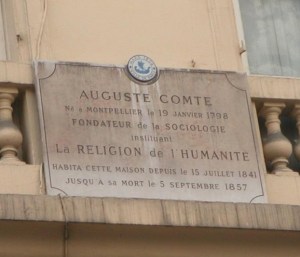
comte

The Western Academy, especially in its social science and humanities wings, incorporates as a priestly caste. Perhaps Kant is the first high priest of this caste when he argues for the Aufklärer to become a corporate entity equivalent to the hierocracy and nobility but exceptional in its duty to provide a truly public service of reasoning. The psalm of this priestly caste is “have the courage to use your own understanding”, its catechism: to singularly possess and hold aloft the flame of revelation, known as science, or, nowadays, the modern episteme. Even Marx holds the flame aloft when he takes Hegel’s Philosopher, who breathes world spirit, and makes him inhabit the skin of the Communist.

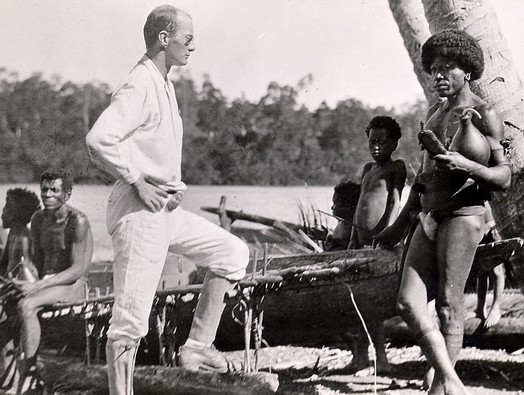
This priestly caste, as it founds the church of modernity, is instantly and integrally involved in founding a broader colonial division of labour.  These new priests conjure up the traditional/modern divide by the use of history –  differentiating old and new European Western societies – and by the use of anthropology (later, sociology too), by differentiating the colonized from the colonized. The living knowledge traditions of the colonized are pronounced dead on arrival in the present. And their cosmologies, philosophies, social practices – are entombed into opaque “cultures” the contents of which can only be clearly illuminated by the keepers of the flame. 

19_malinowski

Ultimately this mapping of difference works through race, gender and class coordinates so that even the “poor” living in the West, as well as un-mastered women and single mothers intersect with (post-)colonized subjects to become part of this opacity. The episteme of the Western Academy thus differentiates between the knowers and the known.

In this respect, the modern episteme is as seminal as gunboats to the maintenance of colonial difference. Key to this difference is not just the attribution of extra-ordinary exploitation, oppression and dispossession to colonized peoples but also their epistemic erasure, i.e., the outlawing of the possibility and desirability of intentional self-determining community amongst the colonized and their post-colonized descendents. It is in the colonial world and not Europe where Europeans develop the art of objectifying peoples into populations such that the basic competency of the colonized to self-define is deemed absent by the instruments and mores of European sanctioned international law. Postcolonial populations have only been able to become peoples under very specific conditionalities; and many who make the transition become the new police of colonial difference. Those who fall between or prefer a third way become the ungoverned, or ungovernable.

Continue reading

What Does It Mean To Become An Open Access Journal?

Following an earlier interview with Eva Erman on editing the open access journal Ethics & Global Politics, another set of enlightening responses on academic publishing. This time with Professor Brad Weiss of the College of William & Mary and President of the Society for Cultural Anthropology, which publishes Cultural Anthropology, the premier journal of the American Anthropological Association (AAA). It is a major journal by other metrics too (take your pick of GoogleScholar or Impact Factor). All of which is as preamble to the point: Cultural Anthropology will be a fully open access journal from 2014. Not just that. It has a web presence and offers a set of connected resources that are without compare (at least in my experience). Brad was kind enough to offer his time to answer some questions on taking a learned society journal of prestige open access.


Cultural Anthropology Cover Trimmed

1. How did the decision to make Cultural Anthropology open access come about? Who initiated it, and why?

There is a longish story here. For several years prior to this action, many members of the Society for Cultural Anthropology (SCA) Board, and our Editorial Board had been interested in pursuing an open access option. That really wasn’t up to us, as we are only one section of the AAA that maintains a contract with Wiley-Blackwell to publish more than 20 of its sections’ journals. However, the director of publications with the AAA, Oona Schmid, proposed the possibility, last August (2012) to all of the publishing sections that one of them could be permitted to go open access for the duration of the Wiley-Blackwell contract (which expires in 2017) given certain provisions. Our Board formed a task force, including some real experts on publishing and open access in particular, and this group determined that it was a good idea to pursue this option. As it happened, we were the only AAA section to elect to do so, so were authorized to make the transition, which will begin in February 2014.

2. How was the move to open access funded?

Again, a little complicated. For one thing, the SCA is the biggest section of the AAA, and our membership dues are important sources of revenue; but in and of themselves, they don’t cover the costs of publishing, as well as all of the other activities (workshops, board meetings, special sessions at the AAA meetings, a biennial conference, etc.) that the SCA undertakes. We have been able to build our fund balances over the last several years, when the Wiley-Blackwell contract brought us significant royalties. Between these two sources of funding, we are confident that we can make open access work – for now. In the long term, we are looking to develop an open access model that will incorporate many more sections of the AAA, so that whatever happens next in publishing (post-Wiley contract) allows sections to share editorial and distribution costs, which will substantially reduce the costs of publications for everyone. Our hope is that the costs of open access become so reduced through cost sharing, that each sections’ member dues will provide sufficient revenue to fund, not only their publications, but all of their other activities. This will probably mean that open access won’t be profitable, but will at least not be prohibitively expensive – and, crucially, that the professionals we hire to edit, publish and design the journal will get paid for their work.

3. It seems that your open access model, as paid for through membership dues, could be characterised as Article Processing Charges by another name. How would you respond to the objection that this is another drain on academic funds? 

We are seeking a middle ground. We cannot sustain open access for long on just membership dues; and we already have a broad membership, so we’re not asking for more money from members, we’re just using these funds for this purpose.  Moreover, we added the membership requirement primarily to reduce the number of unwarranted submissions that take literally hundreds of hours to process.  We are trying not to charge our members extra, but hoping that the fund balances we already have will keep our enterprise going until the AAA can generate a new publication model, which we hope will at least make open access more widely available, if not the standard model.

Continue reading

Struggling with Precarity: From More and Better Jobs to Less and Lesser Work

Once a French neologism, precarity is now a household name describing in equal measure the fate of low-wage, part-time holders of bullshit jobs, seasonal and migrant workers, creative entrepreneurs of the self, “graduates with no future,” foreclosed homeowners, debtors and increasingly even segments of the salaried bourgeoisie. At its most basic, a term for the economic uncertainty and existential angst associated with the dissolution of fixed employment, precarity also suggests the disintegration of stable societal bonds, occupational identities, social protections and a sense of entitlement and belonging characteristic of the old proletariat. In short, then, precarity is the experiential dimension of the crisis of the society of work dating back to the 70s and 80s.

Diego Rivera Detroit Industry Mural 1923

Increasingly advanced production methods, introduced since the 70s to tame shop-floor insubordination as well as reap the untapped potentials of global competition, have caused a decline in growth rates, which no amount of privatization, financialization and austerity measures has been able to make up for since. Andrew Kliman and others have argued that it is this real crisis in capitalist productivity that lies at the heart of the current slump, and not simply unrestrained financial gluttony, as the more short-termist analysis offer. As capitalist production develops, machines replace people and the rate of profitability, which is given by the human labor theory of value, drops, causing sluggish investment and slow growth. This is essentially Marx’s theory of economy crisis, aka the tendency of the profit rate to fall, but also a story we should know by now from Autonomist accounts about the transition from Fordism to post-Fordism (Hardt and Negri) or from profit extraction to rent-becoming-profit (Christian Marazzi), and from David Harvey’s accumulation by dispossession.

If we shift the scale of our focus from capital to labor, though, we see that the crisis of capitalist productivity is, in fact, a crisis of work or a crisis of a society built around work as the only legitimate point of access for income, status and citizenship rights. Again, Marx is instructive here: “Capital itself is the moving contradiction, [in] that it presses to reduce labour time to a minimum, while it posits labour time, on the other side, as sole measure and source of wealth.” Socially necessary labor is reduced to a minimum (through things like automation, outsourcing, and financialization) at the same time that human participation in paid work continues to remain our only measure and source of wealth. Work doesn’t disappear as a result. It becomes fragmented, devalued, and wasteful, ceasing to provide a social identity or a collective language of experience.

Image

Precarity is a word for our time. It describes the slow disintegration of the historic bond between capitalism, democracy and the welfare state. But it also entails a rallying cry to reverse this situation. Continue reading

The Pay Strike And Its Discontents

Breaking Bad Pay Teachers More Money

The ballots are out, the wheels are in motion. Union members have until Thursday 10 October to vote on strike action over the latest derisory pay offer of 1% (if you haven’t received a ballot, go here). The justness of the cause seems clear enough. Since 2009, every pay award has been several percentage points below inflation, leading to a consistent real terms drop in pay. And some of those paltry increases were only attained after negotiations. Yet, despite the protests from above (and excepting a brief dip in student numbers), British higher education is in fine financial health. The overall wage bill is decreasing at the same time that surpluses are growing. And for “growing” read “more than doubling”, from £488 million in 2007/8 to £1.1 billion in 2011/2012. Managers are reaping their rewards accordingly, and a significant portion of Vice-Chancellors are seeing their pay go up by 10-20%. At Sussex, for example, Michael Farthing is now paid £280,000 (including pensions contributions), as compared to £178,000 in 2007 (that’ll be a 57% increase then).

And yet there is a foreboding. Fear is a factor, nondescript anxiety another. Perhaps an awkward sense that any level of action is somehow at odds with the academic code.

Articulated objections come in two stripes. First, the we-haven’t-got-it-so-bad defence. Beyond the usual ‘all in it together’ austerity ideology, there are pay increments (which most permanent academic staff get automatically). Real wages aren’t declining so hard if you move up a pay step each year. This is on its own a pretty restricted ambition, since it amounts to a kind of career “progression” that leaves you standing still. It is also, for all the talk of solidarity with lower-paid workers, a selfish analysis.

In the last 5 years, the pay for new lecturers and tutors has dropped 13% in real terms. Following the USS pension saga, they (we) have each had tens of thousands of pounds taken from them over the course of their careers, while staff that retained their old rights are paying more every month into a scheme that was, let us recall, nowhere near crisis. There are fewer scholarships and research grants than before, and an increase in teaching-heavy posts. Consumer-driven logics are set to make that worse. On the horizon, just over there, is a US-style expansion based on precarity, a prestige elite, and debt bubbles. Some at the top are already breaking from the national pay spine, inaugurating a two-tier system. Consider this trend alongside the state of university finances. What is it to look at this and say things aren’t so bad? I put it to you that such a position is detached, complacent, and irresponsible.

Second, there is the strikes-change-nothing complaint. This has better justification. Local actions over the last years have not reversed policies. Pensions were stripped down anyway. And there is something peculiar, isn’t there, about the idea of day-long walkouts and picket lines in a sector so based on relatively scattered student-teacher interactions. There is no machinery to fall silent, no buzzing shop floors to stand empty. Just a day of saved wages for management and probably a whole stack of reorganised lectures, academics not really being the types to withhold knowledge (or, rather, unwilling to see knowledge as labour). There is a sense that the old tactics are dead, and should be left in their graves.

On the one hand, this is an argument for more radical action. If employers can handle strike days, we need more. Or, alternatively, forms of action that do not fetishise the picket line. Something that will make VCs pay attention, like a marking boycott or withholding final grades. In a customer-orientated culture this is the pressure point, especially if action begins to alter the results of the National Student Survey, that Big Other of the academic scene (what do students really want?). The complaint goes up that the national union lacks the imagination to instigate these actions, and that we should therefore turn to more vibrant kinds of opposition. But new forms of resistance nevertheless confront established modes of punishment. When full pay is withheld day on day, when even partial performance leads to the forfeit of full wages, how quickly will we really buckle? We know something has to break the pattern, but we’re not sure we’re capable of it, or that the sacrifice is worth it. In other words, we find ourselves a little too close to text-book academic bitching: something more fundamental needs doing, but we’re not likely to be the ones to do it.

On the other hand, the fear and the paralysis can be found closer to home. Complaints about the union form do not produce their alternative ex nihilo. There are possible replacements, but no actually-existing ones. Nor does the appetite for creating one seem to exist. And for good reason. The paradoxical character of academic subjectivity is both to consider ourselves in a position of real epistemic and social privilege and to be so despondent about our influence on things as to merely absorb the changes thrust upon us (working conditions, impact agendas, research restrictions). The legal protections of strike action have no parallel, truncated as they are. Creative alternatives have raised energy, and served as political classrooms in their own right, but they haven’t actually stymied ‘reforms’ (whether on fees, outsourcing or investment portfolios). And, strange as it may sound, universities are probably happier taking draconian action against their workers than their students. A faculty occupation, if we could even imagine such a thing, would not end well.

None of that is to say that we (there’s that intangible collective again) should walk zombie-like to the picket. Fersure, let the rejuvenation of academic democracy proceed apace. In the meantime, we have to ask ourselves seriously what the consequence is of another pliant year. There are murmurings that a failure to win this ballot will endanger collective bargaining itself. If we cannot muster the resolve to deliver a strong yes on action short of a strike, and a strong yes on strike – if we cannot even deliver a serious turnout – that’s probably as much as we deserve.

The Queer Art of Whistle Blowing

What should we make of the fact that Bradley Manning has become Chelsea, that Glenn Greenwald is gay, that David Miranda loves a man enough to submit to the harassment incurred by his partner’s work, that Greenwald’s detractors sought to tarnish him by association with—of all things—a porn company? Possibly nothing generalisable, except that gender is doing work here.

There has been no shortage of voices denying a straightforward connection between sexual orientation, gender identity, and patriotism. (Part of the reason I feel compelled to write about this is that there isn’t one.) San Francisco Pride Board notoriously repudiated Manning’s election as a Grand Marshall in the 2013 Pride in that city, declaring: ‘even the hint of support for actions which placed in harms [sic] way the lives of our men and women in uniform—and countless others, military and civilian alike—will not be tolerated by the leadership of San Francisco Pride.’ That statement has not been retracted, notwithstanding its now patent inaccuracy in light of the prosecution’s inability to cite any evidence that Manning’s leaks led to any deaths and the court’s decision finding her not guilty of the charge of ‘aiding the enemy’. Kristin (formerly Chris) Beck, ex-US Navy Seal who recently announced her gender transition, has been harsher in her condemnation of Manning: ‘For this person, whether male or female to use gender identity to act “BADLY” is a slap in the face to me and everyone who does not fit the “Binary Gender Norm.” It is not an excuse for anything illegal or unjust.’ Pablo K is right to point out the dangers of the temptation, for those who see a link between sex/gender and truth-telling, to make the reverse move—’to relegate Beck to a minority report, and so to re-inscribe the hierarchy of authenticity, this time with Manning as the actual face of resistance, and Beck the mere puppet of militarism’—while pointing out, also, that the gap between these contrasting appropriations is constitutive of the space of contemporary politics. So let’s talk politics.

Continue reading