The University, Limited.

The double assault of the Browne Report and Wednesday’s Comprehensive Spending Review have understandably led to despair and anger among academics in the humanities and social sciences. The reasons are manifold: the apparent belief by Cable and Willetts that only science matters, an insidious privatisation of public institutions, further debt for those least able to pay, massive cuts in teaching budgets, and education as a source of funds for bank bail-outs, not to mention rank hypocrisy from men educated for free and now pulling up the ladder while telling the rest of us that their schemes are not only fair, but progressive too.

This knot of anxiety deserves some dissection. The necessity, in the midst of a storm, for calm and sober reflection. Such is my rhetorical mode today. The main strand of existing critique centres on the implications for inequality. Higher fees, under such an account, can only increase the unwillingness of the poorest to attend universities, and so transform them into bastions of privilege.

But this isn’t quite right. Continue reading
The Ethics of Austerity

Today, the Con-Lib Coalition announces their full plan for spending cuts. Although many bits have been leaked, this will be the first chance we have to take the full measure of what is to come. Much has been and will be written about how these cuts are necessary, and even that they don’t go far enough.

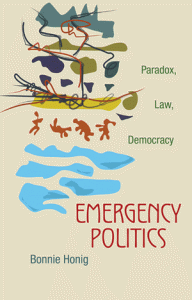
And while much has been said about the economic arguments for and against the cuts proposed by Mr. Osborne, what is not talked about enough, or with sufficient care, is the ethics of austerity. By this I mean the ethical claims that have been made to prepare the ground for the austerity measures announced today. To borrow a phrase from the political theorist Bonnie Honig, we are seeing the culmination of a discourse of emergency politics.

Emergency Politics

While Honig uses the idea of emergency politics to get at how the threat of emergency is deployed to reassert the sovereignty of the state over the democratic sovereignty of the people as the source of law and legitimate political power, I want to suggest that the financial crises has resulted in a similar discourse, which claims we are in a state of emergency economics.

What the claim of emergency economics does, by framing our current experience in terms of emergency, is reaffirm the sovereignty of the capitalist markets over democratic society by presenting us with a catastrophic choice. We must accept the radical restructuring of public life out of necessity; there is no alternative but catastrophe. To discuss solutions is to waste time; to insist on the imperative of democratic values is to court disaster; to oppose the hasty reform of fundamental elements of the social order is to be a dangerous ideologue. Emergency economics are hardly unique to the UK, but today we are witnessing a clear expression of its consequences.

Continue reading

The Paradoxes of Inequality

In the wake of the financial crisis, and the re-establishment of massive corporate profits during a vertiginous economic period, the issue of inequality has become increasingly prominent amongst critical thinkers. The recognition that the period of neoliberalism has been beneficial in a massively asymmetrical way to the richest is a powerful argument against the neoliberal dogma. Yet with countries like the UK disproportionately cutting government spending on the poor, it seems that the only thing changing is the ease with which the poorest can be attacked.

(h/t: Consider the Evidence)

Continue reading