Demarcation Problems: ‘The Conduct Of Inquiry’ Between Politics & Methodology

This is the first in a series of posts by several of us at The Disorder Of Things on Patrick Thaddeus Jackson‘s The Conduct Of Inquiry in International Relations: Philosophy of Science and Its Implications for the Study of World Politics, released last year to considerable critical acclaim. The next few weeks will see further posts, followed by a reply by Jackson (or PTJ) himself. Taken together, we hope they go some way to meeting the challenge, to paraphrase PTJ himself, of emerging from splendid isolation to engage in some contentious conversations on inquiry.

UPDATE (24 Jan): Joe’s call to free the pluralist imagination is now up.

UPDATE (3 Feb): Nick’s speculative realist examination of inference, progress and materialist monism is now available.

UPDATE (17 Feb): Meera’s further untangling of ‘science’ and challenge to the stasis and status of reflexivism completes this round of responses.

UPDATE (14 March): PTJ has begun his reply.


Conclusion: neither science nor the methodology of research programmes provides arguments against anarchism. Neither Lakatos nor anybody else has shown that science is better than witchcraft and that science proceeds in a rational way. Taste, not argument, guides our choice of science; taste, not argument, makes us carry out certain moves within science (which does not mean that decisions on the basis of taste are not surrounded by and entirely covered by arguments, just as a tasty piece of meat may be surrounded and entirely covered by flies). There is no reason to be depressed by this result. Science, after all, is our creature, not our sovereign; ergo, it should be the slave of our whims, and not the tyrant of our wishes.

Paul Feyerabend, ‘Theses on Anarchism’ (1973), For & Against Method (with Imre Lakatos)

I: Conducts Of Inquiry

Paul Feyerabend’s Dada-ist approach to the philosophy of science was informed by a hostility to singular conceptions of the world, a rejection of rigid prescriptions for the correct character of knowledge and a healthy scepticism towards how people thought their forms of inquiry worked. Setting himself against method, he argued that ‘science’ has no common structure and that no general laws can explain its success or prescribe its methods. The growth of knowledge has not only historically been associated with a disrespect for prevailing methodological rules, it in fact requires such violation (whether deliberately or unwittingly).

Patrick Jackson’s The Conduct Of Inquiry attempts both to expand and to limit the knowledge practices counted as legible and legitimate in International Relations. Like Feyerabend (and Imre Lakatos and Thomas Kuhn and Karl Popper for that matter), Jackson evinces a healthy distrust of hard, fast or easy judgements about truth, reality and research procedure. And so he both avoids making the argument for a particular philosophical perspective with which to forge ‘better’ IR and eschews usual schemas that start with the putative ‘fundamentals’ of ontology and epistemology. Instead he offers a Weberian ideal-typification of methodologies (not methods), intended not as a menu of coherent and precise options but as a useful typology of functional categories (on which more in a moment).

The conception of methodology proffered is an expansive one, taken to designate ‘the logical structure and procedure of scientific inquiry’, but not the actual nature of reality and knowledge or the correct technique for a particular problem. Four commitments to philosophical ontology organise the options, generating four methodologies through their various combinations. The purpose is not somehow to test between them, but to reveal their assumptions and explain how they hang together as philosophical wagers. Hence the need to discuss the forms of faith and commitment that under-gird our styles of research.

So, in one sense, we could read PTJ as speaking with Feyerabend in demonstrating that “all methodologies, even the most obvious ones, have their limits…like an undercover agent who plays the game of Reason in order to undercut the authority of Reason (Truth, Honesty, Justice, and so on)“.

This intervention is much needed. Continue reading

Rape & Rape Prevention: A Cod-Evolutionary Perspective

Rape is an evolutionary adaptation. More than that, it now appears that anti-rape strategies are evolutionary too, which for women means increased strength at certain stages of the menstrual cycle, increased general distrust of men and hatred of black men in particular. Taking Darwin in vain, this is the argument put together by Jesse Bering at Slate.

We should probably start by getting our definitional house in order. In an admirable example of rigging the answer by misspecifiying the question Bering names rape as “the use of force, or threat of force, to achieve penile-vaginal penetration of a woman without her consent“. So men are biologically incapable of being raped, women incapable of raping, and the sexual-reproductive organs the only legible site for sexualised aggression (no anal here please!).

Hardly surprising, given this terminological firing gun, that rape emerges as a phenomena only comprehensible in procreational terms. This is a narrower agenda even than saying that it is somehow ‘evolutionary’, itself already less than saying it has something to do with ‘biology’ (the possibility of rape being about ‘sex’, socially understood, or ‘power’ stands at yet further removes).

The quality of proof offered doesn’t fare much better. Take the study on racist attitudes and menstrual cycles, results we’re at risk of ignoring with our rampant ‘political correctness’ (*yawn*). Turns out women from this sample (77 white undergraduates) scored higher on fear-of-rape metrics of black men when they were most vulnerable biologically to impregnation. Bering takes this as supporting an evolutionary adaptation against ‘out-groups’, although he concedes that ‘cultural transmission’ may play a role.

The study itself suggests something rather less conclusive. It found that implicit race bias (non-conscious stereotyped associations of the form ‘black-physical’) was much more strongly correlated with rising fertility than explicit bias. Its metrics for race bias were all clearly consistent with a sociological or interpretive account of race (which is to say that race is a social, not a biological category, and that its meaning is historically and politically determined, not the outcome of adaptive ancestral behaviour). The data is also somewhat partial, as its relation to some wider questions. There is no comment on the fact that, for example, race bias remains fairly pronounced even where there is no ‘conception risk’, nor any significant attempt to cite work on general levels of race bias in general populations as a comparator or to examine variation among degree of bias in the women studied and the possible sources for those differences.

Continue reading

Intimate Dissidence: Assange, Foucault and (Feminist) Rape Discourse

At Critical Legal Thinking, Narnia Bohler-Muller takes issue with the narrow legalism of the often ‘surreal’ commentaries on the Assange controversy. In amongst the denunciation and counter-denunciation she detects an undercurrent of disciplinary power. On this account, the apparently ‘very broad’ rape laws of Sweden, like efforts in South Africa to force HIV tests on rape suspects, enforce dichotomies under the guise of legal formality, and so cast the accused as impurities of the social body:

The argument is that the law is not an appropriate instrument to deal with matters of sexual intimacy as general principles can never do justice to the particularity of the situation and the nuances of sexual game-playing. Such is the forceful and violent nature of The Law. To depend on legal regulation to resolve all the complexities and quirks of human relations is a dangerous precedent and enforces the dualisms of guilt/innocence and normal/perverted. It is such dualisms that serve to re-produce Foucauldian ‘docile bodies’ that do not threaten or resist the status quo

…The problem is that in such a way harmless conduct may be punished merely because we do not approve of it. If Assange is HIV negative, which one assumes he is, and neither of the complaints fall pregnant, then his failure to wear a condom caused no harm. Or are we now choosing to punish potential harm or the risk of harm? Or, perhaps, punishing the failure to be a considerate lover, or the narcissism and promiscuity of a man who fucks helpless women and then leaves?

This ends up turning sexual assault into a form of dissent, a refusal “to express comfort with any kind of subservience to Authority“. As before, Assange is not really the issue, merely a bystander and stand-in. But, amidst her caution against law as a substitute for political critique and her rejection of marginalising discourse (points well-taken), Bohler-Muller’s use of him to mobilise broader arguments about a Foucauldian analytics of rape raises some stark problems. Continue reading

Kissingerian Contempt: Realism, Statism and Other People’s Genocides

For a blog apparently devoted to global politics, we have so far rather neglected its voguish scandals and intrigues. Disciplinary exposure therapy has evidently done its work, particularly where the amorphous theory-cum-policy-manual of Realism is concerned. After all, what could be more mutually disappointing than a lengthy online discourse on the neo-neo ‘debate’ or its ilk? So much somnabulatory exegesis.

That said, last month’s fracas over ‘criminal psychopath’ and one-time ‘elegant wit’ Dr Henry A. Kissinger deserves a mention. In new releases from the Nixon tapes, his fawning jingoism in the name of some clear-cut national interest rather caught the eye:

The emigration of Jews from the Soviet Union is not an objective of American foreign policy…And if they put Jews into gas chambers in the Soviet Union, it is not an American concern. Maybe a humanitarian concern.

Bushite polemicist Michael Gerson took the opportunity to indict Realism, denouncing its shallow moral compass in favour of a vision of more righteous foreign policy (neo-conservative manifest destiny branch). Stephen Walt responded, pointing out that Kissinger is not the delegated representative of Realists, that many who self-describe as such opposed both the Vietnam and Iraq wars, and that hand-wringing by culpable members of the Bush administration over the human costs of foreign policy is straight-up hypocrisy. Henry Farrell at Crooked Timber rightly stressed that this was besides the point, since what makes Kissinger Realist in the relevant sense is his instrumentalist attitude to the lives of others and the over-riding importance of material power in his world view. Along the way, he also provided a particularly apt description of this particular peace-prize winning carpet-bomber as in thrall to “a scholar’s fantasy of Metternich, in which cynicism, duplicity, and clandestine brutality were not foreign policy tools so much as a demonstration of one’s ‘seriousness’ as a statesman“. Nice. Enter Christopher Hitchens, spraying invective like it was the old days and usefully dismantling the apologetics now apparently emanating from several quarters [1].

Naturally, the seriousness of Kissinger’s servile indifference is as nothing next to his actual and extensive crimes, if legal language can be made to fit the special character of his achievements. And one can hardly credit that the good doctor’s snivelling before the anti-Semitism of Richard Milhouse Nixon should matter half as much as his responsibility for the deaths visited on Kien Hoa or the euphemistic and not-so-euphemistic barbeques served up as part of operations ‘Breakfast’, ‘Lunch’, ‘Dinner’, etcetera. Continue reading

The Racial Empire of International Relations

Primarily, our action is based on national self-interest. In other words, it is patriotic. A certain limited number of persons are fond of decrying patriotism as a selfish virtue, and strive with all their feeble might to inculcate in its place a kind of milk-and-water cosmopolitanism. These good people are never men of robust character or imposing personality, and the plea itself is not worth considering. Some reformers may urge that in the ages’ distant future patriotism, like the habit of monogamous marriage, will become a needless and obsolete virtue; but just at present the man who loves other countries as much as he does his own is quite as noxious a member of society as the man who loves other women as much as he loves his wife. Love of country is an elemental virtue, like love of home, or like honesty or courage. No country will accomplish very much for the world at large unless it elevates itself. The useful member of a community is the man who first and foremost attends to his own rights and his own duties, and who therefore becomes better fitted to do his share in the common duties of all. The useful member of the brotherhood of nations is that nation which is most thoroughly saturated with the national idea, and which realizes most fully its rights as a nation and its duties to its own citizens.

Theodore Roosevelt, The Monroe Doctrine (1896)

Roosevelt’s imperial condescension is but one of the historical anecdotes mobilised in a recent paper by Robert Vitalis to trace the legacy of empire and race in the development of International Relations as a discipline. Although eschewing a direct critique of the contemporary field (since “the likelihood is small that self-identified specialists in international relations will seek out an account of the discipline’s past in a journal that has no standing in the field”), he nevertheless provides a wealth of historical detail on the complicity of scholarly ancestors in ‘colonial administration’ and its attendant euphemisms.

Take A. Lawrence Lowell, a political ‘scientist’ who went on become President of Harvard and used that lofty perch to impose a  dormitory colour bar for freshman in 1915 (and a man now also revealed as the convener of homophobic secret trials). A proponent of professionalised training for colonial administrators, Lowell also set legal arguments before Congress explaining that the requirements of the Constitution need not be upheld in those violently-acquired territories where the racial capacities of the indigenes fell short of proper statehood. And, like a rather more recent over-flattered Harvard globetrotter, he was particularly interested in the wisdom to be gleaned for such bold endeavours from British experiments

Or take the institutional delivery rooms of International Relations itself. At the first ever APSA conference in 1904, ‘Colonial Administration’ was designated one of the five fundamental branches of Politics. One prominent speaker that September was William Frank Willoughby, an APSA founder, its 10th President, and the author of Territories and Dependencies of the United States (1905). He crafted this work in a particularly applied setting (pay heed ye  assembled bridgers of theory and practice), serving as both Treasurer and Secretary of Puerto Rico from 1901-1907. It seems reasonable to assume that auto-ethnographic reflexivity did not feature heavily in his work. A decade later he became director of a new research body, soon re-christened as The Brookings Institution.

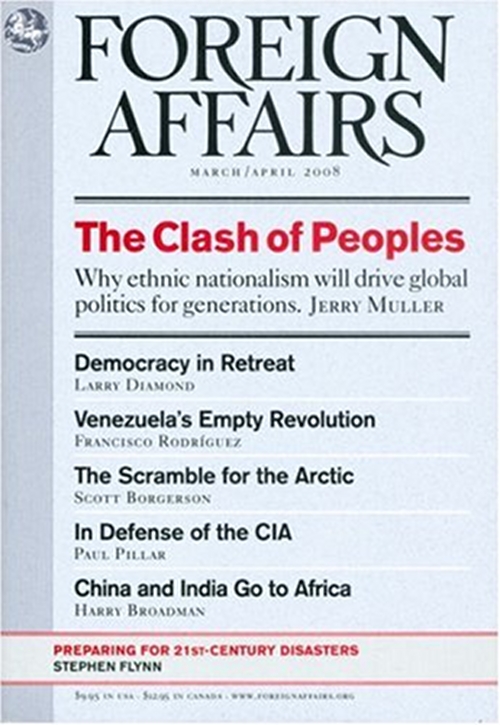
And what of our learned fora? Perhaps most symbolically of all, the debates over the proper governing of lesser peoples were carried out in the discipline’s first publication, The Journal of Race Development. It was founded in 1910 by G. Stanley Hall, who headed up a centre on the psychology of the races at Clark University, and who also pioneered the idea that the developmental stages of individual humans mirror the hierarchies of race, with children being to adults as savages are to the civilized. The twist being that in 1922 The Journal of Race Development became Foreign Affairs, still the go-to publication on global ‘administration’ (although this particular legacy is mysteriously absent from its current autobiography).

Several general themes emerge from the detail. First, far from positing states as the central actors of global politics, the comprador intellectuals of the early 20th century saw race, both within and without the United States, as the salient frontier. The earliest IR scholars all included American racial relations (to wit, the Southern ‘Negro problem’) within their disciplinary remit. In a racial supremacist twist on W.E.B. Du Bois’ ‘colour line’ “the world’s biological boundaries mattered much more to theory-building than did territorial boundaries”.

Second, the centrality of race as a category was not a mere function of scientific ignorance. Continue reading

International Relations versus Punk Rock (Slight Return)

Nothing could compromise a joint blog project more than disagreement over music. Luckily, this much-delayed follow-up to Joe’s sonic assault on global politics gets to play the role of supplement and supplicant, and not that of adversary. And no, it’s not bloody Christmas-themed.


Nobody was as fully aware of the properly traumatic dimension of the human voice, the human voice not as the sublime, ethereal medium for expressing the depth of human subjectivity, but the human voice as a foreign intruder, nobody was more aware of this than Charlie Chaplin [in The Great Dictator]…Silent figures are basically like figures in cartoons, they don’t know death, they don’t know sexuality even, they don’t know suffering, they just go on in their oral egotistic striving, like cats and mouse in a cartoon: you cut them into pieces, they’re reconstituted. There is no finitude, there is no mortality here. There is evil, but a kind of a naïve, good evil, you are just egotistical, you want to compete, you want to hit the other, but there is no guilt proper. What we get with sound is interiority, depth, guilt, pulpability, in other words the complex oedipal universe. The problem of the film is not only the political problem, how to get rid of totalitarianism, of its terrible seductive power, but it is also this more formal problem, how to get rid of this terrifying dimension of the voice. Or, since we cannot get rid of it, how to domesticate it, how to transform this voice nonetheless into the means of expressing humanity, love, and so on…

[Chaplin’s character] delivers his big speech about the need of love, understanding between people, but there is a catch, even a double catch: people applaud exactly in the same way as they were applauding Hitler. The music that accompanies this great humanist finale, the overture to Wagner’s opera Lohenngrin is the same music as the one we hear when Hitler is daydreaming about conquering the entire world and where he has a balloon in the shape of the globe, the music is the same. This can be read as the ultimate redemption of music, that the same music which served evil purposes can be redeemed to served the good, or it can be read – and I think it should be read – in a much more ambiguous way, that with music we cannot ever be sure, insofar as it externalises our inner passion music is always potentially a threat.

Slavoj Žižek, The Pervert’s Guide To Cinema

We humans are a musical species no less than a linguistic one.

Oliver Sacks, Musicophilia: Tales of Music and the Brain


1. Fugazi, ‘Smallpox Champion’, In On The Kill Taker (1993)

Smallpox champion, U S of A
Give natives some blankets
Warm like the grave
This is the pattern cut from the cloth
This is the pattern designed to take you right out, right out, right out
This is the frontier with winter’s so cold
Greed informs action where action makes bold
To take all the cotton that’s cut from the stalk
Weave the disease that’s gonna take you right out, right out, right out
What is good for the future what was good for the past
What is good for the future…won’t last
Bury your heart U S of A
History rears up to spit in your face
You saw what you wanted
You took what you saw
We know how you got it
Your method equals wipe out, wipe out, wipe out
The end of the frontier and all that you own
Under the blankets of all that you’ve done
Memory serves us to serve you
Yet memory serves us to never let you wipe out, wipe out, wipe out
Cha-cha-cha-champion
You’ll get yours
Wipe out

2. Ani Difranco, ‘Fuel’, Little Plastic Castle (1998)

Continue reading

Feminist Fatigues; Or, What Can Feminism Be in International Relations?

What is feminist IR and what does it do? Not a new question, by any means, but one worth mulling over in light of Laura Sjoberg’s attempts to make the case, or just plain describe, feminist IR across several posts at The Duck Of Minerva, spurred on by some less than charitable peer reviews. The complaints, and the responses alternating between outright hostility, condescension and general bemusement, happily confirm critical (European) prejudices. The American mainstream doesn’t think something counts as a knowledge practice unless it can be co-opted into a regression analysis, and lacks what would pass as an undergraduate understanding of feminism elsewhere.

So far, so self-satisfying. Educational-cum-critical interventions of this kind clearly do have their place. As Joe put it to me, marginal and critical perspectives (no less than others) require constant re-inscription and repetition. Different students, different times, different world-historical events: all call for a re-engagement through our preferred lenses, which is how we absorb and become committed to them. It’s not enough for people to just be referred back to de Beauvoir or Enloe.

That said, these are also acts of performance. As Sjoberg herself notes, the conversation repeats itself. Repeats on itself, even. You Just Don’t Understand. Like an algorithmic inter-paradigm debate. The steps are as obvious and stale now as they were decades ago. Feminists are humourless; feminism is inherently a negative critique; there is no place for men in feminism; feminism isn’t really IR, even if it has some purpose somewhere;  feminism is obtuse; feminists lack research projects and cumulative understanding. A stack of intellectual veneers on one big trope of man-hating idealist sex-phobic anti-rationalist frigidity.

So why doesn’t the conversation ever seem to go anywhere? Continue reading

LSE Occupied!

More breaking news. Today LSE students occupied in protest at education cuts, demanding that LSE management produce at least some murmurs of opposition before the Parliamentary vote next Thursday.

Follow here, with updates here. Petition of support here.

Comprador Intellectuals in the Education Crisis

It certainly feels as if things are moving quickly in the fight over the thorough-going recomposition of UK higher education. The scale of occupation and student-led resistance has caught many by surprise. The interpretive battle over ‘violence’ may have performed familiar rituals, but the frequency and militancy of what is going on is new and invigorating. The number of occupations is now considerable, and the leadership of the NUS has been forced into support for tactics and strategy they had previously treated as marginalia. How different it looked in the immediate aftermath of the 10 November actions. The early denunciations of militant protest then seemed to foreshadow the enactment of a reformist middle ground. Aaron Porter gave at least one speech in which he appeared to accept that fees were going to be introduced as planned, and sought to move his energies into getting as much included in the £9,000 fee as possible. He mooted such bold objectives as an end to printing costs and a new universities watchdog to ensure value for money. As if to say, ‘we’ve made our point, now let’s go home’.

Last week’s much smaller protest, and its predictable, petty, kettle, seems to have made all the difference. More walk-outs are planned for today, and doubtless more occupations will follow. This has spooked Clegg to new levels of hysteria, warning that opposition to the cuts will themselves scare off the young, and the poor, and those without sufficient sense to make some back-of-the-envelope calculations as to their eventual debt burden. Obviously, this is true in a rather degraded sense of the word, since without sustained action directed at the proposals, many would not realise the scale of changes until they had already been passed. Verily, ignorance is bliss. Meanwhile, ermine-cloaked colleagues in the blue corner are reduced to crying traitor while the imperatives of civic order require ever more draconian shows of strength.

But where are the academics? Continue reading

‘Immediate Commodifiability’; Or, A Virtual Teach-In on Austerity in Education

As a public service, some of the best of recent (and older) diagnosis and critique, largely an extension of work already done over at Infinite ThØught:

It is fascinating, and very revealing, to see how Browne’s unreal confidence in the rationality of subjective consumer choice is matched by his lack of belief in reasoned argument and judgment. The sentence that immediately follows the vacuous one about students’ ‘wants’ reads: ‘We have looked carefully at the scope to distribute funding by some objective metric of quality; but there is no robust way to do this and we doubt whether the choices of a central funding body should be put before those of students.’ It is, first of all, striking that the only alternative envisaged to the random play of subjective consumer choice is an ‘objective metric of quality’, i.e. some purely quantitative indicator. And second, it is no less striking that instead of allowing that an informed judgment might be based on reasons, arguments and evidence, there are simply the ‘choices’ made by two groups, treated as though they are just two equivalent expressions of subjective preference. We can have the money for a national system of higher education distributed either in accordance with the tastes of 18-year-olds or in accordance with the tastes of a group of older people in London: there’s no other way to do it.

Stefan Collini, Browne’s Gamble

György Lukács used to say that the objective unity of the capitalist order was never so apparent as in a phase of crisis. Then, the relative autonomy of expansionary times, which were so often asserted as the reality of social relations, would be abruptly suspended. The power of discretion would flow back to the centre, to the strategic politics of the state and to those prepared to launch a fundamental challenge to it.

What is objectionable is the ascendency of quantification, the emergence of quantifiability as a qualifying condition of relevance and admissibility. A species of transcendental reductionism. We need look no further than the familiar, degraded world of academic research. Scientific and scholarly projects, we all know, do well in these times to internalise the definitions, the priorities and the timescales of the REF as a main condition of finding institutional support. Reputation – the regard of one’s peers and serious audiences – is a frothy measure of achievement if it cannot be captured in scores and tables…League tables generally do not only reduce particular and distinct activity to a single numerical scale. As numerical procedures, they offer perverse compensation by generating distinctions where none can credibly be thought to exist in reality. 10 or 15 institutions differ within the space of 1%. But the visual code of the table – equal spacing in the plane of the vertical – renders such trivia grave and lapidary, carves them in stone…These processes of quantification and financialisation are effecting a progressive abstraction of university functions, in which exchange value is the homogeneous substance of working life. Now the labour of perfecting and defending these processes calls for an equally abstract organisational stratum of leader-managers, in a classic process of bureaucratisation.

Francis Mulhern, Humanities and University Corporatism

Wendy Brown, Why Privatisation Is About More Than Who Pays

Continue reading