Earlier this year, the U.S. government set out to reduce its vast defence budget. On 5 January, Barack Obama became the first U.S. president to hold a press conference at the Pentagon. What prompted it was the release of Sustaining U.S. Global Leadership: Priorities for 21st Century Defence, a “strategic guidance” document outlining the national blueprint for “deterring and defeating aggression,” while reducing record budget deficits “through a lower level of defence spending.” (The document also attracted much media attention because it offered a rare glimpse into the strategic thinking of a president who seems to refuse to be associated with a “doctrine.”) In his State of the Union address three weeks later, Obama reinstated his belief that paring defence sending could help “pay down our debt.” The Pentagon’s FY2013 budget projection followed on 13 February, with a request for $614 billion in funding: $525 billion for the base budget and $88 billion for the so-called overseas contingency operations. FY2012 budget request, the Pentagon noted, was bigger.
Pundits in the US have been debating the meaning of the coming defence cuts, starting with the question of whether there will, in fact, be any cuts in the first place. This debate will probably intensify as the election date approaches, although, indicatively, Obama’s strategic guidance contains no “East of Suez” moments, and his Pentagon speech was a candid expression about the need to stay the course: “Over the next 10 years, the growth in the defence budget will slow, but the fact of the matter is this: It will still grow, because we have global responsibilities that demand our leadership… I firmly believe, and I think the American people understand, that we can keep our military strong and our nation secure with a defence budget that continues to be larger than roughly the next 10 countries combined” (emphasis mine; also, “10” appears to be way too low).
Much remains to be said about the type, magnitude, and sequence of the coming changes to America’s defence, and the electoral 2012 will be too short to say it all. The first round of projected budget cuts (“$487 billion”) takes into consideration the provisions of the self-flagellating Budget Control Act from August 2011. The second round of cuts (“$500 billion”) refers the so-called automatic sequestration cuts, also specified in the Act, which will take effect in January 2013 if Congress does find “alternative” ways to control the budget. U.S. Secretary of Defense Leon Panetta described these automatic cuts as the “doomsday scenario,” a label that Congress’s bipartisan supercommittee will no doubt keep in mind as it looks for those alternatives (such as, for example, legislation to reverse the Act). In the end, what will change is the ordering of America’s military priorities, but not the militarization of America’s “global responsibilities” (to use Obama’s own label) as such. Behind it, after all, are multiple and reinforcing structural factors that make real cuts difficult. One of them is “defence industry,” which some pundits and watchdog organizations like to call, somewhat retrospectively, the “military-industrial complex” (MIC).
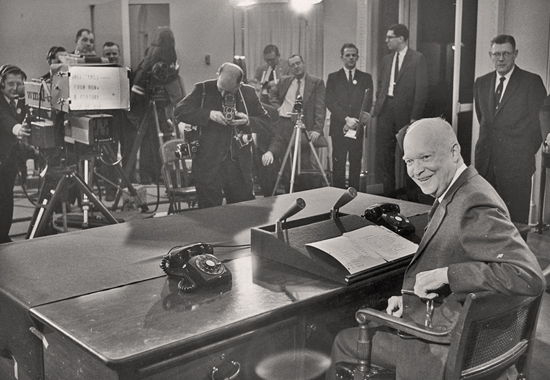
As a conceit, the MIC goes back at least to World War I, but it is popularly dated to Eisenhower’s ‘Farewell Address’ in 1961. As far as US presidential speeches/speechwriting goes, Eisenhower’s was a tour de force in every respect, but the reason why we read it today – or, rather, search for it on YouTube – is for the parts where the president urges the American citizens to pay attention to the “conjunction of an immense military establishment and a large arms industry [that is] new in the American experience,” while advising the American government to “guard against the acquisition of unwarranted influence, whether sought or unsought, by the military-industrial complex.”

 The Disorder Of Things