“New Forms of Genocide”: Annihilation and the Politics of Seeing

The Politics of Annihilation symposium continues with a post from Jessica Auchter, Guerry Professor and Associate Professor of Political Science at University of Tennessee Chattanooga. Jessica’s recent articles include “Imag(in)ing the Severed Head: ISIS Beheadings and the Absent Spectacle” in Critical Studies on Security and “Stories of a Death Tourist” in Journal of Narrative Politics. She is currently working on a book manuscript on the global politics of dead bodies.


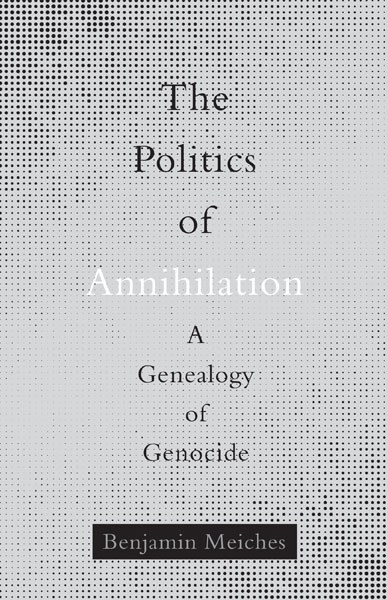
The Politics of Annihilation: A Genealogy of Genocide offers a critical take on the traditional story told by genocide scholars of the importance of the concept of genocide: Raphael Lemkin sees the need for a name to describe the violence he observes, and as this concept evolves, so alongside it emerges a consciousness of human rights and a slow expansion of international law. Benjamin Meiches takes issue with such a “progressive” account of genocide, noting that it does not offer an explanation of how genocide became a concept, does not analyze how concept of genocide links to other ideas, and that the history told in this story is too linear and sets aside the complex histories of great power violence. The main purpose of the book, then, is to examine how the hegemonic discourse of genocide depoliticizes violence. To do so, Ben distinguishes between genocide as politics (the use of mass violence to target groups) and the politics of genocide (the discourses surrounding the concept of genocide), the latter of which he seeks to uncover in his genealogy.

Using assemblage theorizing, the book draws on theoretical ancestors such as Deleuze and Guattari, Latour, Malabou, and Lacan. It is a well-written and immaculately theorized piece of work that takes a well-worn concept and says something new about it. The book is also an impressive review of the larger field of genocide studies in many ways. In this post, I want to highlight what I see as the three main contributions of the book, using each to raise questions about the larger impact this book will have, ending with some reflections on annihilation itself.

Continue reading

Hegemonic Understandings of Genocide and Ontologies of Mass Violence

The third post in our series on Ben Meiches’s The Politics of Annihilation comes courtesy of Alexander D. Barder, Associate Professor of International Relations at Florida International University. His current research explores the relationships between nineteenth and twentieth century geopolitics, race and violence. He is the author of Empire Within: International Hierarchy and its Imperial Laboratories of Governance (Routledge, 2015) and (with François Debrix) Beyond Biopolitics: Theory, Horror and Violence in World Politics (Routledge, 2012).


There’s a curious moment in Kenneth Waltz’s Theory of International Politics. In Chapter Six, Waltz argues that the recurrence of violence does not, in and of itself, distinguish international from domestic politics. “The most destructive wars of the hundred years following the defeat of Napoleon took place,” Waltz writes, “not among states but within them.” As he continues, “Estimates of deaths in China’s Taiping Rebellion, which began in 1851 and lasted 13 years, range as high as 20 million. In the American Civil War some 600,000 people lost their lives. In more recent history, forced collectivization and Stalin’s purges eliminated five million Russians, and Hitler exterminated six million Jews.”[1] To be sure, Waltz glosses over the fact that these examples actually reflect a combination of domestic and international factors. To simply situate them within the domestic realm is highly dubious historically.

What is interesting in Waltz’s gesture, however, is not only how a conceptualization of what the study of international relations is supposed to be essentially brackets the question of (genocidal) violence. What is also noteworthy is an amalgamation of violent events without necessarily discerning a specific genocidal event versus others. Benjamin Meiches’s text The Politics of Annihilation: A Genealogy of Genocide takes this head on by problematizing not only how we should understand genocide as a crucial subject of international relations but also in terms of the very conceptualization of genocide as a discrete and self-evident event. In a very compelling but deeply sobering book, Meiches forces us to reflect much more carefully about the very conceptual scaffolds that genocide studies has erected since Raphael Lemkin’s coinage of the term. Part One is a convincing refutation of what Meiches calls the “hegemonic understanding of genocide” (12). Meiches shows how this hegemonic understanding of genocide, which developed through a mixture of academic studies and policy/political initiatives takes for granted objective metrics to discern a genocidal event, reifies the attributes of what is a (victimized) group, takes for granted a notion of juridical intent and normalizes what genocidal violence is supposed to look like. This hegemonic understanding of genocide is problematic, for Meiches, because it “depoliticizes” and “normalizes” mass violence within a constricted epistemology: only certain kinds of violence then merit the categorization of genocide which provokes a hierarchy of claims and counterclaims about its usage. Indeed, in contesting the hegemonic understanding of violence and its conceptual edifice, Meiches shows how its depoliticization actually reflected a political development and commitment to bracket certain forms of violence versus others, expand state powers to militarily address mass atrocities and to create legal and political institutions which serve and continue to serve the interests of great powers.

Continue reading

The Meaning of Genocide and the Political Stakes of Naming

Following Ben Meiches’s introductory post yesterday to our symposium on his new book The Politics of Annihilation,  we welcome a first guest contribution from Jelena Subotic. Jelena is Professor of Political Science at Georgia State University, Atlanta. She is the author of two books: Hijacked Justice: Dealing with the Past in the Balkans (Cornell University Press, 2009) and Yellow Star, Red Star: Holocaust Remembrance after Communism (Cornell University Press, forthcoming, 2019). She is the author of more than twenty scholarly articles on memory politics, national identity, human rights, and the politics of the Western Balkans.


In his deeply thoughtful book, The Politics of Annihilation, Benjamin Meiches invites us to reconsider one of the fundamental concepts in the contemporary study of mass violence – the concept of genocide. He then asks us to separate the construction of the term genocide from its political usage. Meiches carefully traces the development of the concept of genocide, and in the process challenges the conventional narrative that situates the birth of the term squarely with the individual entrepreneurship of Raphael Lemkin in the mid-1940s. Instead, Meiches demonstrates, Lemkin built on a vast array of already existing scholarship in philosophy and international law. The concept of genocide – and Lemkin’s understanding of it – was immediately contested both theoretically and politically and has remained an unsettled field of meaning, prone to politicization.

It is this political power of the concept of genocide that truly bothers Meiches and that forms the heart of the book. As The Politics of Annihilation persuasively demonstrates, the fluidity of the concept of genocide has allowed for pervasive international hypocrisy – where only some conflicts, in some countries, among some groups, in some time periods get to be understood and processed as genocide, while many other instances of mass atrocity, brutality, and political murder do not earn the same designation, leaving them outside political conversation but, much more important, also outside any meaningful political response.

Continue reading

The Politics of Annihilation: A Symposium

The Disorder of Things is delighted to be hosting over the coming week a symposium for Benjamin Meiches’s important new book The Politics of Annihilation: A Genealogy of Genocide (University of Minnesota Press, 2019). Following Benjamin’s introductory post below, we will have a rich set of interventions from Jelena Subotic, Alexander Barder, Jessica Auchter, and Myriam Fotou before a final rejoinder from the author. All the entries in this series will be collated here. Previous symposia are also available.

Benjamin Meiches is Assistant Professor of security studies and conflict resolution at University of Washington Tacoma. In addition to his new monograph, he has contributed a variety of articles to International Political Sociology, Security Dialogue, Critical Studies on Security, and Review of International Studies.


“New conceptions require new terms” – Raphaël Lemkin (Axis Rule in Occupied Europe)

“To affirm is not to bear, carry, or harness oneself to that which exists, but on the contrary to unburden, unharness, and set free that which lives.” – Gilles Deleuze (Nietzsche and Philosophy)

Raphaël Lemkin coined the neologism ‘genocide’ in 1944 in a publication called Axis Rule in Occupied Europe, a voluminous study that documented legal and policy changes in Europe under Nazi rule. Little did Lemkin know that less than a century later this term would become one of the most charged terms in contemporary politics. Indeed, within a generation, an explosion took place that transformed the concept of genocide from little more than a scholarly heuristic buried in the midst of a legal tome into the most symbolically vexing and affectively potent form of rhetoric in global politics.

Although barely seven and a half decades separates the genesis of the concept of genocide from today, a great drift took place during this period. Consider, for example, a popular and critical use of genocide discourse today. NK Jemisin, author of the brilliant science fiction series The Broken Earth, uses the character of Nassun to speculate about the meaning of genocide. In the text, Nassun is a member of a hunted group called ‘orogenes’ that suffer murder, enslavement, and torture over millennia. Through Nassun’s voice, Jemisin addresses the problem of genocide. Specifically, Nassun states: “But breathing doesn’t always mean living, and maybe…maybe genocide doesn’t always leave bodies.” In some sense, Nassun (or Jemisin) are correct to view this statement as a new (and important) image of genocide because, today, the dominant images of genocide focus primarily on the act of mass killing based on ethnic, religious, national or racial identity. The irony is that Jemisin’s (or Nassun’s) image of genocide, the genocide that may or may not leave bodies, resonates far more powerfully with the vision of genocide articulated by Lemkin and many of his interlocutors at the inception of this discourse.

Continue reading

Fight to Live, Live to Fight: Veteran Activism after War

A guest post from Ben Schrader, on the topic of his new book, Fight to Live, Live to Fight: Veteran Activism After War, published today with SUNY Press. Ben recently completed a visiting professorship with the Bard Globalization and International Affairs program in conjunction with Central European University. He is a war veteran turned peace activist turned academic. He has published in the Journal of Narrative Politics on ‘Auto-Archeology and Political Affect of War’ (2014) as well as in Critical Military Studies on ‘The Affect of Veteran Activism’ (2017). Ben has a number of other published non-academic works, from think pieces to poetry. He is currently living precariously on the job market. Ben is also a board member for the anti-war organization About Face: Veterans Against War.
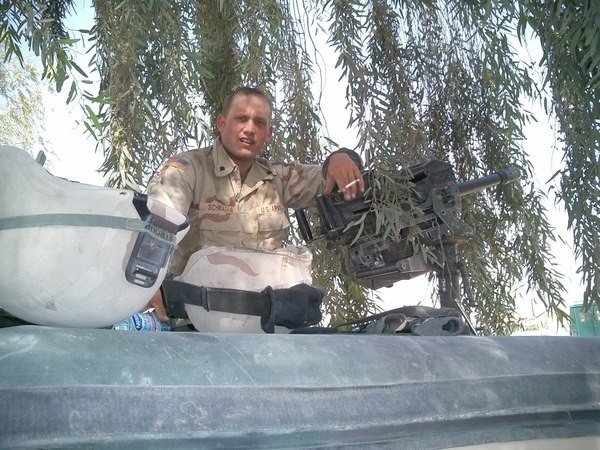

Me in Iraq

Taking in some shade while on patrol in Iraq.

From 2001-2005 I served in the US Army as a 19D Cavalry Scout. I was stationed in Vilseck, Germany and went on two deployments, one to Kosovo from 2002-2003 for a peacekeeping mission, and one to Baqubah, Iraq, where I was a part of my units Quick Reaction Force, so if anything happened in our sector we were the first people that were called. Needless to say I saw a lot of combat. While in Iraq, I began to become disillusioned with the mission, as the reasons we had been given for why we were in Iraq did not seem to align with what we were seeing on the ground. I left the military upset, confused, and as if I had been betrayed by my own country, so to understand my experience I did two things. First and foremost, I joined the group Iraq Veterans Against the War (IVAW), now known as About Face: Veterans Against War. This gave me a tool to channel much of my anger and also connected me with other veterans who were questioning the things they experienced in Iraq. One of the primary tactics I found with IVAW, parrhesia—speaking truth to power—worked to expose the lies that I saw (as well as the truths that have been hidden from civil society), while also working to help me heal by releasing the burden of these truths.
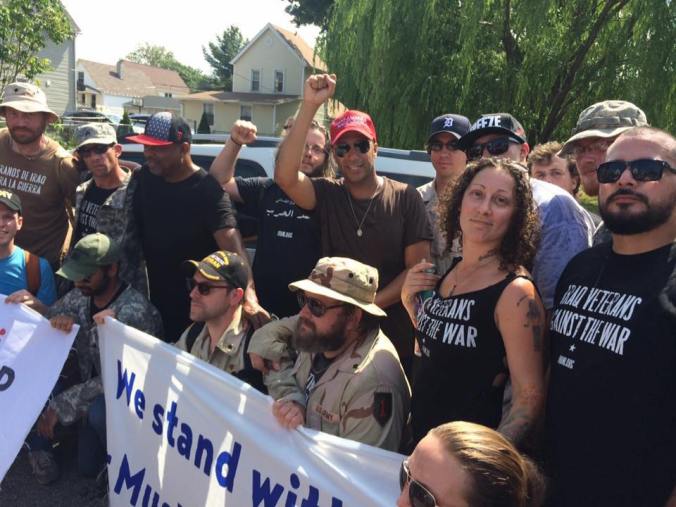
Me at RNC with Rage

IVAW marching with the Prophets of Rage at the 2016 Republic National Convention

The second thing I did was I went back to school. I studied sociology to understand the human and societal impacts of war, and I studied political science to understand the gears and processes of war. Between my activism and academia, I began to see many connections not just on an international level but also on a local level, whereas many of the inequities that Americans face could be tied to different aspects of militarism. This drove me deeper into understanding these connections, as I learned about them in the classroom as a student, and on the streets as an activist. I began to expand my activism and my formal learning beyond just understanding militarism as I got an MA in ethnic studies; examining intersectionality, white supremacy, and colonialism; as well as marching for racial justice, advocating for gender equality, and fighting against homophobia. I then moved on to a PhD where I would work to tie all this together into the project I’m writing about today: a look at military veterans who came home to be social justice activists.

While the project is entangled with my own experiences as a soldier and an activist (as I utilize embodied auto/ethnographic research), my examination of other activists took place over the course of a year. In 2013-2014 I drove around North America interviewing veterans from all walks of life. I started by reaching out to veteran activists that I knew to see if they knew other veterans who would be willing to be interviewed. My only requirement was that they considered themselves “social justice activists,” and that they had served in the US military. In all I ended up interviewing twenty-two veteran activists, twenty of them being in the US, one in Mexico, and one in Canada. I hadn’t begun with the categories of activism I wanted to understand but as one interview led to another categories began to form, as I found veterans who were not only engaged in antiwar activism but also a part of the Occupy movement, doing environmental work, addressing issues of sexual assault in the military, working on immigration issues, and trying to help veteran communities heal from the traumas of war. In some cases, I spent an hour with them conducting an open-ended interview, in other cases I spent a day or two with them observing the work that they were doing. Each interview was different, but all were fruitful. Within the book I primarily highlight two veterans per chapter and their work as an activist, as I do what my former advisor Michael Shapiro calls staging encounters between theory and event. I draw much inspiration from Critical Military Studies as I examine the many ways that war and the military effect the self, groups, and society. Furthermore, these veterans are what Victoria Basham and Paul Higate call geocorporeal actors, not only as soldiers, but also afterwards as veteran activists. I therefore weave these veterans’ stories with my own, from my experiences in war to my engagement with them as interviewees. I try to tell these stories in a manner that is accessible for anyone to grasp both the impacts of war and some of the theoretical concepts around identity formation, militarism, and problems these veterans are addressing around social justice issues.

Continue reading

The case against Woodrow Wilson, after 100 years

This guest post is a collective statement, written by Philip Conway in consultation with several other current and former PhD candidates at the Aberystwyth University Department of International Politics. It is co-signed by a number of current and former Aber PhD candidates, not all of whom were directly involved in the drafting process. It does not, therefore, necessarily present a consensus. However, it does, we hope, present a constructive and forceful contribution to an important debate.

At Aberystwyth University, the year 2019 marks the Centenary of the Department of International Politics. A century, that is, since the philanthropists David, Gwendoline, and Margaret Davies donated a sum of £20,000—more than £1m in today’s money—in order to establish a Chair of International Politics (the first of its kind in the world). The Chair was established “in memory of the fallen students of our University.”[1] It was to be named after the then-current US President, Woodrow Wilson.

This was, and is, an appellation heavy with significance. At the end of the War, as Lord David Davies himself later wrote:

“Among the protagonists of the new Jerusalem stood President Wilson, towering head and shoulders above them all. […] By all those who sincerely desired a permanent peace and were prepared to sacrifice their imperialistic conceptions, he was acclaimed as the leader.”[2]

On 25th October last year, as part of the Department’s Centenary celebrations, a roundtable seminar was held, titled “Reflections on Woodrow Wilson.” It was instigated by the current incumbent of the Woodrow Wilson Chair of International Politics, Andrew Linklater.

This instigation had, in turn, been prompted by a student request to take the occasion of the Centenary as an opportunity to re-evaluate the Department’s association with this particular historical figure.

Continue reading

Property Abolitionism: Race, Colony, Body, Land

For the final post in our symposium on Colonial Lives of Property, Brenna Bhandar replies to her interlocutors. Brenna is Senior Lecturer in Law at SOAS, University of London. She is author of Colonial Lives of Property: Law, Land and Racial Regimes of Ownership (DUP: 2018) and co-editor (with Jon Goldberg-Hiller) of Plastic Materialities: Politics, Legality and Metamorphosis in the Work of Catherine Malabou (DUP: 2015). She is currently completing Thinking Liberation: anti-racist feminist practice, a book on critical race feminisms with Rafeef Ziadah.


Thanks to all five contributors for these incredibly thoughtful interventions. It is a real gift to have such expansive and thorough responses to one’s work, and to have been given the opportunity to consider the questions they raise about the potential for some of the ideas in the book to travel into domains unexplored in the text. It is impossible to respond to each of the issues raised, but I have chosen 4 different themes to discuss which I think connect many of the articles.

One of the themes arising from the responses to the book is a question about the extent to which the concept, “racial regimes of ownership” is adequate to grasp the realities of colonialism outside of the sphere of British colonial and imperial rule.  To what extent has the co-emergence of racial subjectivities and capitalist property relations been a central part of the advent of colonial modernities beyond the settler colony?

Continue reading

(Post)Colonial Lives of Property and the Contradictions of ‘Use’

The fifth post in our symposium on Colonial Lives of Property is by Lisa Tilley. Lisa is Lecturer in Politics and Leverhulme Early Career Fellow at Birkbeck, University of London. She is also co-convenor of the Colonial, Postcolonial, Decolonial Working Group of the British International Studies Association (CPD-BISA); co-founder of the collaborative research project Raced Markets; and Associate Editor of the pedagogical resource Global Social Theory.Her work draws on various theoretical approaches to ‘the colonial question’ in analyses of processes of accumulation and expropriation, especially along urban and rural extractive frontiers in Indonesia.


Brenna Bhandar’s thoughtful and detailed work, Colonial Lives of Property, is a vital reference for anyone seeking to understand land and property in historical, juridical, and economic perspective. This text has application well beyond the disciplinary boundaries of Law and should be given a central place within the Political Economy canon too, especially as it illuminates the long-disregarded, yet undeniably constitutive, relations between the formations of property and race. The text also has a wonderful pedagogical order to it, owing to the way it is structured around central chapters on Use, Propertied Abstractions, Improvement, and Status. I can fully imagine planning a module on the political economy of property around each of those rich and weighty concepts, guided by Bhandar’s exemplary way of thinking them through.

Continue reading

Property as Futurism

The third post in our symposium on Brenna Bhandar’s Colonial Lives of Property is by Sara Salem. Sara is an Assistant Professor in Sociology at the London School of Economics. Sara’s research interests include political sociology, postcolonial studies, Marxist theory, feminist theory, and global histories of empire and imperialism. She is particularly interested in questions of traveling theory, postcolonial/anti-colonial nationalism, and feminist theory. She has recently published articles in journals such as Signs; Interventions: A Journal of Postcolonial Studies; Review of African Political Economy; and the European Journal of Women’s Studies, among others.


Brenna Bhandar’s ‘Colonial Lives of Property’ is an incisive and exciting book on questions of race, empire, property and the law. Drawing on multiple settler-colonial contexts—Palestine, Australia and Canada—and various time frames, Bhandar meticulously unpacks the loaded legal and social concept of ‘property’ to reveal its entanglements with histories of settler colonialism and race. Bhandar shows us that there cannot be a history of private property law that is not also at the same time a history of land appropriation in the colonies. The colonial drive to appropriate indigenous land—often in the process exterminating indigenous peoples—did not only have specific social, political and economic effects, but also produced legal understandings of land, property and citizenship. Bhandar notes, “Property law was a crucial mechanism for the colonial accumulation of capital, and by the late nineteenth century, had unfolded in conjunction with racial schemas that steadfastly held colonized subjects within their grip. Property laws and racial subjectivity developed in relation to one another, an articulation I capture with the concept of racial regimes of ownership,” (p. 2).

The book demonstrates that by unveiling these processes of appropriation and extermination, we come closer to understanding the categories we today so often work with, such as property and private ownership, and who belongs in the category of the ‘modern human’ and can thus access these. It shows us that the law was developed in and through colonialism, and that “there cannot be a history of private property law, as the subject of legal studies and political theory in early modern England that is not at the same time a history of land appropriation in Ireland, the Caribbean, North America, and beyond,” (pp. 3). This is a particularly important project because of the ways in which property is often associated with freedom. To purchase property means to secure freedom from various calamities, including economic insecurity. Private property has long served as the bulwark of modern liberalism, and one only has to think of the various institutions that were set up primarily to defend private property, among these the police forces.

Continue reading

On the British Empire Among Empires, and on Property Beyond Sovereignty

This guest post, from Kerry Goettlich, is the second contribution to our symposium on Brenna Bhandar’s  Colonial Lives of Property. Kerry is a PhD candidate in the IR Department at the London School of Economics. His research is on the historical relationship between space and international politics, particularly the origins and consequences of linear borders. His latest work is ‘The rise of linear borders in world politics’ in the European Journal of International Relations. He was also recently co-editor of Millennium: Journal of International Studies.


As part of the fieldwork for Colonial Lives of Property, Brenna Bhandar witnessed the seventieth razing of the Bedouin village of Al-Araqib by the Israel Land Authority since 2010 (p. 116). Some Bedouin living under Israeli authority are now so used to having their homes destroyed that they have begun building them with particularly pliable materials in order to make reconstruction easier. Others destroy their own homes in order to avoid being charged bulldozing costs by the state. One of Bhandar’s interviewees ‘paid for someone to build his house and paid the same person to destroy it’ (p. 117).

This is just one of many ways in which Colonial Lives of Property powerfully demonstrates the meaning of a ‘history of the present’. The book is a compelling history of private property regimes in settler colonial contexts which never loses sight of what makes this material important for scholars—and, I think, particularly IR scholars—today. It takes us through many centuries of different articulations of the concept and practice of property, each abstracting land space in different ways, and shows us historically how property came to be the upholder of racial and gender inequalities that it is today. It brings together a wealth of theoretical resources to do this, from legal studies scholars such as Cheryl Harris and Alain Pottage to more general social theorists such as Stuart Hall and Cedric Robinson, and many more. The book without a doubt demolishes any account of property as natural, as somehow separate from race and gender, or as emerging fully formed within a self-generating Europe. These, in my reading, would be the main counterarguments, and after reading this book, it would be quite difficult to sustain any of them.

With that in mind, what I want to offer in this post is less of a critique of Colonial Lives of Property than some reflections on some relevant questions it raises. In particular, I focus on two things that are not as prominent here as one might expect: non-Anglophone imperialism and the sovereign or imperial centre. The point here is not that these things are missing, but rather to think about how their relatively subdued roles might help us appreciate the book’s significance differently.

Continue reading