America’s Electoral Apartheid: 30-40 million US residents excluded from voting

This is a guest post by Konstantin Kilibarda, originally blogged on the Abolition Journal blog and reproduced here. Konstantin is a PhD candidate at York University. His dissertation, Making Montenegro Work: Refashioning Labour After Socialism, addresses neoliberal restructuring in Montenegro and its impact on working lives and notions of citizenship in the newly independent state. His research interests include post-socialist transitions; processes of neoliberalization; labor market reforms; globalization; precarious work; gendered and racialized labour market segmentation, and more.

9141373542_ea36335868_z-640x410

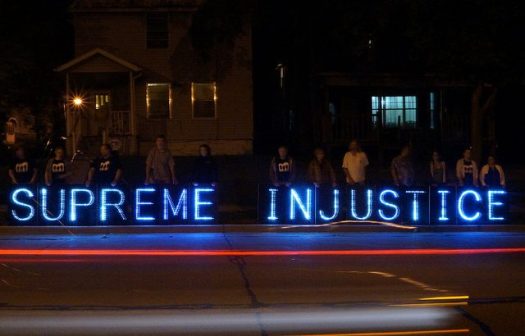
[Photo: ‘Supreme Injustice’ by Joe Brusky via Flickr]

A key component of an apartheid system is the ability to disenfranchise those populations that may tip the political scales. Currently in the United States there are between 30-40 million residents (including millions of US citizens) who remain systematically disenfranchised. The fact that the disenfranchised are primarily racialized or poor, underlines Charles W. Mills’ contention that America’s democracy continues to be premised on a hierarchically structured ‘racial contract.’ Below I’ve compiled a short list of groups in the US who can’t vote, despite living, loving, caring, participating, and working everyday in communities and neighborhoods throughout the country.

If those feeling perplexed by Trump’s rise to power want to build a strong (and lasting) coalition against the Republican politics of hate (and the accommodation of such a politics by some wings of the Democratic party), efforts to expand voting rights, narrow voter suppression, and fundamentally transform the electoral system will play an important role. Racialized communities most directly impacted by these policies have been at the forefront of these struggles since the beginning; it’s now time for those just recognizing these facts to also get involved. The following is a quick breakdown of some of the major groups who live under the US system – some with citizenship, some without – but are nevertheless barred from having a say in the choice of President. Any one of these groups if enfranchised could have made a decisive impact in the 2016 election. Taken together they represent a formidable group that could radically transform American politics. It is perhaps no wonder that Republicans (and some Democrats) are committed to sustaining and even expanding the scope of their disenfranchisement.

(1) 13.3 million permanent residents

Many countries allow permanent residents to vote, yet in the United States those who have attained this status are barred from exercising their franchise. In the rhetoric of the Republican Party, ‘legal’ immigrants are often compared favorably to ‘illegal’ (i.e. undocumented) immigrants. Nevertheless, the Republican Party and some Democrats continue to ensure that all non-citizens (regardless of status) are unable to participate in elections. It’s worth remembering that the Illegal Immigration Reform and Immigrant Responsibility Act (IIRIRA) of 1996, which was pushed forward by a Republican controlled Congress and signed into law by President Bill Clinton, expanded the grounds on which people can be deported, including explicit prohibitions against and harsh penalties for non-citizen voting.

Continue reading

America’s moral crisis

America’s moral crisis

Luke Cooper is Senior Lecturer in Politics at Anglia Ruskin University. He is currently writing a book on the historical sociology of the long nineteenth century.


Parallels of Trumpism to some of the darkest moments in America’s past affirm Barak Obama’s recent claim that the ‘fate of the world is at stake’, argues Luke Cooper

It was springtime in America, but the thoughts of citizens were more preoccupied with the fallout from a distant war and an economic recession at home, than they were the change of seasons. Europeans may have looked on anxiously at how the pressures of a brutalised capitalism and great power politics appeared to have toxified a deeply polarised American public debate. But with their own countries facing similar, if not even more egregious, rise in racial populism, they were hardly in a position to judge.

trumpprotest-2

Continue reading

Against the New Phrenology: De-Pathologizing Trumpism

This is a guest post by Dan Boscov-Ellen. Dan is a Ph.Dprofile. student in Philosophy at the New School for Social Research and a Visiting Instructor in Social Science and Cultural Studies at Pratt Institute. His dissertation research involves exploring the political-philosophical implications of capitalist ecological crisis.


One of the most persistent refrains of the US Presidential election has been that of liberal incredulity at the idiocy of Trump voters. Depending on the current status of Nate Silver’s election forecasts, this tends to manifest either as amusement (perhaps chuckling at a Daily Show interview of deluded rally attendees or a screening of Idiocracy), or as disgust and horror (perhaps soberly staring into one’s craft IPA when the debate watch party gets too real). How, liberals wonder, could anyone vote for Cheeto™ Hitler?

VTPxYrNtCj6Brf4hhZ5O_H4Rdl5qqzJe5XMy-SH1bnI.jpg

But of course they do not wonder too hard – it is obvious to most liberals that Trump voters are simply ignorant and stupid, an apparent truism of which comedians, political scientists, neuroscientists, and cognitive psychologists constantly assure us. Everyone knows that Trump supporters are less well-informed than liberals – if only they read the New York Times and listened to NPR instead of watching Fox News! But the deeper problem, allegedly, is that Trump voters are simply not intelligent enough to realize how ignorant they are. Psychologist David Dunning explains that

[t]he knowledge and intelligence that are required to be good at a task are often the same qualities needed to recognize that one is not good at that task — and if one lacks such knowledge and intelligence, one remains ignorant that one is not good at the task. This includes political judgment.

According to neuroscientist Bobby Azarian, this Dunning-Kruger effect “helps explain why even nonpartisan experts — like military generals and Independent former Mayor of New York/billionaire CEO Michael Bloomberg — as well as some respected Republican politicians, don’t seem to be able to say anything that can change the minds of loyal Trump followers.”

At base, then, it is the Trump voters’ fundamental and impenetrable stupidity that causes them to ignore the experts – highly credentialed neoclassical economists, experienced military and intelligence figures, beneficent billionaires, esteemed members of the mainstream American political establishment and independent press, and Neil Degrasse Tyson – who obviously know far better than the plebian masses. Indeed, many liberals secretly believe it might really be better if the experts just ran things and we revoked the cretins’ right to vote.

Continue reading

Jaw-jaw, War and Law

ainley_kirsten_118Our third comment on Reconstructing Human Rights is authored by Kirsten Ainley. Kirsten is Associate Professor in the Department of International Relations and Director of the Centre for International Studies at the London School of Economics. Her research is in the field of global ethics and is concerned very broadly with relationships between politics, law and ethics in world politics. She has published widely on international criminal law, transitional justice, the International Criminal Court and the notion of evil in international relations. Read Joe’s opening post here, Karen’s comment here, and Anthony’s contribution to the symposium here.


Reconstructing Human Rights is a remarkable book. It sets out, in a most compelling way, grounds to support human rights as an ethos – a way to approach politics that has the potential to be genuinely emancipatory. The book does so not from the widely (and rightly) disparaged universalist wing of political theory, but from a critical perspective. This is where the argument is most original and most impressive. There are plenty of us who are critical of many human rights practices, but supportive of the use of human rights language and law in some instances – or at least despairing of an alternative. Hoover provides, in a beautifully staged argument, a reconstruction of rights that weaves together strands from the work of theorists such as Dewey, Connolly and Honig (as well as drawing on Benhabib, Walzer, Habermas and others). Like many theorists, Hoover has a razor-sharp ability to recognise and expose flaws in arguments. More unusually, he treats the work he is responding to with humility and respect, and is thus able to draw his critiques into a constructive treatise. Engaging with the book was as rewarding as it was intellectually demanding, and the humanity with which Hoover thinks through his subject is testament to the potential of his approach.

So, I agree. He’s right. There is virtually nothing of substance in the book that I would take issue with. This realisation left me in something of a bind when it came to writing this post. But it also, after some time reflecting on the implications of the book, left me with a familiar discomfort about the relationship between philosophy and action. Rather than discussing the book’s argument, therefore, I want instead to think about the tensions that become apparent in campaigning for political change using the tool of human rights, in one form or another, if approached from Hoover’s position. Continue reading

Human Rights: A Love Story?

zivi-headshots-gray-backgroundThis is the first comment, following Joe’s opening post, penned by Karen Zivi. Karen is Associate Professor of Political Science at Grand Valley State University where she teaches courses on rights, democracy, and gender and politics. She is the author of Making Rights Claims: A Practice of Democratic Citizenship (Oxford University Press, 2012) and her work on topics such as LGBT rights, citizenship, and motherhood has appeared in the Journal of Human Rights, American Journal of Political Science, Politics & Gender, and Feminist Studies.

A Longing

As I write this post, I am preparing for the first day of my ‘Introduction to Human Rights’ class. I’ll begin by asking my students to identify a human rights issue of interest to them. I won’t be surprised if they mention the Syrian refugee crisis or police brutality in the United States, religious liberty or reproductive justice, Wikileaks and freedom of the press or Flint and access to clean water (I teach in Michigan after all). I’ll ask them what should be done to address these issues and I won’t be surprised if they advocate for providing humanitarian aid or making new laws that limit or enhance state power. And when I ask them why we should respond one way or another, I won’t be surprised if they make reference to ideas about a common humanity, the meaning of justice, or doing the right thing.

giphy

Not wanting to crush their spirit on the first day, I’ll tell them they are in good company in the way they are thinking about human rights. But over the course of the semester, I’ll tell and show them that political solutions and philosophical justifications disappoint again and again for reasons that go beyond the sheer callousness, greed, or stupidity of human beings. Even when victories are won, as Joe Hoover’s new book makes so astonishingly clear, collateral damage is often unavoidable. My students thus have the difficult task of confronting the reality of human rights’ limitations. I have the task keeping their promise alive, balancing rights realism with rights optimism in ways that motivate my students to engage in making change and yet staves off the kinds of skepticism, despair, and apathy that do nobody any good. I still believe in the power and promise of human rights. And, fortunately, so too does Joe Hoover.

Continue reading

Fantastic Mr President: The Hyperrealities of Putin and Trump

Screen Shot 2016-08-30 at 21.56.56This is a guest post by Maria Brock. Maria is about to commence a postdoctoral fellowship at the Centre for Baltic and East European Studies and the School of Cultural and Critical Theory at Södertörn University (Stockholm). She has a PhD in Psychosocial Studies from Birkbeck and has perviously published on the role of negative affect in reactions to the case of Pussy Riot, and the status of memory objects and ‘museums of the everyday’ in the proliferation of post-socialist nostalgia.


In July 2016 – more than 15 years into his time in office – Vladimir Vladimirovich Putin’s approval rating was at 82%, a figure made all the more remarkable by the fact that the country is experiencing a palpable and lengthy economic downturn. Some commentators have favoured an explanation that treats this as proof that a larger-than-life president is more in line with ‘what Russians want’, as Putin “satisfied a yearning for a strong leader who could make the Russian family proud”. However, concretising a Russian ‘national desire’ is less than helpful if we seek to understand the reasons behind Putin’s continued popularity. Equating a historical past with an inherent propensity to follow strong-men is an exercise in oversimplification, as it treats nations and groups as essentially static, prone to repeat the same historical patterns over and over again. Similarly, a focus on the more overt parallels with the earlier ‘Cults of Personality’ neglects the fact that the underlying ‘conditions of possibility’ that produced the two phenomena are different. Such comparisons also fail to explain the appeal of similarly larger-than-life politicians in countries with a longer democratic tradition. Clearly, an emphasis on national psychological propensities is not productive. Instead, an analysis of the appeal of such leader figures that taps into less conscious mechanisms is worthwhile. By simultaneously looking at the phenomenon of Donald Trump’s remarkable rise, a number of parallels pertaining to the creation of their public personae become apparent. In fact, such an analysis can serve to illuminate overarching principles structuring the successful creation of their outsized public personae.

2016-07-25-1469472310-3744164-gettyimages531157596e1463172570228

The popular support these politicians attract demonstrates that they hold a kind of libidinal appeal that should not be underestimated, lest we render a large part, if not the majority, of a country’s population politically incompetent. While one cannot discount the real inequalities, as well as the real and imagined grievances that opened up the space for less established political figures to gain support, it is nevertheveless worthwhile to examine why these particular kinds of candidates hold such appeal. Their reliance on spectacle and well-orchestrated exploits which combine the hypermasculine with the hyperreal enabled them to set in motion processes of identification that transcend the need for a coherent, well articulated political agenda. Instead, while seeming unsubtle to the point of being crass, they simultaneously operate on a more subliminal level, remaining oblique enough to become conduits for the electorate’s personal hopes and grievances. While this piece centres on the representational mechanisms employed by Vladimir Putin and his team of PR advisers, it is possible to identify a number of parallels with other contemporary leader figures – chief among them Donald Trump – each of whom appears to rely on a kind of hypermasculine charisma to suture a political field that is otherwise characterised by cynicism towards established politics.

Continue reading

From Global to Transnational: Reading Global Justice through W. E. B. Du Bois

s200_in_s.valdezThis is a guest post by Inés Valdez, assistant professor in political science at The Ohio State University. She works on the political theory of immigration, critical race theory, and cosmopolitanism and her articles have appeared in the American Political Science Review, Political Studies, and Politics, Groups, and Identities, among others outlets.Her book manuscript in progress is on Kant and W. E. B. Du Bois’s cosmopolitanisms. This post is based on a recent workshop paper that will be appearing in a collection on empire, race, and global justice edited by Duncan Bell.


An emerging literature in the field of history has made clear that transnational connections between black Americans and anti-colonial movements in the Caribbean and Asia were prominent in the twentieth century (see, among many others, Slate 2012). These connections resulted in more or less institutionalized forms of communication, exchange, and solidarity that influenced politically how these groups understood their own history of injustice and struggle.

These connections indicate that groups within the West saw their marginalization as connected to groups within what we today call the global South and saw the potential of realms of politics beyond the nation as sites of emancipation and justice.

Despite this literature, and the relatively recent events that they cover, the global justice literature is largely unconcerned with them. There are many disagreements within the global justice literature but one assumption is common: that wealthy countries are homogeneously prosperous and poor countries homogeneously poor. Moreover, whenever scholars do note the inequality within the West, they do so to posit that addressing it should take priority over obligations to the non-West. While scholars tend to disagree on the question of whether the West has a duty of justice toward the non-West, neither those who favor a duty to distribute (cosmopolitans), nor those who disagree with it (social liberals), pause to reflect on the potential affinities between marginalized groups within and outside the West.

Continue reading

White World Order, Black Power Politics: The Author’s Response

Bob’s response to Naeem, NiviSrdjan, and Meera completes our symposium on White World Order, Black Power Politics.


Four critical IR theorists have taken time away from other tasks to read my book carefully, generously, and thoughtfully. What a gift. The brevity of this response will appear stingy by comparison, but I don’t mean it to be. Rather, I am typing with my wrist in a splint, and it hurts, while I am also due to leave in the morning for a two-week vacation. Perhaps there will be another chance to show my gratitude. Many of the questions that Nivi, Naeem, Srdjan, and Meera raise have to do either with the book’s and my relationship to theory or with the limitations of my research strategy, as I anticipated and sought, self-servingly, to head off.

Continue reading

No Less A Scream For It Being Artful

Naeem InayatullahAnother guest contribution from Naeem Inayatullah to our symposium on Vitalis’s White World Order, Black Power Politics. Naeem’s research locates the Third World in international relations through history, political economy and method. With David Blaney, he is the co-author of International Relations and the Problem of Difference (Routledge 2004), and Savage Economics: Wealth, Poverty, and the Temporal Walls of Capitalism (Routledge 2010). He is the editor of Autobiographical International Relations: I, IR (Routledge 2011), as well as Narrative Global Politics: Theory, History and the Personal in International Relations (Routledge, 2016) with Elizabeth Dauphinee. His writing, research and talks can be discovered and devoured at his academia.edu page.

*Update* Nivi’s response is here, and Srdjan’s is here.


When I finished reading White World Order, Black Power Politics, I made three decisions.  I would read the book again.  Not because it is theoretically difficult or jargon heavy.  It’s not.  But because I want to absorb its details, re-orient my body through its revelations, savor Bob’s story telling skills, and anticipate his scarce but nevertheless Pharoah Sanders-esque screams.

In addition, I immediately designed a course titled “Race and IR” around Bob’s book.  The course has been approved and I am scheduled to teach it in September.  Third, I’ve suggested Bob’s name to my best students as someone they might consider as a future mentor in graduate study.  So, boom!  Immediate impact.  Could a book and an author want more than this?  Perhaps not.  Still, I suspect Bob has larger ambitions for this book.  It could change our field, if we are lucky.  Count me in for this project as well.

The importance of Vitalis’ book is easy to articulate.  It demonstrates the racist foundations of our discipline (IR).  Bob recounts the narrative as two sides of one tale.  There is the account of those who theorized and practiced white hegemony.  And there is the story of those who rejected it.  Our origin story is not about the three great debates, not the mythical line of realism going back to Machiavelli and Thucydides, not the immaculate conception of a Cold War politics, not anarchy as the founding condition, and not abstractions concerned with statics or dynamics of inter-state relations. Rather, Vitalis demonstrates, it is racist theories and institutions of imperialism constitute the actual origins of our discipline.

Here is how Bob puts it:

What is new and important in this book is the discovery that the intellectuals, institutions, and arguments that constituted international relations were shaped by and often directly concerned with advancing strategies to preserve and extend [the theory and practice of white hegemony against those struggling to end their subjection.  (2)

But also:

…we can’t understand the history of the early decades of the discipline without understanding the long and globe-spanning freedom movements that are central to its intellectual, social, and institutional development. (9)

Each part of the tale is told in equal measure: the ying and the yang, the force and counter-force, imperialism and liberation. Continue reading

White World Order, Black Power Politics: A Symposium

vitalis-e1458738905580This is the first post in the symposium on Robert Vitalis’s, White World Order, Black Power Politics: The Birth of American International Relations (Ithaca: Cornell University Press, 2015). Professor Vitalis (who also answers to ‘Bob’) teaches at the University of Pennsylvania. His first book, When Capitalists Collide: Business Conflict and the End of Empire in Egypt, was published in 1995. His second book, America’s Kingdom: Mythmaking on the Saudi Oil Frontier, published in 2005 was named a book of the year by The Guardian. He has been a fellow at the Woodrow Wilson International Center for Scholars (2009), Rockefeller Foundation (2003), the International Center for Advanced Study, NYU (2002), the American Council of Learned Societies (2002), and the MacArthur-SSRC International Peace and Security Program (1998). He was a MacArthur Award nominee in 1998. Below is his introduction to our symposium.

*Update*

Naeem’s response is here; Nivi’s is here and Srdjan’s is here.


80140100646100L

White World Order, Black Power Politics may well be the only book discussed in this symposium series that isn’t primarily concerned with theory, or at least the only one by an author who does not self identify as a theorist, teaching in a department that does not recognize what I do as “IR.”  It is also less an intellectual history, which might allow it to pass as theory, than it is an institutional history. So I am grateful for the interest in it here.

28522646._UY1280_SS1280_That said, it is indeed a critical history. The records of professors, schools, research organizations, and foundations in the early twentieth century United States reveal a past that bears scant resemblance to the “practitioner histories” or insider accounts of great debates invented about the discipline of international relations in the second half of the century, which are the ones most specialists tell themselves and their students until now. In fact, the more I learned and labored in the archives the more I came to see the problem as similar to the one I wrestled with in my last book, America’s Kingdom: Mythmaking on the Saudi Oil Frontier. The history that U.S. oil companies invented after World War II about their early and unshaken commitment to a “partnership in progress” with the Saudi people, at a moment when criticism of U.S. imperialism was on the rise in the Eastern Province and across the globe, is the one that books repeated uncritically for decades. The firms’ private records though revealed a dramatically different reality. I developed an account of the exploitative order in place in the oil camps, the racial science that justified it in the minds of the American engineers and managers, and the failed efforts of Arab and other workers to bring about its end. I likened what I did in that book to “reverse engineering” particular processes of mythmaking. I’ve done more or less the same thing for a sector of the U.S. academy in White World Order. Continue reading