America’s Electoral Apartheid: 30-40 million US residents excluded from voting

This is a guest post by Konstantin Kilibarda, originally blogged on the Abolition Journal blog and reproduced here. Konstantin is a PhD candidate at York University. His dissertation, Making Montenegro Work: Refashioning Labour After Socialism, addresses neoliberal restructuring in Montenegro and its impact on working lives and notions of citizenship in the newly independent state. His research interests include post-socialist transitions; processes of neoliberalization; labor market reforms; globalization; precarious work; gendered and racialized labour market segmentation, and more.

9141373542_ea36335868_z-640x410

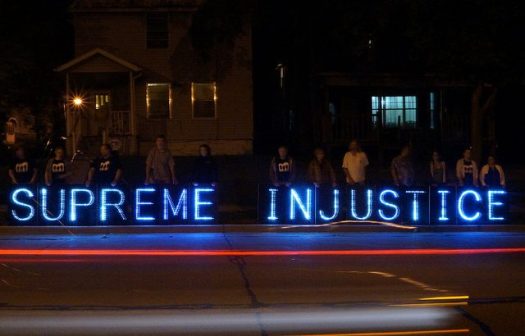
[Photo: ‘Supreme Injustice’ by Joe Brusky via Flickr]

A key component of an apartheid system is the ability to disenfranchise those populations that may tip the political scales. Currently in the United States there are between 30-40 million residents (including millions of US citizens) who remain systematically disenfranchised. The fact that the disenfranchised are primarily racialized or poor, underlines Charles W. Mills’ contention that America’s democracy continues to be premised on a hierarchically structured ‘racial contract.’ Below I’ve compiled a short list of groups in the US who can’t vote, despite living, loving, caring, participating, and working everyday in communities and neighborhoods throughout the country.

If those feeling perplexed by Trump’s rise to power want to build a strong (and lasting) coalition against the Republican politics of hate (and the accommodation of such a politics by some wings of the Democratic party), efforts to expand voting rights, narrow voter suppression, and fundamentally transform the electoral system will play an important role. Racialized communities most directly impacted by these policies have been at the forefront of these struggles since the beginning; it’s now time for those just recognizing these facts to also get involved. The following is a quick breakdown of some of the major groups who live under the US system – some with citizenship, some without – but are nevertheless barred from having a say in the choice of President. Any one of these groups if enfranchised could have made a decisive impact in the 2016 election. Taken together they represent a formidable group that could radically transform American politics. It is perhaps no wonder that Republicans (and some Democrats) are committed to sustaining and even expanding the scope of their disenfranchisement.

(1) 13.3 million permanent residents

Many countries allow permanent residents to vote, yet in the United States those who have attained this status are barred from exercising their franchise. In the rhetoric of the Republican Party, ‘legal’ immigrants are often compared favorably to ‘illegal’ (i.e. undocumented) immigrants. Nevertheless, the Republican Party and some Democrats continue to ensure that all non-citizens (regardless of status) are unable to participate in elections. It’s worth remembering that the Illegal Immigration Reform and Immigrant Responsibility Act (IIRIRA) of 1996, which was pushed forward by a Republican controlled Congress and signed into law by President Bill Clinton, expanded the grounds on which people can be deported, including explicit prohibitions against and harsh penalties for non-citizen voting.
Continue reading

When White Men Rule The World

A shorter version of this post appears at the Oxford University Press blog. It was invited – if that’s the right word – some months ago as a tie-in with the new edition of The Globalization of World Politics. Obviously, I was planning on writing about questions of imperial feminism and intersectionality. Things didn’t turn out that way. Apologies for repetition of good sense already promulgated elsewhere, and for the inevitable commentary fatigue.


Donald Trump

If Hillary Rodham Clinton had triumphed in last Tuesday’s presidential election, it would have been a milestone for women’s political representation: a shattering of the hardest glass ceiling, as her supporters liked to say. Clinton’s defeat in the electoral college (but not the popular ballot, where she narrowly triumphed by about 640,000 votes at last count) is also the failure of a certain feminist stratagem: namely, the cultivation of a highly qualified, centrist, establishment (and comparatively hawkish) female candidate, measured in speech and reassuringly moderate in her politics. But the victory of Donald Trump tells us just as much about the global politics of gender, and how it is being remade.

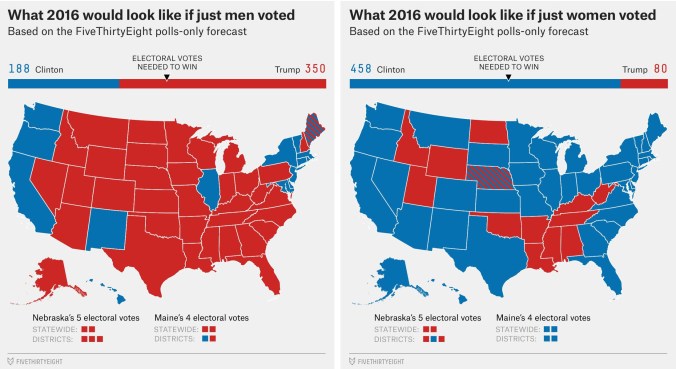
The election itself was predicted to be the most divided by sex in US history. Polls from a few weeks before the election had Clinton’s lead among women at the highest level for a presidential candidate since records began in 1952. A widely shared meme celebrated the trend and declared that “women’s suffrage is saving the world”. Activists from the ‘alt-right’ (a conglomerate of neo-Nazis, xenophobes, men’s rights types, lapsed libertarians and professional agitators) trolled in response that the 19th amendment should be repealed. Time called the election a ‘referendum on gender’; The New Yorker a question of ‘manifest misogyny’.

if-just-men-and-women-voted-meme

In the end, the politics of race mediated the politics of gender: white women were by many leagues more comfortable with Trump’s candidacy than women of colour. As Kimberlé Crenshaw pointed out on Wednesday morning, the claim for a singular female worldview – one that could be mobilised to ordain Clinton ‘Madame President’ – collapses under the pressure of other cross-cutting histories, interests, and ideologies (the idea that women share a common political perspective has of course been under attack within feminist theory for many decades). As has now been much rehearsed, NBC’s exit polls measured a 10% lead for Trump among white women, and an almost 20% lead amongst white women between the ages of 45 and 64. By contrast, CNN data indicated that 94% of black women voted for Clinton. Opinions now vary on how much blame to apportion suburban white women, or what have been called ‘Ivanka voters’, for the result. Somewhat confoundingly, Pew Research finds that the overall gender gap was indeed larger than in the last presidential elections (with women leaning Democrat). In either case the most significant shifts took place within the cohort of white voters (in favour of the Republicans).

And yet the power of race and racism in deciding the election should not be taken to mean that gender is irrelevant after all. As predicted, it was white men who voted for Trump in the greatest numbers. Trump is moreover symbolic of, and personally implicated in, a resurgent strain of misogynistic thinking: regularly dismissive of the intelligence and professionalism of women, speaking about them as sex objects or harridans, and fuelling conspiracy theories and denialism over sexual assault. And although the collapse in the predicted female vote for Clinton is surprising, it is at the same time no novelty to observe that women may also disqualify a politician on the basis of her sex – for example, in setting higher standards for female than male candidates, in believing that only men are aggressive enough for politics, or in judging women more harshly on their appearance and demeanour.  Continue reading

America’s moral crisis

America’s moral crisis

Luke Cooper is Senior Lecturer in Politics at Anglia Ruskin University. He is currently writing a book on the historical sociology of the long nineteenth century.


Parallels of Trumpism to some of the darkest moments in America’s past affirm Barak Obama’s recent claim that the ‘fate of the world is at stake’, argues Luke Cooper

It was springtime in America, but the thoughts of citizens were more preoccupied with the fallout from a distant war and an economic recession at home, than they were the change of seasons. Europeans may have looked on anxiously at how the pressures of a brutalised capitalism and great power politics appeared to have toxified a deeply polarised American public debate. But with their own countries facing similar, if not even more egregious, rise in racial populism, they were hardly in a position to judge.

trumpprotest-2

Continue reading

Of Course Poppies are Political

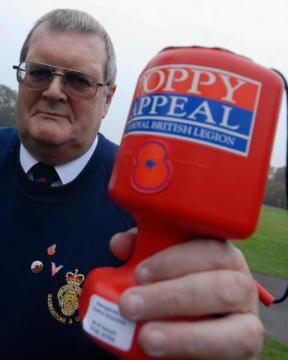
As we approach Armistice Day, which comemmorates the end of World War One, the British media is awash with the usual froth about poppies: the badges sold by a veterans’ group, the Royal British Legion, to raise funds for veterans and their families. This year’s poppy-outrage story is that FIFA has banned British footballers from wearing poppy armbands at this weekend’s matches on the grounds that they are political symbols. The plucky English Football Association plans to defy the ban. FIFA is wrong to ban the armbands, but only because bans on freedom of expression should be opposed in whatever form. But they are, of course, entirely right that the poppy is a political symbol.

poppyappeal261002

Continue reading

Against the New Phrenology: De-Pathologizing Trumpism

This is a guest post by Dan Boscov-Ellen. Dan is a Ph.Dprofile. student in Philosophy at the New School for Social Research and a Visiting Instructor in Social Science and Cultural Studies at Pratt Institute. His dissertation research involves exploring the political-philosophical implications of capitalist ecological crisis.


One of the most persistent refrains of the US Presidential election has been that of liberal incredulity at the idiocy of Trump voters. Depending on the current status of Nate Silver’s election forecasts, this tends to manifest either as amusement (perhaps chuckling at a Daily Show interview of deluded rally attendees or a screening of Idiocracy), or as disgust and horror (perhaps soberly staring into one’s craft IPA when the debate watch party gets too real). How, liberals wonder, could anyone vote for Cheeto™ Hitler?

VTPxYrNtCj6Brf4hhZ5O_H4Rdl5qqzJe5XMy-SH1bnI.jpg

But of course they do not wonder too hard – it is obvious to most liberals that Trump voters are simply ignorant and stupid, an apparent truism of which comedians, political scientists, neuroscientists, and cognitive psychologists constantly assure us. Everyone knows that Trump supporters are less well-informed than liberals – if only they read the New York Times and listened to NPR instead of watching Fox News! But the deeper problem, allegedly, is that Trump voters are simply not intelligent enough to realize how ignorant they are. Psychologist David Dunning explains that

[t]he knowledge and intelligence that are required to be good at a task are often the same qualities needed to recognize that one is not good at that task — and if one lacks such knowledge and intelligence, one remains ignorant that one is not good at the task. This includes political judgment.

According to neuroscientist Bobby Azarian, this Dunning-Kruger effect “helps explain why even nonpartisan experts — like military generals and Independent former Mayor of New York/billionaire CEO Michael Bloomberg — as well as some respected Republican politicians, don’t seem to be able to say anything that can change the minds of loyal Trump followers.”

At base, then, it is the Trump voters’ fundamental and impenetrable stupidity that causes them to ignore the experts – highly credentialed neoclassical economists, experienced military and intelligence figures, beneficent billionaires, esteemed members of the mainstream American political establishment and independent press, and Neil Degrasse Tyson – who obviously know far better than the plebian masses. Indeed, many liberals secretly believe it might really be better if the experts just ran things and we revoked the cretins’ right to vote.

Continue reading