The Women, Peace and Security (WPS) UK Research Network, a community of researchers on the WPS agenda and related issues of gender and conflict, is organising its first workshop. We invite submissions from researchers of all career stages and of any institutional affiliation (or none) based in the United Kingdom.
Network Vision: The network aims to convene workshops, share research findings, and promote informed understanding of WPS among policy makers, civil society, and the general public. We are committed to fostering a critical space for the study of WPS where we can ask searching questions, make explicit our frameworks and methods, and deepen collaboration and understanding among UK-based researchers.
Objectives: The primary objective of this initial one-day workshop is to facilitate engagement among researchers, with an eye towards future collaborative activities and opportunities. The workshop will bring together researchers working on WPS to present their current work and decide next steps for the network.
Participation & Eligibility: We invite submissions from those based across the UK who conduct research in universities, think tanks, civil society organisations or government, as well as independently. Presentations should address gender and conflict issues related to the WPS agenda. We expect to be able to offer some support for travel and accommodation, with priority given to doctoral and early career researchers. Due to cost and logistical considerations, attendance is open exclusively to UK-based researchers.
Submission Guidelines: Interested researchers should submit their abstract (max. 200 words) and a brief bio to the organisers by Monday 2 March 2026. Details on the venue and support will be communicated with the draft programme by the end of March.
It is customary to begin such closing essays with an acknowledgement of the thoughtful efforts of the contributors, and fulsome appreciation of the same. We are indeed indebted to Nicole George, Mohamed Sesay, Helen Berents, and Laura Sjoberg for their careful consideration of our book, and truly grateful for their insights. But, beyond gratitude, other emotions surface also: there is a particular joy unique to having one’s work read and understood (especially when trying to convey a precise meaning can feel so much like nailing jelly to a wall); there is curiosity about why our interlocutors landed on the elements they did to draw out and drill down on; and there is excitement about the possibilities into which such focused engagement breathes life.
The ”life” of the WPS agenda was a central theme in our book – not only anchored in the ecosystem concept we used to describe the empirical focus of our investigations, but also in the motif of vitality (paired with failure) that we argue characterises now 25 years of WPS. The question of where WPS “lives” is also a theme of much WPS scholarship, and something the contributors to this forum pick up on as well. The disjuncture between “government WPS” and “civil society WPS”, however crude and overdrawn this distinction may be, is a tension that has run through the agenda since its inception (quite literally: as we discuss in the book, one of the key faultlines in WPS developed in part from the disagreement between women’s civil society actors and those more closely aligned with UN member states regarding the need for, and content of, the second WPS resolution in 2008). Mohamed, Helen, and Nicole all touch on this tension in different and generative ways.
It has often been argued that WPS belongs to civil society, that women’s rights activists have been responsible for nurturing and continuing to care for the agenda. Our ecosystem concept, which draws attention to the multiple and various ways in which the agenda has flourished in different locations, enables interested researchers to look more closely at these forms of engagement and their effects on how WPS is (re)produced. As Helen comments, “the plurality of WPS offers us ways of leveraging the spaces (and the plural is important to the argument of the book) created by feminist advocacy for inclusive peace and security”. Similarly, Nicole’s expertise on women’s rights and gender justice in the Pacific is brought to bear in her critique, in which she reminds us that “no matter the confines of policy, women’s creativity insists and issues practical challenges to those that seek to ‘govern’ the feminist peace through hegemony and exclusion”. These are calls for the continued recognition of the work done by civil society WPS actors, in diverse locations and unevenly distributed resources and access, and we gladly concur.
In his critique, however, Mohamed sounds a note of caution:
“transformative agendas like WPS do not go very far if the neocolonial structures in which they emerged have not been effectively dismantled. … The future of this peace is not merely about how to make these systems more inclusive of women nor how to deploy them to protect and defend women’s rights. The future in this structural setting is about how to decolonize these systems so that violence and war is delegitimized as a means of governance, a question that seems to be deflected by those governing feminist peace”
We discuss the violences of racism and coloniality in relation to WPS throughout Governing the Feminist Peace, but we neither tackle the pressing need for decolonising WPS governance nor examine at length how white supremacy is imbricated with WPS (though the latter is one of our persistent threads). It would take another book to explore the specifically structural relations between neocolonialism and feminist peace projects in Africa, but let us not palm off the challenge. Mohamed seems to suggest that WPS is not only superficial – insofar as it does not in itself transform colonial political economy – but also serves African elites who have “inherited the colonial governance paradigm”. There is of course a long-runningcritique of WPS as colonial, whether in the relations of saviour and saved embedded in the resolutions, the practices of expertise and tutelage, or the policy representations of a peaceable north and violent south.
Our approach takes up these critiques but follows a different arc, not just because the ecosystem concept resists views of WPS as having any fundamental quality (whether colonial or decolonial) but also because we seek to recover histories that cut against the grain of the global north origin story, a diffusion model ironically shared by liberal advocates and radical critics alike. Whatever the hegemonic forms operative in some times and places (say, the Security Council when Hillary Clinton showed up), the emergence and shape of WPS is also creditable to Namibia and Netumbo Nandi-Ndaitwah, Liberia and Leymah Gbowee, and the Democratic Republic of Congo and Denis Mukwege. For Nandi-Ndaitwah that meant a veteran of the liberation struggle joining the postcolonial condition to gender equality and peacekeeping in the prototype to Resolution 1325; for Gbowee a grassroots women’s movement dethroning Charles Taylor; for Mukwege a model of care for survivors of sexual violence. All could be seen as figures of elite or liberal politics: Nandi-Ndaitwah is Namibia’s next president and was a minister for decades before that; Gbowee became a figurehead for peacemaker discourse and won the Nobel Prize; Mukwege is the exception that proves the rule in figurations of global south perpetrator masculinity. Yet we would also see in each case contestations of colonial governance: a postcolonial WPS born of anti-apartheid resistance; a popular resistance to extractive war economies; a rebuff to western saviour roles.
Whether these figures in their fraught particularity ultimately resolve for or against neocolonialism is a question we cannot decide here, partly because the discrete function of ‘WPS’ in any given setting is open to contestation, and we argue more open that most observers have realised or comparisons with other governance projects would allow. Even in the DR Congo, where the fixation on sexual violence and the reinforcement of racialized scripts has been most gratuitous, women in the east continue to organise with 1325 as a tool. We suggest this is not only because they have their own independent concern with preventing and responding to sexual violence not reducible to a colonial narrative, but also because they take up the themes in the agenda that foreground agency, peacemaking and reparation. That they may do so tactically, and highly cognisant of western humanitarian logics, can be understood in the same frame as a genuine openness and collaborative making in WPS itself. For the regional and international actors who so profit from violence and war in the region, the mobilisation is unlikely to be a welcome one. If we make ‘governance’ synonymous with ‘elite rule’ these possibilities disappear. The more fascinating stories are in the forgotten elements, the tenacious survival of forms of WPS that did not resonate with the hegemonic forms, and in that which is excluded, and some of those we have tried to tell.
Helen pushes us (always with care) to reflect on what is next for feminist peace, in the shape of WPS or otherwise. She asks: “How do more recent calls towards abolitionist notions of feminist peace (Wright and Achilleos-Sarll 2024), or the articulation of Indigenous knowledge as non-co-optable by feminist governance (Russ-Smith 2022), for example, disrupt or exceed the accounts of WPS within the book?” Nicole likewise wonders “if the story of hegemony and exclusion that Kirby and Shepherd draw out in their WPS analysis is simply an inevitable reality”. Let us take the opportunity to emphasise a point that is not clear enough in the book. WPS is but one manifestation of ‘feminist peace’, a much wider field of possibilities that both feeds and generates resistance to the agenda as practiced. It is not our intention to simply expand WPS to swallow all feminist peace practice, nor to plead for WPS governance by adding new adjectives and sub-branches. Ecology does not imply endless metastasis. We do discuss indigenous contentions of the agenda, especially in the case of liberal Canadian WPS, and expect that indigenous knowledge, which is after all not singular, can in principle be accommodated to some WPS niches, though only after a reckoning with settler colonialism that is politically impossible at present. (Indeed, one of the points we emphasise is that indigenous politics should not be read only through the lens of marginalised women or excluded knowledges but as sovereign and counter-sovereign practices). Abolitionism is to us more inimical still to WPS as governance, and we are not sure that there could be anything recognisably WPS without governance. Though we cannot do justice to debates within abolitionism here, it will suffice to say that only those variants that seek institutional reform (e.g. fewer police officers but more social service) can be compatible with the state that remains the main locus for appeal in the agenda. An ecological perspective allows for the enumeration of these points of contact and resistance at great length: it is our hope that the model might serve to better map grafting, subdivision and repulsion.
We conclude our reflections with the prompt set by Laura in her generous engagement with our work, as it is a question that resonates with us – still, even now, having written many thousands of words over many years on this topic: “does this policy ecosystem, even when we ‘forget’ its singularity, still have (too many) limits?” Perhaps unsurprisingly, our answer is yes, and no. The agenda is, in a sense, unbounded – curtailed only by the political imagination of those who act in its name, who write policy that invokes WPS, who enact WPS and thus bring the agenda into being. We locate that openness not just in the coordinates of actors ranging from local women’s groups to great power foreign ministries but also in the sprawl of ‘gender equality’ itself: an emancipatory horizon that implicates every arena of life and every level of analysis. And yet the limits are evident, and inevitable, even when the agenda is revealed as fluid and multiple, in all its kaleidoscopic complexity. The agenda is, after all, partly arrested in governance, and governance is limited by the structures of power that sustain it. Contemporary national and global governance systems rely on and reproduce structures of power, both ideational and material, that work to impose limits and foreclose liberation. In this way, WPS is a case: an example of a sprawling and diverse policy agenda that is both a product of, and challenge to, its context – and which necessarily exists in relation, through multiple connections to the political movements that both motivate and test it. As we note in the conclusion to the book, our work situates WPS “as always entangled in a web of feminist contentions over everything from sexuality to carcerality. The analytical move is paradoxical, since it is precisely by forgetting a pristine WPS that the myriad connections to contemporary feminist movements become visible again”. Rendering feminists visible in the governance of feminist peace and putting politics and power at the centre of our analysis, was at the heart of our project, and simultaneously formed the conditions of our work. So when deliberating the limits of WPS, we question not only the policy ecosystem, but the limits of governance, the limits of feminism – the limits of peace.
Today’s piece for our symposium on Governing the Feminist Peace is from Laura Sjoberg. Laura is Professor of International Relations at the University of Oxford and Kloppenburg Official Fellow and Lecturer in Politics and International Relations, Exeter College, Oxford. Her research addresses issues of gender and security, with focus on politically violent women, feminist war theorising, sexuality in global politics, and political methodology. She teaches, consults, and lectures on gender in global politics, and on international security. Previous posts in the symposium can be found here, here, here and here.
Governing the Feminist Peace is an amazing book that I continue to learn from each time I read it – it is careful, deep, comprehensive, well-reasoned, complex and contingent. It provides a compelling account of the diversity and vitality of feminist efforts to seek peace locally, nationally, and internationally, showing that a wide variety of academics, activists, and policy-makers, even when they disagree, have a commitment to looking to make the world a better place through some form of gender analysis and/or gender advocacy. Across its pages are hundreds of examples of governments, international organizations, NGOs, volunteers, and scholars doing gender work in the security arena, presented in a way that does not discount these efforts’ imperfections but fills even a cynic like me who critiques and discards the feminist peace with optimism about the impressive level of commitment to gender equality, peace, and the future. These accounts are written in impressive detail by Paul Kirby and Laura J. Shepherd, who both individually and together are easily the world’s leading experts on Women, Peace, and Security – something that the detailed and clear engagement with different facets, levels, and geographies of the feminist peace shows and confirms.
It is for this vitality that Kirby and Shepherd suggest that we “forget WPS” (p.206). While that seems contradictory, the book does an excellent job of suggesting that the problem is not “the feminist peace” as such but the idea that Women, Peace, and Security is or could be one coherent ‘agenda’ instead of multiple fellow travelers with tensions. As the authors explain, “we seek to give up on the concept of ‘the WPS agenda’ as a singular political project or vision and instead apprehend and engage with the agenda always as a plural object of knowledge and practice” (p.206-207). On an optimistic day, this makes me think there might be a place in advocacy for the “feminist peace” for even a pessimist like me; other days, it still reads like a better, clearer description of either WPS or the feminist peace than ones I have read before.
Though my work has always been orthogonal to the WPS agenda, the work in Governing the Feminist Peace both articulates some of my critiques of the agenda better than I could have and frames them as too simple. Where I would find WPS’ failures, Kirby and Shepherd find its complexities and potentials. That is why, while this book is full of rich and interesting information, I find myself most engaged with the conclusion. It articulates, outlines, and engages the “fundamental tensions” that structure what Kirby and Shepherd identify as the (multiple) policy ecosystem(s) of the feminist peace. They find six fundamental tensions, and outline each in turn.
The next contribution to our symposium on Governing the Feminist Peace comes from Helen Berents. Helen is Senior Lecturer in International Relations in the School of Government and International Relations at Griffiths University. Helen is a feminist scholar centrally concerned with both representations of young people in contexts of crises and conflict, and with engagements with the lived experience of violence-affected communities. Helen’s work sits in international relations, particularly peace studies and critical security studies but is interdisciplinary in drawing from anthropology, feminist theory and sociology. Earlier posts in the symposium can be found here, here and here.
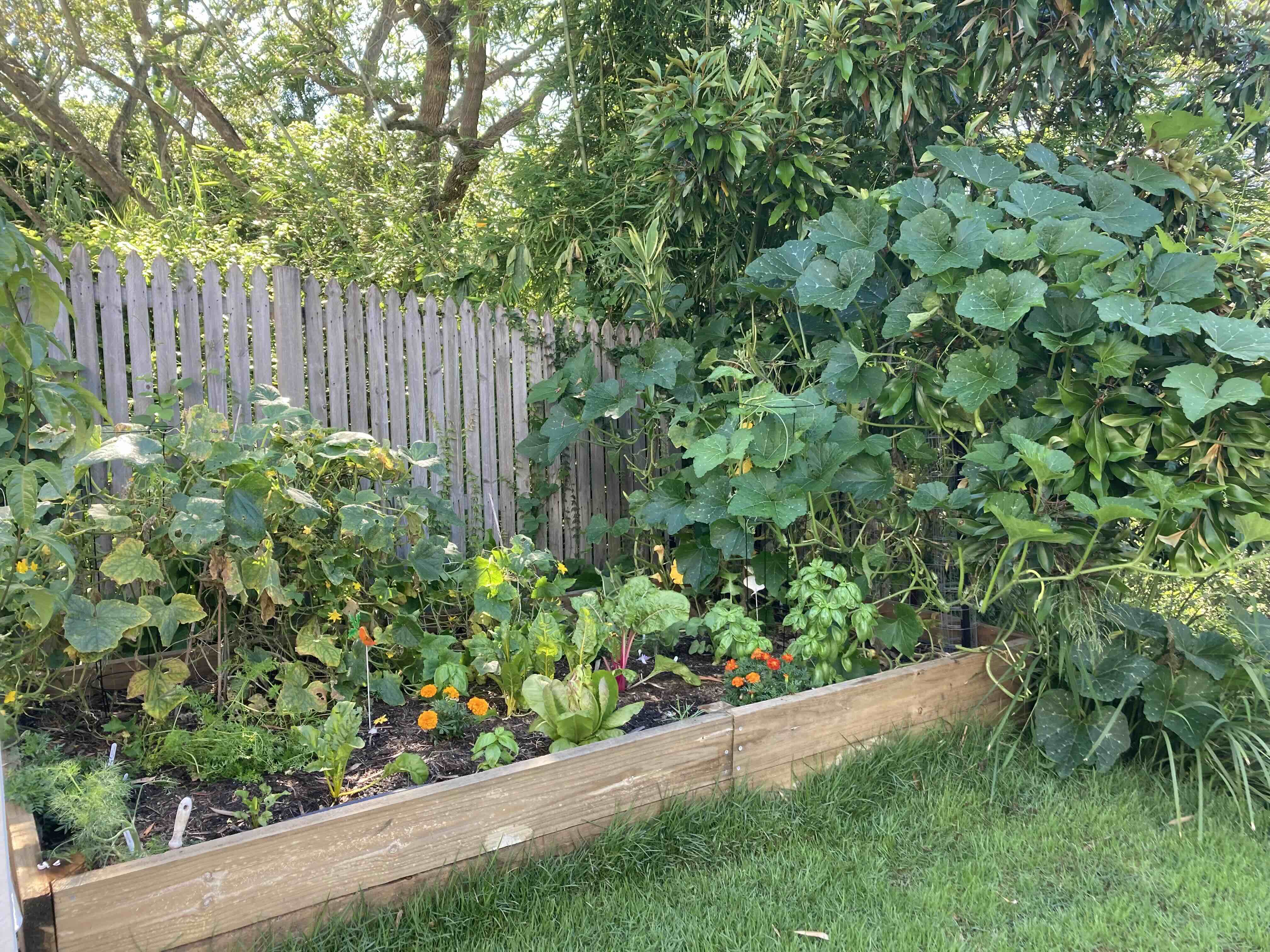
I have always been a gardener; I hold a love of the bright green of new shoots, the petrichor smell of soil after rain (or here in Australia, after an early morning watering before the heat sets in), the uncertainty of success as I bury tiny seeds, the never-ending weeding, and the joy of the harvest. As I’ve gardened in my backyard over the years, my eye has become more attuned to what is present: it is not just that ‘a bee’ is visiting my patch, but a flock of tiny native stingless honeybees, or my favourite, the gorgeous blue banded bee. Their purpose, as they duck in and out of the flowers in search of pollen, is very different to mine as I weed and plant and prune, but we both share a desire for the ecosystem of my backyard vegetable patch to thrive.
Helen’s garden
I kept thinking of my garden as I read Kirby and Shepherd’s rich and brilliant book. The authors encourage us to think about WPS as a policy ‘ecosystem’ and the while a garden and ecosystem are not true synonyms, garden metaphors seem easy to reach for. Kirby and Shepherd stress in the book, and more explicitly in their earlier article (2000), that an ecosystem model is not meant to imply naturalist tendencies of evolution or teleological design. Rather an ecosystem approach enables an emphasis on relationality, reproduction, and plurality as constitutive features of a policy ecosystem such as WPS.
In Governing the Feminist Peace, Kirby and Shepherd draw on decades of individual and joint work on, around, and in ‘the WPS agenda’; their eyes more attuned than many to what is present in its specificity and diversity. In this way, it is a pleasure to be guided by these two authors-slash-policy-ecologists through an environment we might think we are familiar with in our own relational encounters with the actors and artifacts of the agenda, yet be taken down paths, into unexpected clearings, and to be directed to pause and notice what we might otherwise walk past.
It is a monumental task that Kirby and Shepherd have set themselves, and one they execute compellingly. Convincingly demonstrating the limitations of understanding WPS as a norm, they instead invite us along as they become ‘policy ecologists’ to account for the myriad complexities, contradictions, tensions, and co- or parallel- trajectories of all that lies within what gets called ‘WPS’. The ‘bricolage’ approach they adopt enables them to move between the macro and micro of the ecosystem, highlighting moments, events, and lineages as offering lessons on the vitality and failure of actors’ efforts within the policy ecosystem. This results in brilliant accounts, such as that of the WPS resolution that ‘never was’, nuanced consideration of the potential and antagonisms of the favoured WPS policy vehicle of National Action Plans, and the historic and contemporary tensions of diverse actors in the ecosystem such as NATO and WILPF. These explorations demonstrate the success of the bricolage approach of mapping a policy ecosystem, working to make visible the wandering paths of the WPS ecosystem rather than the highway of WPS-as-norm/s.
In selecting just a few paths to wander down here, I offer three reflections: two short observations on the ephemeral nature of feminist peace in the book and on what gets (perhaps necessarily) missed by a focus on and through the documents of the WPS agenda, and a more meandering reflection on the generative potential of the fecundity of borderlands.
This third contribution to our symposium on Governing the Feminist Peace comes from Mohamed Sesay. Mohamed is Associate Professor and Coordinator of the African Studies Program in the Department of Social Science at York University in Canada. His research and teaching interests are in development, transitional justice, international criminal justice, rule of law, customary justice, peacebuilding, and post-conflict reconstruction particularly in sub-Saharan Africa. He is co-investigator for a UKRI GCRF project titled Land Policy, Gender Justice, and Dual Legal Systems. Earlier posts in the symposium can be found here and here.
Let me start by a somewhat unfamiliar account of conflict and violence in Africa. After almost a century of European colonization, anti-colonial struggles resulted in the political independence of African states, particularly in the post-World War II era. However, the end of direct colonialism did not amount to the decolonization of the structures established by violent colonial administrations. Rather, what followed the attainment of juridical-political independence is what postcolonial scholars call coloniality, i.e., “various colonial-like power relations existing today in zones that experienced direct colonialism” (Quijano 2007: 170). Independent nations in Africa did not effect any major ideological or structural break with the colonial state and all they did “was to expand the former colonial administrative and economic infrastructures” (Ogot and Ochieng 1995: XIII). Just as colonial governments relied on coercive structures to rule over their colonies, so too did their African successors embrace violence and militarism as the mechanism to shore up legitimacy deficits in the modern state. In the transition to the postcolony, “the predatory paradigm of governance was conveniently adopted…by the local political, economic, civil, and military elites” (Yusuf 2018:257). This underlining post/neocolonial condition as well as the paradigm of violence it engenders (Ndluvo-Gatsheni 2012, 2015) has remained not only at the root of many conflicts in Africa but also central to what makes peace elusive for ordinary Africans (Zondi 2017). Thus, Fonken Achankeng notes:
If the causes and consequences of the conflicts have their roots in colonialism, the process of decolonization and state formation and the ensuing crisis of nation-building, then any attempt to resolve the conflict must also transcend the concepts of new institutions that will increase participation, legitimacy, and redistribution, and good governance recipes to also address the root causes of the problem (Achankeng 2013:14)
To what extent does the feminist peace, promised by the Women Peace and Security agenda, account for this historical and contemporary reality of conflict and violence in Africa is the question I had in mind as I read Governing the Feminist Peace by Paul Kirby and Laura J. Shepherd. As the authors aptly note, Africa is a central part of the WPS ecosystem, with the Maputo Protocol to the African Charter on Human and People’s Rights on the Rights of Women in Africa, the Solemn Declaration on Gender Equality, and the Dar-es-Salaam Declaration on Peace, Security, Democracy, and Development becoming the earliest policymaking moves to institutionalize Resolution 1325 outside the United Nations. In addition to 32 national action plans (NAPs) adopted by African governments, regional organizations in Africa account for about half of the policy documents issued beyond the UN and its member states as the authors report. Indeed, this massive policy commitment makes Africa a “terrain of reproduction and contestation” of WPS beyond the “narrow diffusionist model” (p. 69) and I appreciate the authors’ efforts to represent Africa from this critical perspective. I cannot agree more that in the African context, policymaking moves such as NAPs can become a “key part of governing,” functioning as “a way of stultifying feminist peace, or interloping WPS into the machinery of the state” (p.119). Unlike women’s rights groups and activists who may contribute to WPS as a means to challenge domestic patriarchy, when the political class in Africa is at the forefront of promoting an agenda aimed at challenging their power, it is often a governing strategy to hijack its radical transformative mission.
Women serving in militaries that are part of US Africa Command (AFRICOM), 2017
That said, the post/neocolonial condition in Africa has not received the due attention it deserves in this book.
This second contribution to our symposium on Governing the Feminist Peace comes from Nicole George at the University of Queensland. Nicole is Associate Professor of Peace and Conflict Studies at the School of Political Science and International Studies at the University of Queensland, where she is also Director of Research. Nicole’s research focuses on the gendered politics of conflict and peacebuilding, violence, security and participation. Since the early 2000s, she has conducted research in the Pacific Islands region focusing on gender politics, gendered security and post conflict transition in Fiji, New Caledonia, Bougainville and Solomon Islands.
In their new book, Governing the Feminist Peace (Columbia University Press, 2024). Paul Kirby and Laura Shepherd draw on the concept of a policy ecology to frame their powerful account of the institutionalisation of the WPS agenda. This approach allows them to tell a story of Women, Peace and Security (WPS) policy evolution that is characterised by competing interests and sites of influence. In addition to their analysis of the form and impact of the 10 UN Security Council resolutions on WPS since 2000, the policy ecology methodology is deployed by Kirby and Shepherd to explain the proposed inclusions that were subsequently written out of WPS resolutions, the varying ways in which states have localised WPS through National Action Plans and the critique that has responded to WPS policy frames and implementation from within advocacy and academic circles.
Governing the Feminist Peace, provides a detailed, and powerful account of the ways that the feminist agenda for peace has been broadened and constrained through institutionalisation at international and national scales of policymaking. Chapter 4 maps the agenda as it is formally articulated in relevant policy documents produced by the UN itself, and within National Action Plan policy. It shows that the policy agenda is dynamic and responsive; one that has evolved, over time, to recognise LGBTQI issues, the impacts of colonialism, the politics of race, and the standing of men and boys (75). This chapter also demonstrates how the agenda has been expanded to take in new considerations beyond those that were considered in the foundational resolution of 2000, including clauses on climate change, sexual and reproductive rights, the status of refugees and internally displaced peoples, or terrorism and political extremism (77).
On the other hand, the challenges of institutionalisation are made clear through investigation of what Kirby and Shepherd refer to as the “hegemonies” and “abolitions” that can also be traced within the WPS policy ecology (217). For example, the mapping exercise in Chapter 4 also shows, that although “new” issues of concern may be mentioned in WPS policy documents in the period from 2000-2020, these do not displace or challenge the prominence of references to sexual violence which remain consistent in policy documents throughout the period in question and equal in number to all other “new” issues mentioned in WPS policy documents. This finding echoes a long-standing feminist critique of the ways the protection agenda has been used to reinforce the trope of gendered vulnerability and victimhood in conflict that concurrently diminishes women’s agency and capacities for leadership (e.g. Reilly 2018).
In later chapters, Kirby and Shepherd further document the lack of recognition given to indigenous knowledges within WPS policy as it has evolved since 2000, despite the fact that Indigenous peace processes are mentioned in the foundational UNSCR 1325. The authors also contrast the ways in which feminist advocacy promoting disarmament or challenging the militarist underpinnings of defence alliances have become downplayed as NATO itself advances an “active embrace of the WPS agenda” (162). Contradictions also emerge. For example the authors observe how WPS principles have been mobilised in the manner of “imperial feminism” to justify or legitimise the protection of women in Global South settings while “violence against women in the West is minimised, ignored and/or individualised” (169). Further, the authors later observe the irony of a situation whereby WPS policy can define violence against women as a global “security problem” yet also be harnessed to initiatives that reinforce and justify the gendered “parameters of military expenditure and reasons of state” that have long been lamented by women peace activists (196).
While these arguments are powerful, as the chapters progressed, I also reflected on the ways in which they are resonate with research conducted by other feminist policy ecologists, who have studied the fortunes of gender policy reform in national and international politics. I am referring here to feminist institutionalist scholarship that, since the early 2000s, has investigated how gender reforms are progressed in policy and the ways in which these reforms are nested within broader institutional contexts that produce their own gender logics (Mackay 2014, 549). In this light, I wondered if the story of hegemony and exclusion that Kirby and Shepherd draw out in their WPS analysis is simply an inevitable reality.
This is the first post in a new book symposium, on Paul Kirby and Laura J. Shepherd’s Governing the Feminist Peace, which was published in 2024 by Columbia University Press.
Laura is Professor of International Relations in the School of Social and Political Sciences at the University of Sydney, and served as President of the International Studies Association from 2023-2024. She is a former Australian Research Council Future Fellow (2018-2022), and has been a Visiting Senior Fellow at the LSE Centre for Women, Peace and Security in London, UK, since 2016. She is a member of The Disorder of Things authorial collective.
Paul is Reader in International Politics and a Fellow of the Institute for the Humanities and Social Sciences at Queen Mary University of London. He was until this year a Co-Director of the GCRF Gender, Justice and Security Hub, a multinational, interdisciplinary research consortium investigating the politics of gender justice and inclusive peace. A founding editor of this blog, he is our own Pablo K.
Following this opening post, we will share contributions from an august roster of colleagues over the coming days, followed by a response from the authors.
In late April 2019, Nadia Murad addressed the United Nations Security Council during its annual open debate on sexual violence in conflict. Murad had gained an international profile as a courageous and articulate survivor of atrocities carried out by Da’esh – the so-called Islamic State – against the Yazidi ethno-religious community in northern Iraq. In her short speech, Murad urged the council to end its reliance on slogans and finally prosecute sexual violence and other grave crimes. Accompanying Murad was her lawyer, Amal Clooney, who challenged the Council to rise to its “Nuremberg moment, its chance to stand on the right side of history” by triggering an International Criminal Court or hybrid court process. The meeting culminated in a new resolution, the ninth in the series of Women, Peace, and Security (WPS) resolutions, consolidating the status of ‘the agenda’ as the most extensive of all the Security Council’s thematic commitments.
Murad’s six-minute speech was but one instance in a still-unfolding mosaic of events and relations, institutions and movements, talk and text, united by reference to conflict-related sexual violence. Similar constellations of actors may be found throughout the WPS agenda, working across boundaries of domestic and international, formal and informal, state and society, military and civil, lay and expert, public and private. Sexual violence is but one – and the most controversial – in a docket of gender issues, encompassing equal rights, the benefits of women’s substantive participation in promoting peace, the contribution of a ‘gender perspective’ to military planning, the urgent need for global disarmament, recognition of gender diversity, changes to humanitarian practice, inclusivity in refugee, disaster and climate change management, and more besides. As well as the national governments that are invariably the target of appeals for resources and action, the WPS circuit runs on an expansive cast of women’s groups, humanitarian agencies, freelance consultants, celebrity activists, academics, private philanthropic foundations, lawyers, investigative journalists, religious authorities, intergovernmental agencies, international courts, treaty bodies, think tanks, and military alliances.
Governing the Feminist Peaceis our attempt to come to terms with this dizzying array of issues and agents. WPS is (still) celebrated as a success for feminists in that a coalition of civil society actors managed to get the Security Council to not just acknowledge the gendered quality of war and peace but to pledge – and on some accounts to legislate – for concerted global action towards feminist goals, from demilitarisation to indigenous peace-making. In formal policy terms it is embraced not only by the Security Council but by over a hundred countries, dozens of regional bodies, and, increasingly, a range of sub-national actors. An accompanying cottage industry has sprung up to track the pace of adoption. For all this energy, WPS is also frequently, almost reflexively, announced as partial, faltering, betrayed, coopted, and securitised. In our terms, a wellspring of vitality and a vortex of failure. These aspects of WPS are not mere opposites, with advocates celebrating vitality and cynics documenting failure. The relation is more intricate, with failure as often a spur to greater implementation efforts as a reason to abandon the agenda, and with vitality in the sense of official adoption to some extent dependent on the failure of the more radical versions of the agenda.
**Disclaimer: none of the people displayed in the photos are present in the text and should not be thought of as complicit with the sexual harassment discussed in the text.
Thales and Elbit Systems, DSEI 2023. Credit: N.E.
Global headlines are once again seized by the outbreak of armed conflict, detailing indescribable suffering and destruction. War, it feels, is everywhere and always. To some, this means business. Many of the facilitators and profiteers of armed conflict globally attended the Defence and Security Equipment International (DSEI) in London, September 2023.
What follows is a personal story, but what it tells us about enduring systems of power and harm goes far beyond my person. That weathered feminist truth that the personal is always also political rings true still. What I experienced in the world of “defence men” – the global war elite – attending DSEI as a white woman, was highly demonstrative of the social, political and economic forces that enable and perpetuate armed violence. The personal behaviours of militarised business masculinities hold clues as to why decisionmakers keep hurtling toward global war at the expense of both people and the planet.
Setting the Scene: A Playground for Phallic Force
Happening in London biannually, DSEI is one of the world’s biggest and most important arms fairs. I went there to research military sectors’ pivot toward environmental sustainability and how to “green” warfare – a key emerging feature especially of European and North American propaganda. The event oozed of hubris. Rob, an American war simulations expert and my main interlocutor, confirmed he’d never seen such a galore of impressive weapons tech exhibitions. Indeed, several arms company reps told me affirmingly: business is booming. Spread across 100,000 sqm. Rob and I were among almost 40,000 participants from all over the world. Including the usual array of repressive, human rights abusing regimes or states involved in active warfare.
You don’t have to be a polemicist to catch how DSEI is but one big bonding ritual for predominantly white men in suits enacting their obsession with force. DSEI puts the global war elite’s drastic detachment from the real-world needs of people and planet into sharp relief. Inside the fair, “defence” and “security” materialise as glaring euphemisms for military-industrial might and titillating experiments in how to model the future of warfare in line with Hollywood fantasies of high-tech battles between good and evil. Rather than signal a dedication – however deceptive – to keeping people safe, the event felt like an inferno of white men in suits blatantly driven by that boyish excitement for tech, kinetics, heroism, beauty, sex and money. And yet, there are enough of these men in power across the globe to make it seem as if they are the realists responding to real threats.
To begin, my immense gratitude to Pinar Bilgin, Cian O’Driscoll, Ellen Martin, Mirko Palestrino, and Chris Rossdale for their close reading, sharp observations, and thoughtful engagement with my work. It’s an intimidating pleasure to have scholars whose work I so value, and whose insights to which I’m indebted, discuss the book. They’ve given me a lot to think about which, over ten years into this project, is a real gift.
Much of the perceptive (and generous) commentary offers a push to clarify and (re)consider what the book does or does not do, does or does not include, and how its insights might be extended to related phenomena. Not unlike the intro to the forum, there are (at least) two ways of approaching this discussion.
The first, I think, is fairly formal answer about scope conditions, and the ambitions of the book to empirical and analytic generalizability. As the reviewers, note, the account of the “fracture” of the liberal military contract, and subsequent politics of supporting the troops, isn’t meant to be empirically generalizable beyond the US and UK. Likewise, I attend only to mainstream and elite discourses; I don’t include the perspectives of serving military personnel, or less organized resistance to the obligation to support the troops.
There are also several entailments of my argument the book doesn’t consider because, following its own logic of inquiry, it can’t. This is because, analytically, I’m interested in the problem that “support the troops” discourses work to solve: the legitimation and normalisation of citizens’ participation in collective violence for/by the state. Liberal democracies encounter a particular spin on this problem, as ideological commitments to autonomy, liberty, and equality sit uneasily with the expropriation of citizens’ time, labour, and lives in the form of military service. But all states encounter a version of this quandry; even in liberal democracies, “support for the troops” doesn’t manifest mechanistically or uniformly. And my account of “supporting the troops” is pitched at the level of a broad discursive formation, and the conditioning of social intelligibility, rather than an interrogation of the intentionality and experiences of “support” of specific individuals. (This latter is incredibly interesting; a discourse analytic approach just can’t get there).
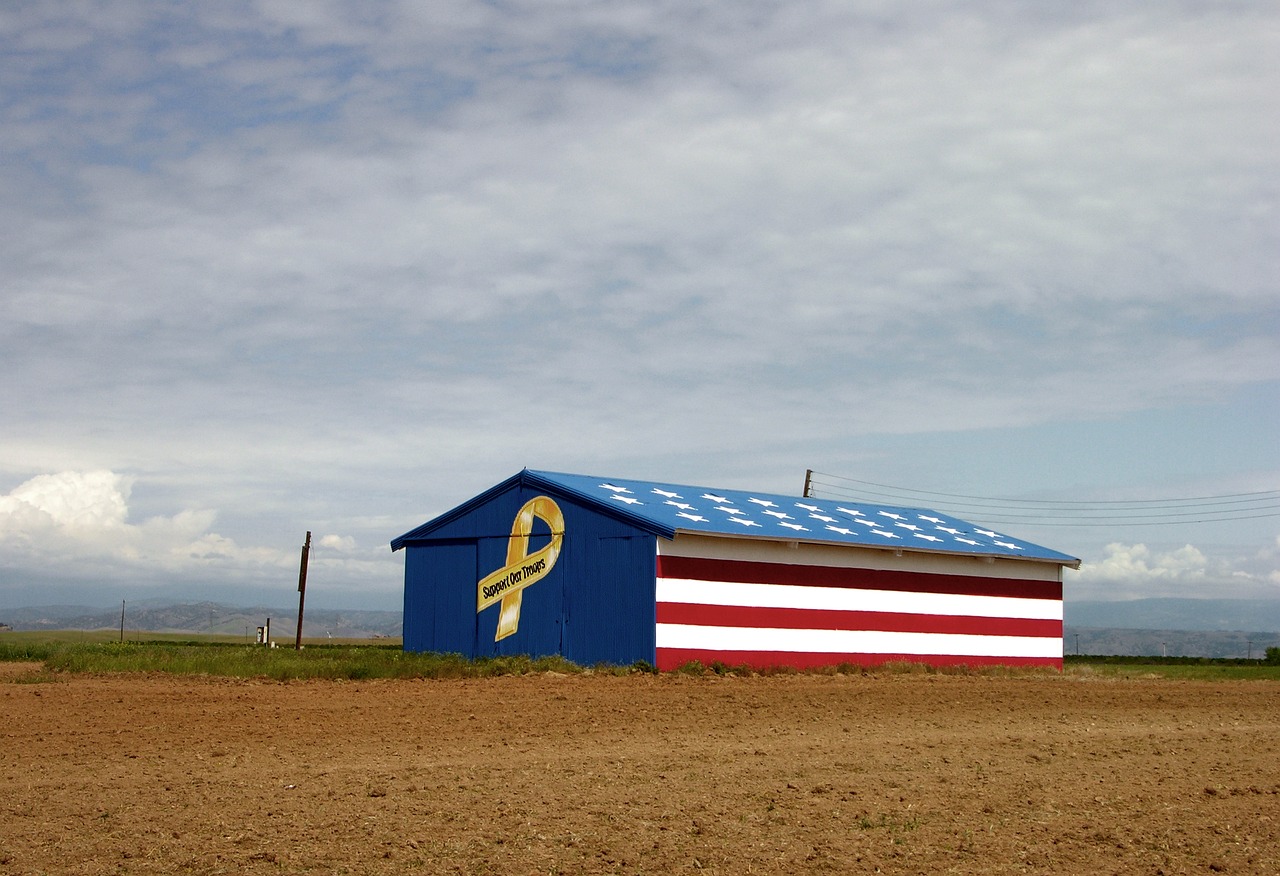
Support the Troops opens with an anecdote about the small town in Canada where Katharine Millar grew up. In 2001 Canada deployed forces to Afghanistan, and a number of enlisted young men from the town found themselves unexpectedly sent to war. Their families gave out yellow ‘support the troops’ ribbon magnets for local people to put on their cars. Millar recalls her parents, sceptical of the intervention, navigating the expectations accompanying the ribbon and its awkward invocation. They displayed the ribbon out of some sense of obligation and genuine care for the local boys overseas, while being uncomfortable with its implications, and seemingly content to let the ribbon disappear once the temperature had fallen.
The book does the impressive job of taking these quotidian gestures of solidarity and tying them to the imperial violence at the heart of the liberal social order. Taking a particular but persistent social discourse, it traces the historical emergence of an imperative that has become central, even foundational, to liberal politics. Elegantly and incisively, Millar shows the workings of the discourse as it has diffused through and become a standard of legitimate speech within contemporary political life. ‘Support the troops’ emerges as a “gendered, racialized logic of violent political obligation” (167) that is ideally positioned to manage civilian anxieties following the end of conscription, while carefully transferring questions of complicity and empire into expressions of care and solidarity within the state. The discourse conceals the harms of war while awkwardly reproducing the liberal community. Making its argument with clarity and force, and showcasing the power of rigorous feminist poststructural analysis, the book is a landmark intervention in scholarship on liberalism, war and violence.
Millar lays a particularly important challenge for anti-war politics. While many expressions of the imperative to ‘support the troops’ are delivered with a clear desire to promote wars, the book shows that the discourse is also central to anti-war politics. As demonstrated by their calls to ‘support the troops: bring them home’ and ‘support the troops, not the war’, opponents of contemporary wars are compelled to frame their opposition in terms of support for the troops. Drawing on her extensive study of discourse from newspapers, state documents and NGO websites, Millar argues that almost half of the incidences of the support the troops discourse in the UK and US come from an anti-war position. It emerges as an apparently necessary element of attempts to criticise wars, in a manner that reveals the discourse as a condition of intelligible political speech and reasonable dissent. If you want to speak politically, you must support the troops; if you don’t support the troops, you’re not a meaningful part of the political community. The problem here is that ‘support the troops’ is an inherently martial discourse. It reproduces the troops as the ideal citizen, solidifies the martiality of the liberal order, and reproduces the hierarchy between ‘our’ troops and others suffering in war (often at the hands of ‘our’ troops). In this respect, anti-war politics faces a trap: frame opposition to wars through support for the troops, and so reproduce the liberal martial order even in the midst of opposing a particular war; or don’t, and be expelled from the terrain of reasonable political speech.











 The Disorder Of Things